
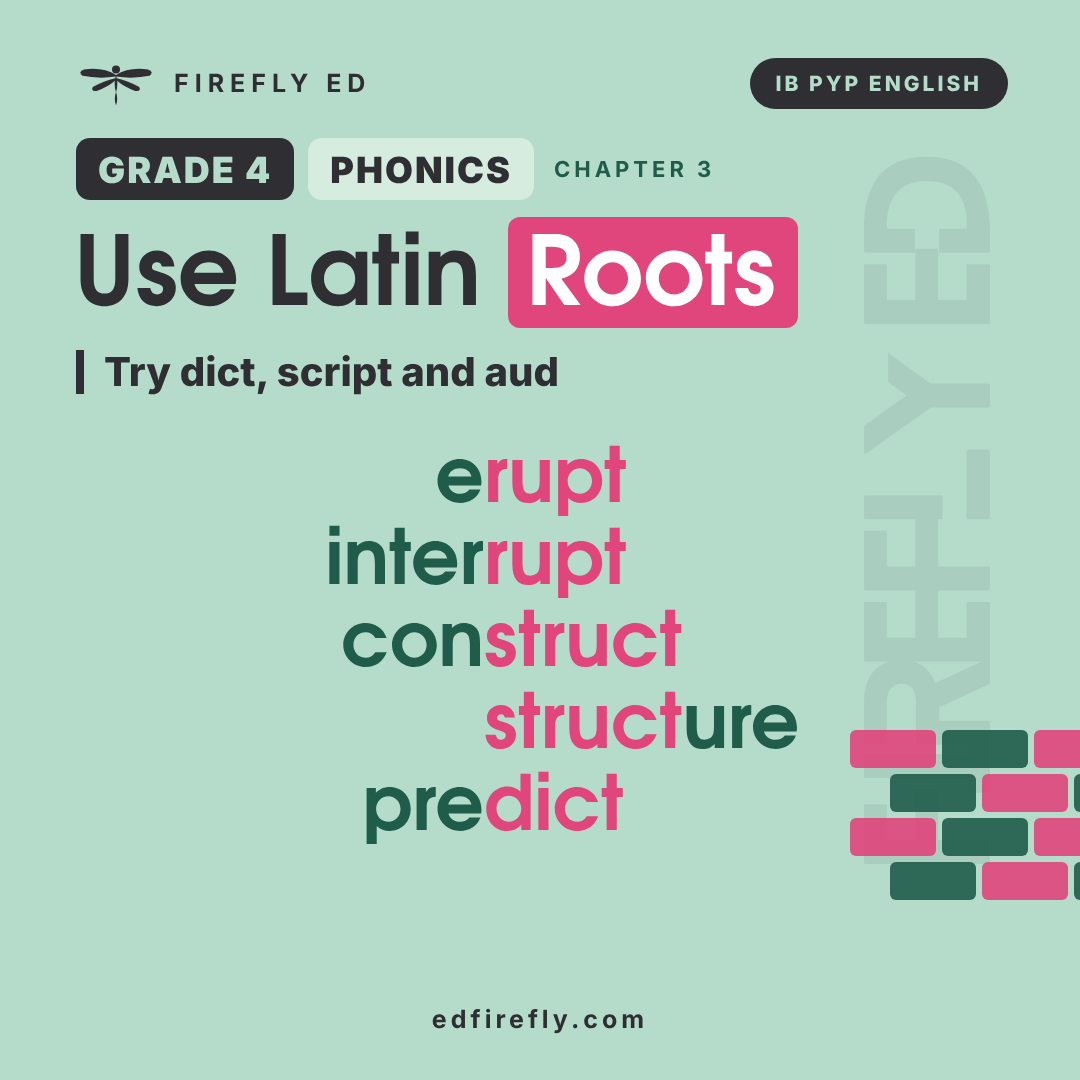
Term 1 | Level 1 | Phonics focus: Latin roots: dict, script, aud, vis, rupt and struct
Chapter 3 – Poems and Plays | Chapters – Index
Lessons
This page has the three phonics lessons of Chapter 3, Poems and Plays: Lessons 3.9, 3.10 and 3.11. The chapter page has the chapter overview, the chapter review and the PDF download.
Tap a lesson to open it. Tap the lesson title again, or use the link at the end of the lesson, to close it.
Lesson 3.9: Latin Roots: dict and script | Phonics | About 20 minutes
Term 1 | Level 1
Goal
“I can use the Latin roots dict and script to read, spell and work out the meaning of new words.”
Words to know
root, Latin, prefix, dictionary, script, predict
Wonder
Think about this question before you start. Say your ideas. You will come back to it at the end of the lesson.
What do a dictionary and a weather forecast have in common?
Let’s Learn
Say each word aloud and clap its syllables.
In Chapter 2 you learned roots from Greek and from Latin. Many more English words come from Latin, the language of ancient Rome. The roots dict and script are found in many words about saying and writing, which makes them useful in a chapter about poems and plays.
Many words add a prefix to the root. The prefix changes the meaning:
Spelling tip: the root script sometimes changes to scrib, as in describe and scribble. Both mean write.
See How It’s Done
Now Try It
1. Underline the root in each word: dictionary, scribble, predict, scripture.
Hint: Look for dict, script or scrib.
2. A diction coach helps actors. What do you think a diction coach helps them do?
__________________________________________________________________
Hint: dict means say.
Time To Practise
Name: ______________________
1. Sort the words.
Write each word in the right column.
dictate describe predict script contradict scribble dictionary manuscript
| dict (say) | script or scrib (write) |
|---|---|
| |
|
2. Word sums.
pre + dict = ______________ post + script = ______________
de + scribe = ______________ contra + dict = ______________
3. Choose the word.
script predict dictionary describe dictate
a) The actors learned their lines from the ______________.
b) I looked up the meaning of “verse” in a ______________.
c) Can you ______________ what will happen at the end of the poem?
d) Please ______________ the stage set in three sentences.
e) The teacher will ______________ a sentence, and we will write it down.
4. Work out the meaning.
Use the roots to write what each word might mean. Then check in a dictionary.
a) unpredictable: ____________________________________________
b) inscription: ______________________________________________
5. Write from dictation.
Listen as an adult reads a sentence aloud. Write it. Then check the spelling of each root.
__________________________________________________________________
Reflect
Think about these questions. Talk about them with someone at home or at school.
1. Go back to the Wonder question: “What do a dictionary and a weather forecast have in common?” What do you think now?
2. I was an inquirer today when I ______________________________.
An inquirer asks questions and finds things out. For example: I was an inquirer today when I used a root to work out the meaning of a new word.
Take action: Look for dict and script words in a newspaper, a programme or a book. Make a list and share it.
Next Steps
If this was easy, try: Find three more words with dict or script in a dictionary. Write a sentence for each.
If this was hard, go back to: Let’s Learn. Say each word in the picture, find the root, and say what the root means.
Notes for Parents and Teachers
Show notes for parents and teachers
These notes cover this lesson only. How every lesson runs is explained in How to Use This Material.
Let’s Learn
Say each word together and clap its syllables.
Time To Practise
- Task 5: Read the sentence in the Answer Key slowly.
Answer Key
Reveal Answers
Now Try It
1. dictionary, scribble, predict, scripture 2. It helps them say their words clearly.
1. Sort the words
dict: dictate, predict, contradict, dictionary script or scrib: describe, script, scribble, manuscript
2. Word sums
predict, postscript, describe, contradict
3. Choose the word
a) script b) dictionary c) predict d) describe e) dictate
4. Work out the meaning
a) not able to be said (known) before it happens b) words written or cut into something, such as a stone or a coin
5. Write from dictation
Dictation sentence: The actors read the script and tried to predict the ending.
Reflect
2. Any real moment from the lesson that shows the learner was an inquirer. Examples: “I was an inquirer today when I used a root to work out the meaning of a new word.” “I was an inquirer today when I checked my guess in a dictionary.”
Lesson 3.10: Latin Roots: aud and vis | Phonics | About 20 minutes
Term 1 | Level 1
Goal
“I can use the Latin roots aud and vis to read, spell and work out the meaning of new words.”
Words to know
root, audience, audition, visible, invisible, revise
Wonder
Think about this question before you start. Say your ideas. You will come back to it at the end of the lesson.
Why do you think a theatre is sometimes called an auditorium?
Let’s Learn
Say each word aloud and clap its syllables.
A play needs an audience, and the audience needs to hear and see the actors. Two Latin roots help us talk about this: aud means hear, and vis means see.
Spelling tips: the root vis sometimes changes to vid, as in video and evidence. Words ending in -ible often follow a root that cannot stand alone: visible, audible.
See How It’s Done
Now Try It
1. Underline the root in each word: auditorium, visitor, audio, evidence.
Hint: Look for aud, vis or vid.
2. A visor is part of a cap. What do you think it helps you do?
__________________________________________________________________
Time To Practise
Name: ______________________
1. Hear or see?
Write H if the word is about hearing, or S if it is about seeing.
audible ____ vision ____ audio ____ visible ____ audience ____ video ____ visual ____ audition ____
2. Word sums.
in + vis + ible = ______________ aud + ition = ______________
re + vis + e = ______________ tele + vis + ion = ______________
3. Choose the word.
audience audition invisible revise audible
a) Leo went to an ______________ to get a part in the play.
b) The ______________ clapped at the end of the show.
c) Speak up so your voice is ______________ at the back.
d) In the story, the magic cloak made her ______________.
e) I will ______________ my poem to make it better.
4. -ible or -able?
Add the ending. Use a dictionary to check.
vis______ aud______ read______ enjoy______
5. Write from dictation.
Listen as an adult reads a sentence aloud. Write it. Then check the spelling of each root.
__________________________________________________________________
Reflect
Think about these questions. Talk about them with someone at home or at school.
1. Go back to the Wonder question: “Why do you think a theatre is sometimes called an auditorium?” What do you think now?
2. I was an inquirer today when I ______________________________.
An inquirer asks questions and finds things out. For example: I was an inquirer today when I worked out what auditorium means from its root.
Take action: Next time you watch a show or a video, listen for a word with aud or vis in it. Write it down and explain its meaning.
Next Steps
If this was easy, try: Write a short advert for a school play that uses four aud or vis words.
If this was hard, go back to: Let’s Learn. Point to your ear and say aud, then point to your eye and say vis. Sort the words in the picture.
Notes for Parents and Teachers
Show notes for parents and teachers
These notes cover this lesson only. How every lesson runs is explained in How to Use This Material.
Let’s Learn
Say each word together and clap its syllables.
Time To Practise
- Task 5: Read the sentence in the Answer Key slowly.
Answer Key
Reveal Answers
Now Try It
1. auditorium, visitor, audio, evidence 2. It shades your eyes so you can see in bright sun.
1. Hear or see?
audible H, vision S, audio H, visible S, audience H (they also watch, so S is accepted), video S, visual S, audition H
2. Word sums
invisible, audition, revise, television
3. Choose the word
a) audition b) audience c) audible d) invisible e) revise
4. -ible or -able?
visible, audible, readable, enjoyable
5. Write from dictation
Dictation sentence: The audience could see the actors, but their voices were hardly audible.
Reflect
2. Any real moment from the lesson that shows the learner was an inquirer. Examples: “I was an inquirer today when I worked out what auditorium means from its root.” “I was an inquirer today when I found out when to use -ible.”
Lesson 3.11: Roots: rupt and struct, and Tricky Words | Phonics | About 20 minutes
Term 1 | Level 1
Goal
“I can use the roots rupt and struct to work out word meanings, and spell six tricky words using memory aids.”
Words to know
root, erupt, interrupt, construct, structure, tricky word, memory aid
Wonder
Think about this question before you start. Say your ideas. You will come back to it at the end of the lesson.
What do a volcano and a person who talks over you have in common?
Let’s Learn
Part 1: rupt and struct
A poem has a structure too. It is built from lines and verses, the way a bridge is built from beams.
Part 2: Tricky words
These six words are often spelled wrongly. The tricky letters are in pink. Use the memory aid, then look, say, cover, write and check.
See How It’s Done
Now Try It
1. What do you think reconstruct means?
__________________________________________________________________
Hint: re means again.
2. Which letters make the tricky part of programme, in British English, at the end?
______________
Time To Practise
Name: ______________________
1. rupt or struct?
Complete each word, then write what it means.
e______: ______________________________________________________
con______: ______________________________________________________
inter______: ____________________________________________________
de______ion: ____________________________________________________
2. Choose the word.
erupted interrupt structure instructions construct
a) Read the ______________ before you build the model.
b) The audience ______________ into cheers at the end.
c) Please do not ______________ the actors while they speak.
d) The team will ______________ a stage from wooden boxes.
e) A sonnet is a poem with a ______________ of fourteen lines.
3. Fix the spelling.
a) Her poem had a marvelous ryme. ______________ ______________
b) The program was in another langauge. ______________ ______________
c) A dove is a simbol of peace, and that is an exelent poem. ______________ ______________
4. Look, say, cover, write, check.
| Word | Write it from memory | Tick |
|---|---|---|
| rhyme | |
|
| symbol | |
|
| marvellous | |
|
| language | |
|
| programme | |
|
| excellent | |
5. Write from dictation.
Listen as an adult reads two sentences aloud. Write them. Then check the tricky words.
__________________________________________________________________
__________________________________________________________________
Reflect
Think about these questions. Talk about them with someone at home or at school.
1. Go back to the Wonder question: “What do a volcano and a person who talks over you have in common?” What do you think now?
2. I was reflective today when I ______________________________.
Being reflective means looking back at your work and thinking how to make it better. For example: I was reflective today when I looked back at my spelling and fixed the tricky letters.
Take action: Make a set of word cards for the six tricky words. Test a family member, then let them test you.
Next Steps
If this was easy, try: Write a four-line poem that uses at least three of the tricky words.
If this was hard, go back to: Part 2 of Let’s Learn. Spell one tricky word at a time, saying the tricky letters aloud.
Notes for Parents and Teachers
Show notes for parents and teachers
These notes cover this lesson only. How every lesson runs is explained in How to Use This Material.
Let’s Learn
Say each word together.
Time To Practise
- Task 5: Read the two sentences in the Answer Key slowly.
Answer Key
Reveal Answers
Now Try It
1. to build something again 2. mme (a double m, then e)
1. rupt or struct?
erupt: to burst out; construct: to build; interrupt: to break in while someone is talking; destruction: breaking something down so it is ruined
2. Choose the word
a) instructions b) erupted c) interrupt d) construct e) structure
3. Fix the spelling
a) marvellous, rhyme b) programme, language c) symbol, excellent
5. Write from dictation
Dictation sentences: The programme said the poem was in a different language. Each line had an excellent rhyme.
Reflect
2. Any real moment from the lesson that shows the learner was reflective. Examples: “I was reflective today when I looked back at my spelling and fixed the tricky letters.” “I was reflective today when I chose a memory aid that works for me.”
For Teachers: IB Details
Show IB and curriculum details
IB theme: How we express ourselves. This theme is about the ways in which we discover and express ideas, feelings, beliefs and values, and how we enjoy and share stories, poems, plays and art.
Central idea: Poets and playwrights choose words, rhythm and structure to share feelings and ideas.
| Lesson | Title | Strand | Key concept |
|---|---|---|---|
| 3.9 | Latin Roots: dict and script | Reading and spelling | Form |
| 3.10 | Latin Roots: aud and vis | Reading and spelling | Form |
| 3.11 | Roots: rupt and struct, and Tricky Words | Reading and spelling | Form |
Each lesson also matches the national curriculum for England (Year 4) and the US Common Core (Grade 4). The Grade 4 Curriculum Map lists the full standards for every lesson.
← Back to Chapter 3 – Poems and Plays | Chapters – Index
© 2026 Firefly Ed. All rights reserved. This page may be printed for personal, home and classroom use. It may not be sold, shared online or reproduced for commercial use without written permission. edfirefly.com



Share your thoughts or ask something..