This page has the two viewing and presenting lessons of Chapter 9, Protecting Wildlife: Lessons 9.7 and 9.8. The chapter page has the chapter overview, the chapter review and the PDF download.
Tap a lesson to open it. Tap the lesson title again, or use the link at the end of the lesson, to close it.
Lesson 9.7: Read a Range Map: Where Do Tigers Live? | Visual | About 20 minutes
Term 3 | Level 3
Goal
“I can read a range map using its key, scale and compass, and explain what it shows.”
Words to know
range, map, key, scale, compass, region
Wonder
Think about this question before you start. Say your ideas. You will come back to it at the end of the lesson.
How could a map help people protect an animal?
Let’s Learn
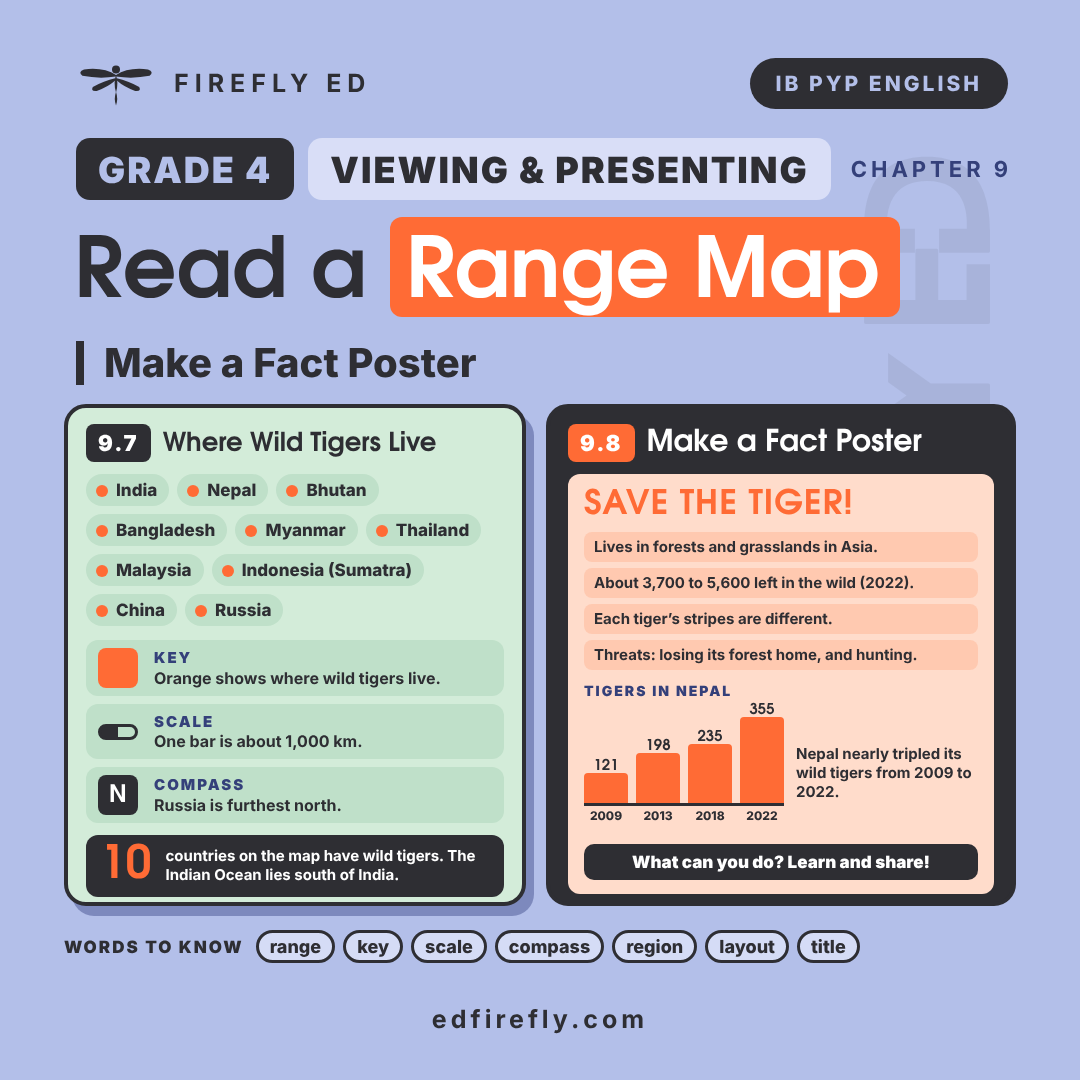
A range map shows where an animal lives in the wild. Its area is called its range. A map has a key, which tells you what the colours and symbols mean; a scale, which shows real distances; and a compass arrow, which shows north.
This is a simplified map. The patches show the main areas only.
See How It’s Done
Now Try It
1. What does the orange colour show? ______________________________
2. Name an island where tigers live. ______________
Time To Practise
Name: ______________________
1. Read the map.
a) Name four countries where wild tigers live. ______________ ______________ ______________ ______________
b) Which country is furthest north on the map with tigers? ______________
c) Which ocean is south of India? ______________
2. Use the compass.
a) Is Nepal north or south of India? ______________ b) Is Malaysia east or west of India? ______________
3. Use the scale.
About how far is it from the tigers in India to the tigers in Thailand? Use the scale bar. ______________
4. Think about it.
The tiger’s range is split into small patches, far apart. Why might this be a problem for tigers?
Think about these questions. Talk about them with someone at home or at school.
1. Go back to the Wonder question: “How could a map help people protect an animal?” What do you think now?
2. I was a thinker today when I ______________________________.
A thinker thinks carefully to work things out. For example: I was a thinker today when I used the key, scale and compass together.
Take action: Find your own home on a map or globe, and work out how far it is from the nearest place where tigers live.
Next Steps
If this was easy, try: Draw a simple range map for the snow leopard or orangutan, with a key, a compass and labels.
If this was hard, go back to: Let’s Learn. Read the key first. Then put your finger on each orange patch and read the country name.
Notes for Parents and Teachers
Show notes for parents and teachers
These notes cover this lesson only. How every lesson runs is explained in How to Use This Material.
Let’s Learn
Read Let’s Learn aloud together. Look at the map together, starting with the key.
Answer Key
Reveal Answers
Now Try It
1. where wild tigers live 2. Sumatra
1. Read the map
a) Any four of: India, Nepal, Bhutan, Bangladesh, Myanmar, Thailand, Malaysia, Indonesia, China, Russia b) Russia c) the Indian Ocean
2. Use the compass
a) north b) east
3. About 2,000 kilometres (about two scale bars). Accept answers between 1,500 and 2,500 km.
4. Sample answer: Tigers in one patch cannot reach tigers in another, so groups stay small and are easier to wipe out.
5. Sample answer: India has the largest orange areas on the map, so it has room for the most tigers.
Reflect
2. Any real moment from the lesson that shows the learner was a thinker. Examples: “I was a thinker today when I used the key, scale and compass together.” “I was a thinker today when I linked a map to a text.”
Lesson 9.8: Make a Fact Poster With a Chart | Visual | About 20 minutes
Term 3 | Level 3
Goal
“I can design a fact poster with a title, a picture, short facts, a chart and an action, using layout and colour to help the reader.”
Words to know
poster, layout, title, chart, font, colour
Wonder
Think about this question before you start. Say your ideas. You will come back to it at the end of the lesson.
Why do some posters catch your eye from across a room?
Let’s Learn
A fact poster shares information quickly, so people can understand it at a glance. Good posters use a clear layout, a big title, short facts, a chart for numbers, and colours and fonts that are easy to read.
Source for the chart: national tiger counts in Nepal, reported by WWF.
See How It’s Done
Now Try It
1. What is the action on the model poster? ______________________________
2. Why are the facts in boxes? ______________________________
Time To Practise
Name: ______________________
1. Plan your poster.
Use your research on your chosen animal from Lessons 9.3 and 9.4.
Chart: what numbers will it show? ______________________________
Action: ______________________________
2. Sketch the layout.
Draw a small sketch of where each part will go before you start.
3. Make your poster.
Make your poster on a large sheet of paper. Use no more than three main colours.
4. Check it from far away.
Put your poster on a wall and stand across the room. Tick each one you can see clearly.
☐ the title ☐ the picture ☐ the chart ☐ the action
Reflect
Think about these questions. Talk about them with someone at home or at school.
1. Go back to the Wonder question: “Why do some posters catch your eye from across a room?” What do you think now?
2. I was a communicator today when I ______________________________.
A communicator shares ideas clearly by talking, writing or drawing. For example: I was a communicator today when I chose a layout that is easy to read.
Take action: Put your poster up at school, in a library or at home, and ask three people what they learned from it.
Next Steps
If this was easy, try: Make a digital version of your poster and compare which one is easier to read.
If this was hard, go back to: Let’s Learn. Use the model poster as a frame. Keep the layout and change the animal, facts and chart.
Notes for Parents and Teachers
Show notes for parents and teachers
These notes cover this lesson only. How every lesson runs is explained in How to Use This Material.
Let’s Learn
Read Let’s Learn aloud together. Look at the model poster together.
Answer Key
Reveal Answers
Now Try It
1. What can you do? Learn and share! 2. Boxes keep each fact short and separate, so they are quick to read.
1 to 4. Look for: a clear title, a large picture, three to five short facts, a chart with a title and labels, an action, and a layout that is easy to read from a distance.
Reflect
2. Any real moment from the lesson that shows the learner was a communicator. Examples: “I was a communicator today when I chose a layout that is easy to read.” “I was a communicator today when I used a chart to show numbers clearly.”
IB theme: Sharing the planet. This theme is about the rights and responsibilities we have as we share the planet’s resources with other people and other living things.
Central idea: Human actions put many animals in danger, and people around the world work to protect them.
Each lesson also matches the national curriculum for England (Year 4) and the US Common Core (Grade 4). The Grade 4 Curriculum Map lists the full standards for every lesson.



Share your thoughts or ask something..