
Term 2 | Level 2 | Phonics focus: word endings: -cious, -tious, -cial and -tial
Chapter 4 – Our Changing Earth | Chapters – Index
Lessons
This page has the two reading lessons of Chapter 4, Our Changing Earth: Lessons 4.1 and 4.2. The chapter page has the chapter overview, the chapter review and the PDF download.
Tap a lesson to open it. Tap the lesson title again, or use the link at the end of the lesson, to close it.
Lesson 4.1: How a Volcano Erupts: Cause and Effect | Reading | About 20 minutes
Term 2 | Level 2
Goal
“I can explain what happens in a volcanic eruption and why, and name the structure of the text.”
Words to know
magma, lava, vent, pressure, eruption, ash, volcanologist, cause, effect
Wonder
Think about this question before you start. Say your ideas. You will come back to it at the end of the lesson.
What do you think makes a volcano erupt?
Let’s Learn
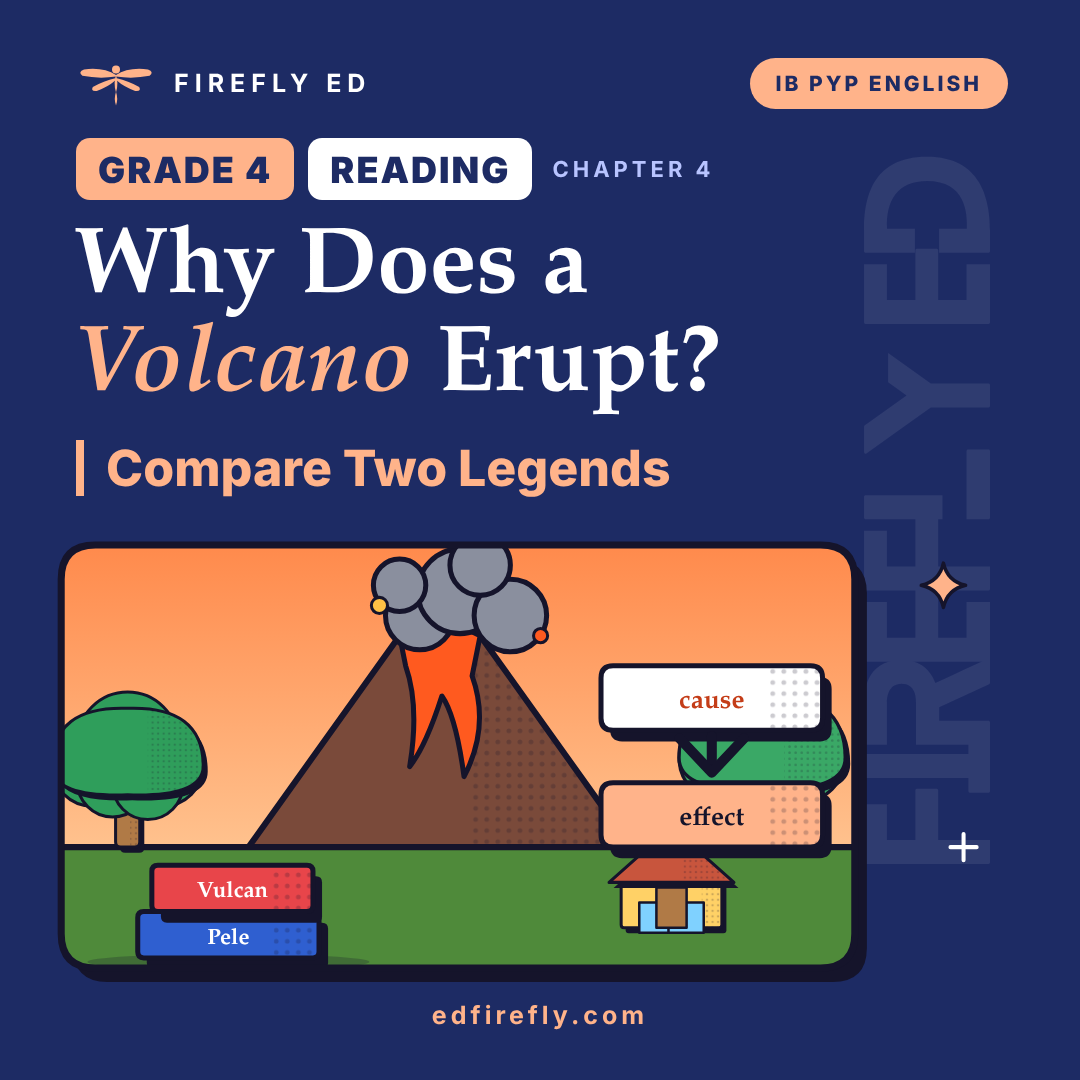
Some information texts explain why things happen. A cause is why something happens. An effect is what happens as a result. A text built this way has a cause and effect structure.
Signal words help you spot causes and effects: because, so, as a result, when, this causes, therefore, since.
Word bank: magma (melted rock under the ground), lava (melted rock that reaches the surface), vent (a crack that magma comes out of), pressure (a strong push), ash (tiny bits of rock and glass blown into the air)
How a Volcano Erupts
The ground under your feet feels solid and still. But far below the surface, the Earth is extremely hot. Deep underground, the heat is so great that some of the rock melts. Melted rock under the ground is called magma.
Why magma rises
Magma is lighter than the solid rock around it, so it slowly rises, like a bubble rising through thick honey. In some places, it collects in a pool under the ground called a magma chamber. Magma also holds gases, such as steam. As more magma pushes into the chamber, the pressure builds up, the way pressure builds in a shaken bottle of fizzy water.
What happens in an eruption
When the pressure becomes too great, the magma forces its way up through a crack in the rock called a vent. As a result, it bursts out at the surface. This is an eruption. Once magma reaches the surface, it is called lava.
Not every eruption is the same. Some volcanoes erupt gently. Their magma is runny, so the gas escapes easily, and rivers of glowing lava pour down the slopes. Kīlauea, on the island of Hawaiʻi, is a famous example. Other volcanoes erupt with a huge explosion. Their magma is thick and sticky, so the gas becomes trapped. When it finally escapes, it blasts rock and clouds of ash high into the sky.
How eruptions change the land
Lava destroys whatever lies in its path, including forests, roads and houses. But when it cools, it hardens into new rock. Over thousands of years, layer upon layer of rock can build a mountain. The islands of Hawaiʻi were built in this way, by volcanoes rising from the floor of the ocean.
Ash can also cause problems. A thick cloud of ash makes it hard to breathe, and it can stop aeroplanes from flying. However, over time, volcanic ash breaks down into rich soil. Because the soil is so good for plants, many farmers grow crops on the slopes of volcanoes, even though they know the danger.
Keeping watch
Scientists who study volcanoes are called volcanologists. They watch for warning signs that magma is moving. For example, there may be many small earthquakes, the ground may swell upwards, or more gas may escape from the vent. When the signs grow stronger, people living nearby can be warned to leave. Because of this careful watching, many lives have been saved.
See How It’s Done
Now Try It
1. Why does magma rise?
__________________________________________________________________
Hint: Read the section “Why magma rises”. Look for the word so.
2. What is the effect of thick, sticky magma?
__________________________________________________________________
Hint: Read about the volcanoes that explode.
Time To Practise
Name: ______________________
1. Words in the text.
Write the word from the text.
a) melted rock under the ground ______________ b) melted rock on the surface ______________
c) a crack that magma comes out of ______________ d) a scientist who studies volcanoes ______________
2. Match the cause and the effect.
| Cause | Effect |
|---|---|
| a) The magma is runny. | |
| b) Ash breaks down into rich soil. | |
| c) More magma pushes into the chamber. | |
| d) Volcanologists see the warning signs. |
Choose from: the pressure builds up | people can be warned to leave | the gas escapes easily and lava flows | farmers grow crops on the slopes
3. Signal words.
Underline the signal word in each sentence. Then circle the cause.
a) Because the soil is so good for plants, farmers grow crops near volcanoes.
b) The gas becomes trapped, so the volcano explodes.
c) When the pressure becomes too great, the magma bursts out.
4. The structure.
Tick the structure of this text. Then give a reason.
☐ time order (chronology) ☐ compare and contrast ☐ cause and effect ☐ problem and solution
Reason: ________________________________________________________
5. Explain.
Lava destroys forests and houses. How can a volcano also be good for people? Use two pieces of evidence from the text.
__________________________________________________________________
__________________________________________________________________
Reflect
Think about these questions. Talk about them with someone at home or at school.
1. Go back to the Wonder question: “What do you think makes a volcano erupt?” What do you think now?
2. I was an inquirer today when I ______________________________.
An inquirer asks questions and finds things out. For example: I was an inquirer today when I asked why magma rises and found the answer in the text.
Take action: Find a volcano on a map or globe. Find out whether it is active, and share one fact about it with your family.
Next Steps
If this was easy, try: Draw your own cause and effect chain for a different event, such as a flood or a melting snowman. Use five boxes.
If this was hard, go back to: Let’s Learn. Read one section at a time, and say the cause and the effect in your own words before you move on.
Notes for Parents and Teachers
Show notes for parents and teachers
These notes cover this lesson only. How every lesson runs is explained in How to Use This Material.
Let’s Learn
Then read the text together.
Answer Key
Reveal Answers
Now Try It
1. Because it is lighter than the solid rock around it. 2. The gas becomes trapped, and when it escapes it blasts rock and ash high into the sky (an explosive eruption).
1. Words in the text
a) magma b) lava c) vent d) volcanologist
2. Match the cause and the effect
a) the gas escapes easily and lava flows b) farmers grow crops on the slopes c) the pressure builds up d) people can be warned to leave
3. Signal words
a) Because; cause: the soil is so good for plants b) so; cause: the gas becomes trapped c) When; cause: the pressure becomes too great
4. The structure
Cause and effect. Sample reason: It explains why volcanoes erupt and what happens as a result, and it uses signal words such as because, so and as a result.
5. Explain
Any two of: cooled lava builds new land, such as the islands of Hawaiʻi; ash breaks down into rich soil, so farmers can grow crops; warning signs give people time to leave safely.
Reflect
2. Any real moment from the lesson that shows the learner was an inquirer. Examples: “I was an inquirer today when I asked why magma rises and found the answer in the text.” “I was an inquirer today when I used signal words to find causes and effects.”
Lesson 4.2: Two Volcano Legends: Pele and Vulcan | Reading | About 20 minutes
Term 2 | Level 2
Goal
“I can compare how two traditional stories from different cultures explain the same thing.”
Words to know
legend, myth, culture, forge, crater, compare, contrast, theme
Wonder
Think about this question before you start. Say your ideas. You will come back to it at the end of the lesson.
Long ago, before there were scientists, how might people have explained a volcano?
Let’s Learn
People all over the world told stories to explain things in nature that they could not understand, such as thunder, floods and volcanoes. Stories like these are myths and legends. They were passed down by word of mouth for hundreds of years.
When you read two stories from different cultures about the same topic, you can compare them (find what is the same) and contrast them (find what is different).
Story 1: Pele Finds a Home
This is a retelling of one version of a traditional Hawaiian story. There are many versions, and many people in Hawaiʻi still honour Pele today.
Long ago, in a land far across the ocean called Kahiki, there lived a young woman named Pele. Pele had a great gift. She could make fire, and her fire was hot enough to melt rock.
Pele’s eldest sister was Nāmakaokahaʻi, the goddess of the sea. One day, Pele’s fire burned the family’s land, and her sister was furious. Pele knew she had to leave. She set off across the ocean in a canoe with her brothers and sisters. She carried her youngest sister, Hiʻiaka, who was still an egg, close to her heart.
After a long voyage, they reached the island of Kauaʻi. Pele took her digging stick and dug a deep pit for her fire. But her sea sister had followed her. Huge waves rolled in, and the sea flooded the pit. So Pele moved on to the next island, Oʻahu, and dug again. Again the sea poured in and put out her fire. On Maui, the two sisters fought a great battle. It is said that Pele’s body was lost, but her spirit lived on.
At last, Pele came to the biggest island, Hawaiʻi. On the mountain of Kīlauea, she dug a crater called Halemaʻumaʻu. It was so high above the sea that the waves could never reach it. There, her fire was safe. Many people say that Pele still lives in Halemaʻumaʻu. When the ground shakes and new lava flows, they say that Pele is at work.
Story 2: Vulcan’s Forge
This is a retelling of a myth from ancient Rome.
The people of ancient Rome believed in many gods. One of them was Vulcan, the god of fire and of metalwork. The Greeks had a god like him, called Hephaestus.
Vulcan was a blacksmith. He worked at a forge, a workshop with a fire so hot that it could soften iron. He was the best metalworker of all the gods. With his heavy hammer, he made shining armour for heroes, and he made the thunderbolts that Jupiter, the king of the gods, hurled across the sky.
Vulcan’s forge was hidden deep inside a mountain. The Romans said that it lay under a small island near Sicily, which they named Vulcano after him. Others said it lay under Mount Etna. When Vulcan stoked his fire and pounded the metal on his anvil, the ground rumbled. Smoke, sparks and burning rock burst out of the top of the mountain, as if from a chimney.
Today, we still remember Vulcan every time we say the word volcano. It comes from his name.
See How It’s Done
Now Try It
1. In Pele’s story, what keeps putting out her fire?
__________________________________________________________________
2. In Vulcan’s story, what causes the smoke and sparks to come out of the mountain?
__________________________________________________________________
Hint: Read the third paragraph of Vulcan’s Forge.
Time To Practise
Name: ______________________
1. Find the facts.
a) Where did Pele come from? ______________ b) Where did she finally make her home? ______________
c) What did Vulcan make at his forge? Name two things. ______________ ______________
d) Which English word comes from Vulcan’s name? ______________
2. Compare and contrast.
| Pele Finds a Home | Vulcan’s Forge | |
|---|---|---|
| Culture it comes from | ||
| Main character | ||
| Where the fire is | ||
| What the story explains | ||
| Is it a journey? |
3. Same or different?
Write S if the sentence is true for both stories, or D if it is true for only one.
a) A powerful being with fire lives inside a mountain. ____
b) The sea is an enemy of the main character. ____
c) The story explains why smoke and fire come out of a mountain. ____
d) The main character makes armour. ____
4. Why do you think so?
Pele travels from Kauaʻi, to Oʻahu, to Maui, and finally to Hawaiʻi. Scientists have found that the volcanoes on Hawaiʻi are the youngest in the island chain. How does the story match what scientists have found?
__________________________________________________________________
5. Your opinion.
Which story do you think explains a volcano better? Give a reason from the text.
__________________________________________________________________
Reflect
Think about these questions. Talk about them with someone at home or at school.
1. Go back to the Wonder question: “Long ago, before there were scientists, how might people have explained a volcano?” What do you think now?
2. I was open-minded today when I ______________________________.
Being open-minded means listening to other ideas and other ways of doing things. For example: I was open-minded today when I listened to stories from two different cultures with respect.
Take action: Ask an older family member whether they know a traditional story that explains something in nature. Write it down or retell it to a friend.
Next Steps
If this was easy, try: Find a third story about a volcano or an earthquake from another culture. Add it to your compare and contrast table.
If this was hard, go back to: Let’s Learn. Read one story at a time. After each one, say who the main character is and where the fire is.
Notes for Parents and Teachers
Show notes for parents and teachers
These notes cover this lesson only. How every lesson runs is explained in How to Use This Material.
Let’s Learn
Then read both stories together.
Answer Key
Reveal Answers
Now Try It
1. The sea, sent by her sister Nāmakaokahaʻi, floods the pits she digs. 2. Vulcan stoking his fire and pounding metal on his anvil.
1. Find the facts
a) Kahiki, a land across the ocean b) Halemaʻumaʻu, a crater on Kīlauea on the island of Hawaiʻi c) Any two of: armour for heroes, thunderbolts for Jupiter d) volcano
2. Compare and contrast
Culture: Hawaiian | ancient Roman. Main character: Pele | Vulcan. Where the fire is: in a crater on Kīlauea | in a forge deep inside a mountain (under Vulcano or Mount Etna). What it explains: why volcanoes erupt in Hawaiʻi and why the ground shakes | why smoke, sparks and burning rock come out of a mountain, and where the word volcano comes from. Journey: yes | no.
3. Same or different?
a) S b) D (Pele) c) S d) D (Vulcan)
4. Why do you think so?
Sample answer: In the story, Pele’s fire moves from island to island and ends up on Hawaiʻi, where it still burns. This matches the science, because the active volcanoes are on Hawaiʻi, the youngest island.
5. Your opinion
Answers will vary. Look for: a clear choice and a reason linked to a detail in the story.
Reflect
2. Any real moment from the lesson that shows the learner was open-minded. Examples: “I was open-minded today when I listened to stories from two different cultures with respect.” “I was open-minded today when I found what was the same and what was different in two stories.”
For Teachers: IB Details
Show IB and curriculum details
IB theme: How the world works. This theme is about the natural world and its laws, how people and nature affect each other, and how people use science to understand the world.
Central idea: Forces inside the Earth and on its surface change the land, and people can prepare for those changes.
| Lesson | Title | Strand | Key concept |
|---|---|---|---|
| 4.1 | How a Volcano Erupts: Cause and Effect | Reading | Causation |
| 4.2 | Two Volcano Legends: Pele and Vulcan | Reading | Perspective |
Each lesson also matches the national curriculum for England (Year 4) and the US Common Core (Grade 4). The Grade 4 Curriculum Map lists the full standards for every lesson.
← Back to Chapter 4 – Our Changing Earth | Chapters – Index
© 2026 Firefly Ed. All rights reserved. This page may be printed for personal, home and classroom use. It may not be sold, shared online or reproduced for commercial use without written permission. edfirefly.com



Share your thoughts or ask something..