This page has the two reading lessons of Chapter 9, Protecting Wildlife: Lessons 9.1 and 9.2. The chapter page has the chapter overview, the chapter review and the PDF download.
Tap a lesson to open it. Tap the lesson title again, or use the link at the end of the lesson, to close it.
Lesson 9.1: Tigers in Danger: Causes and Solutions | Reading | About 20 minutes
Term 3 | Level 3
Goal
“I can explain the problems and solutions in a text, and how the writer organises them.”
Words to know
endangered, habitat, poaching, protected area, ranger, problem and solution
Wonder
Think about this question before you start. Say your ideas. You will come back to it at the end of the lesson.
Why might an animal that has lived for thousands of years suddenly be in danger?
Let’s Learn
Some texts are organised as problem and solution. The writer explains what is wrong and why, then describes what people are doing to fix it. Headings, and words such as problem, because, so, one solution, another help the reader follow it.
Tigers in Danger: Causes and Solutions
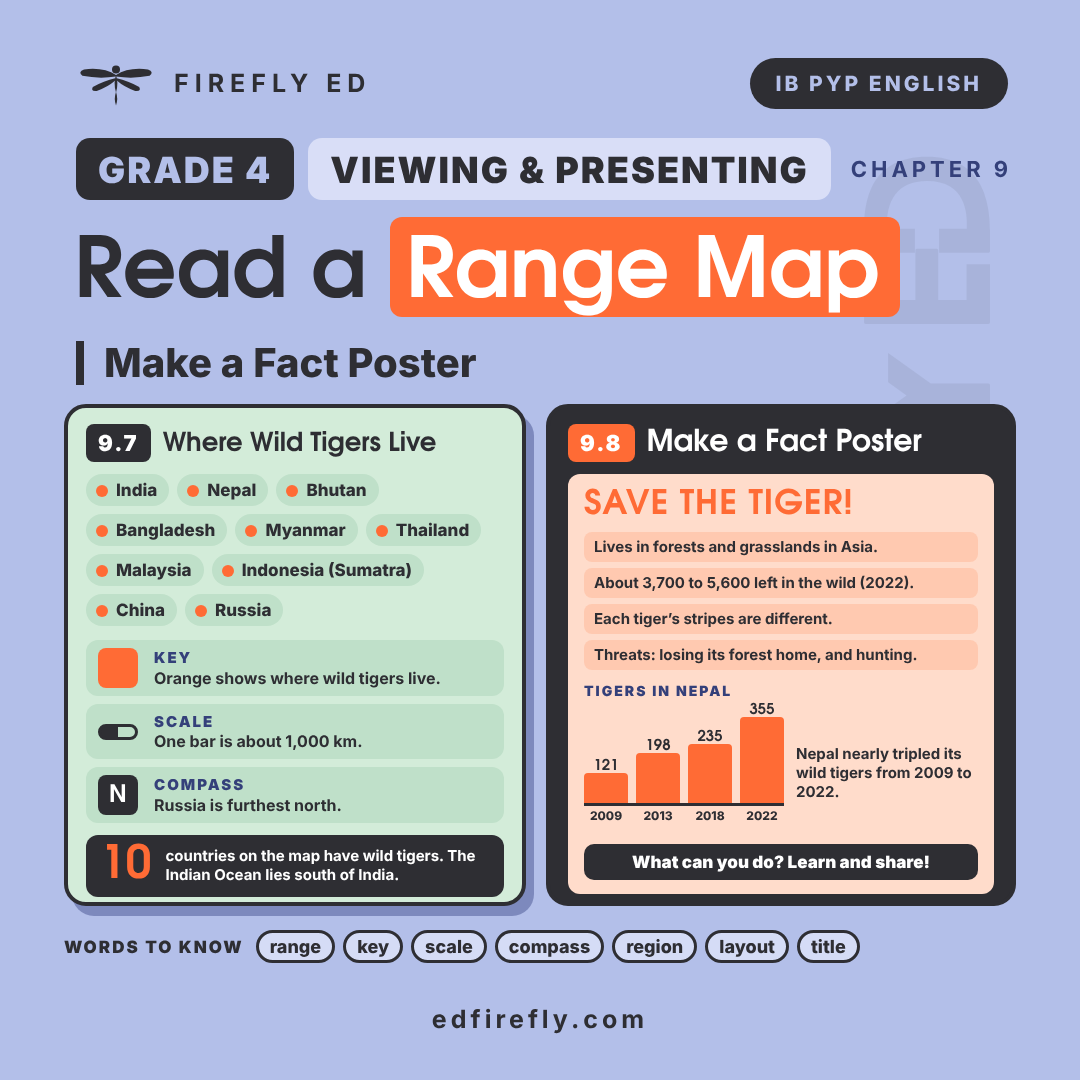
The tiger is the largest wild cat in the world. A hundred years ago, tigers lived across much of Asia, from Turkey to the east coast of Russia. Today, they live in only a few small areas, and they have lost more than nine tenths of the land where they once lived. Scientists think there are about 3,700 to 5,600 tigers left in the wild (2022).
The problems
The biggest problem is habitat loss. As towns, farms and roads grow, forests are cut down. Tigers need large areas to hunt, so when their forest shrinks, they cannot find enough food. Some come into villages looking for cattle, which puts both people and tigers in danger.
A second problem is poaching: hunting animals when it is against the law. Some people kill tigers to sell their skins and bones. Poachers also hunt the deer and wild pigs that tigers eat, so there is less food in the forest.
The solutions
Many countries are working to protect tigers. One solution is to create protected areas, where the forest cannot be cut down. Another is to train rangers, who patrol the forests and stop poachers. Scientists use camera traps, hidden cameras that take a photo when an animal walks past, to count tigers. Because every tiger’s stripes are different, each one can be recognised.
Local people are important too. In some villages, families are paid to protect the forest, or they earn money by guiding visitors who come to see tigers. When people benefit from tigers, they want to keep them safe.
These solutions are working. In 2010, the countries where tigers live agreed to try to double the number of wild tigers. Nepal nearly tripled its tigers, from 121 in 2009 to 355 in 2022. India now has about three quarters of the world’s wild tigers.
See How It’s Done
Now Try It
1. What is poaching? ______________________________
2. Which solution helps scientists count tigers? ______________
Time To Practise
Name: ______________________
1. Find the facts.
a) How many wild tigers are there, according to the 2022 estimate? ______________
b) How much of their old land have tigers lost? ______________
c) How can scientists tell one tiger from another? ______________________________
2. Cause and effect.
a) Why do some tigers come into villages? ______________________________
b) Why does poaching deer harm tigers? ______________________________
3. Match the problem to the solution.
Habitat loss → ______________________ Poaching → ______________________
4. Local people.
Why does the writer say local people are important? Use evidence from the text.
Think about these questions. Talk about them with someone at home or at school.
1. Go back to the Wonder question: “Why might an animal that has lived for thousands of years suddenly be in danger?” What do you think now?
2. I was caring today when I ______________________________.
Being caring means being kind and helping others. For example: I was caring today when I thought about how people and animals share land.
Take action: Tell your family about one solution that is helping tigers. Talk about whether it could help an animal near you.
Next Steps
If this was easy, try: Choose another endangered animal and write a short problem-and-solution paragraph about it, using a trusted source.
If this was hard, go back to: Let’s Learn. Read one section at a time and say the problem or solution in your own words.
Notes for Parents and Teachers
Show notes for parents and teachers
These notes cover this lesson only. How every lesson runs is explained in How to Use This Material.
Let’s Learn
Read Let’s Learn aloud together. Read the text together, one section at a time.
Answer Key
Reveal Answers
Now Try It
1. Hunting animals when it is against the law. 2. camera traps
1. Find the facts
a) about 3,700 to 5,600 b) more than nine tenths c) Every tiger’s stripes are different.
2. Cause and effect
a) Their forest has shrunk, so they cannot find enough food and look for cattle. b) Deer are the tigers’ food, so tigers have less to eat.
3. Habitat loss: protected areas. Poaching: rangers who patrol the forests.
4. Sample answer: When people benefit from tigers, for example by being paid to protect the forest or by guiding visitors, they want to keep tigers safe.
5. Nepal nearly tripled its tigers, from 121 in 2009 to 355 in 2022.
Reflect
2. Any real moment from the lesson that shows the learner was caring. Examples: “I was caring today when I thought about how people and animals share land.” “I was caring today when I explained how a solution helps.”
Lesson 9.2: Two Texts, One Animal: Putting the Facts Together | Reading | About 20 minutes
Term 3 | Level 3
Goal
“I can put together information from two texts on the same animal to write or speak about it knowledgeably.”
Words to know
encyclopedia, news report, integrate, critically endangered, rescue centre, heading
Wonder
Think about this question before you start. Say your ideas. You will come back to it at the end of the lesson.
Why might two texts about the same animal tell you different things?
Let’s Learn
Different texts give different information. An encyclopedia gives general facts. A news report tells a real story that is happening now. When we integrate (put together) facts from both, we know much more than either text tells us on its own.
Text A: Orangutans (from an encyclopedia)
Orangutans are great apes with long arms and shaggy red-brown hair. They live only in the rainforests of two islands in Asia: Borneo and Sumatra. There are three kinds, and all three are critically endangered, which means they are at very high risk of dying out in the wild.
Orangutans spend most of their lives in the trees. They eat mainly fruit, as well as leaves, bark and insects. Every evening, an orangutan bends branches together to build a new nest to sleep in.
A mother orangutan looks after her baby for about seven or eight years, teaching it which fruits to eat and how to build nests. This is one of the longest childhoods of any animal apart from humans.
Text B: A Second Chance (from a news report)
When rangers found the baby orangutan, she was alone at the edge of a burnt forest. Her mother was gone. The trees she should have grown up in had been cleared to plant oil palms.
The rangers took her to a rescue centre in Malaysia, where carers will teach her the skills her mother would have taught her: how to climb, how to find fruit and how to build a nest. It will take years. When she is ready, she will be released into a protected forest.
Scientists estimate that between 1999 and 2015, Borneo lost more than 100,000 orangutans. Forests have been cleared for farms, for wood and for oil palm plantations, and fires have destroyed even more. “Every forest we save is a home we save,” says one of the carers.
See How It’s Done
Now Try It
1. Which text tells you where orangutans live? ______________
2. Which text tells you why the baby was alone? ______________
Time To Practise
Name: ______________________
1. Which text?
Write A, B or both.
a) Orangutans build a nest every night. ____ b) Forests are cleared for oil palms. ____ c) Young orangutans must learn to find fruit. ____ d) Orangutans live in Borneo. ____
2. Put it together.
Use both texts to answer: Why is losing a forest especially hard for a young orangutan?
Think about these questions. Talk about them with someone at home or at school.
1. Go back to the Wonder question: “Why might two texts about the same animal tell you different things?” What do you think now?
2. I was knowledgeable today when I ______________________________.
Being knowledgeable means knowing things and using what you know. For example: I was knowledgeable today when I put facts from two texts together.
Take action: Check food labels at home for palm oil. Find out with an adult what “sustainable palm oil” means.
Next Steps
If this was easy, try: Find a third text about orangutans from a trusted source and add one new fact to the notes table.
If this was hard, go back to: Let’s Learn. Read Text A and say three facts. Then read Text B and say what is new.
Notes for Parents and Teachers
Show notes for parents and teachers
These notes cover this lesson only. How every lesson runs is explained in How to Use This Material.
Let’s Learn
Read Let’s Learn aloud together. Read the two texts together.
Answer Key
Reveal Answers
Now Try It
1. Text A 2. Text B
1. Which text?
a) A b) B c) both d) both (A names Borneo; B says Borneo lost orangutans)
2. Sample answer: Young orangutans learn everything from their mothers for seven or eight years and live in the trees, so when a forest is cleared they lose their home and often their mother and their teacher too.
3. Sample answer: Text B begins with a story about one baby orangutan, while Text A begins with general facts.
4. Look for: a clear paragraph with at least two facts from each text, joined with linking words.
Reflect
2. Any real moment from the lesson that shows the learner was knowledgeable. Examples: “I was knowledgeable today when I put facts from two texts together.” “I was knowledgeable today when I worked out something neither text said on its own.”
IB theme: Sharing the planet. This theme is about the rights and responsibilities we have as we share the planet’s resources with other people and other living things.
Central idea: Human actions put many animals in danger, and people around the world work to protect them.
Each lesson also matches the national curriculum for England (Year 4) and the US Common Core (Grade 4). The Grade 4 Curriculum Map lists the full standards for every lesson.


Share your thoughts or ask something..