
Term 3 | Level 3 | Phonics focus: homophones, words that are often mixed up, and silent letters
Chapter 9 – Protecting Wildlife | Chapters – Index
Lessons
This page has the two listening and speaking lessons of Chapter 9, Protecting Wildlife: Lessons 9.5 and 9.6. The chapter page has the chapter overview, the chapter review and the PDF download.
Tap a lesson to open it. Tap the lesson title again, or use the link at the end of the lesson, to close it.
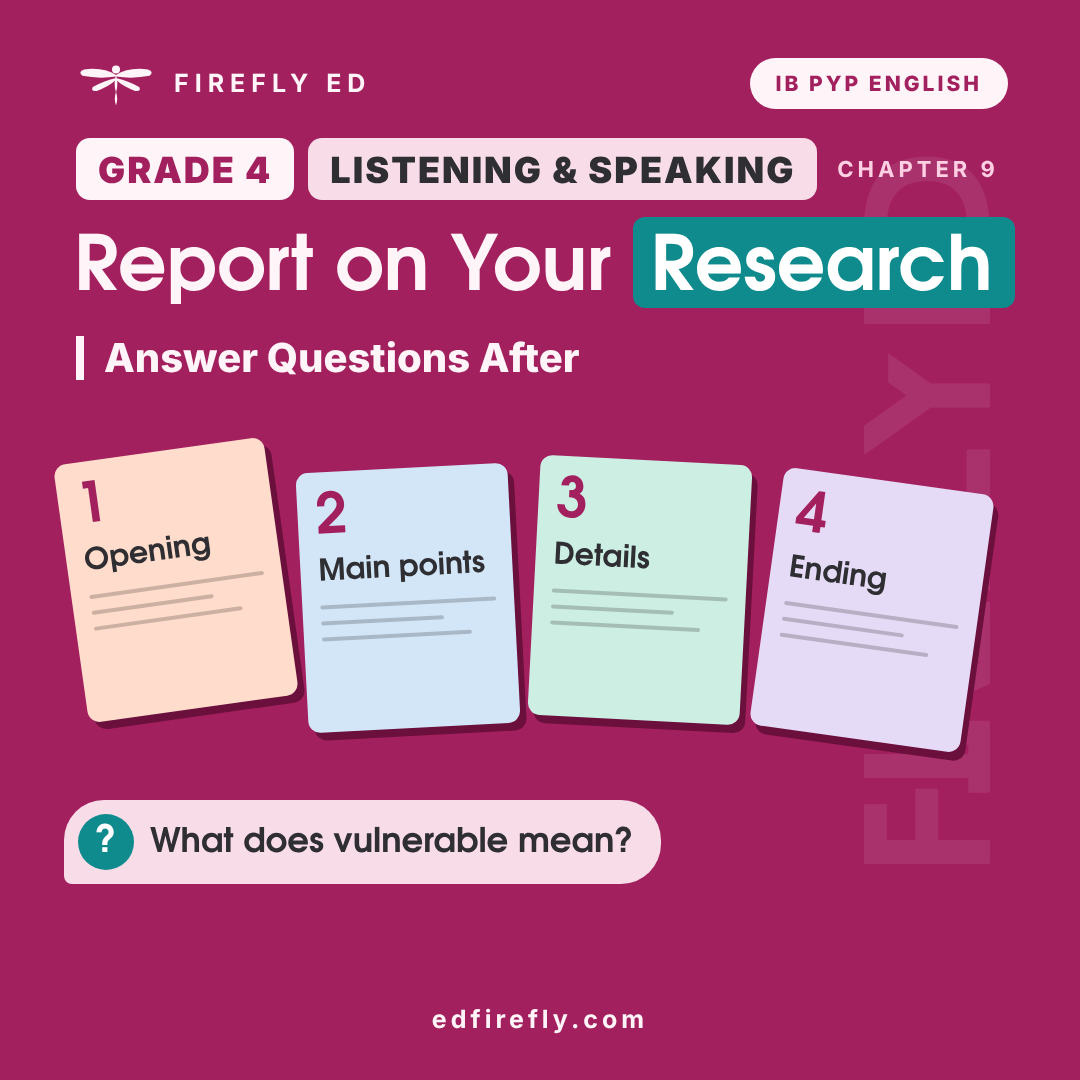
Lesson 9.5: Report on Your Research | Oral | About 20 minutes
Term 3 | Level 3
Goal
“I can give a spoken report in an organised way, with main points, facts and details, speaking clearly at a steady pace.”
Words to know
report, main point, detail, pace, eye contact, cue card
Wonder
Think about this question before you start. Say your ideas. You will come back to it at the end of the lesson.
How is reading your fact page aloud different from giving a spoken report?
Let’s Learn
A spoken report shares your research with an audience. Do not read your fact page word for word. Instead, use cue cards: small cards with key words to remind you of each main point. Then speak in your own words, giving details for each point.
Tips: speak at a steady pace; pause after each main point; look at your audience, not just your cards; and point to your picture or map when it helps.
See How It’s Done
Now Try It
1. Write a cue card for the main point Dangers. ______________________________
2. Write a hook question to open a report on snow leopards. ______________________________
Time To Practise
Name: ______________________
1. Make your cue cards.
Using your fact page from Lesson 9.4, write one cue card for each main point, with key words only.
2. Plan your opening and ending.
Opening: __________________________________________________________
Ending: ___________________________________________________________
3. Practise.
Practise your report twice. The second time, try to look up from your cards after every sentence.
4. Give your report.
Give your report to an adult or a group for two to three minutes.
An adult listens and ticks each one they hear or see.
☐ a hook at the start ☐ three or more main points ☐ a detail for each point ☐ steady pace ☐ eye contact ☐ an ending that says how people can help
Reflect
Think about these questions. Talk about them with someone at home or at school.
1. Go back to the Wonder question: “How is reading your fact page aloud different from giving a spoken report?” What do you think now?
2. I was a communicator today when I ______________________________.
A communicator shares ideas clearly by talking, writing or drawing. For example: I was a communicator today when I spoke in my own words from key words.
Take action: Give your report to someone who does not know about your animal, and ask what they found most interesting.
Next Steps
If this was easy, try: Record your report as a short video or audio clip, adding a picture or map for each main point.
If this was hard, go back to: Let’s Learn. Practise one cue card at a time. Say it three times before moving on.
Notes for Parents and Teachers
Show notes for parents and teachers
These notes cover this lesson only. How every lesson runs is explained in How to Use This Material.
Let’s Learn
Read Let’s Learn aloud together. Look at the plan and the tips together.
Time To Practise
- Task 4: Tick each one you hear or see.
Answer Key
Reveal Answers
Now Try It
1. Sample cue card: Dangers: hunted for fur; farmers; warming climate. 2. Sample answer: Have you ever heard of a cat that people call a ghost?
1 to 3. Look for: key words only on each card, and an opening and ending that suit the audience.
4. Look for: four or more ticks.
Reflect
2. Any real moment from the lesson that shows the learner was a communicator. Examples: “I was a communicator today when I spoke in my own words from key words.” “I was a communicator today when I looked at my audience.”
Lesson 9.6: Questions and Answers After a Report | Oral | About 20 minutes
Term 3 | Level 3
Goal
“I can ask useful questions after a report, and answer questions about my own report clearly and politely.”
Words to know
question, clarify, follow up, evidence, audience, polite
Wonder
Think about this question before you start. Say your ideas. You will come back to it at the end of the lesson.
What makes a really good question?
Let’s Learn
After a report, the audience asks questions. Some questions clarify: they check something you did not understand. Others find out more, or ask for the speaker’s opinion. When you answer, stay calm and polite, answer clearly, and give evidence if you can. It is fine to say you do not know.
See How It’s Done
Now Try It
1. Write a clarifying question about the snow leopard report. ______________________________
2. How would you answer a question you do not know the answer to? ______________________________
Time To Practise
Name: ______________________
1. Prepare.
Think about your own report. Write two questions people might ask you, and how you would answer.
Q: ______________________________ A: ______________________________
Q: ______________________________ A: ______________________________
2. Ask good questions.
Listen to an adult give a short talk on any topic. Ask one clarifying question, one find-out-more question and one opinion question.
______________________________ ______________________________ ______________________________
3. Question time.
Give your report from Lesson 9.5 again, then take three questions from your audience.
An adult listens and ticks each one they hear.
☐ thanked the person ☐ checked the question ☐ answered clearly ☐ gave evidence ☐ stayed calm if unsure
Reflect
Think about these questions. Talk about them with someone at home or at school.
1. Go back to the Wonder question: “What makes a really good question?” What do you think now?
2. I was open-minded today when I ______________________________.
Being open-minded means listening to other ideas and other ways of doing things. For example: I was open-minded today when I listened carefully to other people’s questions.
Take action: At dinner, ask a family member a find-out-more question about their day, and listen to the whole answer.
Next Steps
If this was easy, try: Write a list of five questions you would ask a real wildlife ranger, and sort them into the three kinds.
If this was hard, go back to: Let’s Learn. Practise the five answer frames aloud with an adult who asks easy questions.
Notes for Parents and Teachers
Show notes for parents and teachers
These notes cover this lesson only. How every lesson runs is explained in How to Use This Material.
Let’s Learn
Read Let’s Learn aloud together. Practise the question and answer frames together.
Time To Practise
- Task 3: Tick each one you hear.
Answer Key
Reveal Answers
Now Try It
1. Sample answer: What does “rosettes” mean? 2. Sample answer: I’m not sure, but I could find out and tell you tomorrow.
1 and 2. Answers will vary. Look for: questions of each kind, and answers that are clear and use evidence.
3. Look for: four or more ticks.
Reflect
2. Any real moment from the lesson that shows the learner was open-minded. Examples: “I was open-minded today when I listened carefully to other people’s questions.” “I was open-minded today when I admitted when I was not sure.”
For Teachers: IB Details
Show IB and curriculum details
IB theme: Sharing the planet. This theme is about the rights and responsibilities we have as we share the planet’s resources with other people and other living things.
Central idea: Human actions put many animals in danger, and people around the world work to protect them.
| Lesson | Title | Strand | Key concept |
|---|---|---|---|
| 9.5 | Report on Your Research | Speaking | Responsibility |
| 9.6 | Questions and Answers After a Report | Listening and speaking | Connection |
Each lesson also matches the national curriculum for England (Year 4) and the US Common Core (Grade 4). The Grade 4 Curriculum Map lists the full standards for every lesson.
← Back to Chapter 9 – Protecting Wildlife | Chapters – Index
© 2026 Firefly Ed. All rights reserved. This page may be printed for personal, home and classroom use. It may not be sold, shared online or reproduced for commercial use without written permission. edfirefly.com


Share your thoughts or ask something..