

Term 1 | Level 1 | Phonics focus: syllable patterns: dividing words in the middle, open and closed syllables, and consonant-le endings
Chapter 1 – Rights and Responsibilities | Chapters – Index
Lessons
This page has the three phonics lessons of Chapter 1, Rights and Responsibilities: Lessons 1.9, 1.10 and 1.11. The chapter page has the chapter overview, the chapter review and the PDF download.
Tap a lesson to open it. Tap the lesson title again, or use the link at the end of the lesson, to close it.
Lesson 1.9: Syllables: Dividing Words in the Middle | Phonics | About 20 minutes
Term 1 | Level 1
Goal
“I can divide a word that has two consonants in the middle into syllables, and use the parts to read and spell it.”
Words to know
syllable, vowel, consonant, divide, pattern, blend
Wonder
Think about this question before you start. Say your ideas. You will come back to it at the end of the lesson.
How do you read a long word that you have never seen before?
Let’s Learn
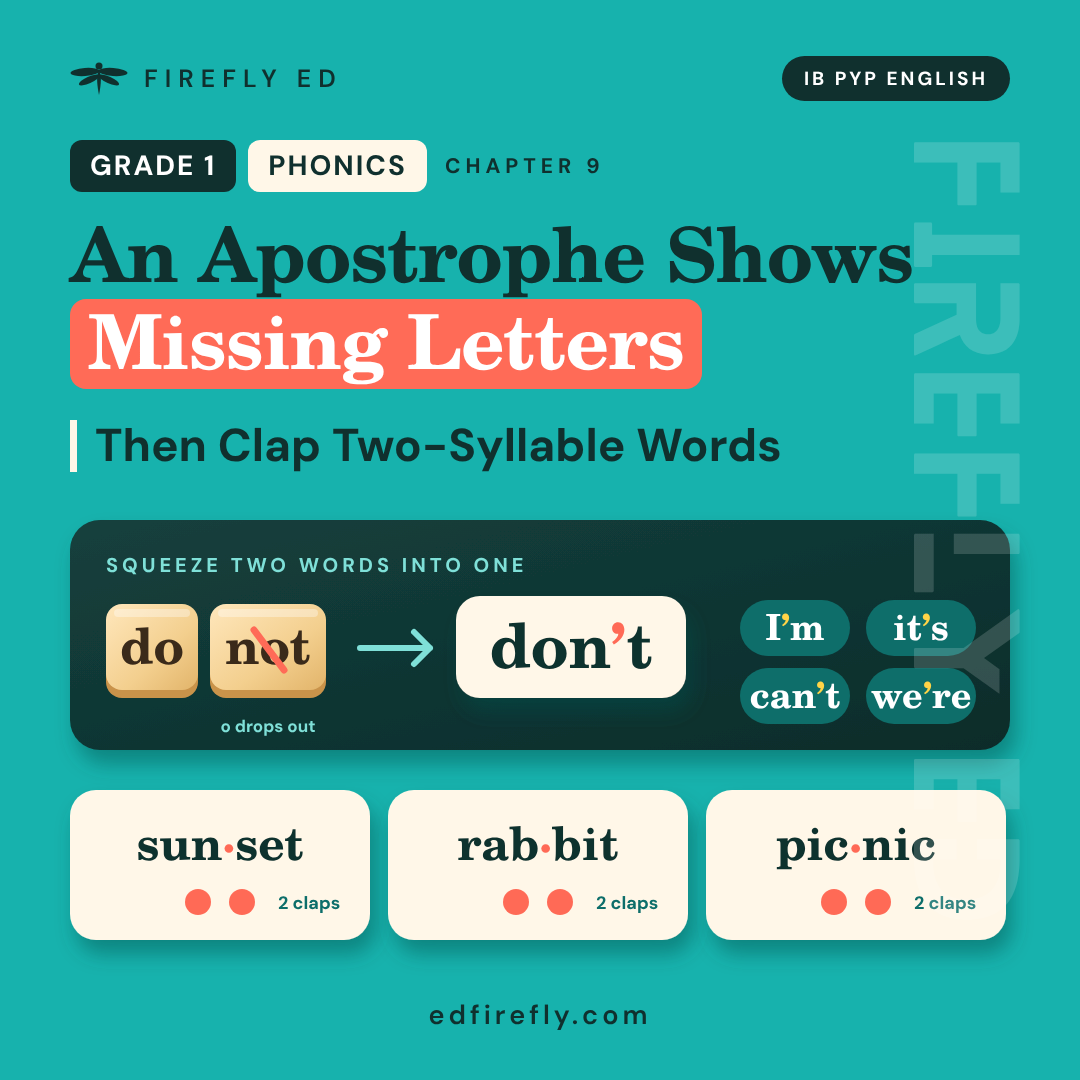
Clap the beats of each word as you read.
A syllable is one beat of a word. Every syllable has one vowel sound. When you can find the syllables, a long word becomes two or three short, easy parts.
Many words have two consonants between two vowels. Divide the word between the two consonants. We call this the VC/CV pattern: vowel, consonant | consonant, vowel.
The first syllable ends with a consonant, so its vowel is usually short. Think of rab in rabbit and nap in napkin.
Follow these four steps:
Some letters make one sound together, such as sh, ch, th, ck, ph and wh. Do not split them. In rubbish, the divide is between the two b letters.
See How It’s Done
Now Try It
1. Divide the word basket. Draw a line between the syllables.
__________ | __________
Hint: Find the two vowels, then the two consonants between them.
2. Read the word window one syllable at a time. How many syllables does it have?
Hint: Say it slowly and clap each beat.
Time To Practise
Name: ______________________
1. Clap and count.
Clap each word. Write the number of syllables.
jump ______ napkin ______ hospital ______ important ______ button ______ elephant ______
2. Divide the words.
Write the two syllables on the lines. Put a line between the two consonants.
rabbit ______ | ______ contest ______ | ______
puppet ______ | ______ window ______ | ______
magnet ______ | ______ dentist ______ | ______
rubbish ______ | ______ tennis ______ | ______
3. Join the parts.
Put the syllables together. Write the whole word. Then check your spelling.
pic + nic = ______________ but + ton = ______________
bas + ket = ______________ mag + net = ______________
win + dow = ______________ den + tist = ______________
4. Find the pattern.
Read the sentence aloud.
Dad packed a basket and a napkin for the picnic after the tennis contest.
Find three words with the VC/CV pattern. Divide each one.
__________ | __________ __________ | __________ __________ | __________
5. Write from dictation.
Listen as an adult reads a sentence aloud, two or three words at a time. Write it. Then check each word against the Answer Key.
__________________________________________________________________
__________________________________________________________________
Reflect
Think about these questions. Talk about them with someone at home or at school.
1. Go back to the Wonder question: “How do you read a long word that you have never seen before?” What do you think now?
2. I was a thinker today when I ______________________________.
A thinker thinks carefully to work things out. For example: I was a thinker today when I worked out how to divide a long word.
Take action: Find three long words on signs, packets or labels at home. Divide each one into syllables and read it aloud to someone.
Next Steps
If this was easy, try: Look for VC/CV words in a story you are reading. Make a list of five. Divide each one and see if the first vowel is short.
If this was hard, go back to: Let’s Learn. Say the four steps aloud with the word rabbit, then try the words window and basket again.
Notes for Parents and Teachers
Show notes for parents and teachers
These notes cover this lesson only. How every lesson runs is explained in How to Use This Material.
Let’s Learn
Clap the beats of each word together.
Time To Practise
- Task 5: Read the sentence in the Answer Key slowly, two or three words at a time.
Answer Key
Reveal Answers
Now Try It
1. bas | ket
2. win | dow. It has 2 syllables.
1. Clap and count
jump 1, napkin 2, hospital 3, important 3, button 2, elephant 3
2. Divide the words
rab | bit, con | test, pup | pet, win | dow, mag | net, den | tist, rub | bish, ten | nis
Look for: the divide between the two consonants. In rubbish, the sh stays together in the second syllable.
3. Join the parts
picnic, button, basket, magnet, window, dentist
4. Find the pattern
Any three of: bas | ket, nap | kin, af | ter, pic | nic, ten | nis, con | test
5. Write from dictation
Dictation sentence: The rabbit sat in the basket at the picnic.
Look for: a capital letter at the start, a full stop at the end, and rabbit, basket and picnic spelled correctly. Ask the learner to say each of those three words in syllables: rab | bit, bas | ket, pic | nic.
Reflect
2. Any real moment from the lesson that shows the learner was a thinker. Examples: “I was a thinker today when I worked out how to divide a long word.” “I was a thinker today when I used the four steps to read a word I did not know.”
Lesson 1.10: Syllables: Open and Closed | Phonics | About 20 minutes
Term 1 | Level 1
Goal
“I can tell open and closed syllables apart, and use them to divide and read a word with one consonant in the middle.”
Words to know
open syllable, closed syllable, long vowel, short vowel, divide, pattern
Wonder
Think about this question before you start. Say your ideas. You will come back to it at the end of the lesson.
Do the words robot and cabin have the same vowel sound in the first syllable? Say them and listen.
Let’s Learn
Last lesson, you divided words with two consonants in the middle. Now look at words with one consonant between two vowels, such as robot and cabin. There are two ways to divide them. First, learn about two kinds of syllable.
Now look at the two ways to divide a word with one consonant between two vowels.
How do you know which way to divide? Try the long vowel first. Then listen to see if it makes a word you know.
Most words follow this plan, but a few do not. Always say the word to check that it sounds right.
See How It’s Done
Now Try It
1. Try the word paper. Divide it with V/CV first. Does it sound like a word you know?
__________ | __________
Hint: Divide before the p and say the long a.
2. Try the word lemon. Divide it with V/CV first. If it does not sound right, divide it with VC/V.
__________ | __________
Hint: Divide after the m and say the short e.
Time To Practise
Name: ______________________
1. Open or closed?
Write open or closed for each syllable.
go ______________ hop ______________ be ______________
sit ______________ pi ______________ lim ______________
2. Divide and sort.
Divide each word. Then write it in the correct column. Use the table below.
robot cabin tiger lemon paper visit music seven pilot river
3. Try it both ways.
Try V/CV first. If it does not sound right, try VC/V. Write the divided word.
planet ______ | ______ frozen ______ | ______
travel ______ | ______ spider ______ | ______
limit ______ | ______ open ______ | ______
4. Find the words.
Read the sentence aloud.
Seven pilots walked to the river and sat in a cabin.
Find three words with one consonant between two vowels. Divide each word. Write open or closed for its first syllable.
__________ | __________ ______________
__________ | __________ ______________
__________ | __________ ______________
5. Write from dictation.
Listen as an adult reads a sentence aloud, two or three words at a time. Write it. Then divide the four words that the adult gives you into syllables.
__________________________________________________________________
Divide these words: tiger, robot, frozen, river
__________ | __________ __________ | __________ __________ | __________ __________ | __________
Reflect
Think about these questions. Talk about them with someone at home or at school.
1. Go back to the Wonder question: “Do the words robot and cabin have the same vowel sound in the first syllable? Say them and listen.” What do you think now?
2. I was an inquirer today when I ______________________________.
An inquirer asks questions and finds things out. For example: I was an inquirer today when I asked myself if a word sounded real before I chose how to divide it.
Take action: Find three words at home with one consonant between two vowels, such as a label on a packet. Divide each one. Say if the first syllable is open or closed.
Next Steps
If this was easy, try: Write five new words with the V/CV pattern and five with the VC/V pattern. Ask someone to say them aloud. Check each one with a dictionary.
If this was hard, go back to: Let’s Learn. Look again at the flow of four steps. Say each step aloud with the word cabin, then try the word lemon again.
Notes for Parents and Teachers
Show notes for parents and teachers
These notes cover this lesson only. How every lesson runs is explained in How to Use This Material.
Let’s Learn
Say each example word together.
Time To Practise
- Task 5: Read the sentence in the Answer Key slowly, two or three words at a time. Then give the learner the four words listed in the Answer Key to divide.
Answer Key
Reveal Answers
Now Try It
1. pa | per. It sounds like a word you know.
2. Try 1: le | mon does not sound right (it says “lee-mon”). Try 2: lem | on works.
1. Open or closed?
go open, hop closed, be open, sit closed, pi open, lim closed
2. Divide and sort
V/CV (open first syllable): ro | bot, ti | ger, pa | per, mu | sic, pi | lot
VC/V (closed first syllable): cab | in, lem | on, vis | it, sev | en, riv | er
Look for: five words in each column, with the divide in the right place.
3. Try it both ways
plan | et, fro | zen, trav | el, spi | der, lim | it, o | pen
4. Find the words
Any three of: sev | en closed, pi | lots open, riv | er closed, cab | in closed
5. Write from dictation
Dictation sentence: The tiger and the robot sat by the frozen river.
Divided words: ti | ger, ro | bot, fro | zen, riv | er
Look for: a capital letter at the start, a full stop at the end and all words spelled correctly.
Reflect
2. Any real moment from the lesson that shows the learner was an inquirer. Examples: “I was an inquirer today when I asked myself if a word sounded real before I chose how to divide it.” “I was an inquirer today when I tried a word two different ways to find out which was right.”
Lesson 1.11: Consonant-le Endings, and Tricky Words | Phonics | About 20 minutes
Term 1 | Level 1
Goal
“I can read and spell words that end in consonant-le, and spell six tricky words by using memory aids.”
Words to know
consonant-le, double consonant, tricky word, memory aid, look, say, cover, write, check
Wonder
Think about this question before you start. Say your ideas. You will come back to it at the end of the lesson.
Say the words table and little. What do you hear at the end of both words?
Let’s Learn
Part 1: Consonant-le
Many words end in a consonant and le, such as bottle, table and simple. The last syllable sounds like “ul”. To find it, count back three letters from the end of the word.
The first syllable can follow three patterns:
Some other word endings sound the same, such as camel, animal and pencil. They are spelled differently, so check a dictionary if you are not sure.
Part 2: Tricky words
Some words are tricky to spell, even when you can read them. Here are six words that people often get wrong. Each has a memory aid. The tricky letters are in pink.
Use these five steps to learn a new spelling:
See How It’s Done
Now Try It
1. Divide the word middle. Count back three letters from the end.
__________ | __________
Hint: The last syllable is a consonant plus le.
2. Look at the word achieve. Which letters are tricky? Say the memory aid aloud.
__________________________________________________________________
Hint: Think of the word believe.
Time To Practise
Name: ______________________
1. Divide the words.
Count back three letters from the end. Draw a line between the syllables.
little ______ | ______ table ______ | ______
simple ______ | ______ puzzle ______ | ______
candle ______ | ______ maple ______ | ______
middle ______ | ______ gentle ______ | ______
2. Sort the words.
Write each word from Task 1 in the correct group.
Short vowel + double consonant: ______________ ______________ ______________
Long vowel + one consonant: ______________ ______________
Short vowel + two different consonants: ______________ ______________ ______________
3. Fix the spelling.
Each sentence has at least one spelling mistake. Find each mistake and write the word correctly.
a) Every individal in our comunity has rights. ______________ ______________
b) It is neccesary to keep clean water avaliable. ______________ ______________
c) Every child has the right to an identety. ______________
d) Children can acheive more when they feel safe. ______________
4. Look, say, cover, write, check.
Use the five steps for each word. Write it from memory in the middle box. Then check it and write a tick if it is correct.
| Word | Write it from memory | Tick |
|---|---|---|
| community | |
|
| individual | |
|
| identity | |
|
| necessary | |
|
| available | |
|
| achieve | |
|
If a word is not correct, write it again. Then try the memory aid.
5. Write from dictation.
Listen as an adult reads two sentences aloud, two or three words at a time. Write them. Then check each word against the Answer Key.
__________________________________________________________________
__________________________________________________________________
__________________________________________________________________
Reflect
Think about these questions. Talk about them with someone at home or at school.
1. Go back to the Wonder question: “Say the words table and little. What do you hear at the end of both words?” What do you think now?
2. I was knowledgeable today when I ______________________________.
Being knowledgeable means knowing things and using what you know. For example: I was knowledgeable today when I used a memory aid to spell a tricky word.
Take action: Choose two of the six tricky words. Write each one three times from memory over the next three days. Ask someone to check them.
Next Steps
If this was easy, try: Make your own memory aid for another word that you find tricky. Teach it to someone at home.
If this was hard, go back to: Let’s Learn. Look at the five steps again. Choose one tricky word and go through the steps slowly, one at a time.
Notes for Parents and Teachers
Show notes for parents and teachers
These notes cover this lesson only. How every lesson runs is explained in How to Use This Material.
Let’s Learn
Say each example word together.
Time To Practise
- Task 5: Read the two sentences in the Answer Key slowly, two or three words at a time.
Answer Key
Reveal Answers
Now Try It
1. mid | dle
2. The tricky letters are ie. Memory aid: achieve and believe both end in ieve.
1. Divide the words
lit | tle, ta | ble, sim | ple, puz | zle, can | dle, ma | ple, mid | dle, gen | tle
2. Sort the words
Short vowel + double consonant: lit | tle, puz | zle, mid | dle
Long vowel + one consonant: ta | ble, ma | ple
Short vowel + two different consonants: sim | ple, can | dle, gen | tle
3. Fix the spelling
a) individual, community
b) necessary, available
c) identity
d) achieve
4. Look, say, cover, write, check
The six words, spelled correctly: community, individual, identity, necessary, available, achieve. Look for: a tick only where the learner has checked each letter against the list.
5. Write from dictation
Dictation sentences: Clean water must be available for every individual in our community. It is necessary to help every child achieve their best.
Look for: a capital letter at the start and a full stop at the end of each sentence, and the four tricky words spelled correctly.
Reflect
2. Any real moment from the lesson that shows the learner was knowledgeable. Examples: “I was knowledgeable today when I used a memory aid to spell a tricky word.” “I was knowledgeable today when I knew how to divide a word that ends in le.”
For Teachers: IB Details
Show IB and curriculum details
IB theme: Who we are. It covers our bodies and feelings, our families and friends, where we belong, our rights and responsibilities, and how we learn and grow.
Central idea: Every child has rights, and everyone shares the responsibility to respect them.
| Lesson | Title | Strand | Key concept |
|---|---|---|---|
| 1.9 | Syllables: Dividing Words in the Middle | Reading and spelling | Form |
| 1.10 | Syllables: Open and Closed | Reading and spelling | Form |
| 1.11 | Consonant-le Endings, and Tricky Words | Reading and spelling | Form |
Each lesson also matches the national curriculum for England (Year 4) and the US Common Core (Grade 4). The Grade 4 Curriculum Map lists the full standards for every lesson.
← Back to Chapter 1 – Rights and Responsibilities | Chapters – Index
© 2026 Firefly Ed. All rights reserved. This page may be printed for personal, home and classroom use. It may not be sold, shared online or reproduced for commercial use without written permission. edfirefly.com


Share your thoughts or ask something..