
Term 3 | Level 3 | Phonics focus: homophones, words that are often mixed up, and silent letters
Chapter 9 – Protecting Wildlife | Chapters – Index
Lessons
This page has the three phonics lessons of Chapter 9, Protecting Wildlife: Lessons 9.9, 9.10 and 9.11. The chapter page has the chapter overview, the chapter review and the PDF download.
Tap a lesson to open it. Tap the lesson title again, or use the link at the end of the lesson, to close it.
Lesson 9.9: Homophones: past and passed, advice and advise | Phonics | About 20 minutes
Term 3 | Level 3
Goal
“I can choose the right spelling for homophones and near-homophones, using the meaning and the word class.”
Words to know
homophone, near-homophone, verb, noun, past tense, meaning
Wonder
Think about this question before you start. Say your ideas. You will come back to it at the end of the lesson.
How can two words sound the same but mean different things?
Let’s Learn
Homophones are words that sound the same but have different spellings and meanings, like passed and past. Near-homophones sound almost the same, like advice and advise. To choose the right spelling, think about what the word means and what job it does in the sentence.
passed or past? Passed is the past tense of the verb pass: it is something someone did. Past is never a verb: the past, past the river, half past two.
See How It’s Done
Now Try It
1. passed or past? The rangers ______ the village at dawn. ______________
2. advice or advise? What would you ______ me to do? ______________
Time To Practise
Name: ______________________
1. passed or past?
a) In the ______, there were many more tigers.
b) A herd of elephants ______ right by our jeep.
c) We waited until half ______ six.
d) She ______ her test on wildlife facts.
2. advice or advise?
a) The vet gave us some ______ about our dog.
b) I ______ you to take a hat.
c) Thank you for your ______.
3. practice or practise?
a) We need to ______ our report. b) Swimming ______ starts at four.
4. Write sentences.
Write one sentence with past and one with passed.
__________________________________________________________________
__________________________________________________________________
5. Write from dictation.
Listen as an adult reads a sentence aloud. Write it.
__________________________________________________________________
Reflect
Think about these questions. Talk about them with someone at home or at school.
1. Go back to the Wonder question: “How can two words sound the same but mean different things?” What do you think now?
2. I was reflective today when I ______________________________.
Being reflective means looking back at your work and thinking how to make it better. For example: I was reflective today when I checked whether I needed a verb or a noun.
Take action: Look for past and passed in a book you are reading. Explain to someone why each spelling is right.
Next Steps
If this was easy, try: Write a short story about a wildlife ranger that uses all six words correctly.
If this was hard, go back to: Let’s Learn. Say each sentence aloud. Ask: is someone doing something? If yes, it is the verb.
Notes for Parents and Teachers
Show notes for parents and teachers
These notes cover this lesson only. How every lesson runs is explained in How to Use This Material.
Let’s Learn
Read Let’s Learn aloud together. Say each pair together and listen carefully.
Time To Practise
- Task 5: Read the sentence from the Answer Key aloud slowly. The learner writes it.
Answer Key
Reveal Answers
Now Try It
1. passed 2. advise
1. a) past b) passed c) past d) passed
2. a) advice b) advise c) advice
3. a) practise b) practice
4. Sample answers: We walked past the old tree. The tiger passed in front of the camera.
5. Write from dictation
Dictation sentence: The ranger’s advice was to practise walking quietly past the river.
Reflect
2. Any real moment from the lesson that shows the learner was reflective. Examples: “I was reflective today when I checked whether I needed a verb or a noun.” “I was reflective today when I tested a word by swapping it.”
Lesson 9.10: Words Often Mixed Up: to, too, two; there, their, they’re | Phonics | About 20 minutes
Term 3 | Level 3
Goal
“I can choose correctly between words that are often mixed up, such as to, too and two, and there, their and they’re.”
Words to know
homophone, contraction, apostrophe, possessive, meaning, test
Wonder
Think about this question before you start. Say your ideas. You will come back to it at the end of the lesson.
Why do you think so many people mix up its and it’s?
Let’s Learn
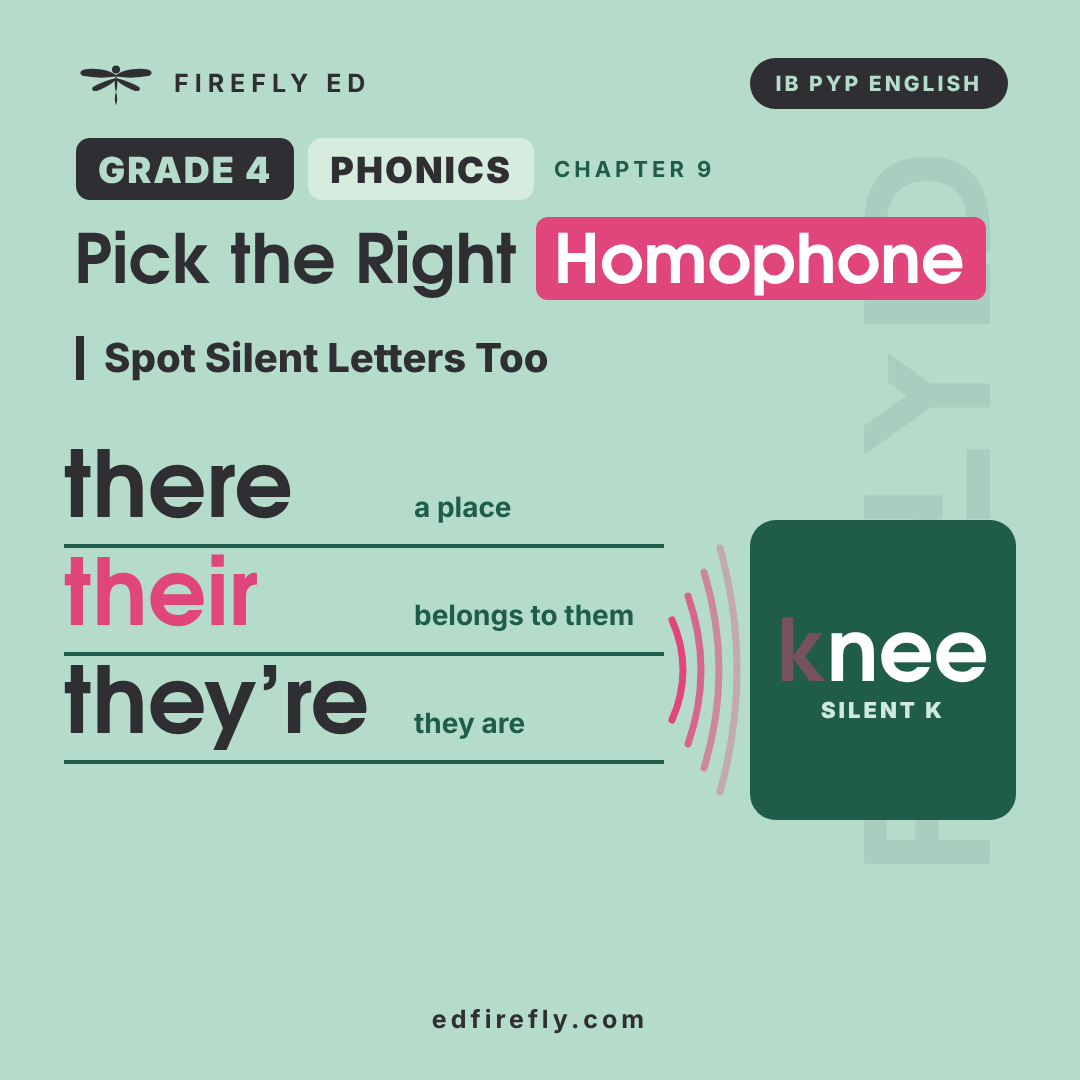
Some of the most common spelling mistakes are with small words that sound the same. Many of them have one word with an apostrophe (a contraction, a short form like they’re for they are) and one that shows who something belongs to.
See How It’s Done
Now Try It
1. to, too or two? I want to come ______! ______________
2. its or it’s? ______ a long way to the river. ______________
Time To Practise
Name: ______________________
1. to, too or two?
a) We went ______ the wildlife park. b) We saw ______ rhinos. c) It was ______ hot to walk far. d) My sister came ______.
2. there, their or they’re?
a) ______ building a new bridge for animals. b) Leave your bags over ______. c) The turtles lay ______ eggs on the beach.
3. its or it’s?
a) ______ time to go. b) The snow leopard wrapped ______ tail around ______ face. c) ______ been raining all day.
4. your/you’re and whose/who’s.
a) ______ going to love this film. b) Is this ______ notebook? c) ______ turn is it? d) ______ coming with us?
5. Proofread.
Find and fix five mistakes.
Their are far two few tigers left, and its our job to help. Their forests are shrinking, and your able to help two.
__________________________________________________________________
Reflect
Think about these questions. Talk about them with someone at home or at school.
1. Go back to the Wonder question: “Why do you think so many people mix up its and it’s?” What do you think now?
2. I was reflective today when I ______________________________.
Being reflective means looking back at your work and thinking how to make it better. For example: I was reflective today when I used the apostrophe test.
Take action: Look for mistakes with there, their and they’re on signs, menus or posters you see this week.
Next Steps
If this was easy, try: Write a short paragraph about an endangered animal that uses every word from the chart correctly.
If this was hard, go back to: Let’s Learn. For each apostrophe word, say it in full first. If the full form makes sense, use the apostrophe.
Notes for Parents and Teachers
Show notes for parents and teachers
These notes cover this lesson only. How every lesson runs is explained in How to Use This Material.
Let’s Learn
Read Let’s Learn aloud together. Read each group and its meanings together.
Answer Key
Reveal Answers
Now Try It
1. too 2. It’s
1. a) to b) two c) too d) too
2. a) They’re b) there c) their
3. a) It’s b) its, its c) It’s
4. a) You’re b) your c) Whose d) Who’s
5. There are far too few tigers left, and it’s our job to help. Their forests are shrinking, and you’re able to help too. (Their forests is already correct.)
Reflect
2. Any real moment from the lesson that shows the learner was reflective. Examples: “I was reflective today when I used the apostrophe test.” “I was reflective today when I proofread my writing for mixed-up words.”
Lesson 9.11: Silent Letters, and Tricky Words: Year Review | Phonics | About 20 minutes
Term 3 | Level 3
Goal
“I can spell words with silent letters, spell six new tricky words, and review tricky words from the whole year.”
Words to know
silent letter, tricky word, memory aid, review, proofread, dictation
Wonder
Think about this question before you start. Say your ideas. You will come back to it at the end of the lesson.
Why do you think some words have letters we do not say?
Let’s Learn
Some words have silent letters: letters we write but do not say. Many of them were once spoken, hundreds of years ago, but the way people say the words has changed. The spelling stayed the same.
These six words are often spelled wrongly. The tricky letters are in pink. Use the memory aid, then look, say, cover, write and check.
See How It’s Done
Now Try It
1. Which letter is silent? knee ____ island ____ autumn ____
2. Which tricky word has a double c? ______________
Time To Practise
Name: ______________________
1. Add the silent letter.
____nee is____and lam____ ____rist autum____ lis____en ____host si____n
2. Tricky words.
Look, say, cover, write, check. Write each word twice.
disastrous ______________ ______________ familiar ______________ ______________
neighbour ______________ ______________ interfere ______________ ______________
desperate ______________ ______________ occupy ______________ ______________
3. Year review.
These tricky words are from earlier chapters. Circle the correct spelling.
a) necessary / neccessary b) foriegn / foreign c) rhyme / ryhme d) environment / enviroment
e) committee / comittee f) recognise / recognice g) equipment / equiptment h) conscious / concious
4. Proofread.
Find and fix four mistakes: Our nieghbour told us about a disasterous flood. The animals were desprate to find dry land, and we must not interfear.
__________________________________________________________________
5. Write from dictation.
Listen as an adult reads a sentence aloud. Write it.
__________________________________________________________________
Reflect
Think about these questions. Talk about them with someone at home or at school.
1. Go back to the Wonder question: “Why do you think some words have letters we do not say?” What do you think now?
2. I was reflective today when I ______________________________.
Being reflective means looking back at your work and thinking how to make it better. For example: I was reflective today when I looked back at tricky words from the whole year.
Take action: Make a set of flashcards of the tricky words you still find hard, and test yourself each day for a week.
Next Steps
If this was easy, try: Write a short story about a wildlife rescue using eight silent-letter words and four tricky words.
If this was hard, go back to: Let’s Learn. Say each silent-letter word in a funny way, sounding the silent letter, to help you remember it.
Notes for Parents and Teachers
Show notes for parents and teachers
These notes cover this lesson only. How every lesson runs is explained in How to Use This Material.
Let’s Learn
Read Let’s Learn aloud together. Say each word together and notice the letter you cannot hear.
Time To Practise
- Task 5: Read the sentence from the Answer Key aloud slowly. The learner writes it.
Answer Key
Reveal Answers
Now Try It
1. k, s, n 2. occupy
1. knee, island, lamb, wrist, autumn, listen, ghost, sign
2. Look for: each word spelled correctly twice.
3. a) necessary b) foreign c) rhyme d) environment e) committee f) recognise g) equipment h) conscious
4. neighbour, disastrous, desperate, interfere
5. Write from dictation
Dictation sentence: Our neighbour knew the island well, and she was desperate to stop a disastrous fire.
Reflect
2. Any real moment from the lesson that shows the learner was reflective. Examples: “I was reflective today when I looked back at tricky words from the whole year.” “I was reflective today when I proofread for silent letters.”
For Teachers: IB Details
Show IB and curriculum details
IB theme: Sharing the planet. This theme is about the rights and responsibilities we have as we share the planet’s resources with other people and other living things.
Central idea: Human actions put many animals in danger, and people around the world work to protect them.
| Lesson | Title | Strand | Key concept |
|---|---|---|---|
| 9.9 | Homophones: past and passed, advice and advise | Reading and spelling | Connection |
| 9.10 | Words Often Mixed Up: to, too, two; there, their, they’re | Reading and spelling | Connection |
| 9.11 | Silent Letters, and Tricky Words: Year Review | Reading and spelling | Connection |
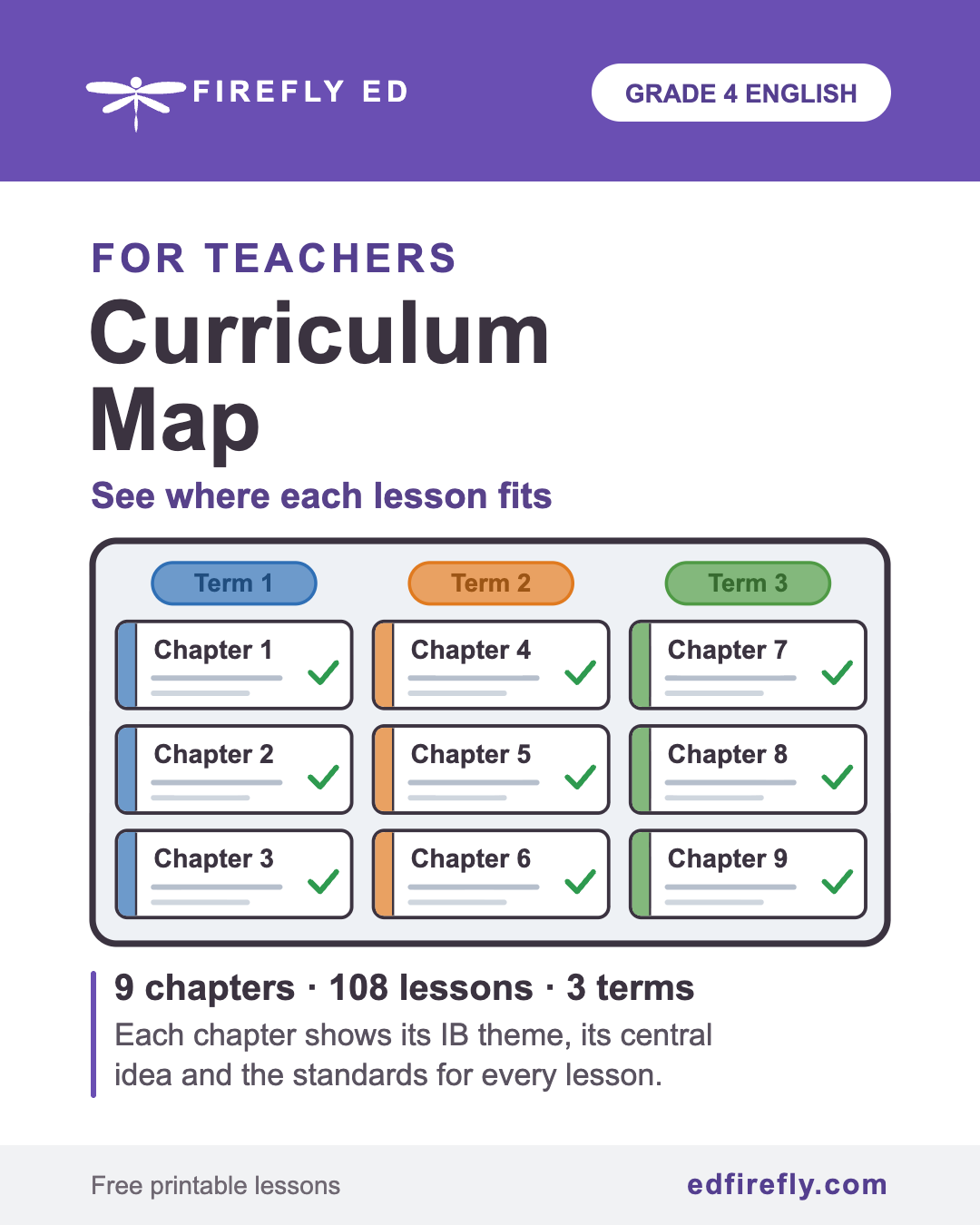
Each lesson also matches the national curriculum for England (Year 4) and the US Common Core (Grade 4). The Grade 4 Curriculum Map lists the full standards for every lesson.
← Back to Chapter 9 – Protecting Wildlife | Chapters – Index
© 2026 Firefly Ed. All rights reserved. This page may be printed for personal, home and classroom use. It may not be sold, shared online or reproduced for commercial use without written permission. edfirefly.com

Share your thoughts or ask something..