This page has the two listening and speaking lessons of Chapter 2, Explorers and Voyages: Lessons 2.5 and 2.6. The chapter page has the chapter overview, the chapter review and the PDF download.
Tap a lesson to open it. Tap the lesson title again, or use the link at the end of the lesson, to close it.
Lesson 2.5: Retell a Journey in Order | Oral | About 20 minutes
Term 1 | Level 1
Goal
“I can retell a journey in the right order, using time words and clear speech.”
Words to know
retell, sequence, beginning, middle, end, time word
Wonder
Think about this question before you start. Say your ideas. You will come back to it at the end of the lesson.
When you tell a friend about a trip, how do you help them follow the story?
Let’s Learn
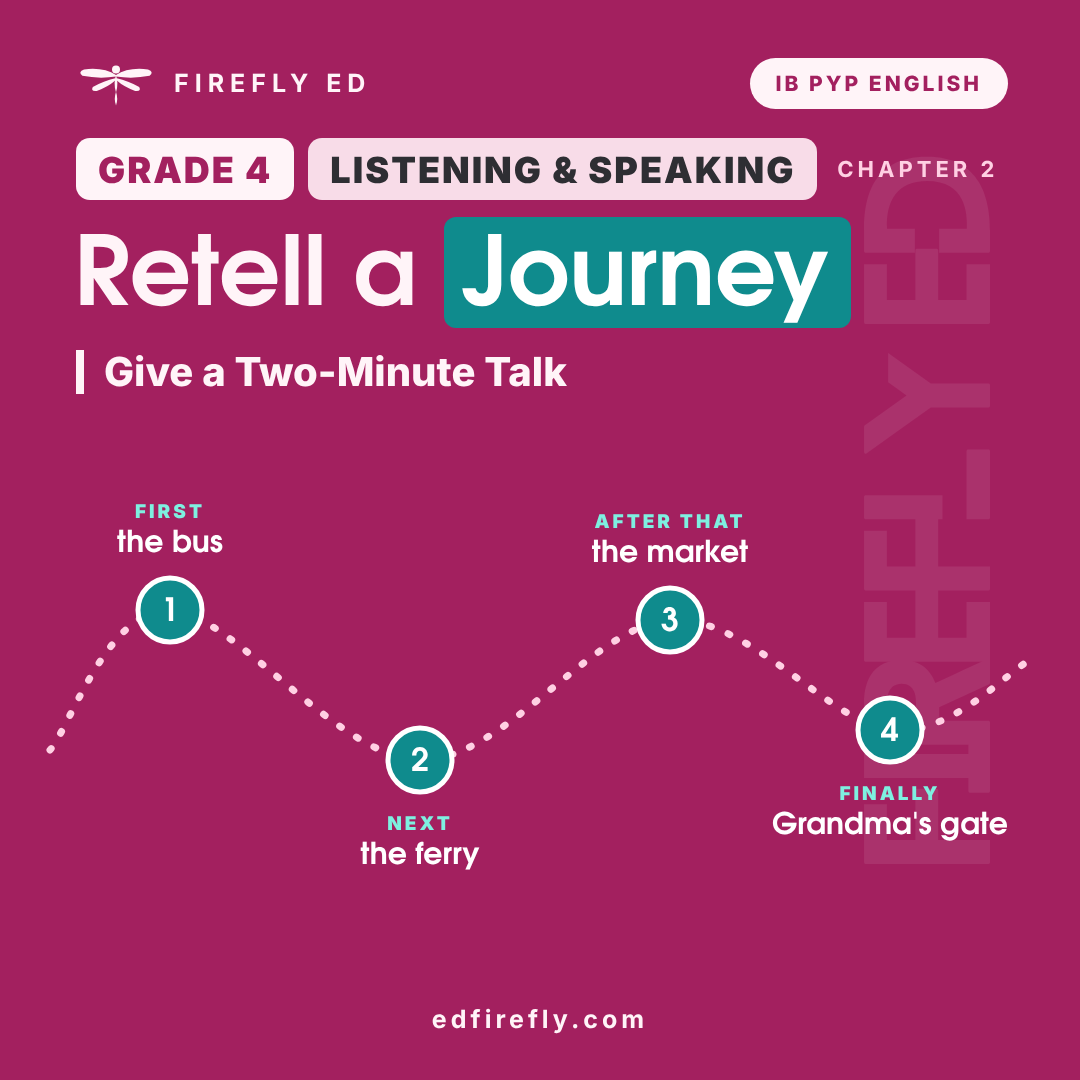
When you retell a journey, you tell the main events in the right sequence: beginning, middle and end. You do not need every word. You need the important events, in order.
Amara’s Journey to the Hills
Early on Saturday morning, Amara and her mum walked to the bus station with one bag each. The bus left at seven o’clock and wound along the coast road for two hours.
Next, they reached the river. There was no bridge, so they rode on a small ferry. Amara stood at the rail and watched the water rush past. A heron lifted off the bank as the ferry hooted.
After that, they climbed the hill path to the market. Amara chose a bag of oranges as a present. The path was steep, and her legs ached.
Finally, just before lunch, they saw Grandma waving from her gate. She hugged them both and said, “You came all that way to see me!” Amara gave her the oranges.
Speak clearly: look up from the page, speak at a steady speed, and pause after each event.
See How It’s Done
Model retelling: “First, Amara and her mum took the bus along the coast for two hours. Next, they crossed the river on a small ferry, and Amara saw a heron. After that, they climbed the hill path to the market, where Amara bought oranges. Finally, they reached Grandma’s house, and Amara gave her the oranges.”
Now Try It
1. What happened just before Amara reached the market?
Retell the journey to an adult, and use the checklist. Then retell a real journey you have made, in four events.
☐ The events are in the right order.
☐ I used a time word for each event.
☐ I gave one detail for each event.
☐ I spoke clearly, at a steady speed, and paused between events.
4. My own journey.
Write four short notes for a journey you have made. Then tell it aloud.
Think about these questions. Talk about them with someone at home or at school.
1. Go back to the Wonder question: “When you tell a friend about a trip, how do you help them follow the story?” What do you think now?
2. I was a communicator today when I ______________________________.
A communicator shares ideas clearly by talking, writing or drawing. For example: I was a communicator today when I retold the journey in order with time words.
Take action: Tell someone at home about your journey to school today in four events, using time words.
Next Steps
If this was easy, try: Retell the journey from Grandma’s point of view, starting when she saw them at the gate.
If this was hard, go back to: Let’s Learn. Look at the four pictures in order and say one sentence for each before you try the mixed-up pictures.
Notes for Parents and Teachers
Show notes for parents and teachers
These notes cover this lesson only. How every lesson runs is explained in How to Use This Material.
Let’s Learn
Read Amara’s journey aloud to the learner.
See How It’s Done
Read the model retelling aloud at a steady speed, so that the learner hears the pace.
Time To Practise
Task 3: Listen to the learner retell the journey, and use the checklist. Then ask the learner to retell a real journey they have made, in four events.
Answer Key
Reveal Answers
Now Try It
1. Amara and her mum crossed the river on a small ferry.
2. Finally (or At last, or In the end)
1. Put the pictures in order
C, D, B, A
2. Plan your retelling
Sample: First, the bus went along the coast for two hours. Next, the ferry crossed the river and a heron flew up. After that, Amara bought oranges at the market. Finally, Grandma waved from her gate.
3 and 4. Retell it aloud
Look for: four events in order, a time word for each, one detail each, and clear, steady speech.
Reflect
2. Any real moment from the lesson that shows the learner was a communicator. Examples: “I was a communicator today when I retold the journey in order with time words.” “I was a communicator today when I paused so my listener could follow.”
Lesson 2.6: Paraphrase and Report: A Two-Minute Explorer Talk | Oral | About 20 minutes
Term 1 | Level 1
Goal
“I can paraphrase what I hear in my own words, and give a short talk about an explorer.”
Words to know
paraphrase, key word, summary, report, audience, pace
Wonder
Think about this question before you start. Say your ideas. You will come back to it at the end of the lesson.
How can you tell someone what you heard, without repeating every word?
Let’s Learn
To paraphrase means to say something in your own words. A paraphrase keeps the same meaning and the same facts, but it is usually shorter and simpler.
Listen as an adult reads this talk aloud. Do not look at the words. Then note the key words.
Talk: Two Climbers on the Roof of the World
Mount Everest is the highest mountain on Earth. For many years, climbers tried to reach the top, but the cold, the wind and the thin air turned them back.
In 1953, a large team set out to try again. Two climbers from the team made the final climb. One was Tenzing Norgay, a Sherpa mountaineer who lived in the Himalayas and had climbed on Everest several times before. The other was Edmund Hillary, a beekeeper and climber from New Zealand.
On 29 May 1953, Tenzing Norgay and Edmund Hillary stood on the summit of Everest. They were the first people known to reach the top. They stayed for only about fifteen minutes, because their oxygen was running low. Tenzing left small gifts of food in the snow, and Hillary took photographs.
Their climb showed that the top of the world could be reached. Since then, thousands of climbers have followed them.
See How It’s Done
The speaker said: “On 29 May 1953, Tenzing Norgay and Edmund Hillary stood on the summit of Everest. They were the first people known to reach the top.”
Now Try It
1. Paraphrase this sentence: The cold, the wind and the thin air turned them back.
Closing: why the journey matters ___________________________________
4. Give your talk.
Give your talk to an adult. It should last about two minutes. Afterwards, the adult says one thing you said in their own words. Tell them whether they got it right.
☐ I used my own words.
☐ My facts were correct.
☐ I spoke clearly and not too fast.
☐ I looked at my audience.
Reflect
Think about these questions. Talk about them with someone at home or at school.
1. Go back to the Wonder question: “How can you tell someone what you heard, without repeating every word?” What do you think now?
2. I was a communicator today when I ______________________________.
A communicator shares ideas clearly by talking, writing or drawing. For example: I was a communicator today when I said the facts again in my own words.
Take action: Listen to a short news item or a weather report with an adult. Paraphrase it in two sentences.
Next Steps
If this was easy, try: Paraphrase the talk for a younger child, using even simpler words.
If this was hard, go back to: Let’s Learn. Listen to the talk again, one paragraph at a time, and write one key word after each paragraph.
Notes for Parents and Teachers
Show notes for parents and teachers
These notes cover this lesson only. How every lesson runs is explained in How to Use This Material.
Let’s Learn
Read the talk aloud to the learner once, at a steady speed.
Read the talk aloud once, at a steady speed. The learner listens without looking, then notes key words.
Time To Practise
Task 4: Time the talk: about two minutes. Afterwards, paraphrase one thing the learner said, and ask the learner whether you got it right.
Answer Key
Reveal Answers
Now Try It
1. Sample answer: The weather was too cold and windy, and there was not enough air, so they had to go back down.
2. b)
1. Key words
Any four of: Everest, highest mountain, 1953, Tenzing Norgay, Sherpa, Edmund Hillary, New Zealand, 29 May, summit, fifteen minutes, oxygen.
2. Paraphrase
a) Tenzing Norgay, a Sherpa climber from the Himalayas, and Edmund Hillary, a climber from New Zealand.
b) They became the first people known to reach the top of Everest.
c) It showed that people could reach the top of the world, and many climbers have followed them.
3 and 4. Plan and give a talk
Look for: an opening, three correct facts in the learner’s own words, a closing, clear speech and eye contact.
Reflect
2. Any real moment from the lesson that shows the learner was a communicator. Examples: “I was a communicator today when I said the facts again in my own words.” “I was a communicator today when I gave a clear talk to my audience.”
IB theme: Where we are in place and time. This theme is about when and where things happen, how people lived in the past, and how discoveries and journeys have shaped the world.
Central idea: Explorers travel for different reasons, and their journeys change what people know about the world.
Each lesson also matches the national curriculum for England (Year 4) and the US Common Core (Grade 4). The Grade 4 Curriculum Map lists the full standards for every lesson.


Share your thoughts or ask something..