
Term 2 | Level 2 | Phonics focus: word endings: -cious, -tious, -cial and -tial
Chapter 4 – Our Changing Earth | Chapters – Index
Lessons
This page has the two listening and speaking lessons of Chapter 4, Our Changing Earth: Lessons 4.5 and 4.6. The chapter page has the chapter overview, the chapter review and the PDF download.
Tap a lesson to open it. Tap the lesson title again, or use the link at the end of the lesson, to close it.
Lesson 4.5: Listen for Reasons and Evidence | Oral | About 20 minutes
Term 2 | Level 2
Goal
“I can listen to a talk and name the speaker’s claim, reasons and evidence.”
Words to know
claim, reason, evidence, persuade, speaker, listener
Wonder
Think about this question before you start. Say your ideas. You will come back to it at the end of the lesson.
When someone tries to persuade you, how do you decide whether to agree?
Let’s Learn
Listen as an adult reads the talk aloud. Do not look at the words.
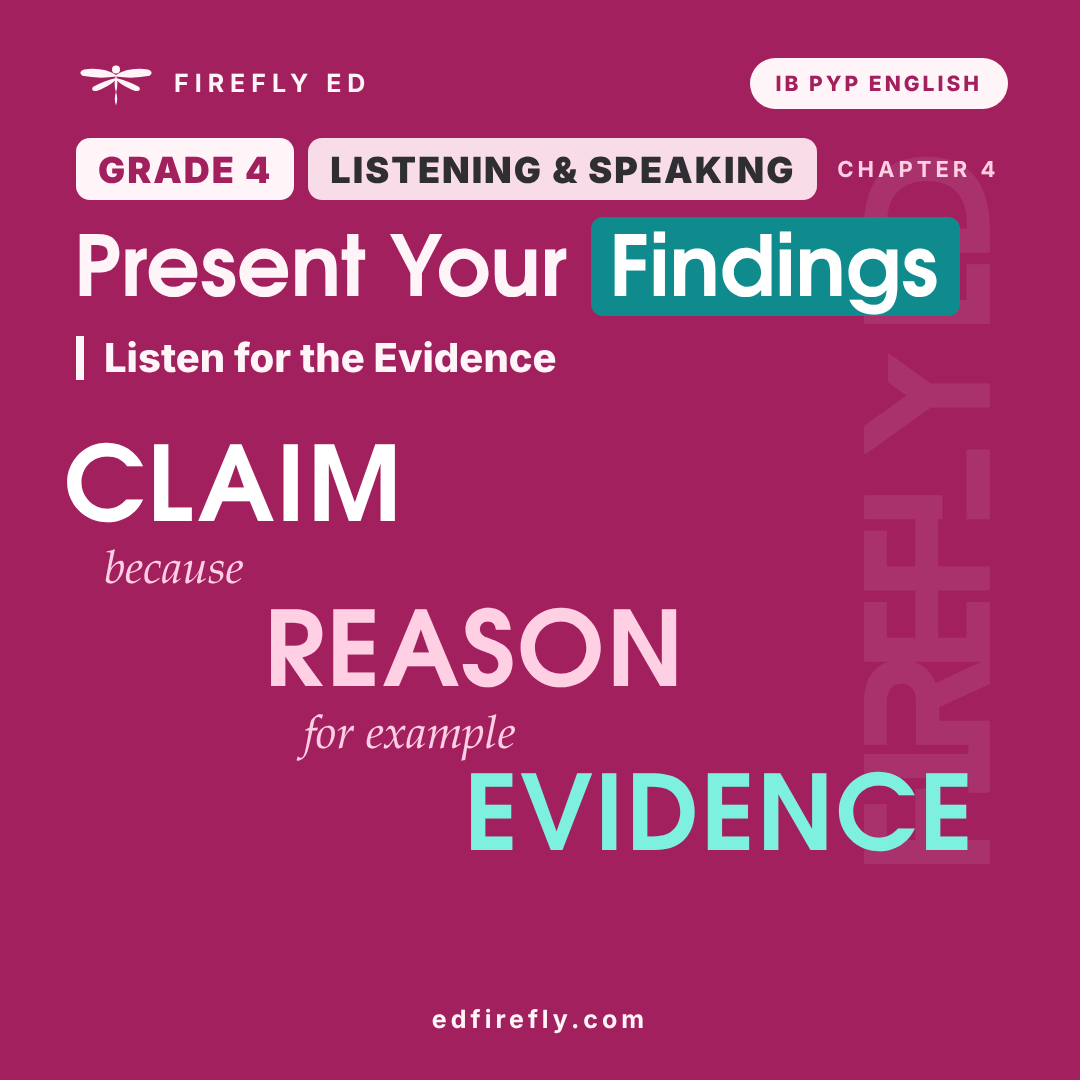
When a speaker wants to persuade you, they make a claim. A good speaker gives reasons for the claim, and backs up each reason with evidence, such as facts, examples or advice from experts.
A careful listener asks: What is the claim? What are the reasons? Is there evidence for each reason?
A talk by Dr Reyes, a scientist who studies earthquakes
“Good morning, everyone. Today I want to persuade you that every family should have an emergency bag ready at home.
My first reason is that after a big earthquake, everyday things can stop working. Water pipes can break, and shops may close. For example, after strong earthquakes, some towns have had no running water for several days.
My second reason is that you may need to leave home quickly. There is no time to search for a torch or a water bottle when you have to go outside straight away. A bag that is already packed by the door saves time.
My third reason is that it is easy and cheap to do. Emergency services in many countries advise keeping enough water and food for at least three days. You can fill a bag with things you already have: bottles of water, tinned food, a torch, spare batteries and a first-aid kit.
So please, go home tonight and pack a bag with your family. It might be the most useful bag you ever pack. Thank you.”
See How It’s Done
Now Try It
1. What is the speaker’s second reason?
__________________________________________________________________
2. Which piece of evidence comes from experts?
__________________________________________________________________
Hint: Listen again to the third reason.
Time To Practise
Name: ______________________
1. Listen and note.
Listen as an adult reads the talk again. Fill in the table without reading the words.
| Part | What the speaker said |
|---|---|
| Claim | |
| Reason 1 | |
| Evidence for reason 1 | |
| Reason 2 | |
| Reason 3 | |
| Evidence for reason 3 |
2. Reason or evidence?
Write R for a reason or E for evidence.
a) You may need to leave home quickly. ____
b) Experts advise keeping food and water for at least three days. ____
c) Some towns have had no running water for several days. ____
d) It is easy and cheap to do. ____
3. Signal words.
Which words helped you hear when a new reason started? ______________________________
4. Judge the talk.
Which reason had the strongest evidence? Explain your choice.
__________________________________________________________________
Which reason did not have much evidence? __________________________________
5. Ask a question.
Write one question you would like to ask Dr Reyes after her talk.
__________________________________________________________________
Reflect
Think about these questions. Talk about them with someone at home or at school.
1. Go back to the Wonder question: “When someone tries to persuade you, how do you decide whether to agree?” What do you think now?
2. I was a thinker today when I ______________________________.
A thinker thinks carefully to work things out. For example: I was a thinker today when I checked whether each reason had evidence.
Take action: Talk with your family about the three reasons in the talk. Decide together whether to pack an emergency bag.
Next Steps
If this was easy, try: Write a short talk of your own to persuade your class to do something. Give three reasons and evidence for at least two of them.
If this was hard, go back to: Let’s Learn. Listen to one paragraph of the talk at a time, and say the reason in your own words after each one.
Notes for Parents and Teachers
Show notes for parents and teachers
These notes cover this lesson only. How every lesson runs is explained in How to Use This Material.
Let’s Learn
Read the talk aloud to the learner, who listens without looking at the words.
Time To Practise
- Task 1: Read the talk aloud again. The learner listens and fills in the table without reading the words.
Answer Key
Reveal Answers
Now Try It
1. You may need to leave home quickly, and a packed bag saves time. 2. Emergency services in many countries advise keeping enough water and food for at least three days.
1. Listen and note
Claim: every family should have an emergency bag ready at home. Reason 1: after a big earthquake, everyday things can stop working. Evidence: some towns have had no running water for several days. Reason 2: you may need to leave home quickly. Reason 3: it is easy and cheap to do. Evidence: emergency services advise keeping water and food for at least three days, and you can use things you already have.
2. Reason or evidence?
a) R b) E c) E d) R
3. Signal words
My first reason, My second reason, My third reason
4. Judge the talk
Answers will vary. Sample answer: Reason 3 had the strongest evidence, because it came from emergency services. Reason 2 had less evidence; it was an explanation, not a fact or an example.
5. Ask a question
Sample answer: What should a family do with the bag once a year?
Reflect
2. Any real moment from the lesson that shows the learner was a thinker. Examples: “I was a thinker today when I checked whether each reason had evidence.” “I was a thinker today when I decided which reason was strongest and explained why.”
Lesson 4.6: Present Your Findings With a Visual Display | Oral | About 20 minutes
Term 2 | Level 2
Goal
“I can present what I found out, speaking clearly and using a visual display to help my audience understand.”
Words to know
present, findings, visual display, audience, eye contact, pace
Wonder
Think about this question before you start. Say your ideas. You will come back to it at the end of the lesson.
Why do presenters often show a picture, a chart or a slide while they talk?
Let’s Learn
When you present your findings, you tell an audience what you found out. A visual display, such as a poster, a diagram, a chart or a slide, helps your audience see what you mean.
A good visual display: has a clear title; shows the main ideas with a picture, a diagram or a chart; uses only a few words; is big enough for everyone to see.
A good presenter: faces the audience and makes eye contact; speaks clearly at a steady pace; points to the display at the right moment; ends by asking for questions.
Ava’s presentation: “Good evening. I found out how a river changes the land. Look at my diagram. Here, high in the mountains, the fast water wears away the rock and makes a waterfall. Here, in the middle, the river makes big bends. And here, at the sea, it drops sand and mud and builds new land called a delta. Thank you for listening. Does anyone have a question?”
See How It’s Done
Now Try It
1. Find two phrases Ava uses to point her audience to the display.
__________________________________________________________________
2. How does Ava end her presentation?
__________________________________________________________________
Time To Practise
Name: ______________________
1. Choose your topic.
Choose something you found out in this chapter: how a volcano erupts, how a river changes the land, two volcano legends, or how to stay safe in an earthquake.
My topic: ______________________________________________________
2. Plan three main ideas.
| Main idea | What I will show on my display |
|---|---|
| 1. | |
| 2. | |
| 3. |
3. Make your display.
Make a poster or draw a slide. Give it a title, one picture or diagram for each main idea, and only a few words.
4. Write your cue cards.
Write key words for each part. Do not write every word.
Opening: ________________________ Idea 1: ________________________
Idea 2: ________________________ Idea 3: ________________________ Ending: ________________________
5. Present.
Present for about two minutes to your family or class.
An adult watches and ticks each one they see or hear:
☐ a clear opening ☐ three main ideas ☐ pointed to the display at the right time ☐ eye contact ☐ steady pace ☐ asked for questions
Reflect
Think about these questions. Talk about them with someone at home or at school.
1. Go back to the Wonder question: “Why do presenters often show a picture, a chart or a slide while they talk?” What do you think now?
2. I was a communicator today when I ______________________________.
A communicator shares ideas clearly by talking, writing or drawing. For example: I was a communicator today when I pointed to my display as I explained each idea.
Take action: Present your display to someone who did not study this topic, and ask them to tell you one thing they learned.
Next Steps
If this was easy, try: Make a slide version of your display and present it again, adding one more fact you found out.
If this was hard, go back to: Let’s Learn. Read Ava’s presentation aloud while you point to each part of the picture.
Notes for Parents and Teachers
Show notes for parents and teachers
These notes cover this lesson only. How every lesson runs is explained in How to Use This Material.
Let’s Learn
Look at the picture together.
Time To Practise
- Task 5: Tick each one you see or hear while the learner presents.
Answer Key
Reveal Answers
Now Try It
1. Any two of: “Look at my diagram”, “Here, high in the mountains”, “Here, in the middle”, “And here, at the sea”. 2. She thanks the audience and asks whether anyone has a question.
1 to 5. Answers will vary. Look for: three clear main ideas, a display with a title and a picture or diagram for each idea, cue cards with key words only, and at least four ticks in task 5.
Reflect
2. Any real moment from the lesson that shows the learner was a communicator. Examples: “I was a communicator today when I pointed to my display as I explained each idea.” “I was a communicator today when I looked at my audience and spoke at a steady pace.”
For Teachers: IB Details
Show IB and curriculum details
IB theme: How the world works. This theme is about the natural world and its laws, how people and nature affect each other, and how people use science to understand the world.
Central idea: Forces inside the Earth and on its surface change the land, and people can prepare for those changes.
| Lesson | Title | Strand | Key concept |
|---|---|---|---|
| 4.5 | Listen for Reasons and Evidence | Listening | Responsibility |
| 4.6 | Present Your Findings With a Visual Display | Speaking | Change |
Each lesson also matches the national curriculum for England (Year 4) and the US Common Core (Grade 4). The Grade 4 Curriculum Map lists the full standards for every lesson.
← Back to Chapter 4 – Our Changing Earth | Chapters – Index
© 2026 Firefly Ed. All rights reserved. This page may be printed for personal, home and classroom use. It may not be sold, shared online or reproduced for commercial use without written permission. edfirefly.com


Share your thoughts or ask something..