
Term 1 | Level 1 | Phonics focus: syllable patterns: dividing words in the middle, open and closed syllables, and consonant-le endings
Chapter 1 – Rights and Responsibilities | Chapters – Index
Lessons
This page has the two listening and speaking lessons of Chapter 1, Rights and Responsibilities: Lessons 1.5 and 1.6. The chapter page has the chapter overview, the chapter review and the PDF download.
Tap a lesson to open it. Tap the lesson title again, or use the link at the end of the lesson, to close it.
Lesson 1.5: Come Prepared: Rules and Roles for a Discussion | Oral | About 20 minutes
Term 1 | Level 1
Goal
“I can prepare for a discussion, follow the rules and carry out a role.”
Words to know
discussion, prepare, rule, role, leader, timekeeper, note-taker, reporter
Wonder
Think about this question before you start. Say your ideas. You will come back to it at the end of the lesson.
What can you do before a discussion so that you have something useful to say?
Let’s Learn
A discussion is a talk in which people share ideas about a topic and listen to each other. A good discussion needs three things: preparation, rules and roles.
Prepare. Read or find out about the topic before the discussion. Then make a note card. Write a fact you know, your opinion with a reason, and a question you would like to ask. During the discussion, use your notes to explain your ideas.
Follow the rules. The group agrees on rules so that everyone can speak and be heard.
Carry out a role. A role is a job in the group. Each person takes one, so the discussion runs smoothly.
See How It’s Done
The discussion topic is: Should pupils help to make school rules?
Now Try It
1. A group member says: We should have a class vote on new rules. Say aloud a sentence that builds on this idea. Start with: ‘I agree with … and I would add …’
Hint: Add a new idea, such as who counts the votes or when to vote.
2. Which role would you like to take in a discussion: leader, timekeeper, note-taker or reporter? Tell the adult why.
Hint: Think about what you are good at.
Time To Practise
Name: ______________________
1. Prepare for a discussion.
The topic is: Should every school ask its pupils for their ideas before it changes a rule?
Use this fact from Article 12 of the Convention: Children have the right to give their opinions freely on issues that affect them. Adults should listen and take children seriously.
| My note card | Write here |
|---|---|
| A fact I know | |
| My opinion and a reason I think … because … |
|
| A question to ask | |
2. Match each role to its job.
Write the letter next to each role.
____ Leader ____ Timekeeper ____ Note-taker ____ Reporter
A. Writes down the key ideas.
B. Tells the class what the group said.
C. Tells the group when time is nearly up.
D. Starts the talk and makes sure everyone has a turn.
3. Read the discussion. Answer the questions.
Priya (leader): Our question is: should pupils help to make school rules? Aisha, would you like to start?
Aisha: I think they should, because Article 12 says that children have the right to give their opinions on issues that affect them.
Tom: Did anyone see the football match last night? It was amazing.
Priya: Tom, please stay on our topic. Mina, what do you think?
Mina: I agree with Aisha, and I would add that pupils know which rules are hard to follow.
a) Which rule did Tom break?
__________________________________________________________________
b) How did Priya help the group?
__________________________________________________________________
c) How did Mina build on what Aisha said?
__________________________________________________________________
d) Which speaker used a fact from reading? How do you know?
__________________________________________________________________
4. Join the discussion.
A pupil says: Pupils should not help to make rules, because teachers know best.
Sentence starters: I see it differently because … I agree that … but … Could you give an example?
Write a polite reply that disagrees and gives a reason.
__________________________________________________________________
__________________________________________________________________
Write a reply that agrees with part of the idea and adds your own.
__________________________________________________________________
__________________________________________________________________
5. Hold a short discussion.
Hold a discussion of about five minutes on the topic in Task 1, using your note card. If only two of you are there, take turns to be the leader and the speaker. Afterwards, tick the boxes below.
☐ I came prepared with notes.
☐ I waited for my turn and listened to the speaker.
☐ I stayed on the topic.
☐ I built on someone else’s idea.
☐ I disagreed politely, or I could have.
☐ I carried out my role.
Reflect
Think about these questions. Talk about them with someone at home or at school.
1. Go back to the Wonder question: “What can you do before a discussion so that you have something useful to say?” What do you think now?
2. I was principled today when I ______________________________.
Being principled means being fair and honest and doing the right thing. For example: I was principled today when I waited for my turn and listened to the speaker.
Take action: At a family meal, suggest a topic for a short discussion, such as where to go at the weekend. Ask everyone to share one idea and to listen to each other.
Next Steps
If this was easy, try: Choose a topic you care about. Prepare a note card for it, and ask a friend or adult to hold a five-minute discussion with you.
If this was hard, go back to: Let’s Learn. Look at the note card and the five rules again. Prepare a note card for a simple topic, such as your favourite game, and say your opinion with a reason before you try Task 1 again.
Notes for Parents and Teachers
Show notes for parents and teachers
These notes cover this lesson only. How every lesson runs is explained in How to Use This Material.
Time To Practise
- Task 5: Join the discussion. If only two people are there, take turns to be the leader and the speaker, and you can also be the timekeeper. The learner uses their note card and ticks the boxes afterwards.
Answer Key
Reveal Answers
Now Try It
1. Sample answer: I agree with the class vote, and I would add that we should vote at the start of the term so that everyone has time to think.
2. Any role, with a reason. For example: I would like to be the timekeeper because I like to keep things on time.
1. Prepare for a discussion
Sample answers: Fact: Article 12 says that children have the right to give their opinions on issues that affect them. Opinion: I think every school should ask pupils, because pupils know which rules are hard to follow. Question: How could a school collect pupils’ ideas?
Look for: a fact that comes from the text, an opinion with ‘because’, and an open question.
2. Match each role to its job
Leader: D Timekeeper: C Note-taker: A Reporter: B
3. Read the discussion
a) He did not stay on the topic. He talked about a football match.
b) She acted as leader. She reminded Tom to stay on the topic and invited Mina to speak, so everyone had a turn.
c) She said she agreed with Aisha and added a new idea: pupils know which rules are hard to follow.
d) Aisha. She said that Article 12 says that children have the right to give their opinions on issues that affect them.
4. Join the discussion
Sample answers: I see it differently because pupils are in the classroom and playground every day, so they know what works. / I agree that teachers know a lot, but pupils could share ideas about rules that affect them, and teachers could still make the final choice.
Look for: polite words, no unkind words, and a reason.
5. Hold a short discussion
Look for: ticks that match what the adult saw. If a box was not ticked, choose that rule to practise in the next discussion.
Reflect
2. Any real moment from the lesson that shows the learner was principled. Examples: “I was principled today when I waited for my turn and listened to the speaker.” “I was principled today when I stayed on the topic when the group talked about rules.”
Lesson 1.6: Ask and Follow Up: Rights and Responsibilities at School | Oral | About 20 minutes
Term 1 | Level 1
Goal
“I can ask open questions and follow up on what a speaker says to find out more.”
Words to know
question, open question, closed question, follow-up question, clarify, interview
Wonder
Think about this question before you start. Say your ideas. You will come back to it at the end of the lesson.
How can a good question help us learn more than we expected?
Let’s Learn
Asking good questions helps us to learn from other people. There are two main kinds of question.
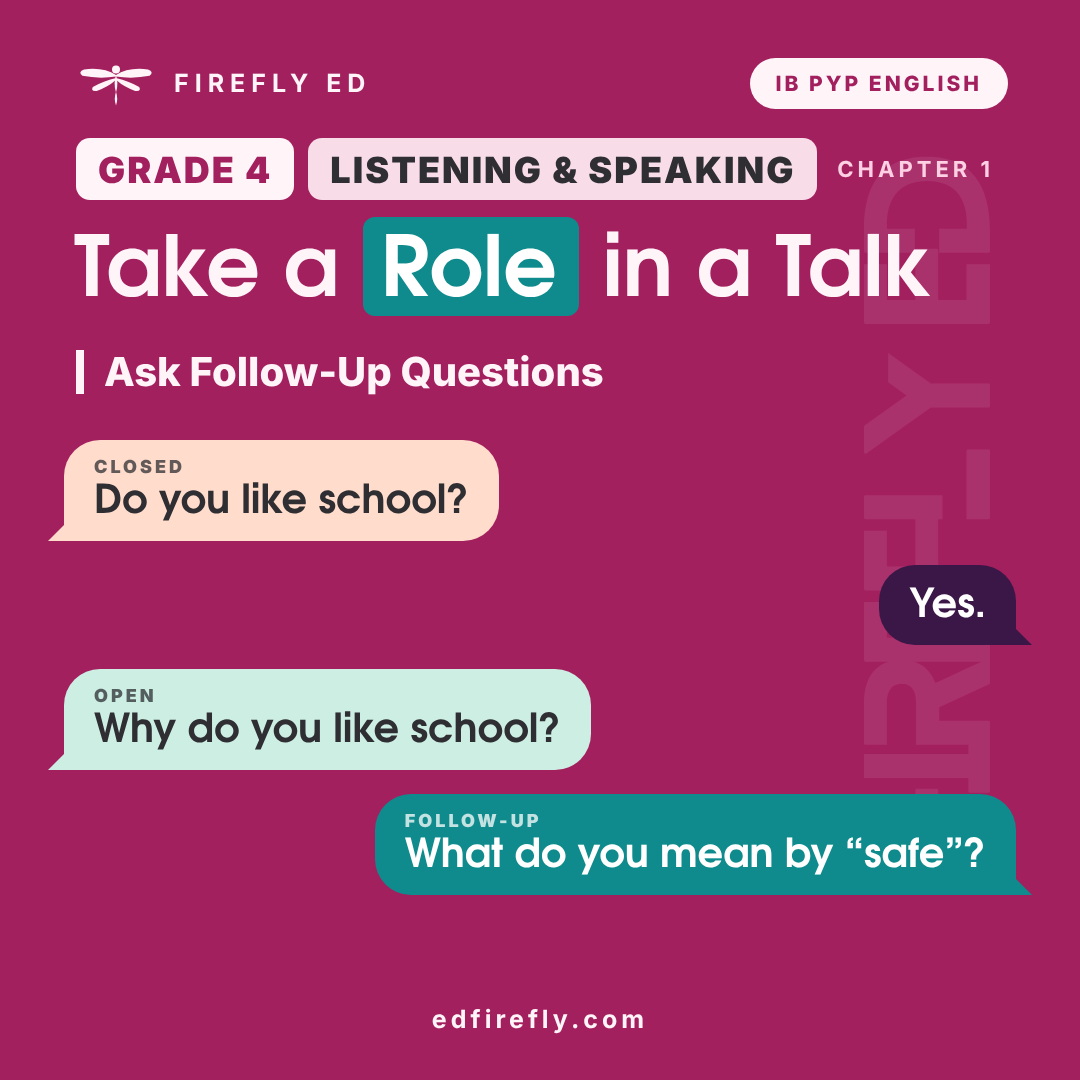
- A closed question can be answered with ‘yes’, ‘no’ or one word. Do you like school?
- An open question needs a longer answer with ideas and reasons. It often starts with ‘what’, ‘why’, ‘how’ or ‘tell me about’. Why do you like school?
A follow-up question comes after someone has answered. To ask one, listen carefully and choose a word or an idea from the answer. Then ask for more. Following up shows the speaker that you are listening, and it helps you to clarify, which means to make something clearer.
School helpers do many jobs that protect children’s rights. You can ask them about their responsibilities in an interview.
See How It’s Done
Interview with the school librarian
Pupil: Do you like your job?
Librarian: Yes.
Pupil: What do you do to help children enjoy reading?
Librarian: I help children find books they like. I also keep the books safe, so everyone can use them.
Pupil: Why does keeping the books safe matter?
Librarian: If a book is torn or lost, the next child cannot read it.
Now Try It
1. Is this question open or closed? Do you eat lunch at school? Change it into an open question.
Hint: An open question starts with what, why or how.
2. A cook says: I make sure the food is healthy and fresh. Say a follow-up question aloud.
Hint: Choose a word such as ‘healthy’ and ask for an example.
Time To Practise
Name: ______________________
1. Open or closed?
Write O for an open question or C for a closed question.
____ a) Is the library open on Fridays?
____ b) How do you decide which books to buy?
____ c) Do you work at the school every day?
____ d) Why is it important to keep the playground clean?
____ e) Can children borrow books?
____ f) What happens if a child feels ill at school?
2. Make the question open.
Rewrite each closed question as an open question.
Hint: Try starting with what, why or how.
a) Do you like cooking?
__________________________________________________________________
b) Is your job hard?
__________________________________________________________________
c) Do children help you?
__________________________________________________________________
3. Write a follow-up question.
Read each answer. Choose a word or idea in it. Write one follow-up question.
a) The nurse says: I make sure that every child who feels unwell gets help quickly.
__________________________________________________________________
b) The caretaker says: I keep the building clean and safe for everyone.
__________________________________________________________________
c) The teacher says: Every child has the right to learn, so I listen to all of their ideas.
__________________________________________________________________
4. Plan an interview.
Choose a school helper: a teacher, librarian, cook, nurse or caretaker. Write three open questions about their job and the right that they help to protect.
Starters: What do you do to help … ? Why is … important? How do you … ?
Helper: ______________________________
1. __________________________________________________________
2. __________________________________________________________
3. __________________________________________________________
5. Hold the interview.
Interview an adult, who plays the school helper. Ask your questions from Task 4 and at least one follow-up question. Then tick the boxes.
☐ I asked open questions.
☐ I listened to the answers.
☐ I asked at least one follow-up question.
☐ I used a word or idea from the answer.
☐ I thanked the speaker.
Reflect
Think about these questions. Talk about them with someone at home or at school.
1. Go back to the Wonder question: “How can a good question help us learn more than we expected?” What do you think now?
2. I was open-minded today when I ______________________________.
Being open-minded means listening to other ideas and other ways of doing things. For example: I was open-minded today when I listened to the answer and asked a question about it.
Take action: Ask someone at home about their work or their day, using one open question. Listen to the answer and ask one follow-up question.
Next Steps
If this was easy, try: Interview a family member or a neighbour about a job they do. Ask five open questions and two follow-up questions. Write down the most interesting answer.
If this was hard, go back to: Let’s Learn. Look at the follow-up questions again. Take one sentence from Task 3, underline a word you want to know more about and ask for an example.
Notes for Parents and Teachers
Show notes for parents and teachers
These notes cover this lesson only. How every lesson runs is explained in How to Use This Material.
Time To Practise
- Task 5: Take the part of the school helper. Answer in two or three sentences, so there is something to follow up on.
Answer Key
Reveal Answers
Now Try It
1. Closed. Sample open question: What do you eat for lunch at school, and why? / How does lunch at school help you?
2. Sample answers: What makes food healthy? Can you give an example of fresh food? How do you check that the food is fresh?
1. Open or closed?
a) C b) O c) C d) O e) C f) O
2. Make the question open
Sample answers:
a) What do you like about cooking?
b) Why is your job hard? / What is hard about your job?
c) How do children help you?
3. Write a follow-up question
Sample answers:
a) What do you do first when a child feels unwell? / Why is it important to help quickly?
b) How do you keep the building safe? / Can you give an example of something that is not safe?
c) How do you listen to all of the children’s ideas? / Why do you think listening matters?
Look for: a question that uses a word or idea from the answer and needs more than ‘yes’ or ‘no’.
4. Plan an interview
Sample answers for a librarian: 1. What do you do to help children enjoy reading? 2. Why is it important for children to have books? 3. How do you decide which books to buy?
Look for: three open questions linked to the helper’s job and the right it protects.
5. Hold the interview
Look for: ticks that match what the adult heard. If a box was not ticked, practise it in the next conversation.
Reflect
2. Any real moment from the lesson that shows the learner was open-minded. Examples: “I was open-minded today when I listened to the answer and asked a question about it.” “I was open-minded today when I asked someone to explain an idea that was new to me.”
For Teachers: IB Details
Show IB and curriculum details
IB theme: Who we are. It covers our bodies and feelings, our families and friends, where we belong, our rights and responsibilities, and how we learn and grow.
Central idea: Every child has rights, and everyone shares the responsibility to respect them.
| Lesson | Title | Strand | Key concept |
|---|---|---|---|
| 1.5 | Come Prepared: Rules and Roles for a Discussion | Listening and speaking | Responsibility |
| 1.6 | Ask and Follow Up: Rights and Responsibilities at School | Listening and speaking | Connection |
Each lesson also matches the national curriculum for England (Year 4) and the US Common Core (Grade 4). The Grade 4 Curriculum Map lists the full standards for every lesson.
← Back to Chapter 1 – Rights and Responsibilities | Chapters – Index
© 2026 Firefly Ed. All rights reserved. This page may be printed for personal, home and classroom use. It may not be sold, shared online or reproduced for commercial use without written permission. edfirefly.com

Share your thoughts or ask something..