
Term 2 | Level 2 | Phonics focus: igh/ie, ar, or, er/ir/ur, compound words
Lesson 6 – Signs, Maps and Journeys | Lessons – Index
Lessons
This page has the two writing lessons in Lesson 6, Signs, Maps and Journeys: Lessons 6.3 and 6.4. The Lesson 6 page has the Lesson 6 overview, the Lesson 6 review and the PDF download.
Select a lesson to go straight to it. Each lesson ends with a link back to the top of the page.
Lesson 6.3: Directions to My House
Writing | About 20 minutes
Term 2 | Level 2
Goal
“I can write direction sentences that tell someone how to get to a place.”
Words to know
directions, left, right, straight, map
Wonder
Think about this question before you start. Say your ideas. You will come back to it at the end of the lesson.
How can words help someone find a place they have never been?
Let’s Learn
Directions tell someone how to get to a place. Each direction is a short sentence that starts with an action word.
We use words like go straight, turn left, turn right and stop.
We also name a place to look for, such as at the shop or next to the park. This helps the person know where to turn.
See How It’s Done
Now Try It
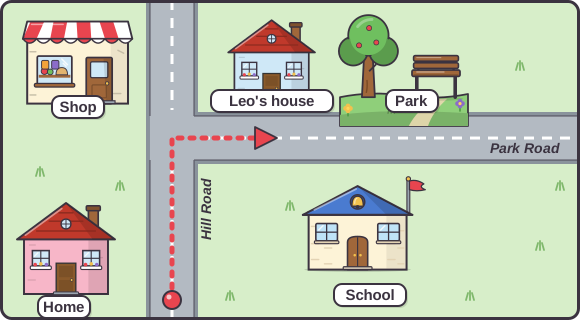
Use the same map. Now you walk the red dotted line from Home to Leo’s house.
1. From Home, which way do you go on Hill Road? Finish the sentence: “Go ______ up Hill Road.”
Hint: Follow the red line with your finger. Does it bend at first?
2. At the shop, which way do you turn? Finish the sentence: “Turn ______ at the shop.”
Hint: Stand up and face the way you are walking. Then point the way the red line goes.
Time To Practise
Name: ______________________
1. Which way?
Write left, right or straight for each arrow.
a) ____________ b) ____________ c) ____________ d) ____________
2. Write the directions.
Look at the map again. Write three sentences that tell someone how to walk from Home to Leo’s house.
Word bank: Hill Road | Park Road | shop | park
1. ______________________________________________
2. ______________________________________________
3. ______________________________________________
3. Directions to my house.
Draw a simple map from a place you know, such as a park or a shop, to your home. Then write three direction sentences.
1. ______________________________________________
2. ______________________________________________
3. ______________________________________________
Reflect
Think about these questions. Talk about them with someone at home or at school.
1. Go back to the Wonder question: “How can words help someone find a place they have never been?” What do you think now?
2. I was a communicator today when I ______________________________.
A communicator shares ideas clearly by talking, writing or drawing. For example: I was a communicator today when I wrote clear directions to a house.
Take action: Give your directions to an adult. Walk the way together and check if the words work.
Next Steps
If this was easy, try: Write directions from your home to a friend’s home. Ask an adult to follow them on a map.
If this was hard, go back to: Let’s Learn. Stand up and practise turning left and right. Then write one direction sentence at a time, using the map.
Notes for Parents and Teachers
Show notes for parents and teachers
These notes cover this lesson only. How every lesson runs is explained in How to Use This Material.
Let’s Learn
Point to each arrow and act it out with your arm.
See How It’s Done
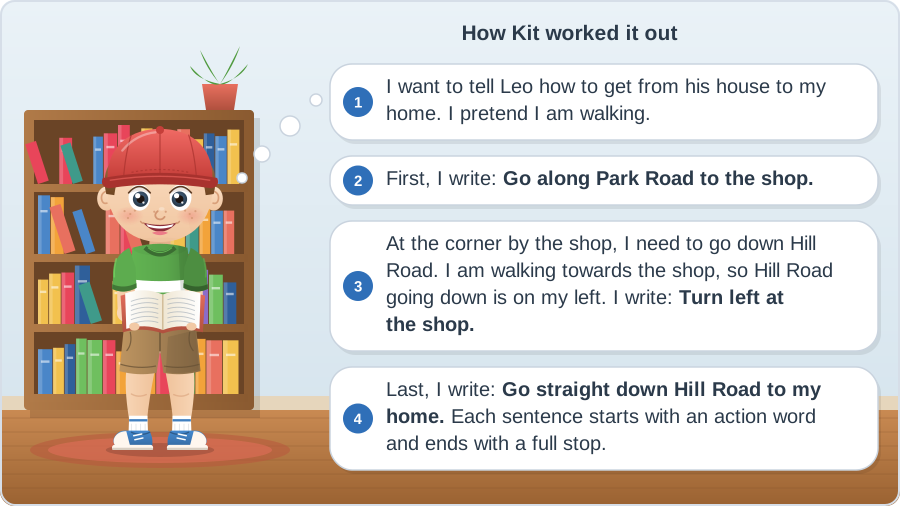
Trace the route on the map with your finger as you go through Kit’s thoughts.
Answer Key
Reveal Answers
Now Try It
1. Go straight up Hill Road.
2. Turn right at the shop.
1. Which way?
a) right
b) left
c) straight
d) left
2. Write the directions
Sample answer: 1. Go straight up Hill Road. 2. Turn right at the shop. 3. Stop at Leo’s house, next to the park.
Look for: three sentences in order; each one starts with an action word or names the place; “right” at the shop; a place to look for, such as the shop or the park.
3. Directions to my house
Sample answer: Go out of the park gate. Turn left at the bakery. My house is the blue one next to the post box.
Look for: a map with a start and an end, three sentences that match the map, and at least one place to look for. Check that left and right match the drawing by walking the route with a finger.
Reflect
2. Any real moment from the lesson that shows the learner was a communicator. Examples: “I was a communicator today when I wrote clear directions to a house.” “I was a communicator today when I used left, right and straight to help someone find the way.”
Lesson 6.4: Write a Postcard
Writing | About 20 minutes
Term 2 | Level 2
Goal
“I can plan and write a postcard to a friend about a real or pretend trip.”
Words to know
postcard, greeting, plan, ending
Wonder
Think about this question before you start. Say your ideas. You will come back to it at the end of the lesson.
Why do people send postcards to friends and family?
Let’s Learn
A postcard tells a friend about a trip. The message is short, so each sentence must give useful news.
A good postcard message has a greeting, then says where you are, what you did or saw, and how you feel. It ends with your name.
Plan first. Then write one sentence for each box in the plan.
See How It’s Done
Now Try It
1. This postcard is missing its greeting. Who could it be for? Say a greeting to start it.
Hint: A greeting starts with Dear, then a name.
2. It is also missing an ending. Say an ending for it.
Hint: Think of Love from or From, then a name.
Time To Practise
Name: ______________________
1. Put the postcard in order.
Number the lines 1 to 5.
____ It is fun here.
____ Dear Gran,
____ Love from Kai
____ I saw a big fish jump.
____ We are at the lake.
2. Plan your postcard.
Choose a real trip or a pretend one. Fill in the plan with a few words for each box.
Where? ______________________________________
What did I do? ______________________________________
What did I see? ______________________________________
How do I feel? ______________________________________
3. Write your postcard.
Write your postcard to a friend or family member. Use your plan. Then draw the place in the box.
Reflect
Think about these questions. Talk about them with someone at home or at school.
1. Go back to the Wonder question: “Why do people send postcards to friends and family?” What do you think now?
2. I was caring today when I ______________________________.
Being caring means being kind and helping others. For example: I was caring today when I wrote a postcard to someone I care about.
Take action: Write a real postcard or card to a family member who lives far away, and post it.
Next Steps
If this was easy, try: Write a second postcard from the same trip, telling what you did on the next day.
If this was hard, go back to: Task 1. Put the postcard lines in order again. Then say each sentence of your own postcard out loud before you write it.
Notes for Parents and Teachers
Show notes for parents and teachers
These notes cover this lesson only. How every lesson runs is explained in How to Use This Material.
Let’s Learn
Point to each box in the plan.
See How It’s Done
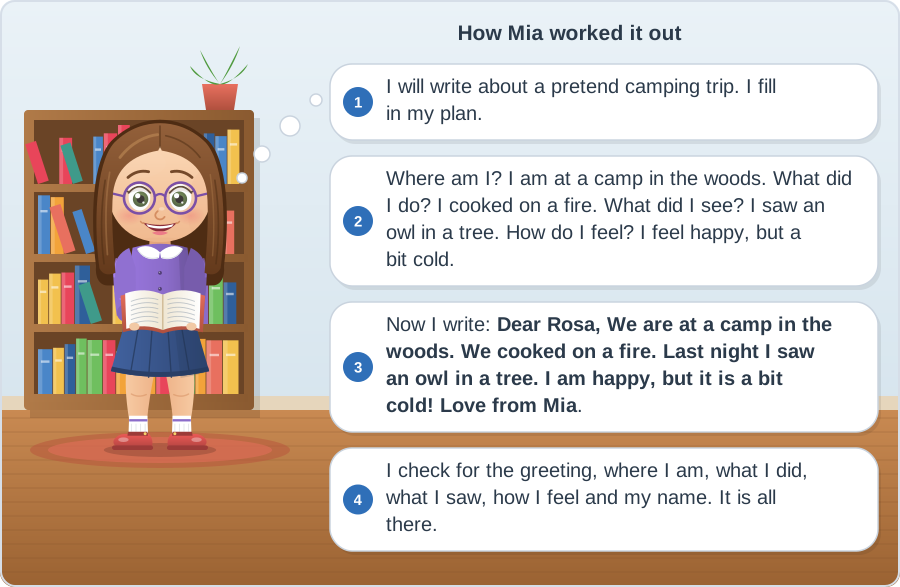
Write the postcard where the learner can see it as you go through Mia’s thoughts.
Answer Key
Reveal Answers
Now Try It
1. Sample answer: Dear Dad,
2. Sample answer: Love from Sara
1. Put the postcard in order
4 It is fun here.
1 Dear Gran,
5 Love from Kai
3 I saw a big fish jump.
2 We are at the lake.
Note: “It is fun here” can also come before “I saw a big fish jump.” Accept 3 and 4 in either order if the learner can explain the choice.
2. Plan your postcard
Sample answer: Where? a farm. What did I do? fed the hens. What did I see? a big red barn. How do I feel? happy.
3. Write your postcard
Sample answer: Dear Leo, I am at my uncle’s farm. I fed the hens this morning. I saw a big red barn with cows in it. I feel happy here. From Adam
Look for: a greeting and an ending; three or four sentences that follow the plan; capital letters and full stops; a drawing that matches the message.
Reflect
2. Any real moment from the lesson that shows the learner was caring. Examples: “I was caring today when I wrote a postcard to someone I care about.” “I was caring today when I thought about what my reader would like to know.”
For Teachers: IB Details
Show IB and curriculum details
IB theme: Where we are in place and time. It covers our homes and journeys, how we find our way, and how people explore and share the places they visit.
Central idea: People use signs, maps and stories to find their way and to share the places they visit.
| Lesson | Title | Strand | Key concept |
|---|---|---|---|
| 6.3 | Directions to My House | Writing | Function |
| 6.4 | Write a Postcard | Writing | Connection |
Each lesson also matches the national curriculum for England (Year 1) and the US Common Core (Grade 1). The Grade 1 Curriculum Map lists the full standards for every lesson.
← Back to Lesson 6 – Signs, Maps and Journeys | Lessons – Index
© 2026 Firefly Ed. All rights reserved. This page may be printed for personal, home and classroom use. It may not be sold, shared online or reproduced for commercial use without written permission. edfirefly.com


Share your thoughts or ask something..