

Guide for teachers | Curriculum links for the whole year
The Grade 1 English lessons follow three curricula: the IB Primary Years Programme (PYP), the national curriculum for England (Year 1) and the US Common Core (Grade 1). This page shows where each lesson fits. Each lesson page (Lesson 1 to Lesson 9) keeps a short summary, and the full list of standards for every lesson is here.
Grade 1 English Lessons Mapped to the IB PYP, England and the Common Core
The year has 9 lessons, three in each term. Each lesson is one IB unit of inquiry, and it has 12 smaller lessons, such as Lesson 1.1 to Lesson 1.12. A review at the end of each term covers its three lessons. Inside each lesson, the smaller lessons are numbered Lesson 1.1, Lesson 1.2 and so on.
The year at a glance
| Term | Lesson | IB theme | Central idea |
|---|---|---|---|
| 1 | Lesson 1: All About Me | Who we are | Each of us is unique, and we can share who we are with others. |
| 1 | Lesson 2: Home and School | How we organize ourselves | Homes and schools use routines, spaces and clear communication to help people live and learn together. |
| 1 | Lesson 3: Stories and Rhymes | How we express ourselves | People use stories and rhymes to share ideas, feelings and imagination. |
| 2 | Lesson 4: Animals Around Us | Sharing the planet | Animals share our world, and people can learn about them and care for them. |
| 2 | Lesson 5: Food and Celebrations | How we express ourselves | People share food and celebrations to express who they are and what they value. |
| 2 | Lesson 6: Signs, Maps and Journeys | Where we are in place and time | People use signs, maps and stories to find their way and to share the places they visit. |
| 3 | Lesson 7: Weather and Seasons | How the world works | Weather and seasons change in patterns, and these changes affect how people and other living things live. |
| 3 | Lesson 8: Friends and Feelings | Who we are | Friendships grow when we understand our own feelings and the feelings of others. |
| 3 | Lesson 9: Our Community | How we organize ourselves | People in a community have different roles, and they share ideas and messages to help one another. |
The term reviews are Term 1 Review, Term 2 Review and Term 3 Review.
How each lesson is built
The IB PYP divides language into three strands. Oral language covers listening and speaking. Visual language covers pictures, charts, maps and signs. Written language covers reading and writing. Each strand has one side for understanding and one side for sharing ideas. Every lesson covers all three strands in the same order.
| Lessons | What the learner does | IB strand |
|---|---|---|
| 1 and 2 | Reads a text and answers questions about it. | Written language: reading |
| 3 and 4 | Plans, writes and checks a piece of writing. | Written language: writing |
| 5 and 6 | Listens, speaks, discusses and presents. | Oral language: listening and speaking |
| 7 and 8 | Reads a chart, map or picture, and then makes one. | Visual language: viewing and presenting |
| 9 to 11 | Learns letter sounds, spelling patterns and tricky words. | Written language: reading and spelling |
| 12 | Reviews the whole lesson. | All strands |
Lesson by lesson
Each lesson shows its IB theme, central idea, key concepts and lines of inquiry. Open the box under a lesson to see the standards that each smaller lesson covers.
Lesson 1: All About Me
IB theme: Who we are. It covers our bodies and feelings, our families and friends, where we belong, and how we learn and grow.
Central idea: Each of us is unique, and we can share who we are with others.
Key concepts: Form (what is it like?), Connection (how is it linked to other things?), Perspective (what are the points of view?). Related concepts: identity, communication, feelings.
Lines of inquiry:
- How we share who we are with others
- What makes each of us unique
- How we notice and respect feelings
Show the standards for Lessons 1.1 to 1.12
Lesson 1.1: All About the Book
Reading. Key concept: Form. Learner profile: Inquirers. Approach to learning: research skills.
IB PYP, Phase 1
- Reading: handle books, showing an understanding of how a book works, for example, cover, beginning, directional movement, end
England, Year 1
- Discuss the significance of the title
Common Core, Grade 1
- RI.K.5 and RL.K.6 (review from Kindergarten)
Lesson 1.2: Read My Name Tag
Reading. Key concept: Form. Learner profile: Communicators. Approach to learning: communication skills.
IB PYP, Phase 1
- Reading: recognize their own first name; make connections to their own experience when listening to or “reading” texts
England, Year 1
- Apply phonic knowledge and skills as the route to decode words
Common Core, Grade 1
- RI.1.1: Ask and answer questions about key details in a text
Lesson 1.3: I Am, I Like
Writing. Key concept: Form. Learner profile: Reflective. Approach to learning: communication skills.
IB PYP, Phase 1
- Writing: use their own experience as a stimulus when drawing and “writing”; participate in shared writing, observing the teacher’s writing and making suggestions
England, Year 1
- Leaving spaces between words
- Using a capital letter for the personal pronoun “I”
- Write sentences by composing a sentence orally before writing it
Common Core, Grade 1
- L.1.2b: Use end punctuation for sentences
Lesson 1.4: Label My Picture
Writing. Key concept: Connection. Learner profile: Communicators. Approach to learning: communication skills.
IB PYP, Phase 1
- Writing: differentiate between illustrations and written text; show an awareness of sound-symbol relationships and begin to recognize the way that some familiar sounds can be recorded
England, Year 1
- Spell words containing each of the phonemes already taught
Common Core, Grade 1
- L.1.2d: Use conventional spelling for words with common spelling patterns
Lesson 1.5: Telling or Asking?
Listening and speaking. Key concept: Connection. Learner profile: Inquirers. Approach to learning: research skills.
IB PYP, Phase 1
- Oral language: understand simple questions and respond with actions or words; use gestures, actions, body language and/or words to communicate needs and to express ideas
England, Year 1
- Ask relevant questions to extend their understanding and knowledge
- Beginning to punctuate sentences using a question mark
Common Core, Grade 1
- SL.1.6: Produce complete sentences when appropriate to task and situation
Lesson 1.6: Show and Tell: My Favourite Thing
Speaking. Key concept: Connection. Learner profile: Risk-takers. Approach to learning: communication skills.
IB PYP, Phase 1
- Oral language: tell their own stories using words, gestures, and objects/artifacts; interact effectively with peers and adults in familiar social settings
England, Year 1
- Speak audibly and fluently
- Give well-structured descriptions, explanations and narratives for different purposes, including for expressing feelings
Common Core, Grade 1
- SL.1.4: Describe people, places, things and events with relevant details, expressing ideas and feelings clearly
Lesson 1.7: How Do They Feel?
Viewing. Key concept: Perspective. Learner profile: Caring. Approach to learning: social skills.
IB PYP, Phase 1
- Visual language: attend to visual information showing understanding through play, gestures, facial expression; reveal their own feelings in response to visual presentations
England, Year 1
- No direct statement
- Links to spoken language, articulate and justify answers
Common Core, Grade 1
- RL.1.7: Use illustrations and details in a story to describe its characters
Lesson 1.8: My Self-Portrait and Caption
Presenting. Key concept: Form. Learner profile: Reflective. Approach to learning: communication skills.
IB PYP, Phase 1
- Visual language: select and incorporate colours, shapes, symbols and images into visual presentations
- Writing: use their own experience as a stimulus when drawing and “writing”
England, Year 1
- Write sentences by composing a sentence orally before writing it
Common Core, Grade 1
- SL.1.5: Add drawings or other visual displays to descriptions when appropriate to clarify ideas, thoughts, and feelings
Lesson 1.9: Sound It Out: Beginning Sounds
Reading and spelling. Key concept: Form. Learner profile: Thinkers. Approach to learning: thinking skills.
IB PYP, Phase 1
- Writing: show an awareness of sound-symbol relationships and begin to recognize the way that some familiar sounds can be recorded
England, Year 1
- Read accurately by blending sounds in unfamiliar words containing GPCs that have been taught
Common Core, Grade 1
- RF.1.2b: Orally produce single-syllable words by blending sounds
- RF.1.2c: Isolate and pronounce initial, medial vowel, and final sounds in spoken single-syllable words
Lesson 1.10: Middle Sounds: Short Vowels
Reading and spelling. Key concept: Form. Learner profile: Thinkers. Approach to learning: thinking skills.
IB PYP, Phase 1
- Writing: show an awareness of sound-symbol relationships and begin to recognize the way that some familiar sounds can be recorded
- Reading: begin to discriminate between visual representations such as symbols, numbers, ICT iconography, letters and words
England, Year 1
- Read accurately by blending sounds in unfamiliar words containing GPCs that have been taught
Common Core, Grade 1
- RF.1.2c: Isolate and pronounce initial, medial vowel, and final sounds in spoken single-syllable words
Lesson 1.11: Tricky Words: the, I, said, was
Reading and spelling. Key concept: Form. Learner profile: Knowledgeable. Approach to learning: self-management skills.
IB PYP, Phase 1
- Reading: begin to discriminate between visual representations such as symbols, numbers, ICT iconography, letters and words
- Writing: show curiosity and ask questions about written language
England, Year 1
- Read common exception words, noting unusual correspondences between spelling and sound and where these occur in the word
Common Core, Grade 1
- RF.1.3g: Recognize and read grade-appropriate irregularly spelled words
Lesson 1.12: Lesson 1 Review
All strands. Key concept: Form, Connection and Perspective. Learner profile: Reflective. Approach to learning: self-management skills.
This review checks the outcomes from Lessons 1.1 to 1.11.
IB PYP
- Phase 1, across reading, writing, oral language and visual language
England, Year 1
- Spell words containing each of the phonemes already taught
Common Core, Grade 1
- RF.1.2c and RF.1.3g
Lesson 2: Home and School
IB theme: How we organize ourselves. This theme is about the systems people make and how they work: how people live and work together, share jobs and make decisions.
Central idea: Homes and schools use routines, spaces and clear communication to help people live and learn together.
Key concepts: Function (how does it work?), Form (what is it like?), Responsibility (what is our responsibility?). Related concepts: routine, order, systems.
Lines of inquiry:
- The routines that organize our day
- How clear communication helps us work together
- How spaces at home and school are set out
Show the standards for Lessons 2.1 to 2.12
Lesson 2.1: Find the Answer
Reading. Key concept: Function. Learner profile: Inquirers. Approach to learning: research skills.
IB PYP, Phase 1
- Reading: listen attentively and respond to stories read aloud; show curiosity and ask questions about pictures or text
England, Year 1
- Participate in discussion about what is read to them, taking turns and listening to what others say
Common Core, Grade 1
- RL.1.1: Ask and answer questions about key details in a text
Lesson 2.2: A Day at School
Reading. Key concept: Function. Learner profile: Balanced. Approach to learning: self-management skills.
IB PYP, Phase 1
- Reading: begin to discriminate between visual representations such as symbols, numbers, ICT iconography, letters and words
- Visual language: observe visual cues that indicate context; show understanding by matching pictures with context
England, Year 1
- Link what they read or hear read to their own experiences
Common Core, Grade 1
- RI.1.7: Use the illustrations and details in a text to describe its key ideas
Lesson 2.3: My Day in Order
Writing. Key concept: Function. Learner profile: Balanced. Approach to learning: self-management skills.
IB PYP, Phase 1
- Writing: use their own experience as a stimulus when drawing and “writing”; participate in shared writing, observing the teacher’s writing and making suggestions
England, Year 1
- Sequencing sentences to form short narratives
Common Core, Grade 1
- W.1.3: Write narratives in which they recount two or more appropriately sequenced events and use temporal words to signal event order
Lesson 2.4: Fix the Sentence
Writing. Key concept: Function. Learner profile: Communicators. Approach to learning: communication skills.
IB PYP, Phase 1
- Writing: participate in shared writing, observing the teacher’s writing and making suggestions; listen and respond to shared books (enlarged texts), observing conventions of print
England, Year 1
- Beginning to punctuate sentences using a capital letter and a full stop, question mark or exclamation mark
- Using a capital letter for names of people and the personal pronoun “I”
Common Core, Grade 1
- L.1.2a: Capitalize dates and names of people
- L.1.2b: Use end punctuation for sentences
Lesson 2.5: Listen and Do: Two-Step Instructions
Listening. Key concept: Responsibility. Learner profile: Principled. Approach to learning: social skills.
IB PYP, Phase 1
- Oral language: follow classroom directions and routines, using context cues; understand simple questions and respond with actions or words
England, Year 1
- Listen and respond appropriately to adults and their peers
Common Core, Grade 1
- SL.1.2: Ask and answer questions about key details in information presented orally
Lesson 2.6: Talk About My Home
Speaking. Key concept: Form. Learner profile: Communicators. Approach to learning: communication skills.
IB PYP, Phase 1
- Oral language: tell their own stories using words, gestures, and objects/artifacts; interact effectively with peers and adults in familiar social settings
England, Year 1
- Use relevant strategies to build their vocabulary
Common Core, Grade 1
- SL.1.4: Describe people, places, things, and events with relevant details, expressing ideas and feelings clearly
Lesson 2.7: Put the Pictures in Order
Viewing. Key concept: Function. Learner profile: Thinkers. Approach to learning: thinking skills.
IB PYP, Phase 1
- Visual language: attend to visual information showing understanding through play, gestures, facial expression; observe visual cues that indicate context; show understanding by matching pictures with context
England, Year 1
- Sequencing sentences to form short narratives
Common Core, Grade 1
- RL.1.7: Use illustrations and details in a story to describe its characters, setting, or events
Lesson 2.8: Draw and Label My Classroom
Presenting. Key concept: Form. Learner profile: Inquirers. Approach to learning: research skills.
IB PYP, Phase 1
- Visual language: select and incorporate colours, shapes, symbols and images into visual presentations; recognize familiar signs, labels and logos
England, Year 1
Common Core, Grade 1
- SL.1.5: Add drawings or other visual displays to descriptions when appropriate to clarify ideas, thoughts, and feelings
Lesson 2.9: sh and ch
Reading and spelling. Key concept: Form. Learner profile: Thinkers. Approach to learning: communication skills.
IB PYP, Phase 1
- Writing: show an awareness of sound-symbol relationships and begin to recognize the way that some familiar sounds can be recorded
England, Year 1
- Respond speedily with the correct sound to graphemes for all 40+ phonemes
Common Core, Grade 1
- RF.1.3a: Know the spelling-sound correspondences for common consonant digraphs
Lesson 2.10: th, ck and ng
Reading and spelling. Key concept: Form. Learner profile: Risk-takers. Approach to learning: communication skills.
IB PYP, Phase 1
- Writing: show an awareness of sound-symbol relationships and begin to recognize the way that some familiar sounds can be recorded
England, Year 1
- Respond speedily with the correct sound to graphemes for all 40+ phonemes
Common Core, Grade 1
- RF.1.3a: Know the spelling-sound correspondences for common consonant digraphs
Lesson 2.11: Double Letters: ff, ll, ss
Reading and spelling. Key concept: Form. Learner profile: Thinkers. Approach to learning: self-management skills.
IB PYP, Phase 1
- Writing: show an awareness of sound-symbol relationships and begin to recognize the way that some familiar sounds can be recorded
England, Year 1
- The sounds /f/, /l/, /s/, /z/ and /k/ spelt ff, ll, ss, zz and ck
Common Core, Grade 1
- L.1.2d: Use conventional spelling for words with common spelling patterns
Lesson 2.12: Lesson 2 Review
All strands. Key concept: Function, Form and Responsibility. Learner profile: Reflective. Approach to learning: self-management skills.
This review checks the outcomes from Lessons 2.1 to 2.11.
IB PYP
- Phase 1, across reading, writing, oral language and visual language
England, Year 1
- Write from memory simple sentences dictated by the teacher that include words using the GPCs and common exception words taught so far
Common Core, Grade 1
- RF.1.3a and L.1.2b
Lesson 3: Stories and Rhymes
IB theme: How we express ourselves. This theme is about how we find and share ideas, feelings and beliefs: through imagination and creativity, the different ways we communicate, and how other people respond.
Central idea: People use stories and rhymes to share ideas, feelings and imagination.
Key concepts: Form (what is it like?), Connection (how is it linked to other things?), Perspective (what are the points of view?). Related concepts: pattern, sequence, imagination.
Lines of inquiry:
- How stories and rhymes are built
- How we tell and retell stories in different ways
- How we use our voices and words to join in and create
Show the standards for Lessons 3.1 to 3.12
Lesson 3.1: Story Order: Beginning, Middle, End
Reading. Key concept: Form. Learner profile: Thinkers. Approach to learning: thinking skills.
IB PYP, Phase 1
- Reading: listen attentively and respond to stories read aloud; express opinions about the meaning of a story
England, Year 1
- Becoming very familiar with key stories, fairy stories and traditional tales, retelling them and considering their particular characteristics
Common Core, Grade 1
- RL.1.2: Retell stories, including key details
Lesson 3.2: Words That Rhyme
Reading. Key concept: Form. Learner profile: Communicators. Approach to learning: communication skills.
IB PYP, Phase 1
- Reading: participate in shared reading, joining in with rhymes, refrains and repeated text as they gain familiarity
- Oral language: join in with poems, rhymes, songs and repeated phrases in shared books
England, Year 1
- Learning to appreciate rhymes and poems, and to recite some by heart
Common Core, Grade 1
- RF.K.2a (review from Kindergarten): recognize and produce rhyming words
Lesson 3.3: Word Order Puzzle
Writing. Key concept: Form. Learner profile: Thinkers. Approach to learning: thinking skills.
IB PYP, Phase 1
- Writing: participate in shared writing, observing the teacher’s writing and making suggestions; listen and respond to shared books (enlarged texts), observing conventions of print
England, Year 1
- How words can combine to make sentences
Common Core, Grade 1
- L.1.1j: Produce and expand complete simple and compound declarative, interrogative, imperative, and exclamatory sentences in response to prompts
Lesson 3.4: Retell a Tale in Three Sentences
Writing. Key concept: Connection. Learner profile: Communicators. Approach to learning: communication skills.
IB PYP, Phase 1
- Reading: listen attentively and respond to stories read aloud
- Oral language: tell their own stories using words, gestures, and objects/artifacts
England, Year 1
- Becoming very familiar with key stories, fairy stories and traditional tales, retelling them
Common Core, Grade 1
- RL.1.2: Retell stories, including key details
Lesson 3.5: Listen and Retell
Listening and speaking. Key concept: Connection. Learner profile: Communicators. Approach to learning: communication skills.
IB PYP, Phase 1
- Oral language: listen and respond to picture books, showing pleasure, and demonstrating their understanding through gestures, expression and/or words; tell their own stories using words, gestures, and objects/artifacts
England, Year 1
- Listen and respond appropriately to adults and their peers
- Becoming very familiar with key stories, retelling them
Common Core, Grade 1
- SL.1.2: Ask and answer questions about key details in a text read aloud or information presented orally or through other media
Lesson 3.6: Join In: Repeating Lines
Listening and speaking. Key concept: Form. Learner profile: Risk-takers. Approach to learning: social skills.
IB PYP, Phase 1
- Oral language: join in with poems, rhymes, songs and repeated phrases in shared books
- Reading: participate in shared reading, joining in with rhymes, refrains and repeated text as they gain familiarity
England, Year 1
- Learning to appreciate rhymes and poems, and to recite some by heart
- Recognising and joining in with predictable phrases
Common Core, Grade 1
- RL.1.4: Identify words and phrases in stories or poems that suggest feelings or appeal to the senses
Lesson 3.7: Real or Make-Believe?
Viewing. Key concept: Form. Learner profile: Thinkers. Approach to learning: thinking skills.
IB PYP, Phase 1
- Visual language: make personal connections to visual texts; observe visual cues that indicate context; show understanding by matching pictures with context
England, Year 1
- Drawing on what they already know or on background information and vocabulary provided by the teacher
Common Core, Grade 1
- RL.1.5: Explain major differences between books that tell stories and books that give information
Lesson 3.8: Same Story, Two Ways
Viewing. Key concept: Perspective. Learner profile: Open-minded. Approach to learning: thinking skills.
IB PYP, Phase 1
- Visual language: show appreciation of illustrations in picture books by selecting and rereading familiar books, focusing on favourite pages; make personal connections to visual texts
England, Year 1
- Participate in discussion about what is read to them, taking turns and listening to what others say
Common Core, Grade 1
- RL.1.9: Compare and contrast the adventures and experiences of characters in stories
Lesson 3.9: Find the Sight Word
Reading and spelling. Key concept: Form. Learner profile: Knowledgeable. Approach to learning: self-management skills.
IB PYP, Phase 1
- Reading: begin to discriminate between visual representations such as symbols, numbers, ICT iconography, letters and words
- Writing: show an awareness of sound-symbol relationships and begin to recognize the way that some familiar sounds can be recorded
England, Year 1
- Read common exception words, noting unusual correspondences between spelling and sound and where these occur in the word
Common Core, Grade 1
- RF.1.3g: Recognize and read grade-appropriate irregularly spelled words
Lesson 3.10: Blends at the Start: st, fl, tr
Reading and spelling. Key concept: Form. Learner profile: Risk-takers. Approach to learning: communication skills.
IB PYP, Phase 1
- Writing: show an awareness of sound-symbol relationships and begin to recognize the way that some familiar sounds can be recorded
England, Year 1
- Read words containing taught GPCs
- Read accurately by blending sounds in unfamiliar words containing GPCs that have been taught
Common Core, Grade 1
- RF.1.2b: Orally produce single-syllable words by blending sounds (phonemes), including consonant blends
Lesson 3.11: Blends at the End, -s and -es
Reading and spelling. Key concept: Form. Learner profile: Thinkers. Approach to learning: thinking skills.
IB PYP, Phase 1
- Writing: show an awareness of sound-symbol relationships and begin to recognize the way that some familiar sounds can be recorded
England, Year 1
- Adding the endings -s and -es to words (plural of nouns)
Common Core, Grade 1
- L.1.1b: Use common, proper, and possessive nouns
- L.1.1c: Use singular and plural nouns with matching verbs in basic sentences
- RF.1.3b: Decode regularly spelled one-syllable words
Lesson 3.12: Lesson 3 Review
All strands. Key concept: Form, Connection and Perspective. Learner profile: Reflective. Approach to learning: self-management skills.
This review checks the outcomes from Lessons 3.1 to 3.11.
IB PYP
- Phase 1, across reading, writing, oral language and visual language
England, Year 1
- Spell words containing each of the phonemes already taught
Common Core, Grade 1
- RF.1.2b and L.1.2d
Lesson 4: Animals Around Us
IB theme: Sharing the planet. This theme is about how we share the planet with other people and other living things: rights and responsibilities, living together fairly, and caring for nature.
Central idea: Animals share our world, and people can learn about them and care for them.
Key concepts: Form (what is it like?), Function (how does it work?), Responsibility (what is our responsibility?). Related concepts: habitat, needs, fact.
Lines of inquiry:
- How we find and share facts about animals
- How animals live and what they need
- How people can care for animals
Show the standards for Lessons 4.1 to 4.12
Lesson 4.1: Story or Fact?
Reading. Key concept: Form. Learner profile: Thinkers. Approach to learning: thinking skills.
IB PYP
- Reading (Phase 2): read and understand the meaning of self-selected and teacher-selected texts at an appropriate level
- Reading, Phase 1 (conceptual understanding): Printed information can tell about the real world
England, Year 1
- Being encouraged to link what they read or hear read to their own experiences
Common Core, Grade 1
- RL.1.5: Explain major differences between books that tell stories and books that give information, drawing on a wide reading of a range of text types
Lesson 4.2: Read an Animal Fact Page
Reading. Key concept: Form. Learner profile: Knowledgeable. Approach to learning: research skills.
IB PYP, Phase 2
- Reading: read and understand the meaning of self-selected and teacher-selected texts at an appropriate level
- Reading, Phase 2 (conceptual understanding): People read to learn
England, Year 1
- Being encouraged to link what they read or hear read to their own experiences
Common Core, Grade 1
- RI.1.5: Know and use various text features (e.g., headings, tables of contents, glossaries, electronic menus, icons) to locate key facts or information in a text
Lesson 4.3: Same Idea, Three Ways
Writing. Key concept: Responsibility. Learner profile: Caring. Approach to learning: communication skills.
IB PYP, Phase 2
- Writing: write to communicate a message to a particular audience, for example, a news story, instructions, a fantasy story
England, Year 1
- Write sentences by composing a sentence orally before writing it
- Sequencing sentences to form short narratives
Common Core, Grade 1
- W.1.2: Write informative/explanatory texts in which they name a topic, supply some facts about the topic, and provide some sense of closure
Lesson 4.4: Three Facts About My Animal
Writing. Key concept: Form. Learner profile: Knowledgeable. Approach to learning: research skills.
IB PYP, Phase 2
- Writing: use familiar aspects of written language with increasing confidence and accuracy, for example, spelling patterns, high-frequency words, high-interest words; create illustrations to match their own written text
England, Year 1
- Sequencing sentences to form short narratives
- Re-reading what they have written to check that it makes sense
Common Core, Grade 1
- W.1.2: Write informative/explanatory texts in which they name a topic, supply some facts about the topic, and provide some sense of closure
Lesson 4.5: Listening for Detail
Listening. Key concept: Responsibility. Learner profile: Caring. Approach to learning: communication skills.
IB PYP, Phase 2
- Oral language: listen to and enjoy stories read aloud; show understanding by responding in oral, written or visual form; obtain simple information from accessible spoken texts
England, Year 1
- Listen and respond appropriately to adults and their peers
Common Core, Grade 1
- SL.1.2: Ask and answer questions about key details in a text read aloud or information presented orally or through other media
Lesson 4.6: Ask Who, What, Where, When, Why
Speaking. Key concept: Function. Learner profile: Inquirers. Approach to learning: research skills.
IB PYP, Phase 2
- Oral language: ask questions to gain information and respond to inquiries directed to themselves or to the class
England, Year 1
- Ask relevant questions to extend their understanding and knowledge
Common Core, Grade 1
- SL.1.3: Ask and answer questions about what a speaker says in order to gather additional information or clarify something that is not understood
Lesson 4.7: Picture and Caption
Viewing. Key concept: Form. Learner profile: Thinkers. Approach to learning: thinking skills.
IB PYP
- Visual language (Phase 2): attend to visual information showing understanding through discussion, role play, illustrations
- Visual language (Phase 1): observe visual cues that indicate context; show understanding by matching pictures with context
England, Year 1
- Participate in discussion about what is read to them, taking turns and listening to what others say
Common Core, Grade 1
- RI.1.6: Distinguish between information provided by pictures or other illustrations and information provided by the words in a text
Lesson 4.8: Words and Pictures Work Together
Presenting. Key concept: Function. Learner profile: Communicators. Approach to learning: communication skills.
IB PYP
- Visual language (Phase 2): relate to different contexts presented in visual texts according to their own experiences
- Visual language (Phase 1): select and incorporate colours, shapes, symbols and images into visual presentations
England, Year 1
- Discuss what they have written with the teacher or other pupils
Common Core, Grade 1
- RI.1.7: Use the illustrations and details in a text to describe its key ideas
Lesson 4.9: Magic e: a_e and the -ake Family
Reading and spelling. Key concept: Form. Learner profile: Thinkers. Approach to learning: thinking skills.
IB PYP, Phase 2
- Reading: understand sound-symbol relationships and recognize familiar sounds/symbols/words of the language community
- Writing: connect written codes with the sounds of spoken language and reflect this understanding when recording ideas
England, Year 1
- Split digraphs a-e, e-e, i-e, o-e, u-e
Common Core, Grade 1
- RF.1.3c: Know final -e and common vowel team conventions for representing long vowel sounds
Lesson 4.10: i_e Words
Reading and spelling. Key concept: Form. Learner profile: Risk-takers. Approach to learning: communication skills.
IB PYP, Phase 2
- Reading: understand sound-symbol relationships and recognize familiar sounds/symbols/words of the language community
- Writing: connect written codes with the sounds of spoken language and reflect this understanding when recording ideas
England, Year 1
- Split digraphs a-e, e-e, i-e, o-e, u-e
Common Core, Grade 1
- RF.1.3c: Know final -e and common vowel team conventions for representing long vowel sounds
Lesson 4.11: o_e and u_e Words
Reading and spelling. Key concept: Form. Learner profile: Knowledgeable. Approach to learning: self-management skills.
IB PYP, Phase 2
- Reading: understand sound-symbol relationships and recognize familiar sounds/symbols/words of the language community
- Writing: connect written codes with the sounds of spoken language and reflect this understanding when recording ideas
England, Year 1
- Split digraphs a-e, e-e, i-e, o-e, u-e
Common Core, Grade 1
- RF.1.3c: Know final -e and common vowel team conventions for representing long vowel sounds
Lesson 4.12: Lesson 4 Review
All strands. Key concept: Form, Function and Responsibility. Learner profile: Reflective. Approach to learning: self-management skills.
This review checks the outcomes from Lessons 4.1 to 4.11.
IB PYP
- Phases 1 and 2, across reading, writing, oral language and visual language
England, Year 1
- Write from memory simple sentences dictated by the teacher that include words using the GPCs and common exception words taught so far
Common Core, Grade 1
- RF.1.3c and W.1.2
Lesson 5: Food and Celebrations
IB theme: How we express ourselves. This theme is about how we find and share ideas, feelings, culture and beliefs: through creativity, through the different ways we communicate, and through how others respond.
Central idea: People share food and celebrations to express who they are and what they value.
Key concepts: Function (how does it work?), Connection (how is it linked to other things?), Perspective (what are the points of view?). Related concepts: culture, tradition, purpose.
Lines of inquiry:
- How we use words and pictures to invite, explain and share
- How food and celebrations bring people together
- How people celebrate special days
Show the standards for Lessons 5.1 to 5.12
Lesson 5.1: What Kind of Text Is This?
Reading. Key concept: Function. Learner profile: Thinkers. Approach to learning: thinking skills.
IB PYP, Phase 2
- Reading: read and understand the meaning of self-selected and teacher-selected texts at an appropriate level
- Reading: read and understand familiar print from the immediate environment, for example, signs, advertisements, logos, ICT iconography
England, Year 1
- Being encouraged to link what they read or hear read to their own experiences
Common Core, Grade 1
- RL.1.5: Explain major differences between books that tell stories and books that give information, drawing on a wide reading of a range of text types
Lesson 5.2: Follow a Recipe
Reading. Key concept: Function. Learner profile: Knowledgeable. Approach to learning: self-management skills.
IB PYP, Phase 2
- Reading: read and understand the meaning of self-selected and teacher-selected texts at an appropriate level
- Reading, Phase 2 (conceptual understanding): People read to learn
England, Year 1
- Being encouraged to link what they read or hear read to their own experiences
Common Core, Grade 1
- RI.1.3: Describe the connection between two individuals, events, ideas, or pieces of information in a text
Lesson 5.3: Write an Invitation
Writing. Key concept: Connection. Learner profile: Caring. Approach to learning: communication skills.
IB PYP, Phase 2
- Writing: write to communicate a message to a particular audience, for example, a news story, instructions, a fantasy story
England, Year 1
- Write sentences by composing a sentence orally before writing it
- Using a capital letter for names of people, places, the days of the week, and the personal pronoun “I”
Common Core, Grade 1
- W.1.2: Write informative/explanatory texts in which they name a topic, supply some facts about the topic, and provide some sense of closure
Lesson 5.4: My Celebration Diary
Writing. Key concept: Perspective. Learner profile: Reflective. Approach to learning: self-management skills.
IB PYP
- Writing (Phase 1): use their own experience as a stimulus when drawing and “writing”
- Writing (Phase 2): read their own writing to the teacher and to classmates, realizing that what they have written remains unchanged
England, Year 1
- Sequencing sentences to form short narratives
- Joining words and joining clauses using “and”
Common Core, Grade 1
- W.1.3: Write narratives in which they recount two or more appropriately sequenced events, include some details regarding what happened, use temporal words to signal event order, and provide some sense of closure
Lesson 5.5: Polite Requests
Speaking. Key concept: Perspective. Learner profile: Caring. Approach to learning: social skills.
IB PYP
- Oral language (Phase 2): use language to address their needs, express feelings and opinions
- Oral language (Phase 1): interact effectively with peers and adults in familiar social settings
England, Year 1
- Participate in discussions, presentations, performances, role play, improvisations and debates
Common Core, Grade 1
- SL.1.6: Produce complete sentences when appropriate to task and situation
Lesson 5.6: Tell Me How to Make a Snack
Speaking. Key concept: Function. Learner profile: Communicators. Approach to learning: communication skills.
IB PYP, Phase 2
- Oral language: use oral language to communicate during classroom activities, conversations and imaginative play; describe personal experiences
England, Year 1
- Give well-structured descriptions, explanations and narratives for different purposes, including for expressing feelings
Common Core, Grade 1
- SL.1.4: Describe people, places, things, and events with relevant details, expressing ideas and feelings clearly
Lesson 5.7: Read a Picture Menu
Viewing. Key concept: Function. Learner profile: Thinkers. Approach to learning: thinking skills.
IB PYP
- Visual language (Phase 2): attend to visual information showing understanding through discussion, role play, illustrations
- Visual language (Phase 1): recognize familiar signs, labels and logos; identify similarities and differences
England, Year 1
- Being encouraged to link what they read or hear read to their own experiences
Common Core, Grade 1
- RI.1.7: Use the illustrations and details in a text to describe its key ideas
Lesson 5.8: Design an Invitation Card
Presenting. Key concept: Perspective. Learner profile: Risk-takers. Approach to learning: thinking skills.
IB PYP
- Visual language (Phase 1): select and incorporate colours, shapes, symbols and images into visual presentations
- Visual language (Phase 2): talk about their own feelings in response to visual messages; show empathy for the way others might feel
England, Year 1
Common Core, Grade 1
- SL.1.5: Add drawings or other visual displays to descriptions when appropriate to clarify ideas, thoughts, and feelings
Lesson 5.9: ai and ay
Reading and spelling. Key concept: Connection. Learner profile: Thinkers. Approach to learning: thinking skills.
IB PYP, Phase 2
- Reading: understand sound-symbol relationships and recognize familiar sounds/symbols/words of the language community
- Writing: connect written codes with the sounds of spoken language and reflect this understanding when recording ideas
England, Year 1
- Vowel digraphs ai and ay (the spelling appendix notes that ai is virtually never used at the end of English words, and ay is used at the end)
Common Core, Grade 1
- RF.1.3c: Know final -e and common vowel team conventions for representing long vowel sounds
Lesson 5.10: ee and ea
Reading and spelling. Key concept: Connection. Learner profile: Risk-takers. Approach to learning: communication skills.
IB PYP, Phase 2
- Reading: understand sound-symbol relationships and recognize familiar sounds/symbols/words of the language community
- Writing: connect written codes with the sounds of spoken language and reflect this understanding when recording ideas
England, Year 1
- Vowel digraphs ee and ea
Common Core, Grade 1
- RF.1.3c: Know final -e and common vowel team conventions for representing long vowel sounds
Lesson 5.11: oa and ow, -ing and -ed
Reading and spelling. Key concept: Connection. Learner profile: Knowledgeable. Approach to learning: self-management skills.
IB PYP, Phase 2
- Reading: understand sound-symbol relationships and recognize familiar sounds/symbols/words of the language community
- Writing: connect written codes with the sounds of spoken language and reflect this understanding when recording ideas
England, Year 1
- Vowel digraphs oa and ow
- Add the endings -ing and -ed to verbs where no change is needed to the root word
Common Core, Grade 1
- RF.1.3c: Know common vowel team conventions for representing long vowel sounds
- L.1.4c: Identify frequently occurring root words and their inflectional forms
Lesson 5.12: Lesson 5 Review
All strands. Key concept: Function, Connection and Perspective. Learner profile: Reflective. Approach to learning: self-management skills.
This review checks the outcomes from Lessons 5.1 to 5.11.
IB PYP
- Phases 1 and 2, across reading, writing, oral language and visual language
England, Year 1
- Write from memory simple sentences dictated by the teacher that include words using the GPCs and common exception words taught so far
Common Core, Grade 1
- RF.1.3c, W.1.2 and SL.1.6
Lesson 6: Signs, Maps and Journeys
IB theme: Where we are in place and time. It covers our homes and journeys, how we find our way, and how people explore and share the places they visit.
Central idea: People use signs, maps and stories to find their way and to share the places they visit.
Key concepts: Form (what is it like?), Function (how does it work?), Connection (how is it linked to other things?). Related concepts: place, direction, journey.
Lines of inquiry:
- How signs and symbols help us find our way
- How people share their journeys with others
- How maps and directions show where places are
Show the standards for Lessons 6.1 to 6.12
Lesson 6.1: Signs Around Town
Reading. Key concept: Function. Learner profile: Inquirers. Approach to learning: research skills.
IB PYP, Phase 2
- Reading: read and understand the meaning of self-selected and teacher-selected texts at an appropriate level
- Reading: read and understand familiar print from the immediate environment, for example, signs, advertisements, logos, ICT iconography
England, Year 1
- Discuss word meanings, linking new meanings to those already known
Common Core, Grade 1
- RI.1.4 and RF.1.4a: read on-level text with purpose and understanding
Lesson 6.2: A Postcard From a Trip
Reading. Key concept: Connection. Learner profile: Open-minded. Approach to learning: thinking skills.
IB PYP, Phase 2
- Reading: read and understand the meaning of self-selected and teacher-selected texts at an appropriate level
- Reading, Phase 2 (conceptual understanding): People read to learn
England, Year 1
- Check that the text makes sense as they read
- Make inferences on the basis of what is being said and done
Common Core, Grade 1
- RI.1.1: Ask and answer questions about key details in a text
Lesson 6.3: Directions to My House
Writing. Key concept: Function. Learner profile: Communicators. Approach to learning: communication skills.
IB PYP, Phase 2
- Writing: write to communicate a message to a particular audience, for example, a news story, instructions, a fantasy story
England, Year 1
- Sequence sentences to form short narratives
- Begin to punctuate sentences using a capital letter and a full stop
Common Core, Grade 1
- W.1.2: Write informative texts that name a topic, supply facts and provide some sense of closure
- L.1.1j: Produce and expand complete simple and imperative sentences
Lesson 6.4: Write a Postcard
Writing. Key concept: Connection. Learner profile: Caring. Approach to learning: social skills.
IB PYP, Phase 2
- Writing: write to communicate a message to a particular audience, for example, a news story, instructions, a fantasy story
England, Year 1
- Say out loud what they are going to write about
- Compose a sentence orally before writing it
- Sequence sentences to form short narratives
Common Core, Grade 1
- W.1.3: Write narratives in which they recount two or more appropriately sequenced events
Lesson 6.5: Following Spoken Directions
Listening and speaking. Key concept: Function. Learner profile: Risk-takers. Approach to learning: self-management skills.
IB PYP
- Oral language (Phase 1): follow classroom directions and routines, using context cues; understand simple questions and respond with actions or words
- Oral language (Phase 2): use oral language to communicate during classroom activities, conversations and imaginative play
England, Year 1
Common Core, Grade 1
- SL.1.2: Ask and answer questions about key details in information presented orally
- SL.1.4: Describe things with relevant details, expressing ideas clearly
Lesson 6.6: Tell About a Trip
Speaking. Key concept: Connection. Learner profile: Communicators. Approach to learning: communication skills.
IB PYP, Phase 2
- Oral language: use oral language to communicate during classroom activities, conversations and imaginative play; describe personal experiences
England, Year 1
Common Core, Grade 1
- SL.1.4: Describe people, places, things and events with relevant details, expressing ideas and feelings clearly
Lesson 6.7: Signs and Symbols
Viewing. Key concept: Form. Learner profile: Thinkers. Approach to learning: thinking skills.
IB PYP
- Visual language (Phase 1): recognize familiar signs, labels and logos; identify similarities and differences
- Visual language (Phase 2): attend to visual information showing understanding through discussion, role play, illustrations
England, Year 1
- Being encouraged to link what they read or hear read to their own experiences
- Explain clearly their understanding of what is read to them
Common Core, Grade 1
- SL.1.2: Ask and answer questions about key details in information presented through media
- RI.1.7: Use illustrations and details to describe key ideas
Lesson 6.8: Read a Simple Map
Viewing. Key concept: Form. Learner profile: Inquirers. Approach to learning: research skills.
IB PYP
- Visual language (Phase 2): relate to different contexts presented in visual texts according to their own experiences
- Visual language (Phase 1): observe visual cues that indicate context; show understanding by matching pictures with context
England, Year 1
- Being encouraged to link what they read or hear read to their own experiences
Common Core, Grade 1
- RI.1.5: Know and use text features to locate key facts or information
- RI.1.7: Use the illustrations and details in a text to describe its key ideas
Lesson 6.9: igh and ie
Reading and spelling. Key concept: Form. Learner profile: Thinkers. Approach to learning: thinking skills.
IB PYP, Phase 2
- Reading: understand sound-symbol relationships and recognize familiar sounds/symbols/words of the language community
- Writing: connect written codes with the sounds of spoken language and reflect this understanding when recording ideas
England, Year 1
- The trigraph igh and the vowel digraph ie
Common Core, Grade 1
- RF.1.3c: Know common vowel team conventions for representing long vowel sounds
Lesson 6.10: ar and or
Reading and spelling. Key concept: Form. Learner profile: Knowledgeable. Approach to learning: communication skills.
IB PYP, Phase 2
- Reading: understand sound-symbol relationships and recognize familiar sounds/symbols/words of the language community
- Writing: connect written codes with the sounds of spoken language and reflect this understanding when recording ideas
England, Year 1
- The r-controlled vowel digraphs ar and or
Common Core, Grade 1
- RF.1.3: Know and apply grade-level phonics and word analysis skills in decoding words
Lesson 6.11: er, ir, ur and Compound Words
Reading and spelling. Key concept: Connection. Learner profile: Risk-takers. Approach to learning: thinking skills.
IB PYP, Phase 2
- Reading: understand sound-symbol relationships and recognize familiar sounds/symbols/words of the language community
- Writing: connect written codes with the sounds of spoken language and reflect this understanding when recording ideas
England, Year 1
- The vowel digraphs er, ir and ur
- Compound words, for example football and playground
Common Core, Grade 1
- RF.1.3: Know and apply grade-level phonics and word analysis skills in decoding words
- L.1.4c: Identify frequently occurring root words
Lesson 6.12: Lesson 6 Review
All strands. Key concept: Form, Function and Connection. Learner profile: Reflective. Approach to learning: self-management skills.
This review checks the outcomes from Lessons 6.1 to 6.11.
IB PYP
- Phases 1 and 2, across reading, writing, oral language and visual language
England, Year 1
- Write from memory simple sentences dictated by the teacher that include words using the GPCs and common exception words taught so far
Common Core, Grade 1
- RF.1.3, W.1.2 and SL.1.2
Lesson 7: Weather and Seasons
IB theme: How the world works. This theme is about how the natural world works: the patterns we can see in nature, such as weather and seasons, and how these patterns affect people, plants and animals.
Central idea: Weather and seasons change in patterns, and these changes affect how people and other living things live.
Key concepts: Change (how is it changing?), Causation (why is it like it is?), Connection (how is it linked to other things?). Related concepts: pattern, season, observation.
Lines of inquiry:
- How we observe, record and describe the weather
- How weather affects people, plants and animals
- How weather and seasons change in patterns
Show the standards for Lessons 7.1 to 7.12
Lesson 7.1: Read a Weather Poem
Reading. Key concept: Connection. Learner profile: Communicators. Approach to learning: communication skills.
IB PYP
- Reading (Phase 2): read and understand the meaning of self-selected and teacher-selected texts at an appropriate level
- Reading (Phase 1): participate in shared reading, joining in with rhymes, refrains and repeated text as they gain familiarity
England, Year 1
- Learn to appreciate rhymes and poems, and to recite some by heart
- Recognise and join in with predictable phrases
Common Core, Grade 1
- RL.1.4: Identify words and phrases in stories or poems that suggest feelings or appeal to the senses
Lesson 7.2: Weather Report: Find the Facts
Reading. Key concept: Causation. Learner profile: Thinkers. Approach to learning: research skills.
IB PYP, Phase 2
- Reading: read and understand the meaning of self-selected and teacher-selected texts at an appropriate level
- Reading, Phase 2 (conceptual understanding): People read to learn
England, Year 1
- Listen to and discuss a wide range of non-fiction
- Draw on what they already know or on background information and vocabulary provided by the teacher
Common Core, Grade 1
- RI.1.1: Ask and answer questions about key details in a text
- RI.1.2: Identify the main topic and retell key details
Lesson 7.3: Word Swaps: Describing Words
Writing. Key concept: Connection. Learner profile: Risk-takers. Approach to learning: communication skills.
IB PYP, Phase 2
- Writing: use familiar aspects of written language with increasing confidence and accuracy, for example, spelling patterns, high-frequency words, high-interest words; create illustrations to match their own written text
England, Year 1
- Sequence sentences to form short narratives
- Re-read what they have written to check that it makes sense
Common Core, Grade 1
- L.1.5d: Distinguish shades of meaning among adjectives differing in intensity
- L.1.1f: Use frequently occurring adjectives
Lesson 7.4: Write a Seasons Poem
Writing. Key concept: Change. Learner profile: Reflective. Approach to learning: self-management skills.
IB PYP
- Writing (Phase 1): use their own experience as a stimulus when drawing and “writing”
- Writing (Phase 2): read their own writing to the teacher and to classmates, realizing that what they have written remains unchanged
England, Year 1
- Compose a sentence orally before writing it
- Read aloud their writing clearly enough to be heard by their peers and the teacher
Common Core, Grade 1
- W.1.8: With guidance, recall information from experiences to answer a question
- L.1.5c: Identify real-life connections between words and their use
Lesson 7.5: Recite a Poem
Speaking. Key concept: Change. Learner profile: Risk-takers. Approach to learning: self-management skills.
IB PYP
- Oral language (Phase 1): join in with poems, rhymes, songs and repeated phrases in shared books
- Oral language (Phase 2): use oral language to communicate during classroom activities, conversations and imaginative play
England, Year 1
- Learn to appreciate rhymes and poems, and to recite some by heart
Common Core, Grade 1
- SL.1.6: Produce complete sentences when appropriate to task and situation
Lesson 7.6: Say It Right: He Runs, They Run
Speaking. Key concept: Connection. Learner profile: Knowledgeable. Approach to learning: communication skills.
IB PYP, Phase 2
- Oral language: use oral language to communicate during classroom activities, conversations and imaginative play; describe personal experiences
England, Year 1
Common Core, Grade 1
- L.1.1c: Use singular and plural nouns with matching verbs in basic sentences
- SL.1.6: Produce complete sentences when appropriate to task and situation
Lesson 7.7: Read a Weather Chart
Viewing. Key concept: Change. Learner profile: Inquirers. Approach to learning: research skills.
IB PYP
- Visual language (Phase 2): attend to visual information showing understanding through discussion, role play, illustrations
- Visual language (Phase 1): observe visual cues that indicate context; show understanding by matching pictures with context
England, Year 1
- Being encouraged to link what they read or hear read to their own experiences
Common Core, Grade 1
- RI.1.7: Use the illustrations and details in a text to describe its key ideas
Lesson 7.8: Paint a Season: Colours and Feelings
Presenting. Key concept: Connection. Learner profile: Thinkers. Approach to learning: thinking skills.
IB PYP
- Visual language (Phase 1): select and incorporate colours, shapes, symbols and images into visual presentations
- Visual language (Phase 2): talk about their own feelings in response to visual messages; show empathy for the way others might feel
England, Year 1
Common Core, Grade 1
- SL.1.5: Add drawings or other visual displays to descriptions when appropriate to clarify ideas, thoughts and feelings
Lesson 7.9: oo, ou and ow
Reading and spelling. Key concept: Connection. Learner profile: Thinkers. Approach to learning: thinking skills.
IB PYP, Phase 2
- Reading: understand sound-symbol relationships and recognize familiar sounds/symbols/words of the language community
- Writing: connect written codes with the sounds of spoken language and reflect this understanding when recording ideas
England, Year 1
- The vowel digraphs oo (long and short), ou and ow
Common Core, Grade 1
- RF.1.3c: Know common vowel team conventions for representing vowel sounds
Lesson 7.10: oi, oy, aw and au
Reading and spelling. Key concept: Change. Learner profile: Inquirers. Approach to learning: research skills.
IB PYP, Phase 2
- Reading: understand sound-symbol relationships and recognize familiar sounds/symbols/words of the language community
- Writing: connect written codes with the sounds of spoken language and reflect this understanding when recording ideas
England, Year 1
- The vowel digraphs oi, oy, aw and au
Common Core, Grade 1
- RF.1.3c: Know common vowel team conventions for representing vowel sounds
Lesson 7.11: ew, ue and the Days of the Week
Reading and spelling. Key concept: Change. Learner profile: Knowledgeable. Approach to learning: self-management skills.
IB PYP, Phase 2
- Reading: understand sound-symbol relationships and recognize familiar sounds/symbols/words of the language community
- Writing: connect written codes with the sounds of spoken language and reflect this understanding when recording ideas
England, Year 1
- The vowel digraphs ew and ue
- Spell the days of the week
- Use a capital letter for names of people, places and the days of the week
Common Core, Grade 1
- RF.1.3c: Know common vowel team conventions
- L.1.2a: Capitalize dates and names of people
Lesson 7.12: Lesson 7 Review
All strands. Key concept: Change, Causation and Connection. Learner profile: Reflective. Approach to learning: self-management skills.
This review checks the outcomes from Lessons 7.1 to 7.11.
IB PYP
- Phases 1 and 2, across reading, writing, oral language and visual language
England, Year 1
- Spell words containing each of the 40+ phonemes already taught
- Spell the days of the week
Common Core, Grade 1
- RF.1.3, L.1.1c and RI.1.1
Lesson 8: Friends and Feelings
IB theme: Who we are. It covers our feelings, our friendships and relationships, and how we understand and care for other people.
Central idea: Friendships grow when we understand our own feelings and the feelings of others.
Key concepts: Causation (why is it like it is?), Perspective (what are the points of view?), Responsibility (what is our responsibility?). Related concepts: empathy, feelings, friendship.
Lines of inquiry:
- How we notice and name feelings
- How people can see the same thing in different ways
- How we can be kind and fair friends
Show the standards for Lessons 8.1 to 8.12
Lesson 8.1: Why Did They Do That?
Reading. Key concept: Causation. Learner profile: Thinkers. Approach to learning: thinking skills.
IB PYP
- Reading (Phase 2): read and understand the meaning of self-selected and teacher-selected texts at an appropriate level
- Reading (Phase 1): listen attentively and respond to stories read aloud; express opinions about the meaning of a story
England, Year 1
- Make inferences on the basis of what is being said and done
- Discuss the significance of the title and events
Common Core, Grade 1
- RL.1.3: Describe characters, settings and major events in a story, using key details
- RL.1.7: Use illustrations and details in a story to describe its characters
Lesson 8.2: Two Characters, Two Ways
Reading. Key concept: Perspective. Learner profile: Open-minded. Approach to learning: thinking skills.
IB PYP, Phase 2
- Reading: read and understand the meaning of self-selected and teacher-selected texts at an appropriate level
- Reading, Phase 2 (conceptual understanding): People read to learn
England, Year 1
- Make inferences on the basis of what is being said and done
- Link what they read or hear read to their own experiences
Common Core, Grade 1
- RL.1.3: Describe characters, settings and major events in a story, using key details
- RL.1.9: Compare and contrast the experiences of characters in stories
Lesson 8.3: Make-Believe Character
Writing. Key concept: Perspective. Learner profile: Risk-takers. Approach to learning: communication skills.
IB PYP, Phase 2
- Writing: write to communicate a message to a particular audience, for example, a news story, instructions, a fantasy story
England, Year 1
- Write sentences by composing a sentence orally before writing it
- Sequence sentences to form short narratives
Common Core, Grade 1
- W.1.3: Write narratives with some details regarding what happened
- L.1.1f: Use frequently occurring adjectives
Lesson 8.4: Plan and Write a Story
Writing. Key concept: Causation. Learner profile: Thinkers. Approach to learning: self-management skills.
IB PYP, Phase 2
- Writing: write to communicate a message to a particular audience, for example, a news story, instructions, a fantasy story; use familiar aspects of written language with increasing confidence and accuracy
England, Year 1
- Sequence sentences to form short narratives
- Say out loud what they are going to write about
- Re-read what they have written to check that it makes sense
Common Core, Grade 1
- W.1.3: Write narratives in which they recount two or more appropriately sequenced events, use temporal words to signal event order, and provide some sense of closure
Lesson 8.5: Walk in Their Shoes
Speaking. Key concept: Perspective. Learner profile: Open-minded. Approach to learning: social skills.
IB PYP
- Oral language (Phase 2): use language to address their needs, express feelings and opinions
- Oral language (Phase 1): interact effectively with peers and adults in familiar social settings
England, Year 1
Common Core, Grade 1
- SL.1.1: Participate in collaborative conversations
- SL.1.4: Describe people, places, things and events with relevant details, expressing ideas and feelings clearly
Lesson 8.6: Sorry and Thank You Role-Play
Listening and speaking. Key concept: Responsibility. Learner profile: Caring. Approach to learning: social skills.
IB PYP
- Oral language (Phase 2): use language to address their needs, express feelings and opinions
- Oral language (Phase 1): interact effectively with peers and adults in familiar social settings
England, Year 1
Common Core, Grade 1
- SL.1.1a: Follow agreed-upon rules for discussions
- SL.1.6: Produce complete sentences when appropriate to task and situation
Lesson 8.7: Same Picture, Different Feelings
Viewing. Key concept: Perspective. Learner profile: Open-minded. Approach to learning: thinking skills.
IB PYP, Phase 2
- Visual language: talk about their own feelings in response to visual messages; show empathy for the way others might feel
England, Year 1
- Link what they read or hear read to their own experiences
- Explain clearly their understanding of what is read to them
Common Core, Grade 1
- SL.1.2: Ask and answer questions about key details in a text or information presented through other media
- RL.1.7: Use illustrations and details to describe characters
Lesson 8.8: My Comic Strip
Presenting. Key concept: Responsibility. Learner profile: Reflective. Approach to learning: communication skills.
IB PYP
- Visual language (Phase 1): select and incorporate colours, shapes, symbols and images into visual presentations
- Visual language (Phase 2): attend to visual information showing understanding through discussion, role play, illustrations
England, Year 1
Common Core, Grade 1
- SL.1.5: Add drawings or other visual displays to descriptions when appropriate to clarify ideas, thoughts and feelings
- W.1.3: Recount sequenced events
Lesson 8.9: y and ea: Two Sounds Each
Reading and spelling. Key concept: Perspective. Learner profile: Thinkers. Approach to learning: thinking skills.
IB PYP, Phase 2
- Reading: understand sound-symbol relationships and recognize familiar sounds/symbols/words of the language community
- Writing: connect written codes with the sounds of spoken language and reflect this understanding when recording ideas
England, Year 1
- Y as a vowel sound at the end of words (/ee/ as in very, /igh/ as in by)
- Ea as /e/ as in head
Common Core, Grade 1
- RF.1.3: Know and apply grade-level phonics and word analysis skills in decoding words
- RF.1.3d: Use knowledge that every syllable must have a vowel sound
Lesson 8.10: Soft c and g, wh and ph
Reading and spelling. Key concept: Causation. Learner profile: Inquirers. Approach to learning: research skills.
IB PYP, Phase 2
- Reading: understand sound-symbol relationships and recognize familiar sounds/symbols/words of the language community
- Writing: connect written codes with the sounds of spoken language and reflect this understanding when recording ideas
England, Year 1
- The digraphs wh and ph
Common Core, Grade 1
- RF.1.3: Know and apply grade-level phonics and word analysis skills in decoding words
- RF.1.3a: Know the spelling-sound correspondences for common consonant digraphs
Lesson 8.11: -er, -est and un-
Reading and spelling. Key concept: Perspective. Learner profile: Caring. Approach to learning: communication skills.
IB PYP, Phase 2
- Reading: understand sound-symbol relationships and recognize familiar sounds/symbols/words of the language community
- Writing: connect written codes with the sounds of spoken language and reflect this understanding when recording ideas
England, Year 1
- Add -er and -est to adjectives where no change is needed to the root word
- Use the prefix un-
Common Core, Grade 1
- L.1.4c: Identify frequently occurring root words and their inflectional forms
- L.1.1f: Use frequently occurring adjectives
Lesson 8.12: Lesson 8 Review
All strands. Key concept: Causation, Perspective and Responsibility. Learner profile: Reflective. Approach to learning: self-management skills.
This review checks the outcomes from Lessons 8.1 to 8.11.
IB PYP
- Phases 1 and 2, across reading, writing, oral language and visual language
England, Year 1
- Write from memory simple sentences dictated by the teacher
- Add -er and -est to adjectives where no change is needed to the root word
Common Core, Grade 1
- RL.1.3, W.1.3 and L.1.4c
Lesson 9: Our Community
IB theme: How we organize ourselves. It covers the communities we belong to, the jobs people do, how people work together, and how messages and ideas are shared.
Central idea: People in a community have different roles, and they share ideas and messages to help one another.
Key concepts: Function (how does it work?), Responsibility (what is our responsibility?), Perspective (what are the points of view?). Related concepts: community, role, opinion.
Lines of inquiry:
- How people in a community help each other
- How we share our ideas and opinions
- How messages try to change what we think and want
Show the standards for Lessons 9.1 to 9.12
Lesson 9.1: People Who Help Us: Using a Contents Page
Reading. Key concept: Function. Learner profile: Inquirers. Approach to learning: research skills.
IB PYP, Phase 2
- Reading: read and understand the meaning of self-selected and teacher-selected texts at an appropriate level
- Reading, Phase 2 (conceptual understanding): People read to learn
England, Year 1
- Listen to and discuss a wide range of non-fiction at a level beyond that at which they can read independently
Common Core, Grade 1
- RI.1.5: Know and use various text features, such as headings and tables of contents, to locate key facts or information in a text
Lesson 9.2: What I Think About This Book
Reading. Key concept: Perspective. Learner profile: Reflective. Approach to learning: thinking skills.
IB PYP
- Reading (Phase 2): read and understand the meaning of self-selected and teacher-selected texts at an appropriate level
- Reading (Phase 1): listen attentively and respond to stories read aloud; express opinions about the meaning of a story
England, Year 1
- Develop pleasure in reading
- Explain clearly their understanding of what is read to them
Common Core, Grade 1
- RL.1.1: Ask and answer questions about key details in a text
- W.1.1: Write opinion pieces that introduce the topic, state an opinion and supply a reason
Lesson 9.3: Thank You, Helper
Writing. Key concept: Responsibility. Learner profile: Caring. Approach to learning: social skills.
IB PYP, Phase 2
- Writing: write to communicate a message to a particular audience, for example, a news story, instructions, a fantasy story
England, Year 1
- Write sentences by composing a sentence orally before writing it
- Sequence sentences
- Re-read what they have written to check it makes sense
Common Core, Grade 1
- W.1.2: Write texts that name a topic, supply facts and provide some sense of closure
- L.1.2: Use conventions of standard English capitalization and punctuation
Lesson 9.4: I Think… Because…
Writing. Key concept: Perspective. Learner profile: Principled. Approach to learning: thinking skills.
IB PYP, Phase 2
- Writing: write to communicate a message to a particular audience; use familiar aspects of written language with increasing confidence and accuracy
England, Year 1
- Sequence sentences
- Join words and join clauses using and
- Discuss what they have written with the teacher or other pupils
Common Core, Grade 1
- W.1.1: Write opinion pieces in which they introduce the topic, state an opinion, supply a reason for the opinion and provide some sense of closure
Lesson 9.5: My Short Talk
Speaking. Key concept: Function. Learner profile: Communicators. Approach to learning: communication skills.
IB PYP, Phase 2
- Oral language: use oral language to communicate during classroom activities, conversations and imaginative play; describe personal experiences
England, Year 1
Common Core, Grade 1
- SL.1.4: Describe people, places, things and events with relevant details, expressing ideas and feelings clearly
- SL.1.6: Produce complete sentences
Lesson 9.6: Interview a Helper
Listening and speaking. Key concept: Function. Learner profile: Inquirers. Approach to learning: research skills.
IB PYP, Phase 2
- Oral language: ask questions to gain information and respond to inquiries directed to themselves or to the class
England, Year 1
Common Core, Grade 1
- SL.1.3: Ask and answer questions about what a speaker says in order to gather additional information
- SL.1.1: Participate in collaborative conversations
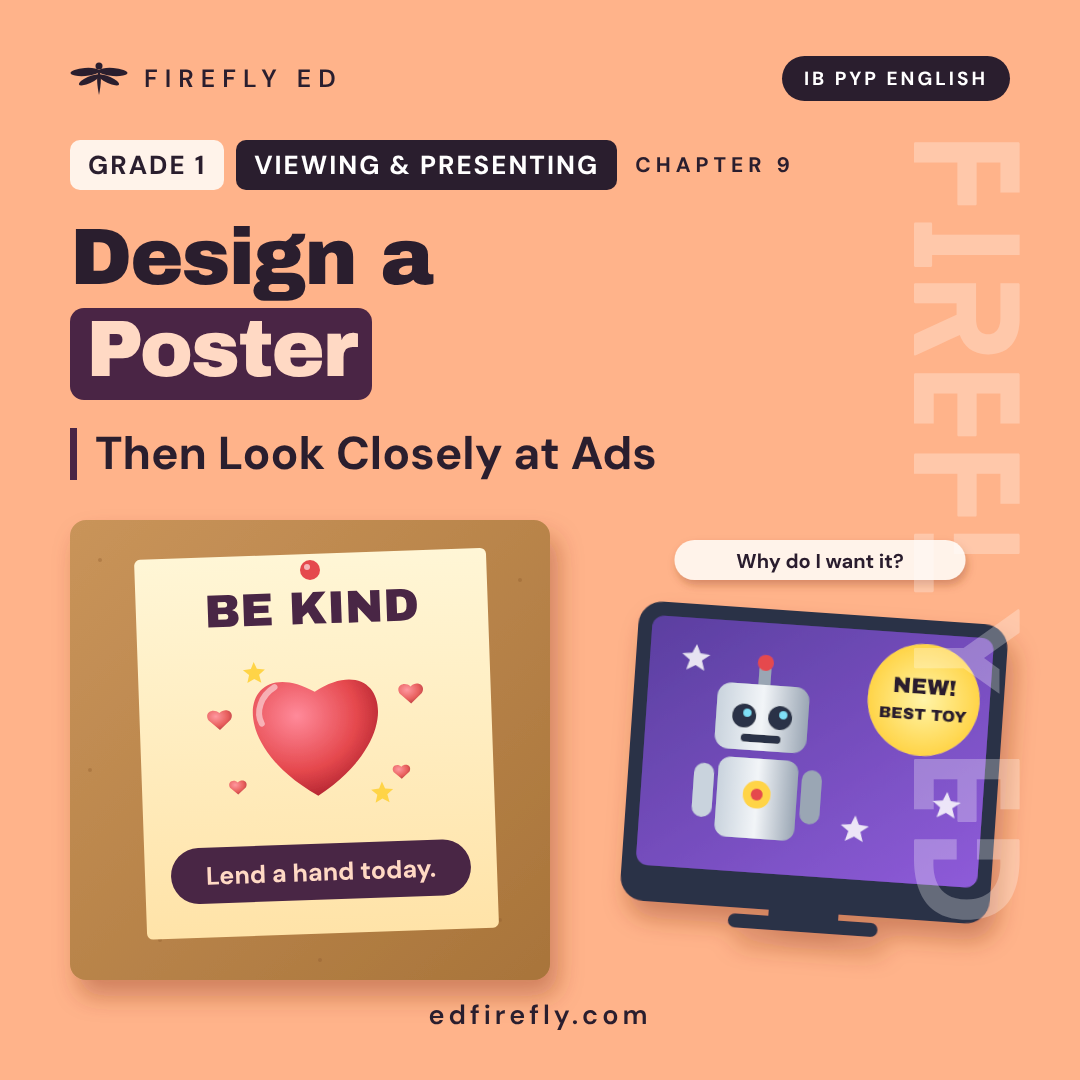
Lesson 9.7: Design a Poster
Presenting. Key concept: Responsibility. Learner profile: Caring. Approach to learning: communication skills.
IB PYP
- Visual language (Phase 1): select and incorporate colours, shapes, symbols and images into visual presentations
- Visual language (Phase 2): attend to visual information showing understanding through discussion, role play, illustrations
England, Year 1
Common Core, Grade 1
- SL.1.5: Add drawings or other visual displays to descriptions when appropriate to clarify ideas, thoughts and feelings
Lesson 9.8: Why Do Ads Make Us Want Things?
Viewing. Key concept: Perspective. Learner profile: Thinkers. Approach to learning: thinking skills.
IB PYP
- Visual language (Phase 2): talk about their own feelings in response to visual messages; show empathy for the way others might feel
- Visual language (Phase 1): recognize familiar signs, labels and logos; identify similarities and differences
England, Year 1
- Participate in discussion about what is read to them, taking turns and listening to what others say
- Explain clearly their understanding
Common Core, Grade 1
- RI.1.6: Distinguish between information provided by pictures and information provided by the words
- SL.1.2: Ask and answer questions about information presented through media
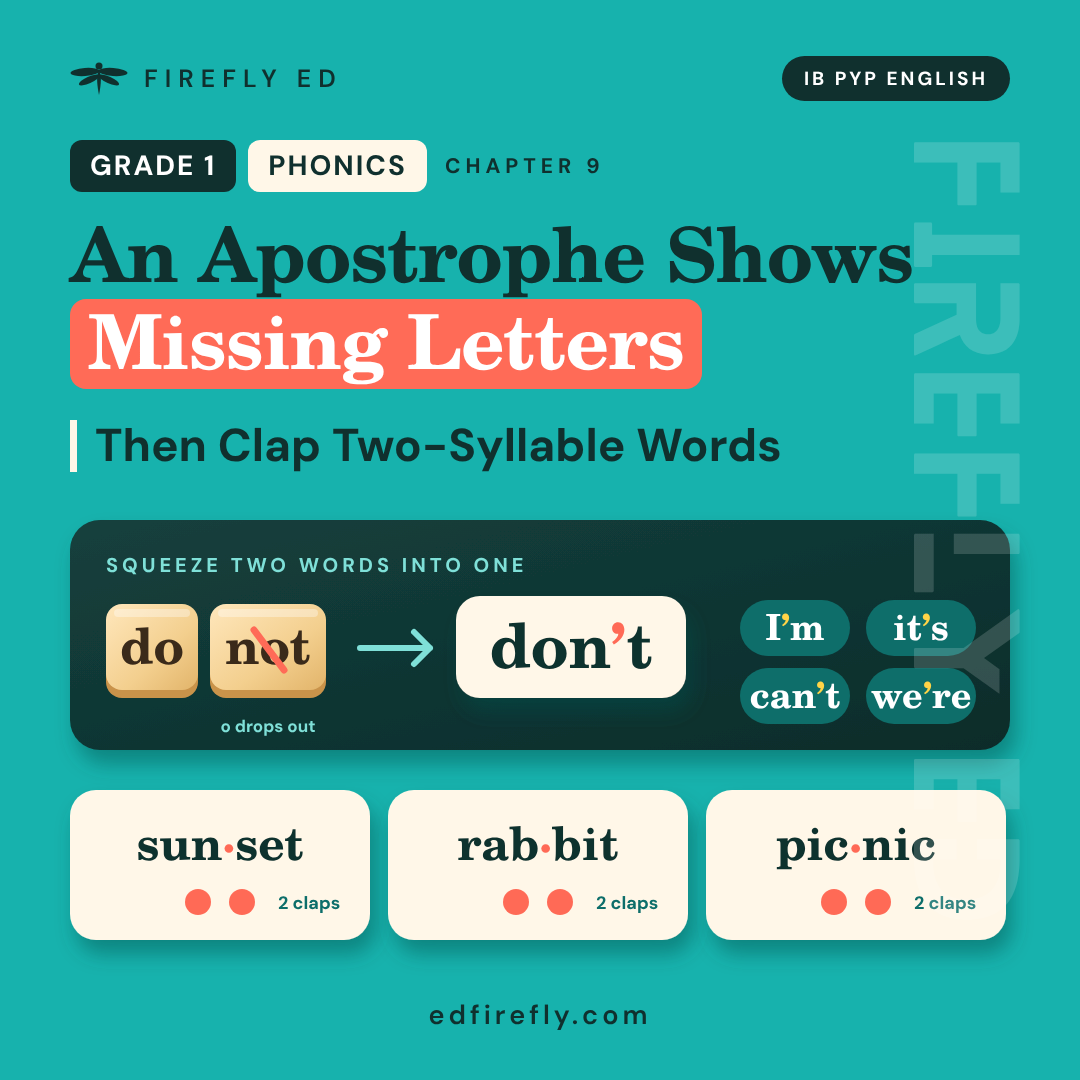
Lesson 9.9: Contractions: I’m, can’t, don’t
Reading and spelling. Key concept: Function. Learner profile: Knowledgeable. Approach to learning: communication skills.
IB PYP, Phase 2
- Reading: understand sound-symbol relationships and recognize familiar sounds/symbols/words of the language community
- Writing: connect written codes with the sounds of spoken language and reflect this understanding when recording ideas
England, Year 1
- Read words with contractions, for example I’m, I’ll, we’ll, and understand that the apostrophe represents the omitted letter(s)
Common Core, Grade 1
- L.1.2: Demonstrate command of the conventions of standard English capitalization, punctuation and spelling when writing
Lesson 9.10: Two-Syllable Words
Reading and spelling. Key concept: Function. Learner profile: Risk-takers. Approach to learning: self-management skills.
IB PYP, Phase 2
- Reading: understand sound-symbol relationships and recognize familiar sounds/symbols/words of the language community
- Writing: connect written codes with the sounds of spoken language and reflect this understanding when recording ideas
England, Year 1
- Read other words of more than one syllable that contain taught GPCs
- Divide words into syllables, for example pocket, rabbit, carrot, thunder, sunset
Common Core, Grade 1
- RF.1.3d and RF.1.3e: use knowledge that every syllable must have a vowel sound; decode two-syllable words following basic patterns by breaking the words into syllables
Lesson 9.11: Tricky Words: Year Review
Reading and spelling. Key concept: Responsibility. Learner profile: Reflective. Approach to learning: self-management skills.
IB PYP, Phase 2
- Reading: understand sound-symbol relationships and recognize familiar sounds/symbols/words of the language community
- Writing: connect written codes with the sounds of spoken language and reflect this understanding when recording ideas
England, Year 1
- Read common exception words, noting unusual correspondences between spelling and sound
- Spell common exception words
Common Core, Grade 1
- RF.1.3g: Recognize and read grade-appropriate irregularly spelled words
Lesson 9.12: Lesson 9 Review
All strands. Key concept: Function, Responsibility and Perspective. Learner profile: Reflective. Approach to learning: self-management skills.
This review checks the outcomes from Lessons 9.1 to 9.11.
IB PYP
- Phases 1 and 2, across reading, writing, oral language and visual language
England, Year 1
- Divide words into syllables
- Read words with contractions
- Spell common exception words
Common Core, Grade 1
- RI.1.5, W.1.1, SL.1.3 and RF.1.3e
For how the lessons run, see How to Use This Material.
All Grade 1 English lessons | Download lesson PDFs
© 2026 Firefly Ed. All rights reserved. This page may be printed for personal, home and classroom use. It may not be sold, shared online or reproduced for commercial use without written permission. edfirefly.com


Share your thoughts or ask something..