
Term 2 | Level 2 | Phonics focus: ai/ay, ee/ea, oa/ow, -ing, -ed
Lesson 5 – Food and Celebrations | Lessons – Index
Lessons
This page has the two writing lessons in Lesson 5, Food and Celebrations: Lessons 5.3 and 5.4. The Lesson 5 page has the Lesson 5 overview, the Lesson 5 review and the PDF download.
Select a lesson to go straight to it. Each lesson ends with a link back to the top of the page.
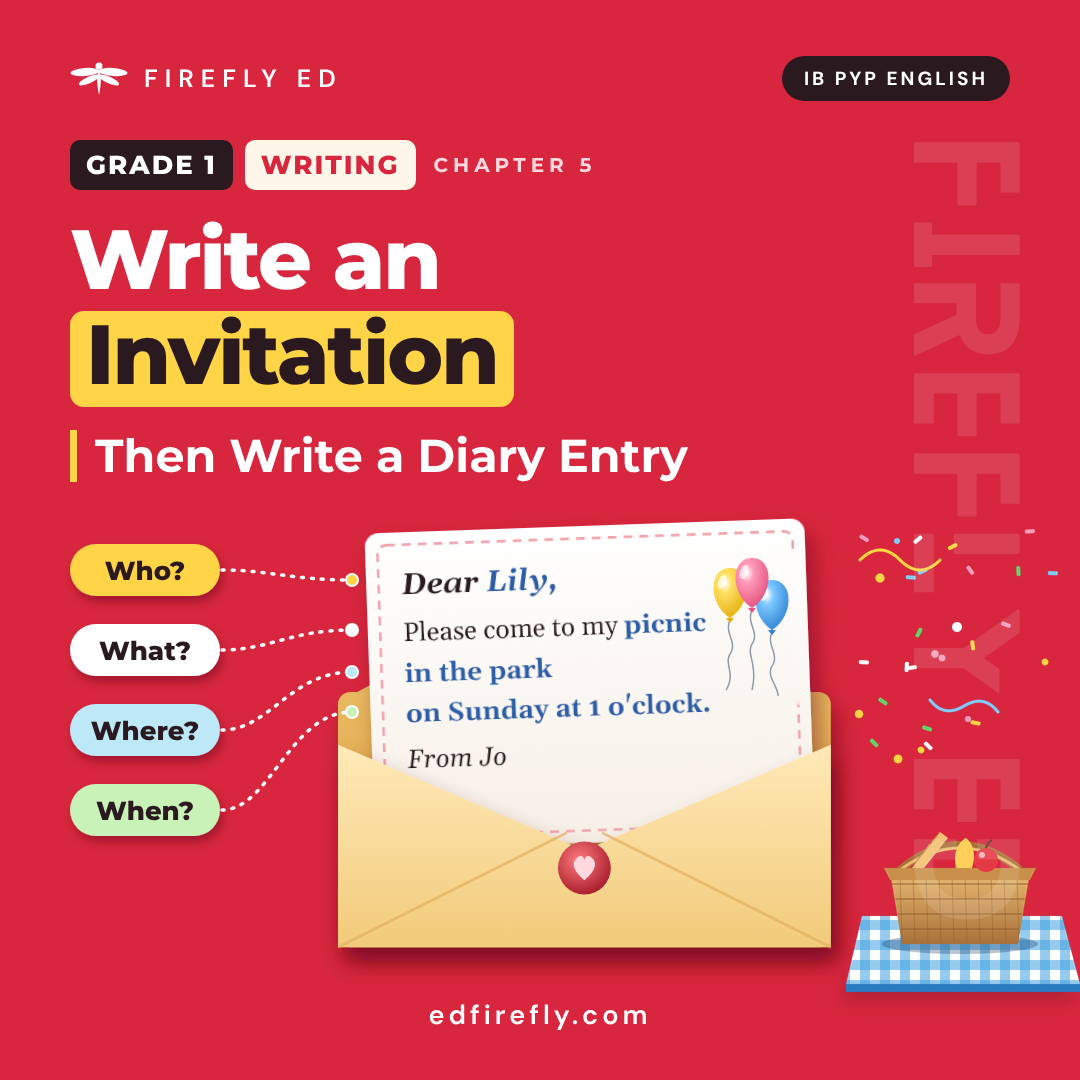
Lesson 5.3: Write an Invitation
Writing | About 20 minutes
Term 2 | Level 2
Goal
“I can write an invitation that tells who, what, when and where.”
Words to know
invitation, who, what, when, where
Wonder
Think about this question before you start. Say your ideas. You will come back to it at the end of the lesson.
What does a guest need to know about a party?
Let’s Learn
An invitation asks someone to come to an event, such as a party or a special meal.
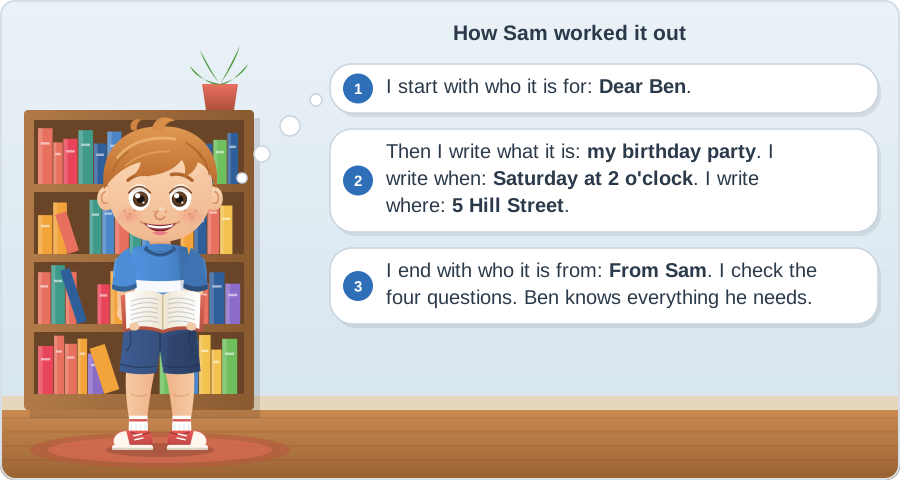
A good invitation answers four questions. Who is it for? What is the event? When is it? Where is it?
It ends with who it is from, so the guest knows who invited them.
See How It’s Done
Now Try It
Listen as an adult reads the invitation. Then answer.
Dear Lily, Please come to my picnic in the park. From Jo
1. Who is the invitation for?
Hint: Look after the word “Dear”.
2. What is missing from this invitation?
Hint: Check the four questions. Does it say when?
Time To Practise
Name: ______________________
1. Read the invitation.
Circle the answer.
a) Who is it for? Arjun Nina Tom
b) What is the event? a birthday party a picnic a Diwali dinner
c) When is it? Friday at 6 o’clock Sunday at 1 o’clock Monday
d) Where is it? at school 3 Green Road the park
2. Fix the invitation.
This invitation is missing two things. Write them in.
When: It is on ______________________________.
Where: It is at ______________________________.
3. Write your own invitation.
Invite someone to a celebration or a special meal. Answer all four questions.
Word bank: party | lunch | picnic | o’clock
Dear ____________________,
Please come to ______________________________.
It is on ______________________________.
It is at ______________________________.
From ____________________
Reflect
Think about these questions. Talk about them with someone at home or at school.
1. Go back to the Wonder question: “What does a guest need to know about a party?” What do you think now?
2. I was caring today when I ______________________________.
Being caring means being kind and helping others. For example: I was caring today when I wrote an invitation so a friend could come to my party.
Take action: Write a real invitation for a family meal or a play date and give it to your guest.
Next Steps
If this was easy, try: Make an invitation for a real family event. Add a sentence that tells the guest what to bring.
If this was hard, go back to: See How It’s Done. Say the invitation out loud first, answering each of the four questions. Then copy the frame and fill in one line at a time.
Notes for Parents and Teachers
Show notes for parents and teachers
These notes cover this lesson only. How every lesson runs is explained in How to Use This Material.
Let’s Learn
Point to each question card.
See How It’s Done
Write the invitation where the learner can see it, one part at a time, as you go through Sam’s thoughts.
Answer Key
Reveal Answers
Now Try It
1. Lily
2. It does not say when the picnic is.
1. Read the invitation
a) Nina
b) a Diwali dinner
c) Friday at 6 o’clock
d) 3 Green Road
Look for: in a), a learner who circles Arjun has picked the person who wrote it. Point to “Dear” and “From”.
2. Fix the invitation
Sample answer: It is on Saturday at 12 o’clock. It is at 8 Rose Lane.
Look for: a day and a time for “when”, and a place for “where”. Any sensible answer is correct.
3. Write your own invitation
Sample answer: Dear Gran, Please come to my birthday party. It is on Sunday at 3 o’clock. It is at our house. From Leo
Look for: all four questions answered, and a “Dear” and “From”. Capital letters for names and days.
Reflect
2. Any real moment from the lesson that shows the learner was caring. Examples: “I was caring today when I wrote an invitation so a friend could come to my party.” “I was caring today when I thought about what my guest needs to know.”
Lesson 5.4: My Celebration Diary
Writing | About 20 minutes
Term 2 | Level 2
Goal
“I can write a diary entry about a special day and say how I felt and why.”
Words to know
diary, date, feeling, because
Wonder
Think about this question before you start. Say your ideas. You will come back to it at the end of the lesson.
How do you feel on a special day, and why?
Let’s Learn
A diary is where we write about our own day. We write it for ourselves.
A diary entry starts with the date. It uses “I” and tells what happened, in order.
It also tells how we felt and why. We can use the words “I felt … because …”.
See How It’s Done
Saturday 4 May
Today was Gran’s birthday. We went to her house and ate chocolate cake. I gave her a card that I made. I felt happy because Gran smiled and gave me a big hug.

Now Try It

1. In the diary entry in See How It’s Done, what is the date?
Hint: It is at the very top.
2. Look at the picture. Finish the sentence out loud: I felt ______ because ______.
Hint: Look at the face. Then look at what happened to the balloon.
Time To Practise
Name: ______________________
Read with an adult.

Sunday 12 November
Today was Diwali. In the morning, I helped Nani make sweets. At night, we lit lots of small lamps. My cousins came over and we ate a big dinner. I felt excited because the whole sky was full of lights.
1. Read the diary entry.
a) What was the special day? a birthday Diwali Eid
b) How did the writer feel? sad cross excited
c) Why did the writer feel that way? Write one sentence.
______________________________________________
2. Join the feeling to the reason.

Write the letter.
1. I felt happy ____ 2. I felt sad ____ 3. I felt excited ____
A. because my balloon popped.
B. because we were going to the fair the next day.
C. because Grandpa came to visit.
3. Write your own diary entry.
Think of a special day, such as a birthday, a festival or a family meal. Draw it. Then write about it.
Word bank: happy | excited | proud | because
Date: ____________________
Today ______________________________________________
______________________________________________
I felt ______________ because ______________________________.
Reflect
Think about these questions. Talk about them with someone at home or at school.
1. Go back to the Wonder question: “How do you feel on a special day, and why?” What do you think now?
2. I was reflective today when I ______________________________.
Being reflective means looking back at your work and thinking how to make it better. For example: I was reflective today when I wrote about a special day and how I felt.
Take action: Ask a family member about their favourite celebration and how it made them feel. Write one sentence about it.
Next Steps
If this was easy, try: Keep a diary for a week. Write one entry each day with an “I felt … because …” sentence.
If this was hard, go back to: Now Try It. Say your diary entry out loud first. Then write just the date and the “I felt … because …” sentence.
Notes for Parents and Teachers
Show notes for parents and teachers
These notes cover this lesson only. How every lesson runs is explained in How to Use This Material.
See How It’s Done
Read the diary entry aloud before Pam’s thoughts.
Answer Key
Reveal Answers
Now Try It
1. Saturday 4 May
2. Sample answer: I felt sad because my balloon popped.
1. Read the diary entry
a) Diwali
b) excited
c) The writer felt excited because the whole sky was full of lights.
2. Join the feeling to the reason
1 C, 2 A, 3 B (also accept 1 B, 3 C if the learner gives a sensible reason)
3. Write your own diary entry
Sample answer: Date: Saturday 3 June. Today was my birthday. We had a picnic in the park and I blew out six candles. I felt proud because I made the invitations myself.
Look for: a date, two or three sentences about what happened in order, and an “I felt … because …” sentence with a real reason. Accept sound-based spelling.
Reflect
2. Any real moment from the lesson that shows the learner was reflective. Examples: “I was reflective today when I wrote about a special day and how I felt.” “I was reflective today when I looked back at my diary entry and added a feeling.”
For Teachers: IB Details
Show IB and curriculum details
IB theme: How we express ourselves. This theme is about how we find and share ideas, feelings, culture and beliefs: through creativity, through the different ways we communicate, and through how others respond.
Central idea: People share food and celebrations to express who they are and what they value.
| Lesson | Title | Strand | Key concept |
|---|---|---|---|
| 5.3 | Write an Invitation | Writing | Connection |
| 5.4 | My Celebration Diary | Writing | Perspective |
Each lesson also matches the national curriculum for England (Year 1) and the US Common Core (Grade 1). The Grade 1 Curriculum Map lists the full standards for every lesson.
← Back to Lesson 5 – Food and Celebrations | Lessons – Index
© 2026 Firefly Ed. All rights reserved. This page may be printed for personal, home and classroom use. It may not be sold, shared online or reproduced for commercial use without written permission. edfirefly.com



Share your thoughts or ask something..