
Term 3 | Level 3 | Phonics focus: oo, ou/ow, oi/oy, aw/au, ew/ue, days of the week
Lesson 7 – Weather and Seasons | Lessons – Index
Lessons
This page has the two writing lessons in Lesson 7, Weather and Seasons: Lessons 7.3 and 7.4. The Lesson 7 page has the Lesson 7 overview, the Lesson 7 review and the PDF download.
Select a lesson to go straight to it. Each lesson ends with a link back to the top of the page.
Lesson 7.3: Word Swaps: Describing Words
Writing | About 20 minutes
Term 3 | Level 3
Goal
“I can swap plain words for stronger describing words to make my writing clearer.”
Words to know
describing word, plain word, word swap, stronger
Wonder
Think about this question before you start. Say your ideas. You will come back to it at the end of the lesson.
Why do writers choose some words instead of others?
Let’s Learn
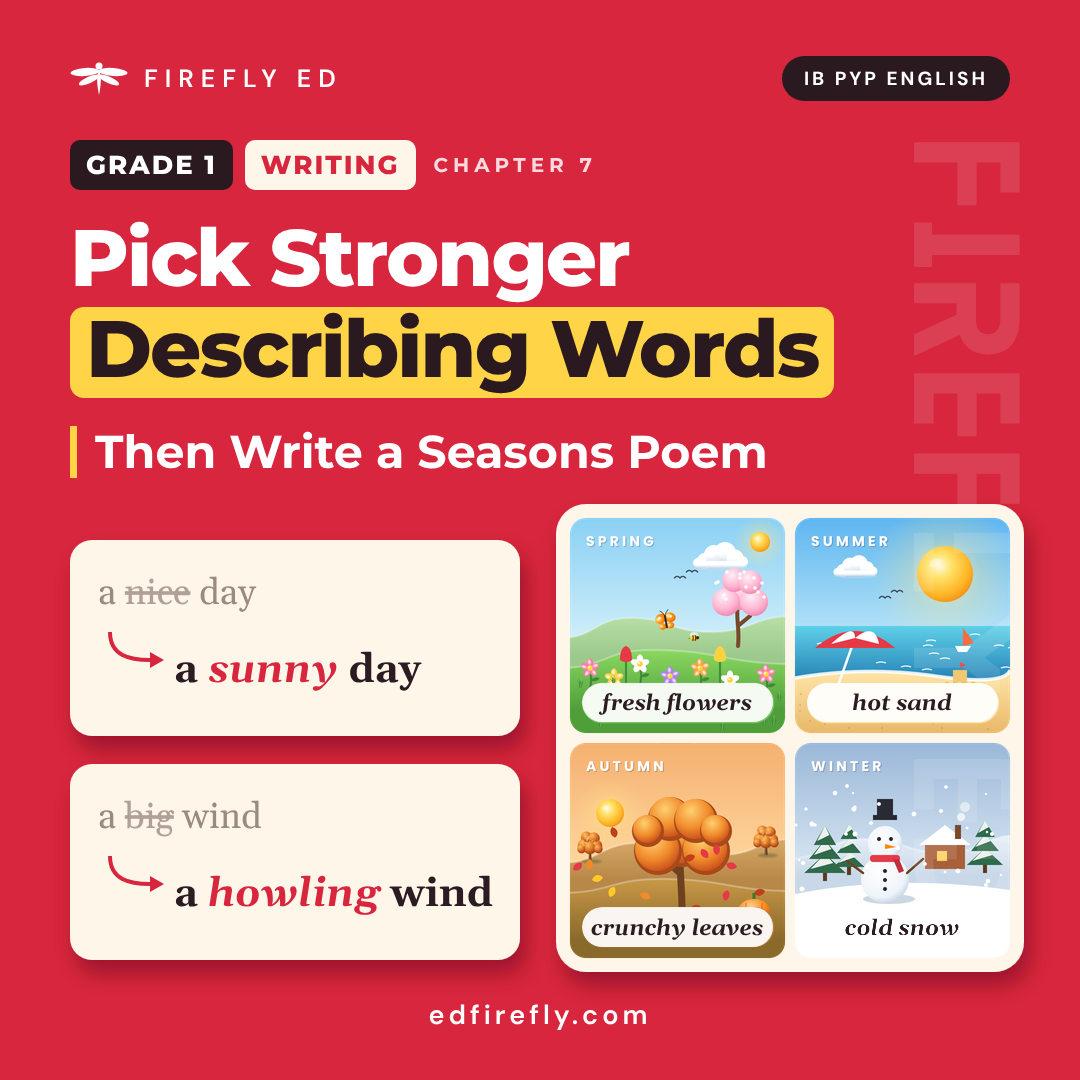
Describing words tell us what something is like. They help the reader see, hear and feel what we are writing about.
Some describing words are plain, such as good, bad, nice, big and cold. They do not tell the reader very much.
A word swap changes a plain word for a stronger, more exact word. Instead of a bad day, we can write a stormy day or a gloomy day.
See How It’s Done

Now Try It
1. Swap the plain word: “It was a nice day.” Look at the sun picture. What stronger word could you use?
Hint: Think of words like sunny, bright or warm.
2. Swap the plain word: “The wind was big.” What stronger word could you use?
Hint: What does a very strong wind sound like? Think of strong, wild or howling.
Time To Practise
Name: ______________________
1. Word swap.
Swap the underlined plain word for a stronger word from the word bank. Write the new word.
Word bank: fluffy | gloomy | gentle | scorching | icy
a) The sky was bad and dark. ______________
b) The cold wind made my nose red. ______________
c) It was a hot day at the beach. ______________
d) A little rain fell on the flowers. ______________
e) The clouds were soft and white. ______________
2. Describe the picture.
Write four sentences about this snowy day. Use at least three strong describing words. You can use words from Task 1 or your own.
______________________________________________
______________________________________________
______________________________________________
______________________________________________
3. Make it better.
Read this plain writing. Write it again with word swaps. Change at least four plain words.
It was a bad day. The wind was big. The rain was bad. I was cold. Then the sun came out and it was nice.
______________________________________________
______________________________________________
______________________________________________
______________________________________________
______________________________________________
Reflect
Think about these questions. Talk about them with someone at home or at school.
1. Go back to the Wonder question: “Why do writers choose some words instead of others?” What do you think now?
2. I was a risk-taker today when I ______________________________.
A risk-taker tries something new, even when it feels hard. For example: I was a risk-taker today when I swapped a plain word for a stronger word.
Take action: Look out of the window and describe today’s weather to someone using two strong describing words.
Next Steps
If this was easy, try: Make a word swap chart for the wall. Write five plain words and three stronger words for each one.
If this was hard, go back to: Task 1. Say each sentence aloud with each word from the bank until one sounds right.
Notes for Parents and Teachers
Show notes for parents and teachers
These notes cover this lesson only. How every lesson runs is explained in How to Use This Material.
Let’s Learn
Point to each word in the swap.
See How It’s Done
Write the new sentence on paper as you go through Leo’s thoughts, so that the learner can see it.
Answer Key
Reveal Answers
Now Try It
1. Sample answers: sunny, bright, warm
2. Sample answers: strong, wild, howling
1. Word swap
a) gloomy
b) icy
c) scorching
d) gentle
e) fluffy
2. Describe the picture
Sample answer: It was a freezing winter day. Soft, white snow fell from the grey sky. The bare tree stood in the deep snow. I wrapped my warm blue scarf around my neck.
Look for: four sentences about the picture; at least three describing words that are more exact than plain words like cold or nice.
3. Make it better
Sample answer: It was a stormy day. The wind was wild and howling. The rain was heavy. I was freezing. Then the golden sun came out and it was warm and bright.
Look for: at least four swaps; the meaning of each sentence stays the same; capital letters and full stops.
Reflect
2. Any real moment from the lesson that shows the learner was a risk-taker. Examples: “I was a risk-taker today when I swapped a plain word for a stronger word.” “I was a risk-taker today when I tried a new describing word I had not used before.”
Lesson 7.4: Write a Seasons Poem
Writing | About 20 minutes
Term 3 | Level 3
Goal
“I can write a pattern poem about a season using my senses.”
Words to know
pattern poem, season, senses, describing word
Wonder
Think about this question before you start. Say your ideas. You will come back to it at the end of the lesson.
What changes when one season turns into the next?
Let’s Learn
A pattern poem repeats the same words at the start of each line. The pattern makes the poem easy to write and fun to read aloud.
A seasons poem uses our senses. We tell what we see, hear and feel in that season.
The poem does not need to rhyme. Choose strong describing words to help the reader imagine the season.
See How It’s Done
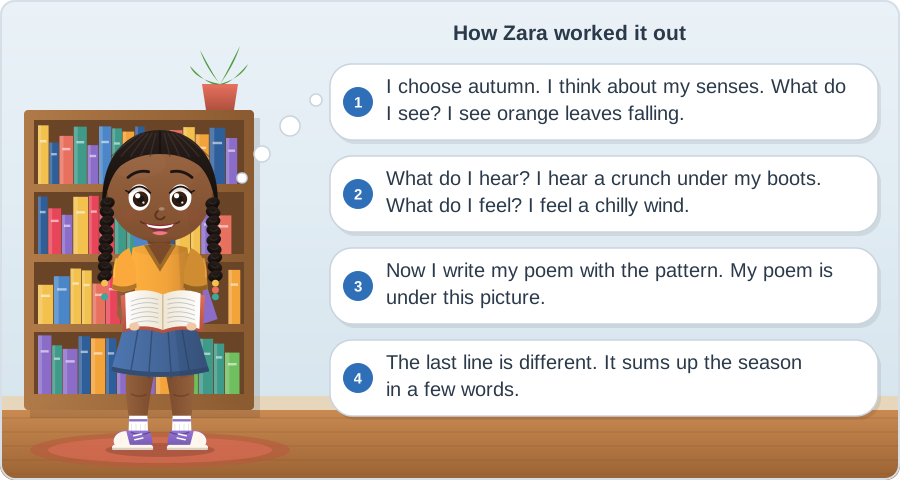
In autumn I see orange leaves falling.
In autumn I hear a crunch under my boots.
In autumn I feel a chilly wind on my face.
Autumn is crunchy and cool.
Now Try It
1. Say a line for winter: “In winter I see …”
Hint: Look at the picture. What is on the ground? What is on the tree?
2. Say a line for winter: “In winter I feel …”
Hint: Think about touching snow, or stepping outside on a winter morning.
Time To Practise
Name: ______________________
1. Which season?
Write spring, summer, autumn or winter after each line.
a) In ______ I hear dry leaves crunch. ______________
b) In ______ I see pink blossom on the trees. ______________
c) In ______ I feel snow melt on my glove. ______________
d) In ______ I feel the hot sun on my arms. ______________
2. Plan with your senses.
Choose one season: ______________
Write two ideas for each sense.
I see: ______________________________________________
I hear: ______________________________________________
I feel: ______________________________________________
I smell (if you like): ______________________________________________
3. Write your seasons poem.
Use the pattern. Write four lines, then a last line that sums up the season. Then draw a picture for your poem.
In ______________ I see ______________________________________
In ______________ I hear ______________________________________
In ______________ I feel ______________________________________
In ______________ I ______________________________________
______________ is ______________________________________
Reflect
Think about these questions. Talk about them with someone at home or at school.
1. Go back to the Wonder question: “What changes when one season turns into the next?” What do you think now?
2. I was reflective today when I ______________________________.
Being reflective means looking back at your work and thinking how to make it better. For example: I was reflective today when I read my poem again and made it better.
Take action: Read your seasons poem to your family. Add a new verse when the season changes.
Next Steps
If this was easy, try: Write a second verse for a different season. Read both verses to your family.
If this was hard, go back to: See How It’s Done. Read the autumn poem aloud together. Then write just three lines with the pattern: I see, I hear and I feel.
Notes for Parents and Teachers
Show notes for parents and teachers
These notes cover this lesson only. How every lesson runs is explained in How to Use This Material.
Let’s Learn
Point to each season as you name it.
See How It’s Done
Write Zara’s poem on paper as you go through her thoughts, so that the learner can see it.
Answer Key
Reveal Answers
Now Try It
1. Sample answer: In winter I see white snow on the bare branches.
2. Sample answer: In winter I feel cold snow on my fingers.
1. Which season?
a) autumn
b) spring
c) winter
d) summer
2. Plan with your senses
Sample answer (summer): I see: a blue sea, ice cream. I hear: waves, children laughing. I feel: hot sand, cool water. I smell: sun cream.
3. Write your seasons poem
Sample answer:
In summer I see a bright blue sea.
In summer I hear children laughing on the sand.
In summer I feel hot sand under my feet.
In summer I smell sweet sun cream.
Summer is sunny and full of fun.
Look for: the pattern kept on each line; ideas from the plan; at least three senses; a last line that sums up the season; a picture that matches. Note: in places near the equator, seasons may be wet and dry instead of four seasons. Let the learner write about the seasons where they live.
Reflect
2. Any real moment from the lesson that shows the learner was reflective. Examples: “I was reflective today when I read my poem again and made it better.” “I was reflective today when I changed a word in my poem to make it clearer.”
For Teachers: IB Details
Show IB and curriculum details
IB theme: How the world works. This theme is about how the natural world works: the patterns we can see in nature, such as weather and seasons, and how these patterns affect people, plants and animals.
Central idea: Weather and seasons change in patterns, and these changes affect how people and other living things live.
| Lesson | Title | Strand | Key concept |
|---|---|---|---|
| 7.3 | Word Swaps: Describing Words | Writing | Connection |
| 7.4 | Write a Seasons Poem | Writing | Change |
Each lesson also matches the national curriculum for England (Year 1) and the US Common Core (Grade 1). The Grade 1 Curriculum Map lists the full standards for every lesson.
← Back to Lesson 7 – Weather and Seasons | Lessons – Index
© 2026 Firefly Ed. All rights reserved. This page may be printed for personal, home and classroom use. It may not be sold, shared online or reproduced for commercial use without written permission. edfirefly.com



Share your thoughts or ask something..