
Term 3 | Level 3 | Phonics focus: y, ea, soft c and g, wh, ph, -er, -est, un-
Lesson 8 – Friends and Feelings | Lessons – Index
Lessons
This page has the two writing lessons in Lesson 8, Friends and Feelings: Lessons 8.3 and 8.4. The Lesson 8 page has the Lesson 8 overview, the Lesson 8 review and the PDF download.
Select a lesson to go straight to it. Each lesson ends with a link back to the top of the page.
Lesson 8.3: Make-Believe Character
Writing | About 20 minutes
Term 3 | Level 3
Goal
“I can invent a character, describe what it looks like and what it is like inside, and write what it does.”
Words to know
character, outside, inside, describe
Wonder
Think about this question before you start. Say your ideas. You will come back to it at the end of the lesson.
What makes a story character feel real?
Let’s Learn
A make-believe character is a person, animal or creature that you invent. It can be anything you imagine.
To make a character feel real, describe two things. What does it look like on the outside? What is it like on the inside: kind, brave, shy or grumpy?
Then show what the character does. What does it like? What special thing can it do? What problem might it have? These ideas help you write a story about it later.
See How It’s Done
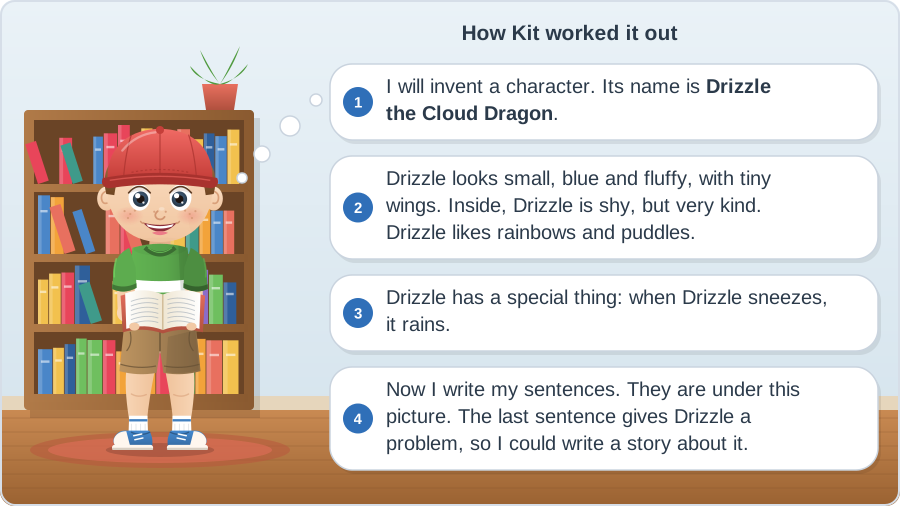
Drizzle is a small, fluffy cloud dragon with tiny wings. Drizzle is shy, but very kind. Drizzle loves to float over rainbows. When Drizzle sneezes, it starts to rain! One day, Drizzle sneezed on a sunny picnic by mistake.
Now Try It
1. Find two words that tell what Drizzle looks like.
Hint: Look at the picture. What colour is Drizzle? What size?
2. Find one word that tells what Drizzle is like on the inside.
Hint: Inside words tell how a character acts or feels, not how it looks.
Time To Practise
Name: ______________________
1. Outside or inside?
Sort the describing words. Write each one in the right box.
Words: tall | brave | spotty | shy | furry | kind | tiny | grumpy
| Looks like (outside) | Is like (inside) |
|---|---|
| ______________________________ | ______________________________ |
| ______________________________ | ______________________________ |
2. Plan your character.
Name: ______________________________________________
Looks like: ______________________________________________
Is like inside: ______________________________________________
Likes: ______________________________________________
Special thing it can do: ______________________________________________
A problem it might have: ______________________________________________
3. Draw and write.
Draw your character. Then write four to six sentences about it. Say what it looks like, what it is like inside and what it does.
______________________________________________
______________________________________________
______________________________________________
______________________________________________
______________________________________________
Reflect
Think about these questions. Talk about them with someone at home or at school.
1. Go back to the Wonder question: “What makes a story character feel real?” What do you think now?
2. I was a risk-taker today when I ______________________________.
A risk-taker tries something new, even when it feels hard. For example: I was a risk-taker today when I made up my own character.
Take action: Tell your make-believe character story to a friend. Ask them what they think your character will do next.
Next Steps
If this was easy, try: Invent a second character who is a friend of your first one. Write how they are the same and how they are different.
If this was hard, go back to: Now Try It. Describe a toy or a pet first, using one outside word and one inside word. Then plan a make-believe character.
Notes for Parents and Teachers
Show notes for parents and teachers
These notes cover this lesson only. How every lesson runs is explained in How to Use This Material.
Let’s Learn
Point to each part of the plan.
See How It’s Done
Write Kit’s sentences on paper as you go through Kit’s thoughts, so that the learner can see them.
Answer Key
Reveal Answers
Now Try It
1. Any two of: small, blue, fluffy, tiny wings
2. shy or kind
1. Outside or inside?
Looks like: tall, spotty, furry, tiny
Is like: brave, shy, kind, grumpy
2. Plan your character
Sample answer: Name: Bolt. Looks like: a tiny, silver robot with a round head. Is like inside: brave and helpful. Likes: fixing things and bright lights. Special thing: can fly for one minute. Problem: gets rusty in the rain.
3. Draw and write
Sample answer: Bolt is a tiny, silver robot with a round head. He is brave and always helps his friends. Bolt likes fixing broken toys. He can fly, but only for one minute. When it rains, Bolt gets rusty and creaky. His friend Mia keeps him dry with her umbrella.
Look for: at least one outside word and one inside word; something the character does or can do; four to six sentences with capital letters and full stops; a drawing that matches the words. Keep this plan for Lesson 8.4.
Reflect
2. Any real moment from the lesson that shows the learner was a risk-taker. Examples: “I was a risk-taker today when I made up my own character.” “I was a risk-taker today when I tried a new idea for a story.”
Lesson 8.4: Plan and Write a Story
Writing | About 20 minutes
Term 3 | Level 3
Goal
“I can plan a story with a beginning, middle and end, and then write it.”
Words to know
plan, beginning, middle, end, problem
Wonder
Think about this question before you start. Say your ideas. You will come back to it at the end of the lesson.
How does planning help us tell a good story?
Let’s Learn
A good story has a beginning, a middle and an end.
The beginning tells who the story is about and where it happens. The middle has a problem: something goes wrong. The end tells how the problem is fixed and how the characters feel.
Writers plan before they write. A plan can be a few words or quick drawings in three boxes. Then each box becomes one or two sentences.
See How It’s Done
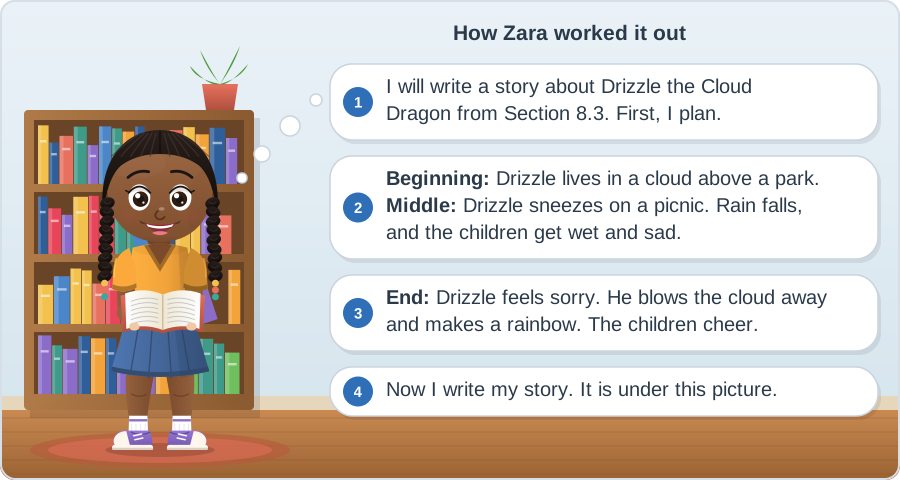
Drizzle the Cloud Dragon lived in a cloud above the park. One sunny day, some children had a picnic on the grass. Suddenly, Drizzle sneezed. Rain poured down, and the children ran under a tree, wet and sad. Drizzle felt terrible. He blew his cloud away and painted a rainbow across the sky. The children cheered, and Drizzle smiled.
Now Try It
1. What is the problem in the Drizzle story?
Hint: Look at the middle part of the plan. What went wrong?
2. How was the problem fixed? How did everyone feel at the end?
Hint: Look at the end part of the plan.
Time To Practise
Name: ______________________
1. Beginning, middle or end?
Read these three parts of a story. Write B for beginning, M for middle or E for end.
a) At last, a tall man lifted the kite down, and Tia said a big thank you. ____
b) Tia went to the park with her new kite. ____
c) A strong wind blew the kite into the top of a tree. ____
2. Plan your story.
Use your character from Lesson 8.3, or invent a new one. Draw or write notes in each box.
3. Write your story.
Use your plan. Write six sentences or more: two for the beginning, two for the middle and two for the end. Give your story a title.
Title: ______________________________________
______________________________________________
______________________________________________
______________________________________________
______________________________________________
______________________________________________
______________________________________________
______________________________________________
When you finish, read your story aloud. Check: Does it have a problem? Is the problem fixed at the end?
Reflect
Think about these questions. Talk about them with someone at home or at school.
1. Go back to the Wonder question: “How does planning help us tell a good story?” What do you think now?
2. I was a thinker today when I ______________________________.
A thinker thinks carefully to work things out. For example: I was a thinker today when I planned my story before I wrote it.
Take action: Make your story into a small book with pictures and share it with a younger child or a friend.
Next Steps
If this was easy, try: Turn your story into a small book with a cover, a title and a picture on each page. Read it to a younger child.
If this was hard, go back to: Task 1. Then plan your story by drawing three pictures before writing any words. Write one sentence for each picture.
Notes for Parents and Teachers
Show notes for parents and teachers
These notes cover this lesson only. How every lesson runs is explained in How to Use This Material.
Let’s Learn
Point to each box in the planner.
See How It’s Done
Write Zara’s story on paper as you go through her thoughts, so that the learner can see it.
Answer Key
Reveal Answers
Now Try It
1. Drizzle sneezed on the picnic, and the rain made the children wet and sad.
2. Drizzle blew the cloud away and made a rainbow. The children felt happy and cheered, and Drizzle smiled.
1. Beginning, middle or end?
a) E
b) B
c) M
2. Plan your story
Look for: a character and a place in the first box; a clear problem in the middle box; a solution and a feeling in the last box.
3. Write your story
Sample answer: Bolt and the Rain. Bolt was a tiny, silver robot who lived with Mia. One morning, they went to the shops. On the way home, it started to pour with rain. Bolt began to creak and slow down, because rain made him rusty. Mia opened her big umbrella and held it over him. They walked home together, and Bolt was dry and happy.
Look for: a title; at least six sentences; a beginning, a problem and an ending that follow the plan; order words such as one morning, then or in the end; capital letters and full stops.
Reflect
2. Any real moment from the lesson that shows the learner was a thinker. Examples: “I was a thinker today when I planned my story before I wrote it.” “I was a thinker today when I worked out a problem and a solution for my story.”
For Teachers: IB Details
Show IB and curriculum details
IB theme: Who we are. It covers our feelings, our friendships and relationships, and how we understand and care for other people.
Central idea: Friendships grow when we understand our own feelings and the feelings of others.
| Lesson | Title | Strand | Key concept |
|---|---|---|---|
| 8.3 | Make-Believe Character | Writing | Perspective |
| 8.4 | Plan and Write a Story | Writing | Causation |
Each lesson also matches the national curriculum for England (Year 1) and the US Common Core (Grade 1). The Grade 1 Curriculum Map lists the full standards for every lesson.
← Back to Lesson 8 – Friends and Feelings | Lessons – Index
© 2026 Firefly Ed. All rights reserved. This page may be printed for personal, home and classroom use. It may not be sold, shared online or reproduced for commercial use without written permission. edfirefly.com


Share your thoughts or ask something..