
Term 3 | Level 3 | Phonics focus: oo, ou/ow, oi/oy, aw/au, ew/ue, days of the week
Lesson 7 – Weather and Seasons | Lessons – Index
Lessons
This page has the two viewing and presenting lessons in Lesson 7, Weather and Seasons: Lessons 7.7 and 7.8. The Lesson 7 page has the Lesson 7 overview, the Lesson 7 review and the PDF download.
Select a lesson to go straight to it. Each lesson ends with a link back to the top of the page.
Lesson 7.7: Read a Weather Chart
Visual | About 20 minutes
Term 3 | Level 3
Goal
“I can read a weather chart for a week and use it to find and compare facts.”
Words to know
chart, row, column, key, pattern
Wonder
Think about this question before you start. Say your ideas. You will come back to it at the end of the lesson.
How can a chart show us a pattern in the weather?
Let’s Learn
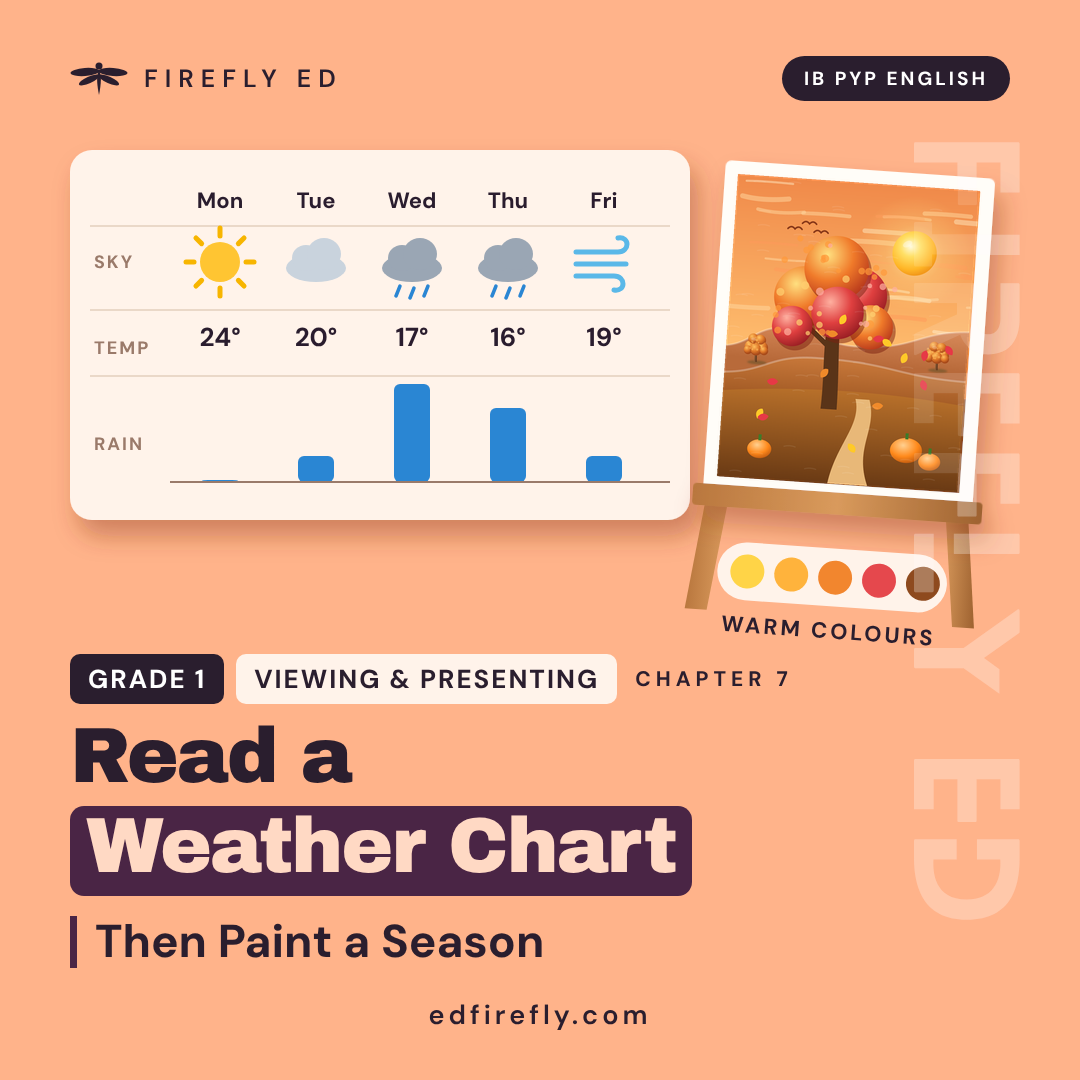
A chart puts facts into rows and columns so we can read them quickly.
In a weather chart, each column is one day. Each row is one kind of fact: the weather picture, the temperature and the rain.
To find a fact, go down the column for the day, then across to the row you need. The key tells us what the small pictures mean. When we compare the days, we can see a pattern.

See How It’s Done
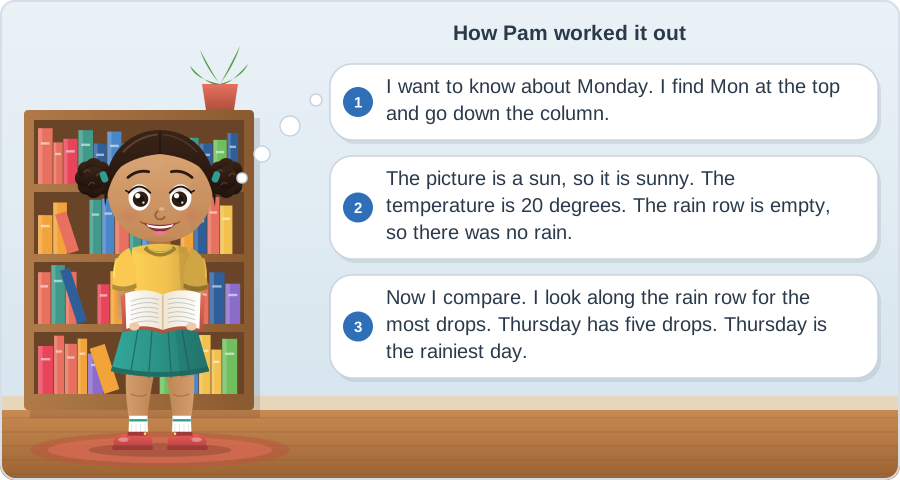
Look at the chart in Let’s Learn.
Now Try It
1. What is the weather on Friday? How much rain is there?
Hint: Find Fri at the top. Go down the column.
2. Which day is the warmest?
Hint: Look along the temperature row for the biggest number.
Time To Practise
Name: ______________________
Use the weather chart in Let’s Learn.
1. Read the chart.
a) Which day is the rainiest? ______________
b) How many days have no rain at all? ______________
c) Which day is the coldest? ______________
d) What is the weather on Saturday? ______________
2. Look for a pattern.
a) Look at the rainy days and the sunny days. What do you notice about the temperature? Write two sentences.
______________________________________________
______________________________________________
b) You want to go to the beach. Which day would you choose? Give two reasons from the chart.
______________________________________________
______________________________________________
3. Make your own chart.
Keep a weather chart for three days. Each day, draw the weather, write the temperature if you can find it, and draw raindrops if it rains. Then write one sentence about what you notice.
______________________________________________
Reflect
Think about these questions. Talk about them with someone at home or at school.
1. Go back to the Wonder question: “How can a chart show us a pattern in the weather?” What do you think now?
2. I was an inquirer today when I ______________________________.
An inquirer asks questions and finds things out. For example: I was an inquirer today when I asked questions about the weather chart.
Take action: Keep your own weather chart for one week. At the end, tell your family which weather you had most often.
Next Steps
If this was easy, try: Keep a weather chart for a whole week. At the end, write three sentences about the pattern you see.
If this was hard, go back to: See How It’s Done. Read one column at a time, saying the day, the weather, the temperature and the rain.
Notes for Parents and Teachers
Show notes for parents and teachers
These notes cover this lesson only. How every lesson runs is explained in How to Use This Material.
Let’s Learn
Point to a column, then a row, then the key.
See How It’s Done
Trace the chart in Let’s Learn with your finger as you go through Pam’s thoughts.
Answer Key
Reveal Answers
Now Try It
1. Friday is rainy, with 2 drops of rain.
2. Sunday (21 degrees)
1. Read the chart
a) Thursday
b) 3 days (Monday, Saturday and Sunday)
c) Thursday (12 degrees)
d) windy
2. Look for a pattern
a) Sample answer: On rainy days, it is colder. On sunny days, it is warmer.
b) Sample answer: I would choose Sunday. It is sunny with no rain, and it is the warmest day, 21 degrees.
Look for: facts taken from the chart, not guesses. In part a, the learner links the two rows (weather and temperature).
3. Make your own chart
Look for: a picture for each day, and a sentence that compares the days, such as “It rained on two of the three days.”
Reflect
2. Any real moment from the lesson that shows the learner was an inquirer. Examples: “I was an inquirer today when I asked questions about the weather chart.” “I was an inquirer today when I found a pattern in the weather chart.”
Lesson 7.8: Paint a Season: Colours and Feelings
Visual | About 20 minutes
Term 3 | Level 3
Goal
“I can choose colours for a season picture and explain the feeling they give.”
Words to know
warm colours, cool colours, feeling, mood
Wonder
Think about this question before you start. Say your ideas. You will come back to it at the end of the lesson.
How can colours make us feel a season?
Let’s Learn
Colours can make us feel something. Artists choose colours on purpose.
Warm colours, such as red, orange and yellow, can feel hot, happy, busy or exciting. Cool colours, such as blue, green and purple, can feel calm, fresh, cold or quiet.
Light colours can feel soft and gentle. Dark colours, such as grey and black, can feel gloomy or a little scary. The same place can feel different with different colours.
See How It’s Done
Now Try It
1. Look at the summer picture. Which colours do you see? How do they make you feel?
Hint: Is yellow a warm colour or a cool colour?
2. You want to paint a stormy night. Which colours would you choose? Why?
Hint: Think about dark colours and what feeling a storm gives.
Time To Practise
Name: ______________________
1. Colours for a season.
Which season could each colour group show? Write the season and one feeling word.
a) Season: ______________ Feeling: ______________
b) Season: ______________ Feeling: ______________
c) Season: ______________ Feeling: ______________
d) Season: ______________ Feeling: ______________
2. Plan your picture.
My season: ______________
The feeling I want to show: ______________
Three colours I will use: ______________ ______________ ______________
What I will draw: ______________________________________________
3. Paint a season.
Paint or colour your season picture. Use the colours from your plan.
Write four sentences about your picture. Say which colours you used and how they make people feel.
______________________________________________
______________________________________________
______________________________________________
______________________________________________
Then show your picture to someone. Ask: How does it make you feel? Did they feel what you wanted?
Reflect
Think about these questions. Talk about them with someone at home or at school.
1. Go back to the Wonder question: “How can colours make us feel a season?” What do you think now?
2. I was a thinker today when I ______________________________.
A thinker thinks carefully to work things out. For example: I was a thinker today when I worked out which colours show each season.
Take action: Paint or draw your favourite season. Show it to someone and ask how the colours make them feel.
Next Steps
If this was easy, try: Paint the same place twice: once with warm colours and once with cool colours. Ask your family which one they like and why.
If this was hard, go back to: Let’s Learn. Sort a box of crayons into warm colours and cool colours. Then choose just two colours for your season picture.
Notes for Parents and Teachers
Show notes for parents and teachers
These notes cover this lesson only. How every lesson runs is explained in How to Use This Material.
Let’s Learn
Point to each colour as you name it.
See How It’s Done
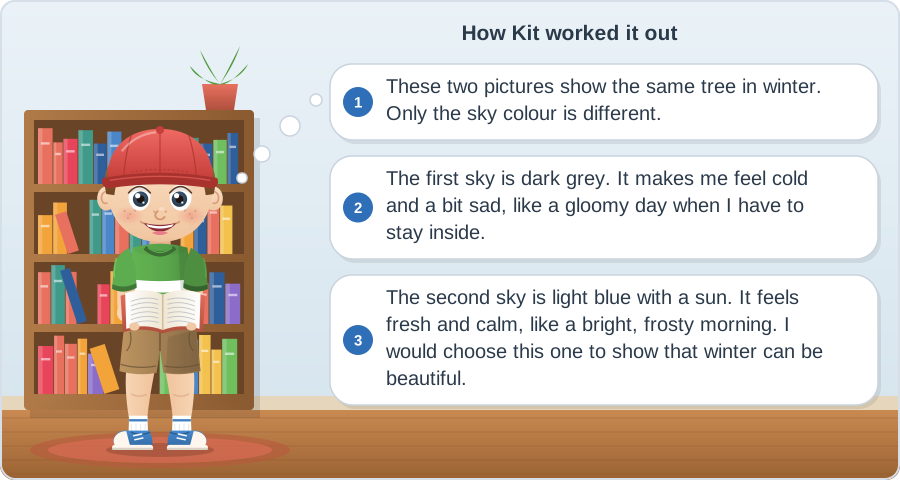
Point to each sky as you go through Kit’s thoughts.
Answer Key
Reveal Answers
Now Try It
1. Sample answer: I see yellow and green. The yellow sun feels warm and happy. The green tree feels fresh.
2. Sample answer: I would choose dark blue, black and grey, with a bit of yellow for the lightning. Dark colours feel scary, like a storm.
1. Colours for a season
Likely answers:
a) autumn; cosy or calm
b) winter; cold or quiet
c) spring; fresh or happy
d) summer; hot, bright or excited
Note: accept other answers if the learner gives a sensible reason. Colours and feelings are personal, and seasons look different in different places.
2. Plan your picture
Sample answer: My season: autumn. The feeling: cosy. Colours: orange, red and brown. What I will draw: a tree with falling leaves and a child in a warm hat.
3. Paint a season
Sample answer: I painted autumn. I used orange, red and brown for the leaves. These are warm colours, so they make the picture feel cosy. I made the sky light grey to show a chilly day.
Look for: colours that match the plan; four sentences that name colours and link them to a feeling; the learner asks a viewer for their feeling and compares it with their own.
Reflect
2. Any real moment from the lesson that shows the learner was a thinker. Examples: “I was a thinker today when I worked out which colours show each season.” “I was a thinker today when I explained why a colour gives me a feeling.”
For Teachers: IB Details
Show IB and curriculum details
IB theme: How the world works. This theme is about how the natural world works: the patterns we can see in nature, such as weather and seasons, and how these patterns affect people, plants and animals.
Central idea: Weather and seasons change in patterns, and these changes affect how people and other living things live.
| Lesson | Title | Strand | Key concept |
|---|---|---|---|
| 7.7 | Read a Weather Chart | Viewing | Change |
| 7.8 | Paint a Season: Colours and Feelings | Presenting | Connection |
Each lesson also matches the national curriculum for England (Year 1) and the US Common Core (Grade 1). The Grade 1 Curriculum Map lists the full standards for every lesson.
← Back to Lesson 7 – Weather and Seasons | Lessons – Index
© 2026 Firefly Ed. All rights reserved. This page may be printed for personal, home and classroom use. It may not be sold, shared online or reproduced for commercial use without written permission. edfirefly.com



Share your thoughts or ask something..