
Term 2 | Level 2 | Phonics focus: ai/ay, ee/ea, oa/ow, -ing, -ed
Lesson 5 – Food and Celebrations | Lessons – Index
Lessons
This page has the two viewing and presenting lessons in Lesson 5, Food and Celebrations: Lessons 5.7 and 5.8. The Lesson 5 page has the Lesson 5 overview, the Lesson 5 review and the PDF download.
Select a lesson to go straight to it. Each lesson ends with a link back to the top of the page.
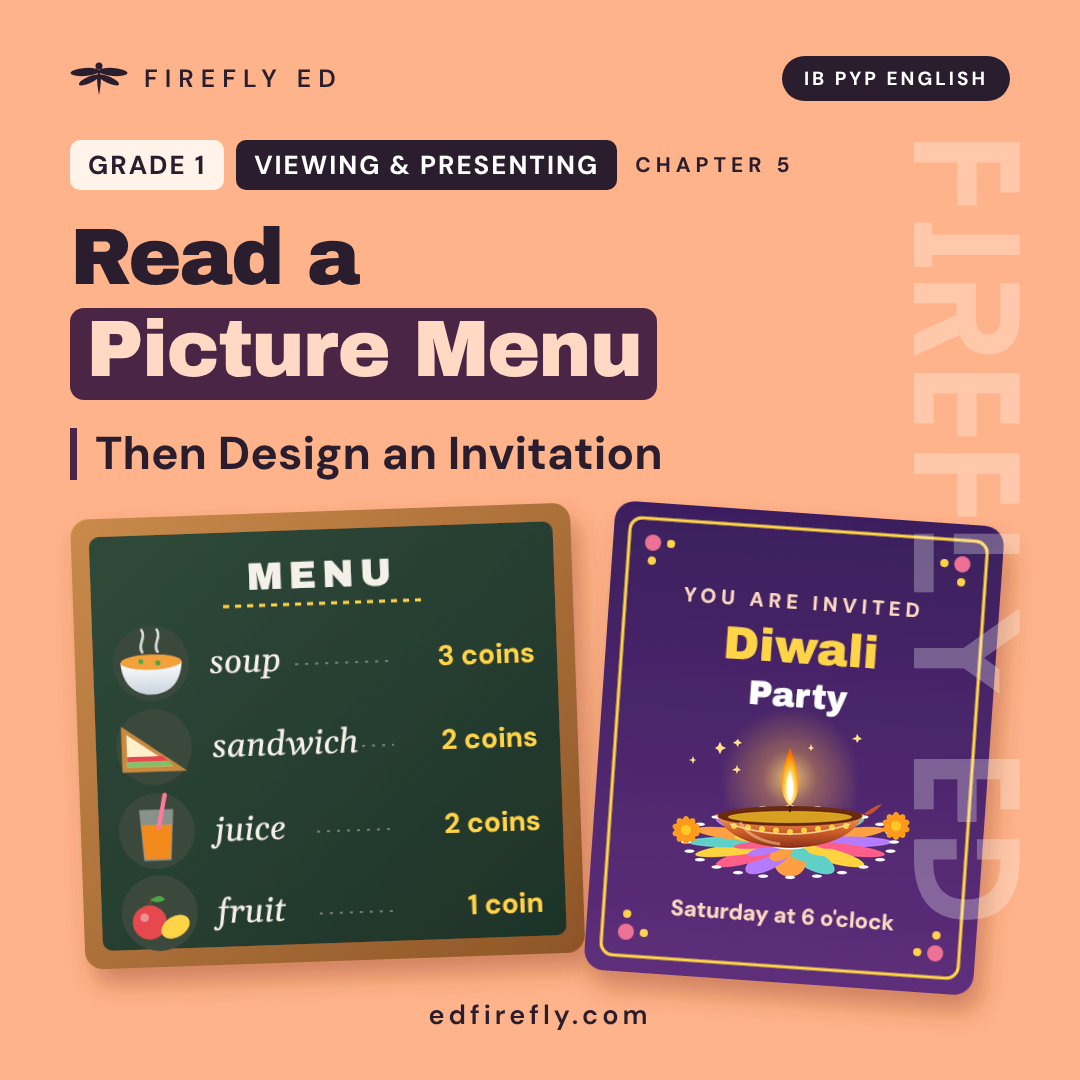
Lesson 5.7: Read a Picture Menu
Visual | About 20 minutes
Term 2 | Level 2
Goal
“I can read a picture menu to choose a meal and find what it costs.”
Words to know
menu, picture, price, cost
Wonder
Think about this question before you start. Say your ideas. You will come back to it at the end of the lesson.
How do pictures help us choose what to eat?
Let’s Learn
A menu shows the food and drinks we can choose, and what each one costs.
A picture menu uses pictures to help us read it. Each picture has a name and a price.
In our menu, the price is shown with coins. Count the coins to find the cost. To find the cost of a meal, add the coins together.
See How It’s Done
Use the menu in Time To Practise.

Now Try It
Use the menu in Time To Practise.
1. How much does the soup cost?
Hint: Find the soup picture. Count the coins under it.
2. Which drink costs less?
Hint: Look at the two drinks. Which has fewer coins?
Time To Practise
Name: ______________________

1. Read the menu.
Circle the answer.
a) How much does the rice cost? 2 coins 3 coins 4 coins
b) Which food costs 1 coin? Fruit Soup Rice
c) Which costs more? Juice Milk
2. Order a meal.
Choose one food and one drink. Add up the cost.
Food: ______________ costs ____ coins
Drink: ______________ costs ____ coins
My meal costs ____ coins.
3. Spend 5 coins.
You have 5 coins. Choose a meal that costs 5 coins or less. Say what you would choose and why. Then write two sentences.
______________________________________________
______________________________________________
Reflect
Think about these questions. Talk about them with someone at home or at school.
1. Go back to the Wonder question: “How do pictures help us choose what to eat?” What do you think now?
2. I was a thinker today when I ______________________________.
A thinker thinks carefully to work things out. For example: I was a thinker today when I worked out how much my meal would cost.
Take action: Make a picture menu for a family snack time. Let everyone choose from it.
Next Steps
If this was easy, try: Look at a real menu with an adult. Choose a meal for each person in your family and find the total cost.
If this was hard, go back to: See How It’s Done. Choose only one item at a time and count its coins. Add a second item when counting is easy.
Notes for Parents and Teachers
Show notes for parents and teachers
These notes cover this lesson only. How every lesson runs is explained in How to Use This Material.
Let’s Learn
If you can, show a real menu from a cafe or a takeaway.
See How It’s Done
Point to each picture and count the coins aloud as you go through Aisha’s thoughts.
Answer Key
Reveal Answers
Now Try It
1. 3 coins
2. Milk (1 coin)
1. Read the menu
a) 4 coins
b) Fruit
c) Juice
2. Order a meal
Answers will vary. Check that the cost of each item matches the menu and the total is correct. For example: Soup 3 + Milk 1 = 4 coins.
3. Spend 5 coins
Sample answer: I would choose rice and milk. That costs 5 coins, and I like rice best.
Look for: a meal that costs 5 coins or less, the correct total, and a reason. Other correct choices include soup and juice (5), sandwich and juice (4), sandwich, fruit and milk (4).
Reflect
2. Any real moment from the lesson that shows the learner was a thinker. Examples: “I was a thinker today when I worked out how much my meal would cost.” “I was a thinker today when I used the menu to find the cheapest food.”
Lesson 5.8: Design an Invitation Card
Visual | About 20 minutes
Term 2 | Level 2
Goal
“I can choose colours and pictures for an invitation card and explain my choices.”
Words to know
design, colour, feeling, attention
Wonder
Think about this question before you start. Say your ideas. You will come back to it at the end of the lesson.
How can colours and pictures make someone feel excited to come?
Let’s Learn
An invitation card should make people want to come.
Colours give a feeling. Bright colours, such as red, yellow and orange, can feel happy and exciting. Soft or dark colours can feel calm or quiet.
Pictures show what the event is about. Big, bold words help people read the most important part first.
See How It’s Done

Now Try It
Use the two cards in See How It’s Done.
1. Which card would you pick up first? Why?
Hint: Which one catches your eye across the room?
2. What picture would suit an invitation to a Diwali party?
Hint: What do people light at Diwali?
Time To Practise
Name: ______________________
1. Match the picture to the party.
Write the letter.
a) a birthday party ____ b) a Diwali party ____ c) an Eid party ____
2. Choose the colours.
You are making a card for a happy summer party. Circle three colours you would use.
grey yellow black orange brown red
Why did you choose them? Write two sentences.
______________________________________________
______________________________________________
3. Design your own invitation card.
Pick a celebration. Design the front of the card. Choose colours and pictures that fit.
Tick what your card has:
☐ a big, bold title ☐ a picture that fits the event ☐ colours that give the right feeling ☐ when and where
Tell an adult why you chose your colours.
Reflect
Think about these questions. Talk about them with someone at home or at school.
1. Go back to the Wonder question: “How can colours and pictures make someone feel excited to come?” What do you think now?
2. I was a risk-taker today when I ______________________________.
A risk-taker tries something new, even when it feels hard. For example: I was a risk-taker today when I chose my own colours and pictures for a card.
Take action: Make a real invitation card for a celebration at home and give it to a guest.
Next Steps
If this was easy, try: Make two versions of your card with different colours. Ask your family which one they like better and why.
If this was hard, go back to: See How It’s Done. Look at real cards or wrapping paper and sort them into “exciting” and “calm” piles.
Notes for Parents and Teachers
Show notes for parents and teachers
These notes cover this lesson only. How every lesson runs is explained in How to Use This Material.
Let’s Learn
Show a few real cards if you have them.
See How It’s Done
Point to each card as you go through Ben’s thoughts.
Answer Key
Reveal Answers
Now Try It
1. Sample answer: Card B, because the bright colours and big title catch my eye.
2. Sample answer: a lamp, candles or fireworks
1. Match the picture to the party
a) B (balloons)
b) C (lamp)
c) A (moon and star)
2. Choose the colours
Yellow, orange and red
Sample answer: Yellow and orange are like the sun. Bright colours make people feel happy and excited.
Look for: a reason that links colour to feeling. Accept other bright colours if the learner gives a sensible reason.
3. Design your own invitation card
Look for: a title that stands out, a picture that fits the event, and colours the learner can explain. The learner can say how they want guests to feel.
Reflect
2. Any real moment from the lesson that shows the learner was a risk-taker. Examples: “I was a risk-taker today when I chose my own colours and pictures for a card.” “I was a risk-taker today when I tried a new idea for my invitation card.”
For Teachers: IB Details
Show IB and curriculum details
IB theme: How we express ourselves. This theme is about how we find and share ideas, feelings, culture and beliefs: through creativity, through the different ways we communicate, and through how others respond.
Central idea: People share food and celebrations to express who they are and what they value.
| Lesson | Title | Strand | Key concept |
|---|---|---|---|
| 5.7 | Read a Picture Menu | Viewing | Function |
| 5.8 | Design an Invitation Card | Presenting | Perspective |
Each lesson also matches the national curriculum for England (Year 1) and the US Common Core (Grade 1). The Grade 1 Curriculum Map lists the full standards for every lesson.
← Back to Lesson 5 – Food and Celebrations | Lessons – Index
© 2026 Firefly Ed. All rights reserved. This page may be printed for personal, home and classroom use. It may not be sold, shared online or reproduced for commercial use without written permission. edfirefly.com


Share your thoughts or ask something..