
Term 3 | Level 3 | Phonics focus: y, ea, soft c and g, wh, ph, -er, -est, un-
Lesson 8 – Friends and Feelings | Lessons – Index
Lessons
This page has the two viewing and presenting lessons in Lesson 8, Friends and Feelings: Lessons 8.7 and 8.8. The Lesson 8 page has the Lesson 8 overview, the Lesson 8 review and the PDF download.
Select a lesson to go straight to it. Each lesson ends with a link back to the top of the page.
Lesson 8.7: Same Picture, Different Feelings
Visual | About 20 minutes
Term 3 | Level 3
Goal
“I can explain how the same picture can make two people feel different things.”
Words to know
point of view, experience, detail, feeling
Wonder
Think about this question before you start. Say your ideas. You will come back to it at the end of the lesson.
Why can one picture make two people feel different things?
Let’s Learn
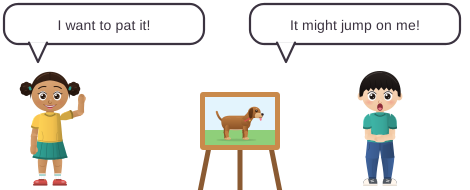
When we look at a picture, we bring our own experiences with us. The things that have happened to us change how we feel about what we see.
So the same picture can make two people feel very different things. Neither person is wrong.
To understand someone else, look closely at the details in the picture, and then ask: What has this person lived through? How might it look to them?
See How It’s Done

Now Try It
1. Look at the big waves. How might a surfer feel? How might a child who cannot swim feel?
Hint: Think about what each person can do in the water.
2. Look at the spider. Who might feel curious about it? Who might feel scared?
Hint: Think of someone who studies bugs, and someone who does not like them.
Time To Practise
Name: ______________________
1. Two people, two feelings.
For each picture, write how two different people might feel.
| Picture | Person 1 and feeling | Person 2 and feeling |
|---|---|---|
| a) storm | ____________________ | ____________________ |
| b) snow | ____________________ | ____________________ |
| c) bee | ____________________ | ____________________ |
2. The dog picture.
Look at the dog picture in Let’s Learn. Zoe loves dogs. Ravi is scared of dogs.
a) Which detail in the picture might make Ravi scared? Why?
______________________________________________
b) Which detail might make Zoe happy? Why?
______________________________________________
3. What about you?
How do you feel when you look at the dog picture? Why? Then write how Zoe could help Ravi feel safer. Write four to six sentences.
______________________________________________
______________________________________________
______________________________________________
______________________________________________
______________________________________________
Reflect
Think about these questions. Talk about them with someone at home or at school.
1. Go back to the Wonder question: “Why can one picture make two people feel different things?” What do you think now?
2. I was open-minded today when I ______________________________.
Being open-minded means listening to other ideas and other ways of doing things. For example: I was open-minded today when I understood that two people can feel different about the same thing.
Take action: Show a photo to two family members. Ask each one how it makes them feel.
Next Steps
If this was easy, try: Find a photo in a book or magazine. Ask two people how it makes them feel, and why. Tell someone what you found out.
If this was hard, go back to: See How It’s Done. Talk about just one picture and two people. Use: ___ feels ___ because ___.
Notes for Parents and Teachers
Show notes for parents and teachers
These notes cover this lesson only. How every lesson runs is explained in How to Use This Material.
Let’s Learn
Point to the details in the dog picture.
See How It’s Done
Point to each child and to the detail they notice as you go through Aisha’s thoughts.
Answer Key
Reveal Answers
Now Try It
1. Sample answer: The surfer might feel excited, because big waves are fun to ride. The child might feel scared, because the water is deep and rough.
2. Sample answer: A scientist who studies bugs might feel curious. Someone who does not like spiders might feel scared.
1. Two people, two feelings
Sample answers:
a) A farmer: glad, because the plants get rain. A child: scared of the thunder.
b) A child with a sledge: excited. A bus driver: worried about icy roads.
c) A beekeeper: calm or happy, because bees make honey. A child who was stung: scared.
2. The dog picture
a) Sample answer: The open mouth might make Ravi scared, because he thinks the dog might bite. The dog is big and running fast, too.
b) Sample answer: The ball might make Zoe happy, because she thinks the dog wants to play.
3. What about you?
Sample answer: I feel happy when I see the dog, because I like dogs. But I understand why Ravi feels scared. Zoe could hold Ravi’s hand. She could ask the owner to hold the dog still. Then Ravi could watch from far away first. He might feel safer if he goes slowly.
Look for: the learner’s own feeling with a reason; at least one kind idea for how Zoe could help; four to six sentences. Accept any honest feeling about dogs.
Reflect
2. Any real moment from the lesson that shows the learner was open-minded. Examples: “I was open-minded today when I understood that two people can feel different about the same thing.” “I was open-minded today when I listened to how someone else felt about a picture.”
Lesson 8.8: My Comic Strip
Visual | About 20 minutes
Term 3 | Level 3
Goal
“I can draw a three-panel comic about a small problem between friends, using speech bubbles and faces to show feelings.”
Words to know
comic strip, panel, speech bubble, thought bubble
Wonder
Think about this question before you start. Say your ideas. You will come back to it at the end of the lesson.
How can friends solve a small problem together?
Let’s Learn
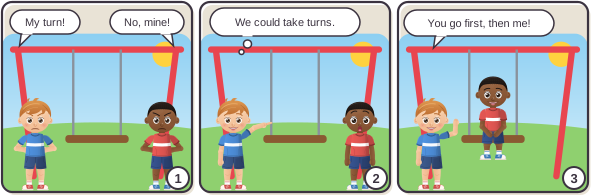
A comic strip tells a story in pictures. Each box is called a panel. We read the panels in order, from left to right.
A speech bubble shows the words a character says. Its tail points to the speaker. A thought bubble is cloud-shaped with small circles, and shows what a character thinks.
Faces show feelings. In a three-panel comic, panel 1 shows the problem, panel 2 shows someone thinking or trying, and panel 3 shows how it is fixed.
See How It’s Done

Now Try It
1. What is the problem in panel 1? How do you know?
Hint: Read both speech bubbles. Look at the faces.
2. Why does panel 2 have a thought bubble and not a speech bubble?
Hint: Is Ana saying the words out loud, or thinking them?
Time To Practise
Name: ______________________
1. Fill the bubbles.
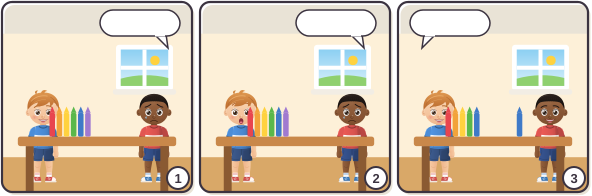
Which words go in each panel? Write the letter under each panel number.
a) “Can we share them?” b) “Here, you have the blue one.” c) “Hey, I need a crayon too!”
Panel 1: ____ Panel 2: ____ Panel 3: ____
2. Plan your comic.
Think of a small problem between two friends, such as sharing a toy, a spoiled game or a mix-up.
The problem (panel 1): ______________________________________________
Thinking or trying (panel 2): ______________________________________________
How it is fixed (panel 3): ______________________________________________
3. Draw your comic strip.
Draw your three panels. Add at least two speech bubbles and one thought bubble. Show feelings on the faces.
How do the friends’ feelings change from panel 1 to panel 3? Write two sentences.
______________________________________________
______________________________________________
Reflect
Think about these questions. Talk about them with someone at home or at school.
1. Go back to the Wonder question: “How can friends solve a small problem together?” What do you think now?
2. I was reflective today when I ______________________________.
Being reflective means looking back at your work and thinking how to make it better. For example: I was reflective today when I looked back at my comic and made it clearer.
Take action: Share your comic with a friend. Talk about another way the friends could fix the problem.
Next Steps
If this was easy, try: Make a longer comic of five or six panels. Give it a title and share it with a friend.
If this was hard, go back to: Task 1. Then draw your comic with stick figures and just one speech bubble per panel.
Notes for Parents and Teachers
Show notes for parents and teachers
These notes cover this lesson only. How every lesson runs is explained in How to Use This Material.
Let’s Learn
Point to a panel, a speech bubble and a thought bubble.
See How It’s Done
Point to each panel in order as you go through Sam’s thoughts.
Answer Key
Reveal Answers
Now Try It
1. Both friends want the swing at the same time. The speech bubbles say “My turn!” and “No, mine!”, and their faces look cross.
2. Ana is thinking the idea, not saying it yet. A thought bubble shows what is in her head.
1. Fill the bubbles
Panel 1: c
Panel 2: a
Panel 3: b
Note: in panel 1, the speech bubble belongs to the sad child, who has no crayons. In panel 3, the child with the crayons gives one away.
2. Plan your comic
Sample answer: Problem: Mia knocks over Tom’s sandcastle by mistake. Thinking: Mia thinks, “I should say sorry.” Fixed: Mia says sorry and they build a bigger castle together.
3. Draw your comic strip
Look for: three panels in order; a problem, a turning point and a fix; at least two speech bubbles and one thought bubble with tails or circles pointing to the right character; faces that change. Sample sentences: At first, Tom was cross and Mia was upset. At the end, they were both happy.
Reflect
2. Any real moment from the lesson that shows the learner was reflective. Examples: “I was reflective today when I looked back at my comic and made it clearer.” “I was reflective today when I checked that my speech bubbles made sense.”
For Teachers: IB Details
Show IB and curriculum details
IB theme: Who we are. It covers our feelings, our friendships and relationships, and how we understand and care for other people.
Central idea: Friendships grow when we understand our own feelings and the feelings of others.
| Lesson | Title | Strand | Key concept |
|---|---|---|---|
| 8.7 | Same Picture, Different Feelings | Viewing | Perspective |
| 8.8 | My Comic Strip | Presenting | Responsibility |
Each lesson also matches the national curriculum for England (Year 1) and the US Common Core (Grade 1). The Grade 1 Curriculum Map lists the full standards for every lesson.
← Back to Lesson 8 – Friends and Feelings | Lessons – Index
© 2026 Firefly Ed. All rights reserved. This page may be printed for personal, home and classroom use. It may not be sold, shared online or reproduced for commercial use without written permission. edfirefly.com


Share your thoughts or ask something..