
Term 3 | Level 3 | Phonics focus: oo, ou/ow, oi/oy, aw/au, ew/ue, days of the week
Lesson 7 – Weather and Seasons | Lessons – Index
Lessons
This page has the two reading lessons in Lesson 7, Weather and Seasons: Lessons 7.1 and 7.2. The Lesson 7 page has the Lesson 7 overview, the Lesson 7 review and the PDF download.
Select a lesson to go straight to it. Each lesson ends with a link back to the top of the page.
Lesson 7.1: Read a Weather Poem
Reading | About 20 minutes
Term 3 | Level 3
Goal
“I can read a weather poem, find rhyming words and say what the poem makes me think and feel.”
Words to know
poem, verse, rhyme, sound word
Wonder
Think about this question before you start. Say your ideas. You will come back to it at the end of the lesson.
How can a poem help us feel the weather?
Let’s Learn
A poem is written in short lines. The lines are grouped into verses. Poems often have a beat, like music.
Many poems use rhyme. Rhyming words end with the same sound, such as sky and by. They do not always have the same spelling: night and white rhyme too.
Poets also use sound words, such as drip and splash, to help us hear what is happening.
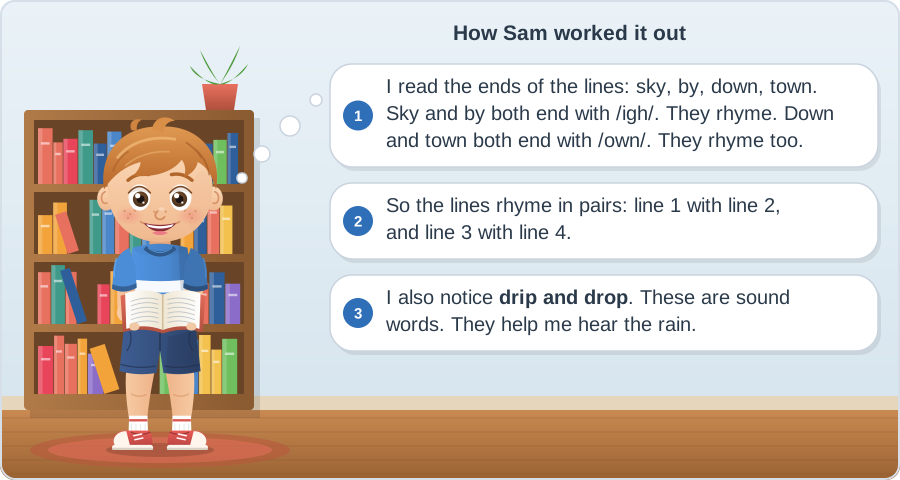
See How It’s Done
First, read the first verse of the poem in Time To Practise with an adult.
Now Try It
1. Read verse 2. Which word rhymes with splat?
Hint: Look at the end of the next line.
2. Which word in verse 2 rhymes with wide? Is it spelled the same way at the end?
Hint: Look at the last word of the last line in verse 2.
Time To Practise
Name: ______________________
Read the poem with an adult. Then read it again on your own.
The Rain Comes Down
Grey clouds roll across the sky,
The birds fly low, the wind blows by.
Then drip and drop, the rain comes down
On every roof in every town.
It taps the window, splash and splat,
It drips upon my yellow hat.
It fills the puddles, deep and wide,
So on go boots, and I run outside!
The cat stays in, curled on a chair.
She does not like the rain out there.
The flowers drink, the grass grows green,
The streets are washed and shiny clean.
And when the rain has gone away,
A rainbow comes to end the day.
1. Find the rhymes.
Find the word in the poem that rhymes with each word. Write it.
a) green ______________ b) chair ______________
c) away ______________ d) down ______________
e) Which pair rhymes but has different spellings at the end? ______________
2. Think about the poem.
a) Find three sound words in the poem.
______________________________________________
b) How does the cat feel about the rain? How do you know?
______________________________________________
______________________________________________
c) The child and the cat feel different about the rain. Do you feel more like the child or the cat? Write four sentences and give reasons.
______________________________________________
______________________________________________
______________________________________________
______________________________________________
3. Add a verse.
Write two new lines about the rain or the sun. Make the last words rhyme. You can use a pair from this list or think of your own: sun / fun, hot / lot, wet / get, rain / again.
______________________________________________
______________________________________________
Reflect
Think about these questions. Talk about them with someone at home or at school.
1. Go back to the Wonder question: “How can a poem help us feel the weather?” What do you think now?
2. I was a communicator today when I ______________________________.
A communicator shares ideas clearly by talking, writing or drawing. For example: I was a communicator today when I read the weather poem aloud.
Take action: Stand at a window when it rains. Listen, then say two rhyming words about what you hear.
Next Steps
If this was easy, try: Find another weather poem in a library book or online with an adult. Read it aloud and find three rhyming pairs.
If this was hard, go back to: Now Try It. Read one verse at a time and clap on the last word of each line to find the rhymes.
Notes for Parents and Teachers
Show notes for parents and teachers
These notes cover this lesson only. How every lesson runs is explained in How to Use This Material.
Let’s Learn
Point to the pictures and say what the weather is like in each.
See How It’s Done
Read the first verse of the poem in Time To Practise aloud before Sam’s thoughts.
Answer Key
Reveal Answers
Now Try It
1. hat
2. outside. Yes, both end in -ide.
1. Find the rhymes
a) clean
b) there
c) day
d) town
e) chair and there (also accept green and clean)
2. Think about the poem
a) Any three of: drip, drop, taps, splash, splat.
b) Sample answer: The cat does not like the rain. It says she stays in and curls up on a chair, and she does not like the rain out there.
c) Sample answer: I feel more like the child. I love jumping in puddles. I have red boots that keep my feet dry. After the rain, I like to look for a rainbow.
Look for: in part c, a clear choice and at least two reasons; four sentences with capital letters and full stops. In part b, a clue from the poem.
3. Add a verse
Sample answer: The rain has stopped, out comes the sun, / We run outside to have some fun.
Look for: two lines about weather that end in rhyming words.
Words to watch: across, window, puddles, flowers and rainbow have two syllables. Help the learner clap and read each part.
Reflect
2. Any real moment from the lesson that shows the learner was a communicator. Examples: “I was a communicator today when I read the weather poem aloud.” “I was a communicator today when I read the poem with feeling.”
Lesson 7.2: Weather Report: Find the Facts
Reading | About 20 minutes
Term 3 | Level 3
Goal
“I can read a weather report, find the facts and use them to plan what to wear.”
Words to know
weather report, fact, temperature, advice
Wonder
Think about this question before you start. Say your ideas. You will come back to it at the end of the lesson.
How does knowing the weather help us plan our day?
Let’s Learn
A weather report tells us what the weather will be like. It is a fact text. It uses facts from people who study the weather.
A weather report tells us the day, the weather (such as sunny, windy or rainy) and the temperature. The temperature is a number that tells how hot or cold it will be. A bigger number means warmer.
Some reports also give advice, such as what to wear. We use the facts to plan our day.
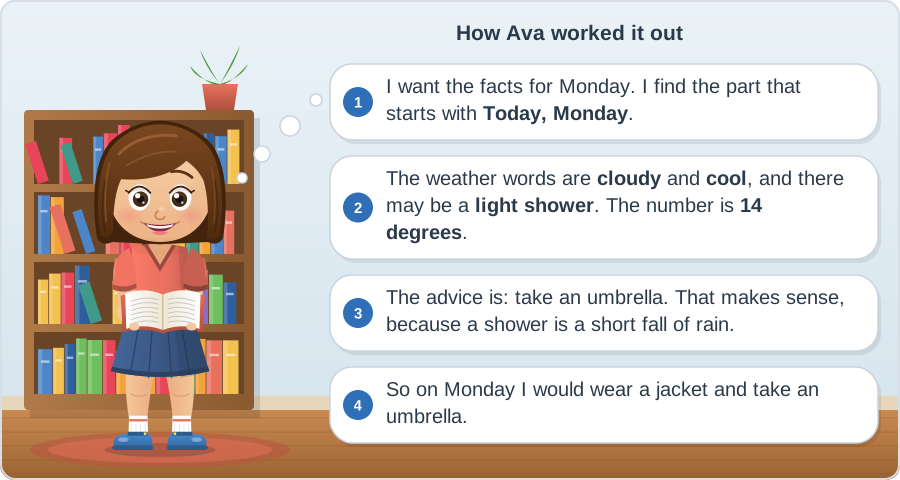
See How It’s Done
Look at the weather report in Time To Practise.
Now Try It
1. Which day will be the warmest?
Hint: Find the three temperature numbers. Which is the biggest?
2. On which day will there be strong winds?
Hint: Look for the word wind in each part.
Time To Practise
Name: ______________________
Read the weather report with an adult. Then read it again on your own.
Weather Report for Riverton
Good morning! Here is the weather for the next three days.
Today, Monday, will be cloudy and cool. There may be a light shower in the afternoon, so take an umbrella if you go out. The top temperature will be 14 degrees.
Tomorrow, Tuesday, heavy rain will start early in the morning and last all day. Strong winds will blow from the west. It will feel cold, with a top temperature of only 9 degrees. The puddles will be deep, so wear boots and a warm coat.
On Wednesday, the rain will clear by lunch time. The afternoon will be sunny and warm, with a top temperature of 18 degrees. It will be a good day to play in the park.
That is all from the weather desk. Have a good week!
Word bank: temperature | degrees | shower
1. Find the facts.
Fill in the chart with facts from the report.
| Day | Weather | Top temperature |
|---|---|---|
| Monday | ______________________ | __________ |
| Tuesday | ______________________ | __________ |
| Wednesday | ______________________ | __________ |
2. What should you wear tomorrow?
a) Tomorrow is Tuesday. Circle the letters of the things you should wear or take.
b) Explain your choices. Use facts from the report. Write four sentences.
______________________________________________
______________________________________________
______________________________________________
______________________________________________
3. Plan with the facts.
a) Your class wants to have a picnic this week. Which day and time is best? Why?
______________________________________________
______________________________________________
b) Is Tuesday a good day to fly a kite? Give a reason from the report.
______________________________________________
Reflect
Think about these questions. Talk about them with someone at home or at school.
1. Go back to the Wonder question: “How does knowing the weather help us plan our day?” What do you think now?
2. I was a thinker today when I ______________________________.
A thinker thinks carefully to work things out. For example: I was a thinker today when I worked out which day would be the warmest.
Take action: Check a weather report with an adult each morning for a week. Choose your clothes to match it.
Next Steps
If this was easy, try: Watch or listen to a real weather report with an adult. Write down the weather and temperature for tomorrow, and plan what to wear.
If this was hard, go back to: Now Try It. Read one day of the report at a time. Underline the weather word and circle the number before filling in the chart.
Notes for Parents and Teachers
Show notes for parents and teachers
These notes cover this lesson only. How every lesson runs is explained in How to Use This Material.
Let’s Learn
Point to each weather picture.
See How It’s Done
Point to each part of the weather report as you go through Ava’s thoughts.
Answer Key
Reveal Answers
Now Try It
1. Wednesday (18 degrees)
2. Tuesday
1. Find the facts
Monday: cloudy and cool, maybe a light shower; 14 degrees
Tuesday: heavy rain all day, strong winds, cold; 9 degrees
Wednesday: rain in the morning, then sunny and warm in the afternoon; 18 degrees
2. What should you wear tomorrow?
a) b (boots), c (coat), d (umbrella) and e (scarf). Do not circle a (sun hat).
Note: an umbrella may be hard to hold in strong winds. Accept it with or without that note, if the learner explains the choice.
b) Sample answer: Tomorrow there will be heavy rain all day, so I will wear boots and take an umbrella. It will be cold, only 9 degrees. I will wear my warm coat and a scarf. I will not need a sun hat, because it will not be sunny.
3. Plan with the facts
a) Sample answer: Wednesday afternoon is best. The rain will stop by lunch time, and it will be sunny and warm.
b) Sample answer: No. There will be strong winds, but there will also be heavy rain all day, so it is not a good day to be outside. (Some learners may say yes because of the wind. Accept this only if they also think about the rain.)
Look for: answers that use facts from the report, not just opinions. In part 2b, four sentences, each linked to a fact.
Reflect
2. Any real moment from the lesson that shows the learner was a thinker. Examples: “I was a thinker today when I worked out which day would be the warmest.” “I was a thinker today when I found the facts in the weather report.”
For Teachers: IB Details
Show IB and curriculum details
IB theme: How the world works. This theme is about how the natural world works: the patterns we can see in nature, such as weather and seasons, and how these patterns affect people, plants and animals.
Central idea: Weather and seasons change in patterns, and these changes affect how people and other living things live.
| Lesson | Title | Strand | Key concept |
|---|---|---|---|
| 7.1 | Read a Weather Poem | Reading | Connection |
| 7.2 | Weather Report: Find the Facts | Reading | Causation |
Each lesson also matches the national curriculum for England (Year 1) and the US Common Core (Grade 1). The Grade 1 Curriculum Map lists the full standards for every lesson.
← Back to Lesson 7 – Weather and Seasons | Lessons – Index
© 2026 Firefly Ed. All rights reserved. This page may be printed for personal, home and classroom use. It may not be sold, shared online or reproduced for commercial use without written permission. edfirefly.com



Share your thoughts or ask something..