
Term 3 | Level 3 | Phonics focus: y, ea, soft c and g, wh, ph, -er, -est, un-
Lesson 8 – Friends and Feelings | Lessons – Index
Lessons
This page has the two listening and speaking lessons in Lesson 8, Friends and Feelings: Lessons 8.5 and 8.6. The Lesson 8 page has the Lesson 8 overview, the Lesson 8 review and the PDF download.
Select a lesson to go straight to it. Each lesson ends with a link back to the top of the page.
Lesson 8.5: Walk in Their Shoes
Oral | About 20 minutes
Term 3 | Level 3
Goal
“I can say how two different people might feel about the same weather, and explain why.”
Words to know
point of view, feel, because, role-play
Wonder
Think about this question before you start. Say your ideas. You will come back to it at the end of the lesson.
Why might two people feel differently about the same weather?
Let’s Learn
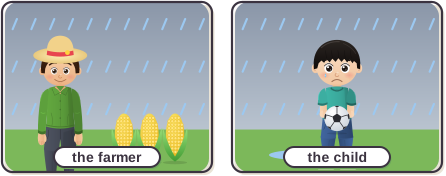
To walk in someone’s shoes means to imagine what it is like to be them. We think about their life, what they need and what they want.
Different people can feel very differently about the same thing, because they have different needs. Rain can make one person happy and another person sad.
When we talk about how someone else feels, we can say: I think ___ feels ___ because ___.
See How It’s Done
Now Try It
Listen to each question. Answer out loud.
1. A duck and a cat are outside in the rain. How might the duck feel? Say it with because.
Hint: Ducks love water. Their feathers keep them dry.
2. How might the cat feel? Say it with because.
Hint: Most cats do not like getting wet.
Time To Practise
Name: ______________________
1. Same weather, different feelings.
For each weather, say how each person might feel and why. Then write one of your answers for each.
| Weather | Person 1 | Person 2 |
|---|---|---|
| A very hot, sunny day | an ice cream seller | a dog with thick fur |
| Deep snow | a child with a sledge | a bus driver |
| A strong wind | a child with a kite | a man with an umbrella |
a) Hot day: I think ______________ feels ______________ because ______________________________
b) Snow: I think ______________ feels ______________ because ______________________________
c) Wind: I think ______________ feels ______________ because ______________________________
2. Role-play: the farmer and the child.
Role-play with an adult. One of you is the farmer, and the other is the child. Stand in the rain together, or pretend. Each of you says how you feel about the rain and why. Then each of you asks the other one question.
☐ I said how my character feels and why.
☐ I listened to the other character.
☐ I asked a question to understand the other character.
3. Walk in a family member’s shoes.
Choose one person in your family. Tell an adult four to six sentences: How would this person feel about a rainy day, and why? Then ask the person to see if you were right.
Write two of your sentences.
______________________________________________
______________________________________________
Was I right? yes no a little
Reflect
Think about these questions. Talk about them with someone at home or at school.
1. Go back to the Wonder question: “Why might two people feel differently about the same weather?” What do you think now?
2. I was open-minded today when I ______________________________.
Being open-minded means listening to other ideas and other ways of doing things. For example: I was open-minded today when I thought about how another person might feel.
Take action: Ask two people how they feel about rain. Tell them what you found out.
Next Steps
If this was easy, try: Ask three people how they feel about snow. Tell your family the different answers and the reasons.
If this was hard, go back to: Now Try It. Use the sentence starter for one person at a time: I think ___ feels ___ because ___.
Notes for Parents and Teachers
Show notes for parents and teachers
These notes cover this lesson only. How every lesson runs is explained in How to Use This Material.
Let’s Learn
Point to the farmer, then to the child.
See How It’s Done
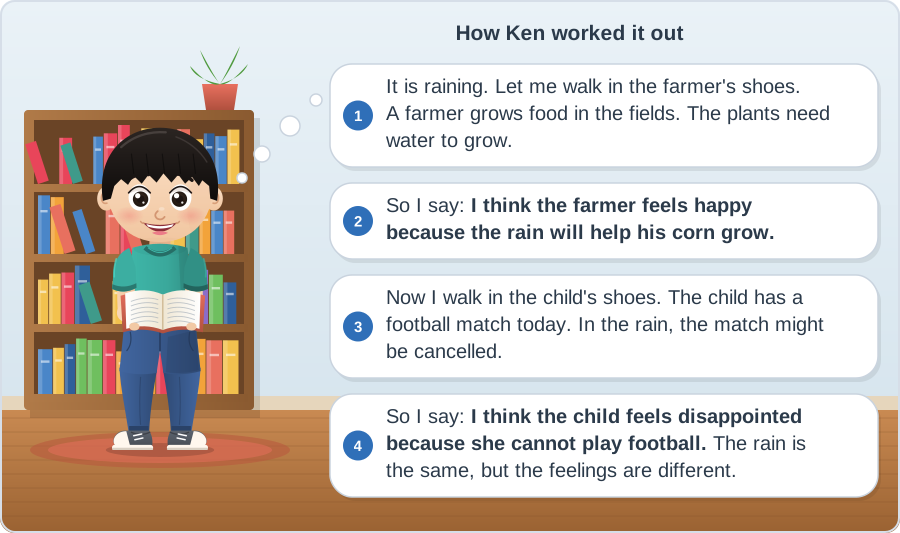
Point to each person in the pictures as you go through Ken’s thoughts.
Now Try It
Read each question aloud. The learner answers out loud.
Time To Practise
- Task 2: You play the farmer and the learner plays the child, or swap.
Answer Key
Reveal Answers
Now Try It
1. Sample answer: I think the duck feels happy because it loves swimming in the puddles.
2. Sample answer: I think the cat feels grumpy because it does not like getting its fur wet.
1. Same weather, different feelings
Sample answers:
a) I think the ice cream seller feels happy because lots of people will buy ice cream. I think the dog feels hot and tired because its thick fur keeps the heat in.
b) I think the child feels excited because she can ride on her sledge. I think the bus driver feels worried because the roads are slippery.
c) I think the child feels happy because the kite will fly high. I think the man feels cross because the wind blows his umbrella inside out.
Look for: a feeling word and a reason with because, linked to what that person or animal needs.
2. Role-play
Look for: the learner stays in character, gives a reason for the feeling, and asks a real question, such as “Why do you like the rain?”
3. Walk in a family member’s shoes
Sample answer: I think my grandpa would like a rainy day. He loves his garden. The rain waters his tomatoes, so he does not need to. He can stay inside and read his paper. He likes to listen to the rain on the roof.
Look for: four to six sentences; reasons linked to the person’s life; the learner checks their idea with the person. It is fine if they were wrong. That is part of learning about others.
Reflect
2. Any real moment from the lesson that shows the learner was open-minded. Examples: “I was open-minded today when I thought about how another person might feel.” “I was open-minded today when I listened to a different point of view.”
Lesson 8.6: Sorry and Thank You Role-Play
Oral | About 20 minutes
Term 3 | Level 3
Goal
“I can say a good sorry and a good thank you, and answer kindly when someone says them to me.”
Words to know
sorry, thank you, kind voice, role-play
Wonder
Think about this question before you start. Say your ideas. You will come back to it at the end of the lesson.
How do sorry and thank you help friendships?
Let’s Learn
Sorry and thank you are small words that do a big job. They help keep friendships strong.
A good sorry shows you understand what went wrong, and it tries to make it better. A good thank you shows the other person that you noticed their kindness.
How we say it matters too. Look at the person, use a kind voice, and mean what you say.
See How It’s Done
Now Try It
Listen to each situation. Say the words out loud.
1. You bumped into a friend and knocked over their tower of blocks. Say a good sorry.
Hint: Use the three steps: what you did, sorry, how you will put it right.
2. Your grandma read you a story at bedtime. Say a good thank you.
Hint: Use the three steps: her name, what she did, how you feel.
Time To Practise
Name: ______________________
1. Which one is better?
Read each pair. Tick the better one. Then say why.
a) ☐ “Sorry.” (said while looking away)
☐ “Sorry I took your pencil without asking. Here it is back.”
b) ☐ “Thanks, Ben, for sharing your snack with me. I was really hungry.”
☐ “Yeah, thanks.”
c) ☐ “It was not my fault, but sorry.”
☐ “I am sorry I stepped on your picture. I will help you draw it again.”
Why is the better one better? Choose one pair and write two sentences.
______________________________________________
______________________________________________
2. Role-play.
Act out each scene with an adult. Then swap parts.
Scene 1: You borrowed a friend’s toy car, and a wheel came off. Say sorry.
Scene 2: A friend helped you find your lost hat in the park. Say thank you.
Scene 3: An adult says sorry to you for being late. Answer kindly.
☐ I used the three steps for sorry.
☐ I used the three steps for thank you.
☐ I looked at the person and used a kind voice.
☐ When someone said sorry to me, I answered kindly.
3. Write a thank-you note.
Think of a real person who helped you. Write them a thank-you note of three or four sentences. Then give it to them.
Dear ______________________,
______________________________________________
______________________________________________
______________________________________________
From ______________________
Reflect
Think about these questions. Talk about them with someone at home or at school.
1. Go back to the Wonder question: “How do sorry and thank you help friendships?” What do you think now?
2. I was caring today when I ______________________________.
Being caring means being kind and helping others. For example: I was caring today when I practised saying a kind sorry.
Take action: Say a real thank you to someone who helped you this week. Tell them what they did.
Next Steps
If this was easy, try: Keep a thank-you list for one week. Each day, write one thing someone did for you, and say thank you to them.
If this was hard, go back to: Let’s Learn. Practise just the sorry steps with a toy. Then practise the thank-you steps the next day.
Notes for Parents and Teachers
Show notes for parents and teachers
These notes cover this lesson only. How every lesson runs is explained in How to Use This Material.
Let’s Learn
Point to each step in each list.
See How It’s Done
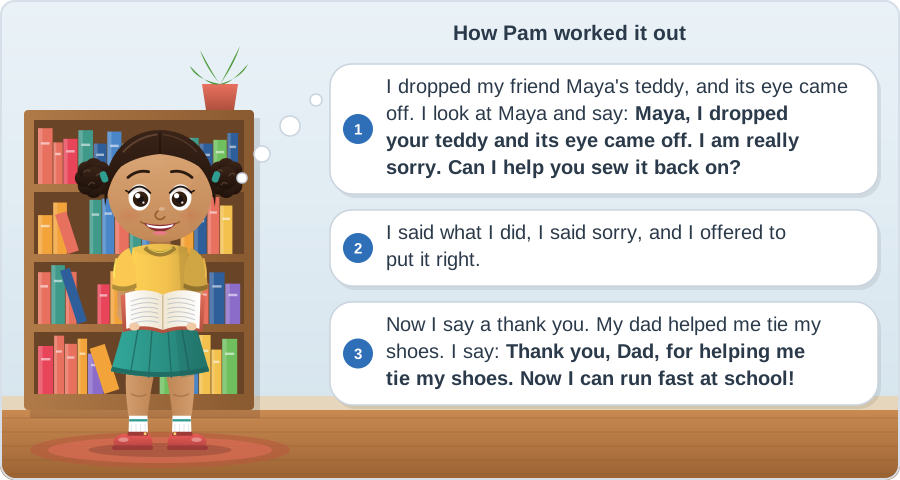
Act out Pam’s words in a kind voice as you go through her thoughts. Look at the learner as if they are Maya.
Now Try It
Read each situation aloud. The learner says the words out loud.
Time To Practise
- Task 2: Act out each scene with the learner. Then swap parts.
Answer Key
Reveal Answers
Now Try It
1. Sample answer: I knocked over your tower. I am sorry. Let me help you build it again.
2. Sample answer: Thank you, Grandma, for reading me a story. It helped me fall asleep, and I loved the funny voices.
1. Which one is better?
a) The second one (“Sorry I took your pencil …”)
b) The first one (“Thanks, Ben, for sharing …”)
c) The second one (“I am sorry I stepped on your picture …”)
Sample reason: The second sorry in c is better because it says what happened. It also offers to help, so the friend feels better.
2. Role-play
Look for: all three steps used; eye contact and a kind voice. In Scene 3, a kind reply such as “That is OK. Thank you for saying sorry.”
3. Write a thank-you note
Sample answer: Dear Mrs Lee, Thank you for helping me learn to ride my bike. You held the back until I was ready. Now I can ride to the park on my own. From Omar
Look for: the person’s name, what they did, and how it helped; three or four sentences; the note is given to a real person.
Reflect
2. Any real moment from the lesson that shows the learner was caring. Examples: “I was caring today when I practised saying a kind sorry.” “I was caring today when I said a thank you that told the person why.”
For Teachers: IB Details
Show IB and curriculum details
IB theme: Who we are. It covers our feelings, our friendships and relationships, and how we understand and care for other people.
Central idea: Friendships grow when we understand our own feelings and the feelings of others.
| Lesson | Title | Strand | Key concept |
|---|---|---|---|
| 8.5 | Walk in Their Shoes | Speaking | Perspective |
| 8.6 | Sorry and Thank You Role-Play | Listening and speaking | Responsibility |
Each lesson also matches the national curriculum for England (Year 1) and the US Common Core (Grade 1). The Grade 1 Curriculum Map lists the full standards for every lesson.
← Back to Lesson 8 – Friends and Feelings | Lessons – Index
© 2026 Firefly Ed. All rights reserved. This page may be printed for personal, home and classroom use. It may not be sold, shared online or reproduced for commercial use without written permission. edfirefly.com


Share your thoughts or ask something..