
Term 2 | Level 2 | Phonics focus: a_e, i_e, o_e, u_e
Lesson 4 – Animals Around Us | Lessons – Index
Lessons
This page has the two listening and speaking lessons in Lesson 4, Animals Around Us: Lessons 4.5 and 4.6. The Lesson 4 page has the Lesson 4 overview, the Lesson 4 review and the PDF download.
Select a lesson to go straight to it. Each lesson ends with a link back to the top of the page.
Lesson 4.5: Listening for Detail
Oral | About 20 minutes
Term 2 | Level 2
Goal
“I can listen to a text once and remember the details.”
Words to know
listen, detail, remember, picture it
Wonder
Think about this question before you start. Say your ideas. You will come back to it at the end of the lesson.
How do good listeners remember the details?
Let’s Learn
A detail is a small piece of information, such as a name, a colour, a number or a place.
Good listeners look at the speaker and make a picture in their head.
They listen for details. Then they can answer questions from memory, without seeing the words.
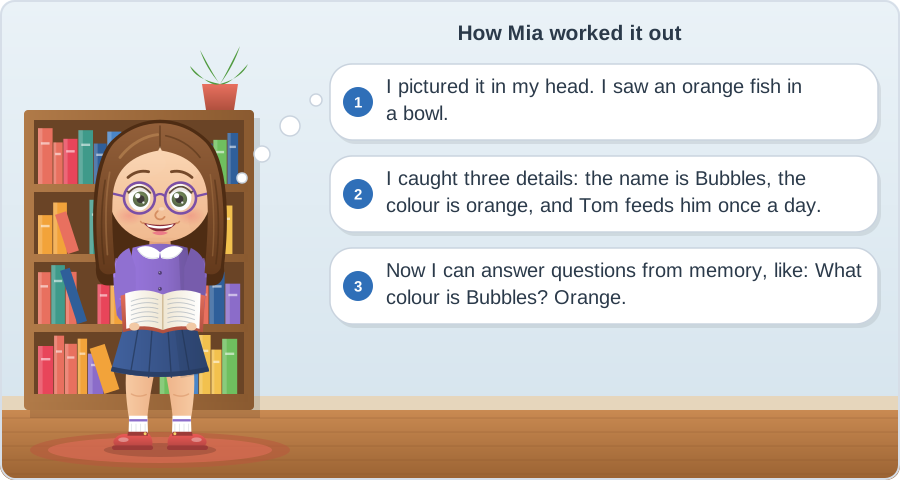
See How It’s Done
Tom has a fish called Bubbles. Bubbles is orange. Tom feeds him once a day.
Now Try It
Listen as an adult reads the Bubbles sentences again. Then answer the questions without looking at the words.
1. Who looks after Bubbles?
Hint: Picture the person in the story. What is his name?
2. How often does Tom feed Bubbles?
Hint: Listen for a number word.
Time To Practise
Name: ______________________
Do not open the text. Listen as an adult reads it aloud once. Then answer the questions from memory.
Text for an adult to read aloud: Pip the Rabbit
Pip is a pet rabbit. She is white with one black ear. Pip lives in a hutch in the garden. Every morning, Maya gives Pip fresh water and hay. Pip likes to eat carrots and green leaves. On sunny days, Pip hops on the grass. Maya checks that the gate is shut, so Pip cannot run away. At night, Pip sleeps in her hutch on a bed of straw.
1. Circle the answer.
a) What colour is Pip? brown white grey
b) Where does Pip live? in a box in the house in a hutch
2. Answer in a sentence.
Word bank: hay | carrots | straw | water
a) What does Maya give Pip every morning?
______________________________________________
b) What does Pip like to eat?
______________________________________________
3. Think and tell.
a) Why does Maya check that the gate is shut? Say your answer, then write it in two sentences.
______________________________________________
______________________________________________
b) Tell an adult two ways Maya cares for Pip.
☐ I told two ways.
Reflect
Think about these questions. Talk about them with someone at home or at school.
1. Go back to the Wonder question: “How do good listeners remember the details?” What do you think now?
2. I was caring today when I ______________________________.
Being caring means being kind and helping others. For example: I was caring today when I listened to how Pip the rabbit is looked after.
Take action: Listen to someone at home talk about a pet or an animal they know. Tell them back three details.
Next Steps
If this was easy, try: Listen to a longer text about an animal, such as a short radio or video clip. Tell someone five details.
If this was hard, go back to: Time To Practise. Read the Pip text one sentence at a time. After each sentence, ask one question about it.
Notes for Parents and Teachers
Show notes for parents and teachers
These notes cover this lesson only. How every lesson runs is explained in How to Use This Material.
Let’s Learn
Point to each listening tip card.
See How It’s Done
Read the Bubbles sentences aloud once before Mia’s thoughts.
Now Try It
Read the Bubbles sentences aloud once more. Then ask the questions. Do not show the words.
Time To Practise
Open the text and read it aloud once. The learner listens and does not see the words. Then the learner answers the questions from memory.
Answer Key
Reveal Answers
Now Try It
1. Tom
2. once a day
1. Circle the answer
a) white
b) in a hutch
2. Answer in a sentence
a) Maya gives Pip fresh water and hay.
b) Pip likes to eat carrots and green leaves.
Look for: both details in each answer. Answers come from memory, so accept close wording.
3. Think and tell
a) Sample answer: Maya checks the gate so Pip cannot run away. She wants to keep Pip safe.
b) Any two of: she gives Pip fresh water and hay; she lets Pip hop on the grass; she checks the gate is shut; Pip has a hutch with straw to sleep on.
Look for: in a), the second sentence gives a reason that is not in the text. That is a simple inference.
Reflect
2. Any real moment from the lesson that shows the learner was caring. Examples: “I was caring today when I listened to how Pip the rabbit is looked after.” “I was caring today when I talked about what a pet needs to stay well.”
Lesson 4.6: Ask Who, What, Where, When, Why
Oral | About 20 minutes
Term 2 | Level 2
Goal
“I can ask questions with who, what, where, when and why.”
Words to know
question, question word, question mark
Wonder
Think about this question before you start. Say your ideas. You will come back to it at the end of the lesson.
What do you want to find out about animals?
Let’s Learn
We ask questions to find out things we do not know.
A question starts with a question word. Each question word asks for a different kind of answer.
A question ends with a question mark.
See How It’s Done

Now Try It
1. Ask a what question about the frog.
Hint: Start with “What”.
2. Ask a where question about the frog.
Hint: ‘Where’ asks about a place.
Time To Practise
Name: ______________________
1. Match the question word.
Write the letter of what each question word asks about.
Who ____ What ____ Where ____ When ____ Why ____
A. a time B. a reason C. a person D. a place E. a thing
2. Circle the question word that fits.
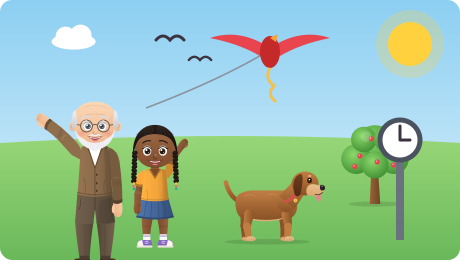
a) ________ is flying the kite? What Who Where
b) ________ is the dog? It is in the park. Where When Who
c) ________ time does the clock show? Who Why What
3. Ask your own questions.
Write one question about the picture with each question word. Then ask an adult your questions and listen to the answers.
Who ______________________________________________?
What ______________________________________________?
Where ______________________________________________?
When ______________________________________________?
Why ______________________________________________?
Reflect
Think about these questions. Talk about them with someone at home or at school.
1. Go back to the Wonder question: “What do you want to find out about animals?” What do you think now?
2. I was an inquirer today when I ______________________________.
An inquirer asks questions and finds things out. For example: I was an inquirer today when I asked who, what, where, when and why questions.
Take action: Ask a pet owner, a vet or a zookeeper two of your questions. Share the answers.
Next Steps
If this was easy, try: Play a question game with a picture book. Take turns asking one question with each question word.
If this was hard, go back to: Now Try It. Practise only who, what and where questions first. Add when and why after that.
Notes for Parents and Teachers
Show notes for parents and teachers
These notes cover this lesson only. How every lesson runs is explained in How to Use This Material.
Let’s Learn
Point to each question word card.
See How It’s Done
Point to the picture as you go through Ken’s questions.
Answer Key
Reveal Answers
Now Try It
1. Sample answer: What is the frog sitting on?
2. Sample answer: Where does the frog live?
1. Match the question word
Who C, What E, Where D, When A, Why B
2. Circle the question word that fits
a) Who
b) Where
c) What
3. Ask your own questions
Sample answers: Who is holding the kite? What is the dog doing? Where are the birds? When is the girl flying the kite? Why is the kite in the sky?
Look for: each question starts with the right word, asks about the picture and ends with a question mark. The learner asks the questions out loud and listens to each answer.
Reflect
2. Any real moment from the lesson that shows the learner was an inquirer. Examples: “I was an inquirer today when I asked who, what, where, when and why questions.” “I was an inquirer today when I chose the right question word to find out more.”
For Teachers: IB Details
Show IB and curriculum details
IB theme: Sharing the planet. This theme is about how we share the planet with other people and other living things: rights and responsibilities, living together fairly, and caring for nature.
Central idea: Animals share our world, and people can learn about them and care for them.
| Lesson | Title | Strand | Key concept |
|---|---|---|---|
| 4.5 | Listening for Detail | Listening | Responsibility |
| 4.6 | Ask Who, What, Where, When, Why | Speaking | Function |
Each lesson also matches the national curriculum for England (Year 1) and the US Common Core (Grade 1). The Grade 1 Curriculum Map lists the full standards for every lesson.
← Back to Lesson 4 – Animals Around Us | Lessons – Index
© 2026 Firefly Ed. All rights reserved. This page may be printed for personal, home and classroom use. It may not be sold, shared online or reproduced for commercial use without written permission. edfirefly.com


Share your thoughts or ask something..