
Term 1 | Level 1 | Phonics focus: Greek and Latin roots: tele, photo, graph, port, nav, geo and meter
Chapter 2 – Explorers and Voyages | Chapters – Index
Lessons
This page has the two writing lessons of Chapter 2, Explorers and Voyages: Lessons 2.3 and 2.4. The chapter page has the chapter overview, the chapter review and the PDF download.
Tap a lesson to open it. Tap the lesson title again, or use the link at the end of the lesson, to close it.
Lesson 2.3: Write a Ship’s Diary Entry | Writing | About 20 minutes
Term 1 | Level 1
Goal
“I can write a diary entry in the first person, with events in order and details from my senses.”
Words to know
diary entry, first person, past tense, sensory detail, event, feeling
Wonder
Think about this question before you start. Say your ideas. You will come back to it at the end of the lesson.
What makes a diary entry feel real when you read it?
Let’s Learn
A diary entry is a firsthand account. The writer tells what happened to them on one day, in the first person (I, we, my) and in the past tense (I saw, we sailed).
Sensory details help the reader to see, hear, smell, taste and feel what you did. Compare these two sentences:
✗ It was windy.
✓ The wind snapped the sails and threw cold spray into my face.
See How It’s Done
Model diary entry
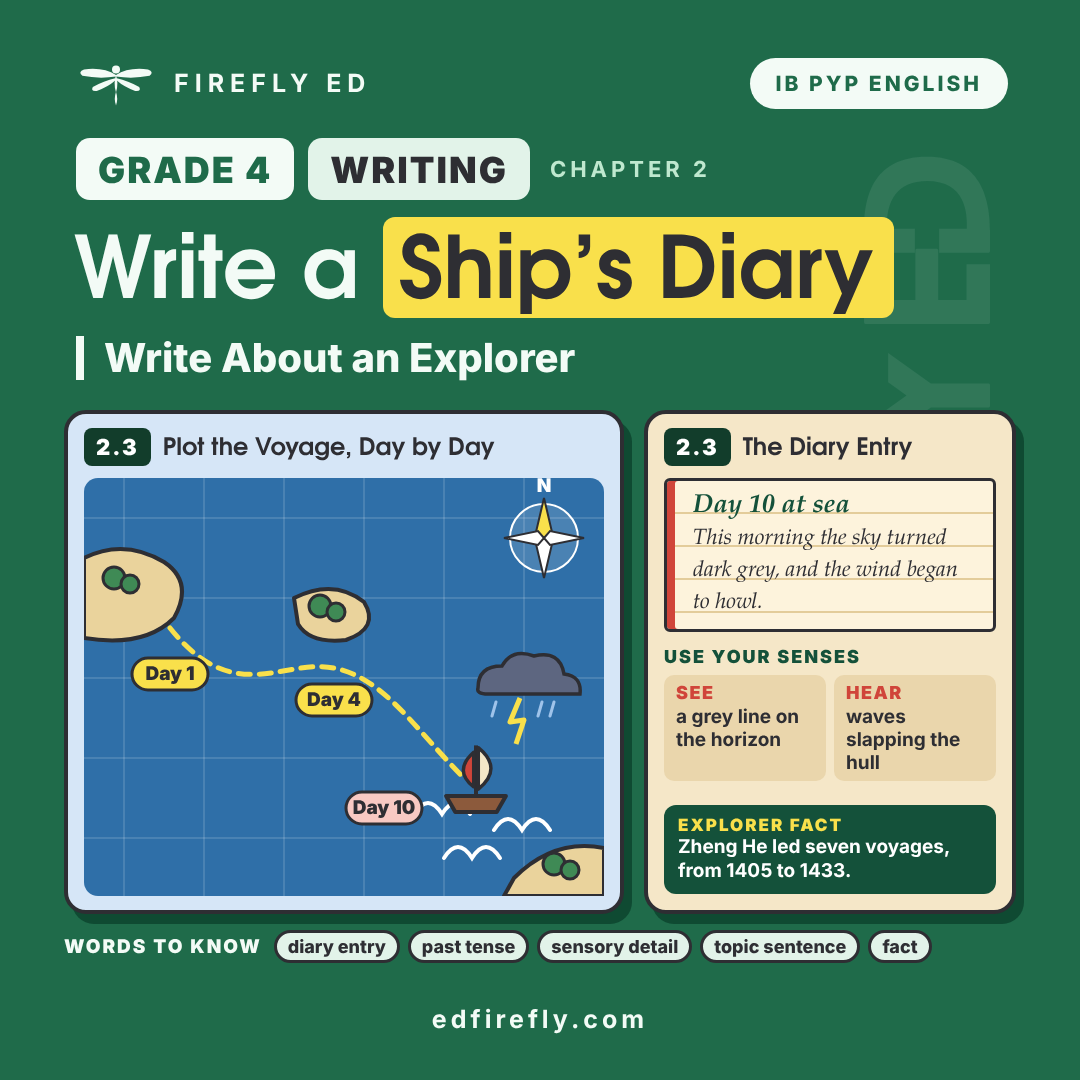
Day 10 at sea. This morning the sky turned dark grey, and the wind began to howl. By midday the waves were as tall as houses.
First, the captain shouted at us to pull down the top sail. My hands burned on the rough, wet rope. Then the rain came. It hammered on the deck so loudly that I could not hear my own voice. I tasted salt every time I opened my mouth.
At last, in the afternoon, the storm moved away. Through the mist I saw a green island with tall palm trees. I felt so tired, but I was smiling. Tomorrow I hope we will step onto dry land.
Now Try It
1. Make this sentence more vivid with a sensory detail: The sea was rough.
__________________________________________________________________
Hint: What could you hear, see or feel?
2. Find the three time words in the model diary entry.
__________________________________________________________________
Hint: Look at the start of the sentences in the second and third paragraphs.
Time To Practise
Name: ______________________
1. Look at the picture.
You are a young sailor on this ship. Today there was a storm, and then you saw an island.
2. Plan with your senses.
| Sense | My detail |
|---|---|
| I saw | |
| I heard | |
| I smelled or tasted | |
| I touched or felt | |
| My feeling | |
3. Write your diary entry.
Write three paragraphs. Follow the plan.
Paragraph 1: the day, where you are and the weather.
Paragraph 2: what happened during the storm, in order. Use first, then, after that.
Paragraph 3: seeing the island, how you felt and an ending thought.
Word bank: deck, sail, rope, mast, crew, captain, waves, spray, horizon, thunder, lightning
Sentence starters: Day ___ at sea. First, … Then … At last, … I felt … Tomorrow I hope …
__________________________________________________________________
__________________________________________________________________
__________________________________________________________________
__________________________________________________________________
__________________________________________________________________
__________________________________________________________________
__________________________________________________________________
__________________________________________________________________
__________________________________________________________________
4. Check your diary entry.
☐ I wrote the day at the start.
☐ I wrote in the first person (I, we, my).
☐ I wrote in the past tense.
☐ The events are in order, with time words.
☐ I used at least three senses.
☐ I said how I felt, and I ended with a thought.
Reflect
Think about these questions. Talk about them with someone at home or at school.
1. Go back to the Wonder question: “What makes a diary entry feel real when you read it?” What do you think now?
2. I was a communicator today when I ______________________________.
A communicator shares ideas clearly by talking, writing or drawing. For example: I was a communicator today when I used my senses to help the reader picture the storm.
Take action: Keep a diary for three days. Each day, add one detail for at least two senses.
Next Steps
If this was easy, try: Write the next day’s diary entry: the day you landed on the island. Use all five senses.
If this was hard, go back to: Let’s Learn. Read the model diary entry again and colour each sense a different colour before you write.
Answer Key
Reveal Answers
Now Try It
1. Sample answer: Huge grey waves crashed against the side of the ship, and the deck tipped under my feet.
2. First, Then, At last
2. Plan with your senses
Sample plan: I saw dark clouds and lightning, then a green island. I heard thunder and the captain shouting. I tasted salty spray. I felt the deck rocking and the cold rain. My feeling: scared, then relieved.
3. Write your diary entry
Sample paragraph: Day 12 at sea. When I woke up, black clouds covered the sky and the ship was rocking from side to side.
Look for: three paragraphs that follow the plan; I, we and my; past tense verbs; time words; at least three senses; a feeling and an ending thought.
4. Check your diary entry
Look for: a tick only where the learner can point to the evidence in the writing.
Reflect
2. Any real moment from the lesson that shows the learner was a communicator. Examples: “I was a communicator today when I used my senses to help the reader picture the storm.” “I was a communicator today when I wrote the events in order with time words.”
Lesson 2.4: Write About an Explorer: Topic Sentences and Facts | Writing | About 20 minutes
Term 1 | Level 1
Goal
“I can write a paragraph about an explorer with a topic sentence, facts and a closing sentence.”
Words to know
topic sentence, fact, detail, closing sentence, linking word, paragraph
Wonder
Think about this question before you start. Say your ideas. You will come back to it at the end of the lesson.
What makes a paragraph easy to follow?
Let’s Learn
An information paragraph is about one topic. It starts with a topic sentence, which tells the reader what the paragraph is about. The next sentences give facts and details. A closing sentence sums up.
A fact can be checked. “Ibn Battuta left Tangier in 1325” is a fact. “Ibn Battuta was the best traveller ever” is an opinion. Information paragraphs use facts.
See How It’s Done
Model paragraph: Ibn Battuta
Ibn Battuta was a traveller from Morocco who made some of the longest journeys of his time. He was born in Tangier, in Morocco, and he left home in 1325, when he was 21 years old. He travelled for 29 years across Africa, the Middle East and Asia. In that time he covered about 120,000 kilometres. When he came home, he told his story to a writer called Ibn Juzayy, who wrote it down in a work called the Rihla, which means “travels”. Today, the Rihla still tells us what life was like in many places 700 years ago.
Now Try It
1. Which sentence would make the best topic sentence for a paragraph about Zheng He? Circle it.
a) Ships are interesting. b) Zheng He led huge fleets of ships across the Indian Ocean. c) He had 255 ships.
Hint: A topic sentence covers the whole paragraph.
2. Is this a fact or an opinion? Zheng He’s ships were the most beautiful ships in the world.
______________
Hint: Could you check it?
Time To Practise
Name: ______________________
1. Read the fact card.
2. Plan your paragraph.
Topic sentence: __________________________________________________
Fact 1 and detail: _______________________________________________
Fact 2 and detail: _______________________________________________
Fact 3 and detail: _______________________________________________
Closing sentence: _______________________________________________
3. Write your paragraph.
Use the facts from the card. Join them with linking words.
Word bank: admiral, fleet, voyage, treasure ship, Indian Ocean, East Africa
Linking words: also, in addition, for example, later, as well as
__________________________________________________________________
__________________________________________________________________
__________________________________________________________________
__________________________________________________________________
__________________________________________________________________
__________________________________________________________________
4. Fact or opinion?
Write F or O.
______ Zheng He led seven voyages.
______ Zheng He was the bravest sailor who ever lived.
______ The later voyages reached East Africa.
______ Sailing with Zheng He must have been fun.
5. Check your paragraph.
☐ My topic sentence tells what the paragraph is about.
☐ I used at least three facts, each with a detail.
☐ I used linking words.
☐ Every sentence is about the topic.
☐ I have a closing sentence.
Reflect
Think about these questions. Talk about them with someone at home or at school.
1. Go back to the Wonder question: “What makes a paragraph easy to follow?” What do you think now?
2. I was a thinker today when I ______________________________.
A thinker thinks carefully to work things out. For example: I was a thinker today when I chose the facts that fit my topic.
Take action: Find one fact about an explorer from your own country or region. Write it on a card with a date or a number.
Next Steps
If this was easy, try: Write a second paragraph about Ibn Battuta or Zheng He, using a library or online source. Write down where you found each fact.
If this was hard, go back to: Let’s Learn. Look at the shape of the paragraph again, then point to the topic sentence and the closing sentence in the model paragraph.
Answer Key
Reveal Answers
Now Try It
1. b) 2. Opinion
2 and 3. Plan and write
Sample paragraph: Zheng He was a Chinese admiral who led huge fleets across the Indian Ocean. He lived during the Ming dynasty, and he led seven voyages between 1405 and 1433. One history says his first fleet had 255 ships. Doctors and map makers also sailed with him. His ships reached Java, Sri Lanka and India, and later voyages went as far as Kenya in East Africa. His voyages linked China with many lands across the ocean.
Look for: a topic sentence, three or more facts from the card, linking words and a closing sentence. Every sentence should be about Zheng He’s voyages.
4. Fact or opinion?
F, O, F, O
Reflect
2. Any real moment from the lesson that shows the learner was a thinker. Examples: “I was a thinker today when I chose the facts that fit my topic.” “I was a thinker today when I checked whether a sentence was a fact or an opinion.”
For Teachers: IB Details
Show IB and curriculum details
IB theme: Where we are in place and time. This theme is about when and where things happen, how people lived in the past, and how discoveries and journeys have shaped the world.
Central idea: Explorers travel for different reasons, and their journeys change what people know about the world.
| Lesson | Title | Strand | Key concept |
|---|---|---|---|
| 2.3 | Write a Ship’s Diary Entry | Writing | Perspective |
| 2.4 | Write About an Explorer: Topic Sentences and Facts | Writing | Change |
Each lesson also matches the national curriculum for England (Year 4) and the US Common Core (Grade 4). The Grade 4 Curriculum Map lists the full standards for every lesson.
← Back to Chapter 2 – Explorers and Voyages | Chapters – Index
© 2026 Firefly Ed. All rights reserved. This page may be printed for personal, home and classroom use. It may not be sold, shared online or reproduced for commercial use without written permission. edfirefly.com



Share your thoughts or ask something..