
Term 1 | Level 1 | Phonics focus: syllable patterns: dividing words in the middle, open and closed syllables, and consonant-le endings
Chapter 1 – Rights and Responsibilities | Chapters – Index
Lessons
This page has the two viewing and presenting lessons of Chapter 1, Rights and Responsibilities: Lessons 1.7 and 1.8. The chapter page has the chapter overview, the chapter review and the PDF download.
Tap a lesson to open it. Tap the lesson title again, or use the link at the end of the lesson, to close it.
Lesson 1.7: Read a Chart: A Right and Its Responsibility | Visual | About 20 minutes
Term 1 | Level 1
Goal
“I can read a chart and a bar graph, pair a right with its responsibility and use the information to answer questions.”
Words to know
chart, row, column, heading, bar graph, scale, right, responsibility
Wonder
Think about this question before you start. Say your ideas. You will come back to it at the end of the lesson.
How can a chart show us how two ideas are connected?
Let’s Learn
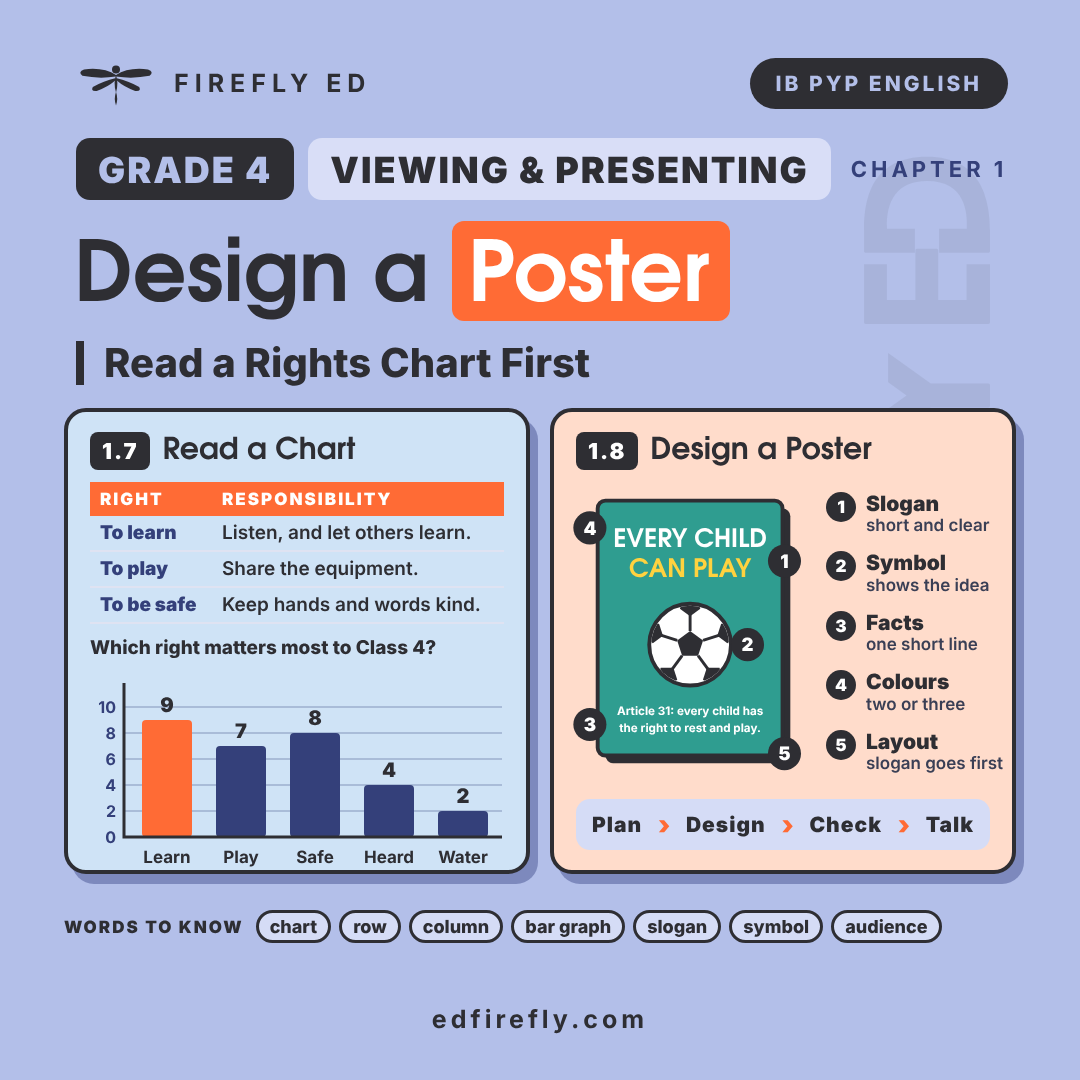
A chart puts information in an order that is easy to find. It has rows, which go across, and columns, which go down. Headings tell you what each column or row shows.
To find an answer in a chart: read the title, find the right row, then move across to the right column. The answer is in the cell where they meet.
A bar graph uses bars to compare numbers. The scale up the side tells you how much each bar is worth, and the label under each bar tells you what it shows. The taller the bar, the greater the number.
A rights chart can pair each right with a responsibility. The responsibility is what we do so that other people can enjoy the same right.
See How It’s Done
Now Try It
1. Use Our Class Rights Chart. Which responsibility goes with the right to play?
Hint: Find the row first, then move across.
2. Look at this responsibility: Put litter in the bin. Tidy up after yourself. Which right goes with it?
Hint: Look down the second column, then move back along the row.
Time To Practise
Name: ______________________
1. Read the chart. Answer the questions.
a) Which responsibility goes with the right to play and rest?
__________________________________________________________________
b) What is the example from school for the right to be safe?
__________________________________________________________________
c) How many rights are on the chart? ______
d) Which right goes with the example working quietly while others read? ______________________________
e) The chart says that the right to be heard goes with taking turns to speak and listening. Why do you think listening is a responsibility?
__________________________________________________________________
__________________________________________________________________
2. Complete the chart.
Fill in each empty box. Use Our Class Rights Chart to help you.
| Right | Responsibility |
|---|---|
| The right to a clean place | |
| |
Share the equipment. Include others. |
| The right to be safe | |
| |
Listen, and let others learn. |
3. Read the bar graph.
a) Which right got the most votes? How many votes did it get?
__________________________________________________________________
b) How many votes did ‘to be heard’ get? ______
c) How many more votes did ‘to be safe’ get than ‘to be heard’? ______
d) How many children voted altogether? Show how you worked it out.
__________________________________________________________________
e) Write one sentence that tells what the graph shows.
__________________________________________________________________
4. Write about a pair.
Choose two pairs from the charts. Finish each sentence.
Because I have the right to ______________________________, I have the responsibility to ______________________________.
Because I have the right to ______________________________, I have the responsibility to ______________________________.
Reflect
Think about these questions. Talk about them with someone at home or at school.
1. Go back to the Wonder question: “How can a chart show us how two ideas are connected?” What do you think now?
2. I was knowledgeable today when I ______________________________.
Being knowledgeable means knowing things and using what you know. For example: I was knowledgeable today when I used the title and headings to find an answer in the chart.
Take action: Find a chart or a graph in a newspaper, a magazine or a school book. Ask an adult to give you a question about it, and find the answer using the title, the headings and the scale.
Next Steps
If this was easy, try: Make your own chart of rights and responsibilities for your home, with three rows. Ask someone to find an answer in it.
If this was hard, go back to: Let’s Learn. Look at the numbered labels for the chart and for the bar graph. Use your finger to follow a row across, then try Task 1 again, one question at a time.
Answer Key
Reveal Answers
Now Try It
1. Share the equipment. Include others.
2. The right to a clean place.
1. Read the chart
a) Share the equipment and include others.
b) Walking, not running, on the stairs.
c) 4
d) The right to learn.
e) Sample answer: Listening is a responsibility because when I listen, other people can be heard and their right to speak is respected.
2. Complete the chart
Row 1: Put litter in the bin. Tidy up after yourself.
Row 2: The right to play.
Row 3: Keep hands and words kind. Follow the safety rules.
Row 4: The right to learn.
Look for: answers that match the pairs in Our Class Rights Chart. Similar wording is fine.
3. Read the bar graph
a) To learn. It got 9 votes.
b) 4
c) 4 (8 – 4 = 4)
d) 30 children. 9 + 7 + 8 + 4 + 2 = 30.
e) Sample answer: The graph shows which right each child in Class 4 thinks matters most. The right to learn got the most votes.
4. Write about a pair
Sample answers: Because I have the right to play, I have the responsibility to share the equipment and include others. Because I have the right to be heard, I have the responsibility to listen to others.
Look for: a right from the charts with a matching responsibility.
Reflect
2. Any real moment from the lesson that shows the learner was knowledgeable. Examples: “I was knowledgeable today when I used the title and headings to find an answer in the chart.” “I was knowledgeable today when I counted the bars and added the votes correctly.”
Lesson 1.8: Design a Poster for a Right | Visual | About 20 minutes
Term 1 | Level 1
Goal
“I can plan and design a poster that uses a slogan, a symbol, colour and layout to share one right.”
Words to know
poster, slogan, symbol, layout, audience, message
Wonder
Think about this question before you start. Say your ideas. You will come back to it at the end of the lesson.
What makes you stop and look at a poster?
Let’s Learn
A poster shares one message with an audience, the people who will see it. People often look at a poster for only a few seconds, so it must be clear and simple.
Good designers make careful choices about five things:
- Slogan: a short, strong message. Use few words in big, clear letters.
- Symbol: a picture that stands for an idea, such as a book for learning.
- Facts: one short line that backs up the message.
- Colours: bright colours that catch the eye. Choose two or three, and make sure the words stand out from the background.
- Layout: where everything goes. Put the slogan where the eye goes first, and leave space around the picture so the poster does not feel crowded.
Many symbols are easy to recognise. Choose one that the audience will understand quickly.
See How It’s Done
Now Try It
1. Look at the clean water poster. What is the message? Who is the audience?
Hint: Look at the slogan and at the designer’s choices.
2. Which symbol and which colours would you choose for a poster about the right to learn? Tell the adult why.
Hint: Think about which picture people will recognise quickly.
Time To Practise
Name: ______________________
1. Improve a poster.
This poster is hard to read. Look at it carefully.
a) Write three problems with the poster.
1. __________________________________________________________
2. __________________________________________________________
3. __________________________________________________________
b) Say how you would fix each problem.
__________________________________________________________________
__________________________________________________________________
2. Plan your poster.
Choose one right. Circle it.
the right to learn | the right to rest and play | the right to clean water and healthy food | the right to be safe from harm | the right to give your opinion | the right to a name and a country
| Design choice | My plan |
|---|---|
| Audience: who will see it, and where? | |
| Slogan (six words or fewer) | |
| Symbol | |
| Facts line (one short sentence) | |
| Two or three colours | |
3. Design your poster.
Use coloured pencils or pens, and a full sheet of paper if you can. Sketch the layout in pencil first, then add colour.
4. Check your poster.
Tick each box that is true.
☐ My poster has one clear message about one right.
☐ The slogan is short, and the letters are big and clear.
☐ My symbol shows the right.
☐ I used only two or three colours, and the words stand out.
☐ There is space around the picture and the words.
☐ The facts line is short and correct.
5. Talk about your poster.
Explain your poster to an adult. Give a reason for each choice you made.
Sentence starters: I chose … because … The audience will … Next time I would change …
I chose the slogan ______________________________ because ______________________________.
I chose the symbol ______________________________ because ______________________________.
I chose the colours ______________________________ because ______________________________.
Reflect
Think about these questions. Talk about them with someone at home or at school.
1. Go back to the Wonder question: “What makes you stop and look at a poster?” What do you think now?
2. I was a risk-taker today when I ______________________________.
A risk-taker tries something new, even when it feels hard. For example: I was a risk-taker today when I tried a new layout for my poster.
Take action: Look at posters on your way to school or in a shop. Pick one. Tell someone at home what its message is and which design choice you like best.
Next Steps
If this was easy, try: Make a second poster for a different right. Change the colours and the layout. Ask someone which poster they notice first, and why.
If this was hard, go back to: Let’s Learn. Look at the five labels on the Every Child Can Play poster. Then look at the clean water poster and find the slogan, the symbol, the facts and the colours before you plan your own poster.
Notes for Parents and Teachers
Show notes for parents and teachers
These notes cover this lesson only. How every lesson runs is explained in How to Use This Material.
Time To Practise
- Task 3: Give the learner coloured pencils or pens, and a full sheet of paper if you can.
- Task 5: Ask the learner to explain the poster. Listen for reasons.
Answer Key
Reveal Answers
Now Try It
1. The message is that every child has the right to clean water. The audience is families at the school gate.
2. Sample answer: A book, because people know it stands for learning. Bright yellow and blue, because they stand out.
1. Improve a poster
a) Sample problems: there are far too many words; the letters are small and hard to read; the colours of the words are too pale on the yellow background; there are too many pictures and they are crowded; it does not say which right it is about; there is no clear slogan.
b) Sample fixes: keep one right and one short slogan; make the letters big; use dark letters on a light background; use one large symbol with space around it; add one short facts line.
Look for: three problems that are different from each other, and a fix that matches each problem.
2. Plan your poster
Sample plan: Right: the right to rest and play. Audience: pupils in the school hall. Slogan: Every child can play. Symbol: a ball. Facts line: Article 31 says every child has the right to rest and play. Colours: yellow and blue.
Look for: one right, a short slogan, a symbol that matches it, and a facts line that is correct. Check any facts against the Convention text in Lesson 1.2.
3. Design your poster
Look for: a slogan in big letters, a symbol, two or three colours and some space. The poster should match the plan.
4. Check your poster
Look for: a tick only where the learner can point to the evidence on the poster. If a box is not ticked, ask the learner how to improve that part.
5. Talk about your poster
Sample answer: I chose the slogan ‘Every child can play’ because it is short and easy to read. I chose a ball because everyone knows it means play. I chose yellow and blue because they are bright and the words stand out.
Look for: a reason with ‘because’ for each choice.
Reflect
2. Any real moment from the lesson that shows the learner was a risk-taker. Examples: “I was a risk-taker today when I tried a new layout for my poster.” “I was a risk-taker today when I chose a bold colour even though I was not sure about it.”
For Teachers: IB Details
Show IB and curriculum details
IB theme: Who we are. It covers our bodies and feelings, our families and friends, where we belong, our rights and responsibilities, and how we learn and grow.
Central idea: Every child has rights, and everyone shares the responsibility to respect them.
| Lesson | Title | Strand | Key concept |
|---|---|---|---|
| 1.7 | Read a Chart: A Right and Its Responsibility | Viewing | Connection |
| 1.8 | Design a Poster for a Right | Presenting | Function |
Each lesson also matches the national curriculum for England (Year 4) and the US Common Core (Grade 4). The Grade 4 Curriculum Map lists the full standards for every lesson.
← Back to Chapter 1 – Rights and Responsibilities | Chapters – Index
© 2026 Firefly Ed. All rights reserved. This page may be printed for personal, home and classroom use. It may not be sold, shared online or reproduced for commercial use without written permission. edfirefly.com


Share your thoughts or ask something..