
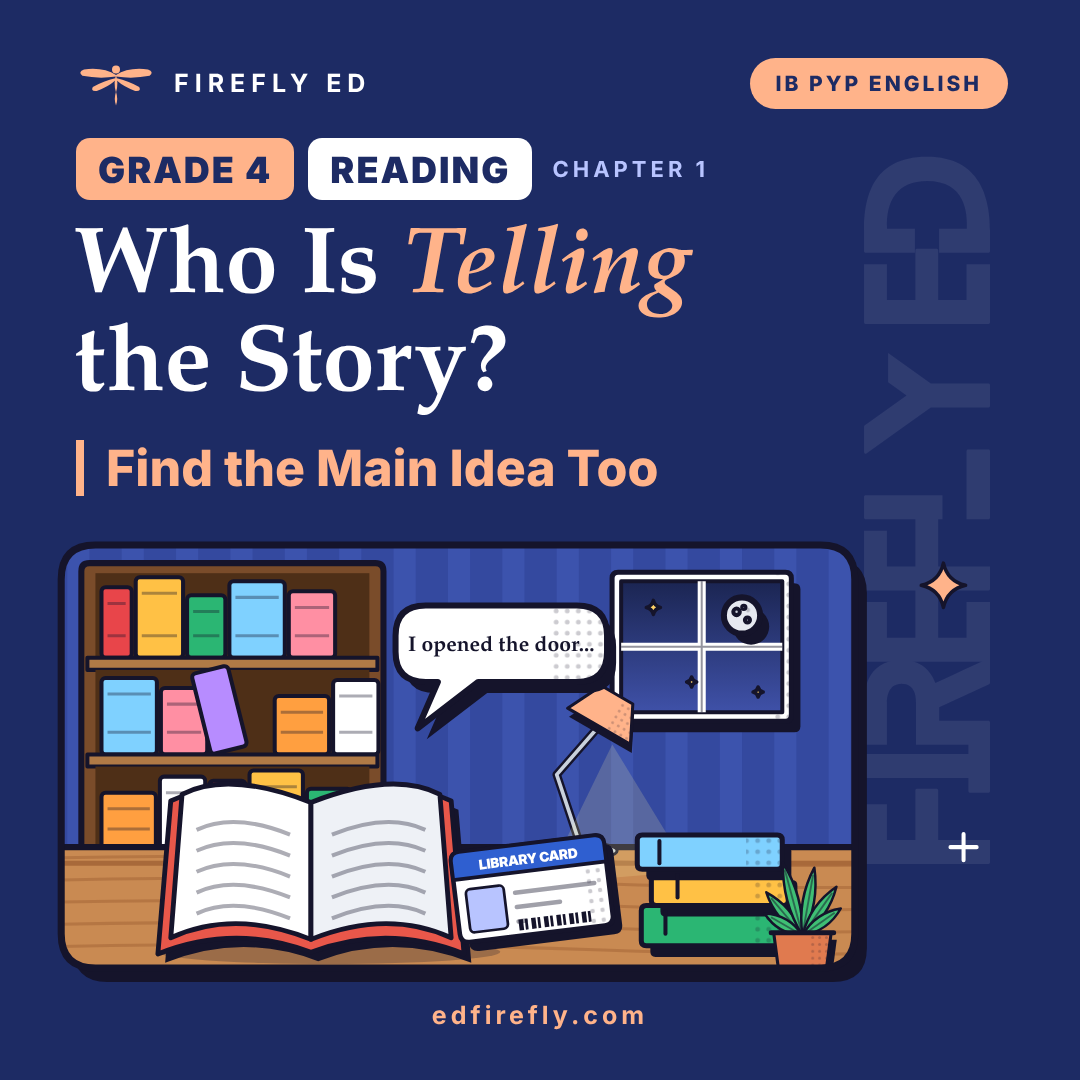
Term 1 | Level 1 | Phonics focus: syllable patterns: dividing words in the middle, open and closed syllables, and consonant-le endings
Chapter 1 – Rights and Responsibilities | Chapters – Index
Lessons
This page has the two reading lessons of Chapter 1, Rights and Responsibilities: Lessons 1.1 and 1.2. The chapter page has the chapter overview, the chapter review and the PDF download.
Tap a lesson to open it. Tap the lesson title again, or use the link at the end of the lesson, to close it.
Lesson 1.1: A Library Card for Everyone: A Story in the First Person | Reading | About 20 minutes
Term 1 | Level 1
Goal
“I can tell whether a story is told in the first person or the third person, and explain what that choice lets us know.”
Words to know
narrator, first person, third person, point of view, pronoun, clue
Wonder
Think about this question before you start. Say your ideas. You will come back to it at the end of the lesson.
Why might an author let a character tell the story, instead of someone outside the story?
Let’s Learn
Every story has a narrator, the voice that tells the story. The author decides who the narrator will be. This choice is called the point of view.
- In the first person, the narrator is a character in the story. The narrator says ‘I’, ‘me’, ‘my’, ‘we’ and ‘our’. We see events through this character’s eyes. We know what the character thinks and feels, but only what the character sees, hears and knows.
- In the third person, the narrator is outside the story. The narrator uses names and words such as ‘he’, ‘she’, ‘they’ and ‘her’. The narrator can tell us about many characters.
The same moment can sound different in each point of view. The pronouns are the clue. A pronoun is a word that takes the place of a name.
Be careful with speech. A character may say ‘I’ inside quotation marks, even when the story is told in the third person. To find the narrator, look at the words outside the quotation marks.
See How It’s Done
The Reading Corner
Last term, our classroom had no quiet place to read. At the class meeting, I put up my hand, and my voice shook. I asked if we could turn one corner into a reading corner, with cushions and a bookshelf. Everyone voted, and my idea won. Now I read there every day, and I am glad that I spoke up.
Now Try It
1. Read: Dev picked up the heavy bag. He felt tired, but he kept walking. Is it first person or third person? Which words tell you? Now change it to the first person.
Hint: Find the pronouns and the name. Then replace them.
2. Say one thing that a first-person narrator can tell us that an outside narrator might not know.
Hint: Think about thoughts and feelings.
Time To Practise
Name: ______________________
1. Read the story. Answer the questions.
Read the story with an adult, or on your own if you can.
Word bank: narrator | first person | third person | pronoun
A Library Card for Everyone
When we moved to a new town in September, I counted everything we had left behind: my old school, my best friend Noor and the little bookshop on our old street. I did not expect to find anything I wanted in the new town. Then, on my second Saturday, I saw it from the bus window. It was a big red-brick building with the word LIBRARY above the door.
“Can we go in?” I asked Dad.
Inside, the air smelled of paper and polish. There were shelves higher than my head, and a whole corner for children with beanbags and a reading tree painted on the wall. At the desk, I hesitated. My heart was beating fast, and I held on to the strap of my bag.
“Hello,” said the librarian. Her badge said Ms Okafor. “Would you like a library card?”
“Yes, please,” I said. “I would like to borrow books.”
She slid a form across the desk. I wrote my name, my school and our new address, and Dad signed at the bottom. Ms Okafor typed for a moment, and the printer hummed. Out slid a small blue card with my name on it. I held it in both hands, as if it were made of glass.
“Every child in this town can have a card,” she said, “because children have a right to read and to learn. But there are three rules. You may borrow six books at a time. You must return them in three weeks. And you must look after them, because other children want to read them too.”
“I will take care of them,” I promised.
That afternoon, I borrowed a book about a girl who sailed around the world. I read it every evening. Then, on Thursday, my little brother knocked his juice across the kitchen table. The juice ran straight onto my library book. By the time I grabbed it, the last ten pages were orange and wrinkled.
I felt sick. I thought about pushing the book into the returns box when nobody was looking. Then nobody would know that it was me. But the next child who borrowed it would find the sticky pages, and they would not be able to finish the story.
On Saturday, I put the book on the desk in front of Ms Okafor. “I am sorry,” I said. “My brother spilled juice on it, and I did not stop it in time.”
Ms Okafor turned the pages slowly. Then she smiled. “Thank you for telling me,” she said. “Most of it can still be read, and we can mend the cover. Some people hide a damaged book, but you told the truth. That is what a responsible reader does.”
That made me think. The card had given me something: the right to borrow books. But it had also given me a job: the responsibility to look after them, and to be honest when something goes wrong.
Last Saturday, a boy stood at the desk exactly where I once stood, holding on to the strap of his bag. “I have never had a library card,” he whispered.
I stepped up beside him. “Ms Okafor will help you,” I said. “Just look after the books, and tell her if anything happens to them. I know, because it happened to me.”
a) Who is telling the story? Write two words from the story that show it is told in the first person.
The narrator is ______________________ Words: ______________ and ______________
b) Why was the narrator worried when she went back to the library?
__________________________________________________________________
c) The narrator hesitated at the desk. What does ‘hesitated’ mean? Which clue in the next sentence helped you?
Sentence starters: ‘Hesitated’ means … A clue is …
__________________________________________________________________
d) The narrator held the card ‘as if it were made of glass’. How did the narrator feel about the card? Explain how you know.
__________________________________________________________________
__________________________________________________________________
e) The library card gave the narrator a right and a responsibility. Write each one.
Right: ______________________________________________
Responsibility: ______________________________________
f) At the end, why does the narrator speak to the boy? What does this show about the narrator?
__________________________________________________________________
__________________________________________________________________
2. Retell in the third person.
Rewrite these sentences in the third person. Call the narrator Sana. Change the pronouns and ‘Dad’.
I did not expect to find anything I wanted in the new town. Then, on my second Saturday, I saw it from the bus window. I asked Dad if we could go in.
__________________________________________________________________
__________________________________________________________________
__________________________________________________________________
3. First person or third person?
Write 1 for first person or 3 for third person. Circle the clue words.
____ a) I could hear my heart beating fast.
____ b) Dina looked at her father.
____ c) We had only been in our flat for two weeks.
____ d) The librarian slid the form across the desk.
____ e) “I can help,” said Maya. She picked up the books.
____ f) My hands shook as I opened the door.
4. Why choose the first person?
Finish the sentence. Use what you learned from the story.
The author lets the narrator tell this story so that we can ______________________________________ because ______________________________________.
__________________________________________________________________
Reflect
Think about these questions. Talk about them with someone at home or at school.
1. Go back to the Wonder question: “Why might an author let a character tell the story, instead of someone outside the story?” What do you think now?
2. I was caring today when I ______________________________.
Being caring means being kind and helping others. For example: I was caring today when I thought about how the narrator felt at the library desk.
Take action: Think of something that happened to you today. Tell it to someone at home in the first person. Then tell it again in the third person, using your name.
Next Steps
If this was easy, try: Write a short paragraph about a time you were nervous. Write it in the first person. Then write the same moment in the third person.
If this was hard, go back to: Let’s Learn and See How It’s Done. Look at the clue words again. Take the sentences in Task 3 one at a time and ask who is telling the story.
Answer Key
Reveal Answers
Now Try It
1. Third person. The clue words are ‘Dev’ and ‘He’. First person: I picked up the heavy bag. I felt tired, but I kept walking.
2. Sample answers: how the narrator feels inside, such as being nervous. What the narrator is thinking.
1. A Library Card for Everyone
a) The narrator is the girl who moved to a new town. Any two of: I, my, me, we, our. (The narrator says ‘I’ and ‘my’ all the way through.)
b) Her little brother had spilled juice on her library book, and the last pages were wrinkled. She was afraid of what Ms Okafor would say.
c) ‘Hesitated’ means waited or paused because of feeling nervous or unsure. Clue: her heart was beating fast and she held on to the strap of her bag.
d) She felt that it was precious and she was proud and happy. A clue is that she held it in both hands, as if it were made of glass, so she was being very careful with it.
e) Right: to borrow books. Responsibility: to look after the books, return them on time and be honest when something goes wrong.
f) She remembers how nervous she felt, and she wants to help the boy and pass on what she learned. It shows that she is kind and helpful, and that she has learned from her own experience.
Look for: in a), the learner names the narrator as the character who moved to a new town, not ‘the author’. In d) and f), the learner gives evidence from the story.
2. Retell in the third person
Sana did not expect to find anything she wanted in the new town. Then, on her second Saturday, she saw it from the bus window. She asked her dad if they could go in.
Look for: ‘I’ to ‘she’, ‘my’ to ‘her’, ‘we’ to ‘they’, ‘Dad’ to ‘her dad’ or ‘her father’.
3. First person or third person?
a) 1 (I, my)
b) 3 (Dina, her)
c) 1 (We, our)
d) 3 (the librarian)
e) 3 (The ‘I’ is inside quotation marks. The narrator says ‘said Maya’ and ‘She’.)
f) 1 (My, I)
4. Why choose the first person?
Sample answers: The author lets the narrator tell this story so that we can feel how nervous and proud the narrator is, because the narrator tells us what she thinks and feels. / … so that we can see the library through the narrator’s eyes, because we only know what she knows.
Reflect
2. Any real moment from the lesson that shows the learner was caring. Examples: “I was caring today when I thought about how the narrator felt at the library desk.” “I was caring today when I imagined how the boy at the end of the story was feeling.”
Lesson 1.2: What Are Children’s Rights? An Information Text | Reading | About 20 minutes
Term 1 | Level 1
Goal
“I can find the main idea of an information text and the key details that support it.”
Words to know
right, convention, article, responsibility, main idea, key detail, heading
Wonder
Think about this question before you start. Say your ideas. You will come back to it at the end of the lesson.
What does every child need, wherever they live?
Let’s Learn
An information text gives facts about a topic. It often has a title, headings and paragraphs, and sometimes pictures, tables or boxes.
The main idea is what a text, or one part of it, is mostly about. You can say it in one sentence. Key details are the facts, examples and numbers that support the main idea.
To find the main idea, read the title and the heading first. Then read the first sentence of the paragraph, because it often states the main idea. Ask yourself: What is this mostly about? To find key details, ask: Which facts help to show this idea?
Each paragraph, or each section under a heading, has its own main idea. The whole text has a main idea too, made from the ideas of its sections.
See How It’s Done
Time to Play
Children need time to play. Playing helps children keep fit and healthy. It helps them make friends and learn to share. It also gives their minds a rest after lessons. That is why play is a right, written down in Article 31 of the Convention.
Now Try It
1. Read the heading ‘Rights and responsibilities’. What do you expect that part of the text to be about?
Hint: Use the words in the heading.
2. Read this paragraph. What is the main idea?
Many children share a bedroom with a brother or sister. They learn to take turns and to be quiet when someone is asleep. They learn to keep the room tidy together. Sharing a room teaches children to think about other people.
Hint: Which sentence says what all the other sentences are showing?
Time To Practise
Name: ______________________
1. Read the text. Answer the questions.
Read the text with an adult, or on your own if you can.
Word bank: right | convention | article | responsibility | government
What Are Children’s Rights?
What is a right?
A right is something that every person should have or be able to do. A right is not a prize or a favour, and nobody has to earn it. Rights are also about fairness, because they help every child to be treated with respect. For example, every child has the right to go to school.
A right is different from a want. A child may want a new toy, but every child needs food, clean water and a safe home. Rights protect what children need to live, learn and grow.
The Convention on the Rights of the Child
In 1989, countries at the United Nations agreed on a list of rights for children. The list is called the Convention on the Rights of the Child. A convention is a written agreement between countries. This one was adopted on 20 November 1989. It has 54 articles, and an article is one numbered part of the convention. Article 1 says that a child is any person under the age of 18. UNICEF describes the Convention as the human rights treaty that most countries have agreed to.
Some of the rights
Article 2 says that all children have all these rights, no matter who they are or where they live. No child should be treated unfairly. Article 7 gives every child the right to a name and to belong to a country. Article 12 says that children have the right to give their opinions on issues that affect them, and adults should listen. Article 13 gives children the right to share what they learn, think and feel by talking, drawing, writing or in any other way, unless it harms other people. Article 19 says that governments must protect children from violence, abuse and neglect. Article 24 gives children the right to the best healthcare possible, clean water to drink and healthy food. Article 28 says that every child has the right to an education, and that primary education should be free. Article 31 gives every child the right to rest, relax and play.
Rights and responsibilities
Governments have the main duty to protect children’s rights. Parents, carers and teachers help too. Children have a part to play as well. Article 29 says that education should teach children to respect other people’s rights and differences.
A responsibility is a duty, something that you should do. When you respect other people’s rights, you share the responsibility. For example, your right to learn comes with the responsibility to let your classmates learn too. Your right to be safe comes with the responsibility to keep others safe. A child does not have to earn a right by being responsible, because rights belong to every child. Taking responsibility is how people make sure that rights are respected for everyone.
Knowing your rights
Article 42 says that governments should tell children and adults about the Convention, so that everyone knows about children’s rights. Every year on 20 November, the United Nations marks World Children’s Day, the day when the Convention was adopted. On this day, children around the world speak about their lives and their rights.
a) Tick the best main idea for the whole text.
☐ Children want many toys and games.
☐ Children have rights that are written in a convention, and everyone shares the responsibility to respect them.
☐ Governments make the rules for every school.
b) What is a right? Write it in your own words.
__________________________________________________________________
c) How many articles does the Convention have? When was it adopted?
________ articles Adopted on ______________________
d) Which article says that every child has the right to rest, relax and play? Article ______
e) Look at the section ‘Rights and responsibilities’. Write its main idea in one sentence. Then write two key details.
Sentence starters: This part is mostly about … One key detail is …
Main idea: __________________________________________________
Key detail 1: _________________________________________________
Key detail 2: _________________________________________________
f) The text says: ‘your right to learn comes with the responsibility to let your classmates learn too’. How does this example help you to understand what a responsibility is?
__________________________________________________________________
__________________________________________________________________
2. Which sentences are key details?
The main idea of the section ‘Rights and responsibilities’ is: Everyone shares the responsibility to respect children’s rights. Tick the three sentences that support this main idea.
☐ Governments have the main duty to protect children’s rights.
☐ Article 31 gives every child the right to rest, relax and play.
☐ Article 29 says that education should teach children to respect other people’s rights.
☐ The Convention was adopted on 20 November 1989.
☐ Your right to learn comes with the responsibility to let your classmates learn too.
3. Match the right to its article.
Draw a line, or write the letter. Use the text to check.
| Right | Article |
|---|---|
| A. A name and a country | Article 12 |
| B. Giving your opinion on things that affect you | Article 28 |
| C. Healthcare, clean water and healthy food | Article 7 |
| D. An education | Article 24 |
Article 7: ____ Article 12: ____ Article 24: ____ Article 28: ____
4. Write a summary.
Write two sentences that tell the main idea of the whole text and one key detail. Use your own words.
__________________________________________________________________
__________________________________________________________________
Reflect
Think about these questions. Talk about them with someone at home or at school.
1. Go back to the Wonder question: “What does every child need, wherever they live?” What do you think now?
2. I was an inquirer today when I ______________________________.
An inquirer asks questions and finds things out. For example: I was an inquirer today when I asked myself what each section of the text was mostly about.
Take action: Look at a page in a school textbook or an article at home. Read the heading and the first sentence of each paragraph. Say the main idea of the page to an adult.
Next Steps
If this was easy, try: Choose a short article from a magazine or a school textbook. Write its main idea in one sentence, then list three key details.
If this was hard, go back to: Let’s Learn and See How It’s Done. Read ‘Time to Play’ again. Cover the paragraph and say the main idea from the heading and first sentence. Then try Task 1 again, one section at a time.
Answer Key
Reveal Answers
Now Try It
1. Sample answer: It will explain what a responsibility is and how rights and responsibilities go together.
2. The main idea is the last sentence: sharing a room teaches children to think about other people.
1. What Are Children’s Rights?
a) Children have rights that are written in a convention, and everyone shares the responsibility to respect them.
b) A right is something that every person should have or be able to do. It is not a prize or a favour, and nobody has to earn it.
c) 54 articles. Adopted on 20 November 1989.
d) Article 31
e) Sample answer: Main idea: Rights come with responsibilities, and everyone helps to protect them. Key detail 1: Governments have the main duty to protect children’s rights, and parents, carers and teachers help too. Key detail 2: Children can respect other people’s rights, such as letting classmates learn.
f) Sample answer: It shows that a responsibility is something I do so that other people can use their rights too. If I let my classmates learn, they can use their right to learn.
Look for: a one-sentence main idea in the learner’s own words, and key details that are facts from that section, not from other sections.
2. Which sentences are key details?
Ticked: ‘Governments have the main duty…’, ‘Article 29 says that education should teach children to respect…’ and ‘Your right to learn comes with the responsibility…’. The other two sentences are true, but they are about other sections of the text.
3. Match the right to its article.
Article 7: A Article 12: B Article 24: C Article 28: D
4. Write a summary
Sample answer: The text explains that children have rights, which are written in the Convention on the Rights of the Child, and that everyone shares the responsibility to respect them. For example, Article 28 says that every child has the right to an education.
Look for: the main idea in the learner’s own words and one correct key detail from the text.
Reflect
2. Any real moment from the lesson that shows the learner was an inquirer. Examples: “I was an inquirer today when I asked myself what each section of the text was mostly about.” “I was an inquirer today when I went back to the text to check an answer.”
For Teachers: IB Details
Show IB and curriculum details
IB theme: Who we are. It covers our bodies and feelings, our families and friends, where we belong, our rights and responsibilities, and how we learn and grow.
Central idea: Every child has rights, and everyone shares the responsibility to respect them.
| Lesson | Title | Strand | Key concept |
|---|---|---|---|
| 1.1 | A Library Card for Everyone: A Story in the First Person | Reading | Perspective |
| 1.2 | What Are Children’s Rights? An Information Text | Reading | Form |
Each lesson also matches the national curriculum for England (Year 4) and the US Common Core (Grade 4). The Grade 4 Curriculum Map lists the full standards for every lesson.
← Back to Chapter 1 – Rights and Responsibilities | Chapters – Index
© 2026 Firefly Ed. All rights reserved. This page may be printed for personal, home and classroom use. It may not be sold, shared online or reproduced for commercial use without written permission. edfirefly.com


Share your thoughts or ask something..