
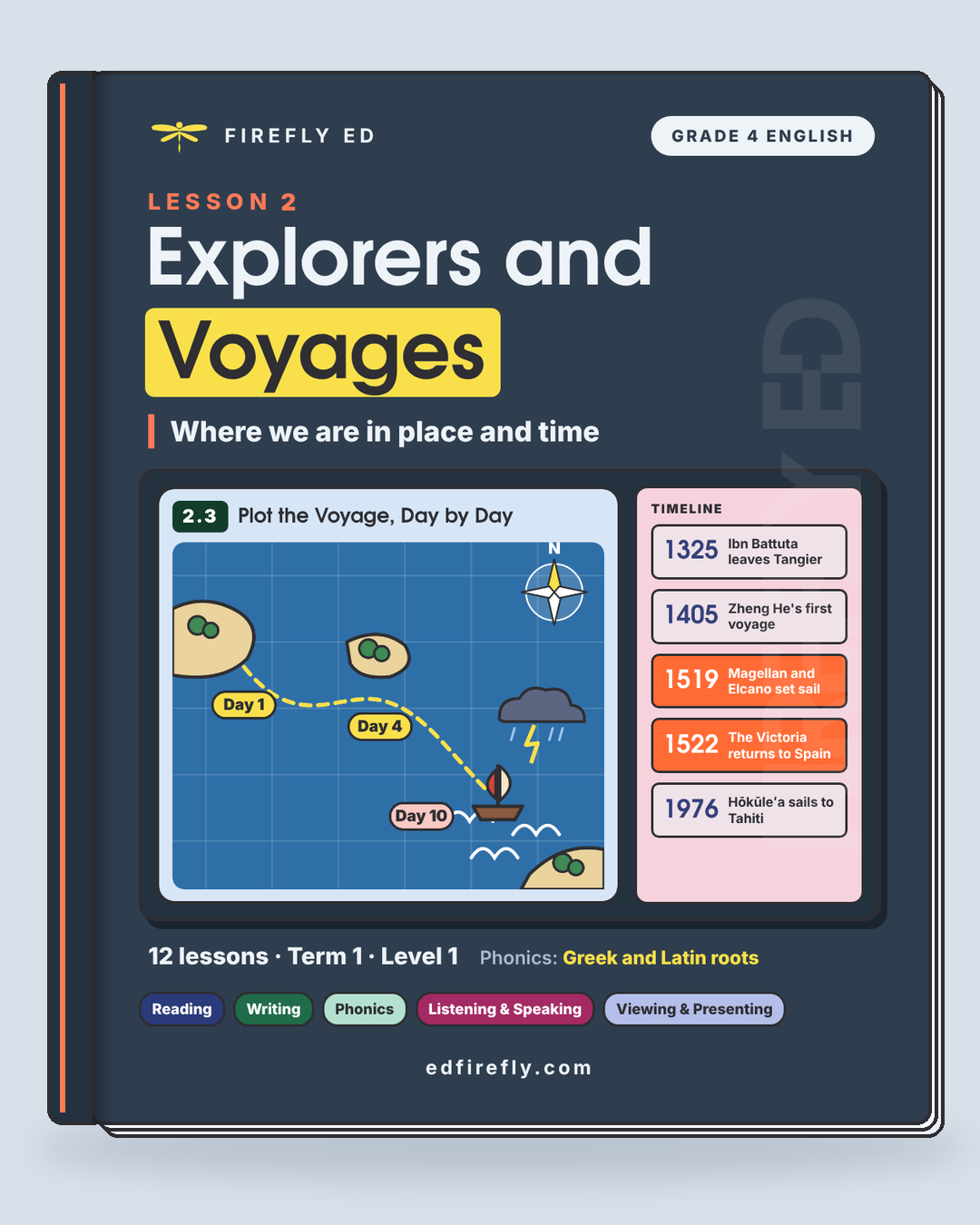
Term 1 | Level 1 | Phonics focus: Greek and Latin roots: tele, photo, graph, port, nav, geo and meter
What Lesson 2 is about
Explorers travel for different reasons, and their journeys change what people know about the world.
Theme: Where we are in place and time. It covers why people have set out on long journeys, how they found their way across land and sea, and how we tell, read and map the story of a voyage.
Before you start
Before Lesson 2.1, think about the longest journey you have made, or one you would like to make. Why do people go on long journeys? How could you find your way without a map or a phone?
Write down your ideas and keep them. You will look at them again at the end of Lesson 2.
Questions we explore
- Why people set out to explore
- How explorers find their way
- How journeys change what people know about the world
How each lesson works
Every lesson starts with a Wonder question to think about. Next, you learn something new, see how it is done, try it, and practise on your own. Each lesson ends with Reflect, where you go back to the Wonder question, think about how you learned, and choose something to do at home.
Lessons
Each strand of Lesson 2 has its own page. Open a page to see its lessons.
Download all of Lesson 2 as a PDF (free after you subscribe)
Reading: Polynesian Wayfinders and Firsthand and Secondhand Accounts
In Lessons 2.1 and 2.2, you put the events of a voyage in time order, and tell a firsthand account from a secondhand account.
Writing: Write a Ship’s Diary and a Paragraph About an Explorer
In Lessons 2.3 and 2.4, you write a ship’s diary entry in the first person, and write a paragraph about an explorer with a topic sentence and facts.
Listening and Speaking: Retell a Journey and Give a Two-Minute Explorer Talk
In Lessons 2.5 and 2.6, you retell a journey in order with time words, and paraphrase what they hear in a short talk about an explorer.
Viewing and Presenting: Read a Timeline and a Map With Scale, Compass and Key
In Lessons 2.7 and 2.8, you read a timeline of voyages, and use a compass rose, a scale and a key to find places and distances on a map.
Phonics: Roots tele, photo, graph, port, nav, geo and meter
In Lessons 2.9, 2.10 and 2.11, you use the roots tele, photo, graph, port, nav, geo and meter to read, spell and work out new words, and spell six tricky words.
Review
Lesson 2.12 reviews the whole of Lesson 2. An optional Challenge with a story and a grammar task follows it. Select a section to go straight to it. Each section ends with a link back to the top of the page.
Lesson 2.12: Lesson 2 Review
All strands | About 20 minutes
Term 1 | Level 1
Goal
“I can show what I have learned about voyages, accounts, diaries, timelines, maps and word roots in Lesson 2.”
Words to know
firsthand, secondhand, time order, topic sentence, paraphrase, timeline, scale, root
Wonder
Think about this question before you start. Say your ideas. You will come back to it at the end of the lesson.
Which explorer from Lesson 2 would you most like to have travelled with, and why?
Let’s Learn
This review has six tasks. Here is a reminder of what each one checks.
1. Read each task carefully.
2. Try it on your own first.
3. Check your work with the Answer Key.
4. Mark any task that felt hard. Go back to that lesson and try again.
See How It’s Done
Now Try It
1. “We heard the waves crash as I climbed the mast.” Is this firsthand or secondhand? How do you know?
__________________________________________________________________
Hint: Look for clue words.
2. What does the root port mean?
______________
Hint: Think of transport and portable.
Time To Practise
Name: ______________________
1. Reading.
Read the two short accounts.
A: The explorers reached the coast on 3 March. They had walked for 40 days. Two of their camels had run away.
B: At last I saw the sea! My feet were sore and my throat was dry, but I laughed out loud.
a) Which account is firsthand? ______ Write one clue word: ______________
b) Write one fact that only account A gives. ________________________________
c) Number these in time order: ______ reached the coast ______ set off ______ walked for 40 days
2. Writing.
a) Circle the best topic sentence for a paragraph about Ibn Battuta.
i) He liked travelling. ii) Ibn Battuta was a traveller who spent 29 years on journeys across Africa and Asia. iii) 1325.
b) Make this diary sentence more vivid with a sensory detail: It was hot.
__________________________________________________________________
3. Oral.
Paraphrase this sentence in your own words: “The navigator read the stars, the swells and the flight of birds to find land.”
__________________________________________________________________
4. Visual.
Use the map of Pua Island.
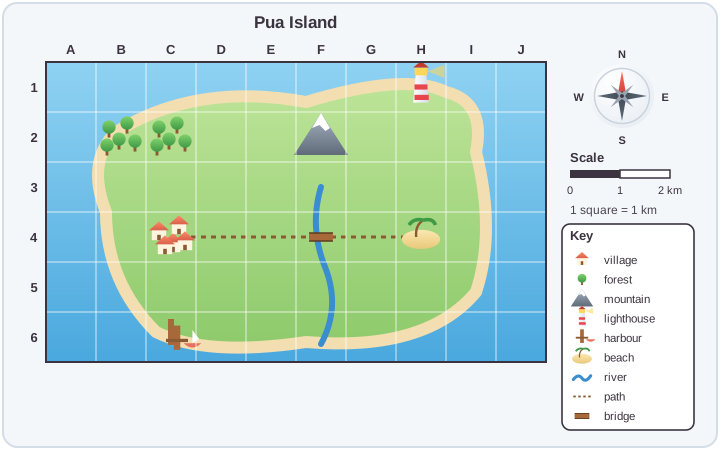
a) What is in square F2? ______________ b) In which direction is the harbour from the forest? ______________
c) About how many kilometres is it from the village to the beach? ______________
d) On a timeline from 1300 to 2000, which comes first: 1911 or 1405? ______________
5. Phonics.
Write the meaning of each root.
tele ______________ photo ______________ graph ______________ nav ______________ geo ______________
Complete: trans + port = ______________ thermo + meter = ______________
6. Spelling.
a) Circle the correct spelling.
ancient / anceint foriegn / foreign vehicle / vehical temperature / temprature
b) Write from dictation.
Listen as an adult reads a sentence aloud. Write it.
__________________________________________________________________
Reflect
Think about these questions. Talk about them with someone at home or at school.
1. Go back to the Wonder question: “Which explorer from Lesson 2 would you most like to have travelled with, and why?” What do you think now?
2. I was reflective today when I ______________________________.
Being reflective means looking back at your work and thinking how to make it better. For example: I was reflective today when I looked back at a task that was hard and tried again.
Take action: Choose one task from this review that felt hard. Show someone at home how you worked through it.
Next Steps
If this was easy, try: Make a timeline of five journeys your family has made, with dates, and write two questions about it for someone to answer.
If this was hard, go back to: Let’s Learn. Look at the reminder chart, find the lesson for the task that felt hard, and try that lesson again.
Notes for Parents and Teachers
Show notes for parents and teachers
These notes cover this lesson only. How every lesson runs is explained in How to Use This Material.
See How It’s Done
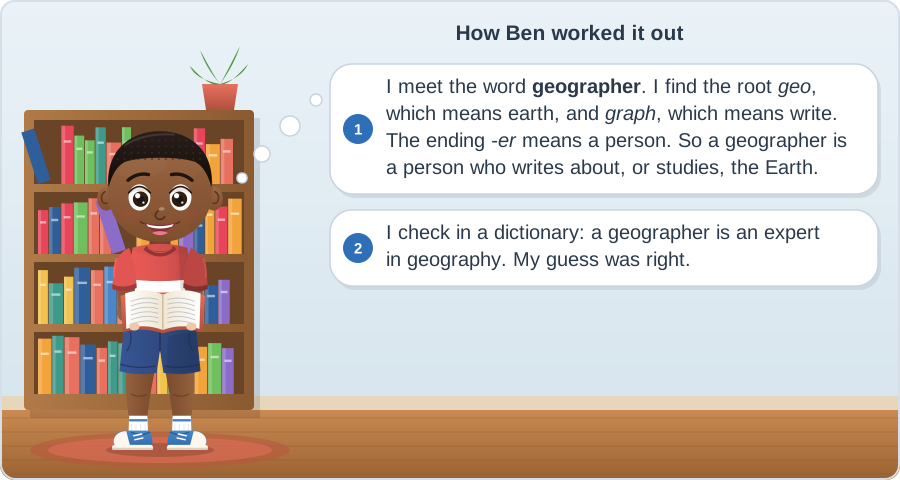
Ben’s thoughts show one way to check a root word, using the word ‘geographer’.
Time To Practise
- Task 6: Read the sentence in the Answer Key slowly.
Answer Key
Reveal Answers
Now Try It
1. Firsthand. The clue words are we and I. 2. carry
1. Reading
a) B; clue word: I or my b) Any one of: they reached the coast on 3 March; they walked for 40 days; two camels ran away. c) 3, 1, 2
If it was hard, go back to Lessons 2.1 and 2.2.
2. Writing
a) ii) b) Sample answer: The sun burned the back of my neck, and the sand was too hot to touch.
If it was hard, go back to Lessons 2.3 and 2.4.
3. Oral
Sample answer: The navigator found land by watching the stars, the waves and the birds.
If it was hard, go back to Lessons 2.5 and 2.6.
4. Visual
a) the mountain b) south c) about 5 km d) 1405
If it was hard, go back to Lessons 2.7 and 2.8.
5. Phonics
far, light, write or draw, ship, earth; transport, thermometer
If it was hard, go back to Lessons 2.9 to 2.11.
6. Spelling
a) ancient, foreign, vehicle, temperature b) Dictation sentence: The determined explorers saw an opportunity to cross the ancient desert.
If it was hard, go back to Lesson 2.11.
Reflect
2. Any real moment from the lesson that shows the learner was reflective. Examples: “I was reflective today when I looked back at a task that was hard and tried again.” “I was reflective today when I checked my answers and fixed a mistake.”
Challenge: Read-Aloud Story and Grammar
Optional | About 20 minutes
This Challenge is optional. It has a story to listen to and a grammar task.
Part 1: Read-Aloud Story
Listen as an adult reads the story aloud. Then talk about it.
The Stick Chart
Lijon lived on an island in the Marshall Islands, where the sea was the colour of green glass. Her grandfather, who had sailed every reef and channel around the island, was teaching her to navigate.
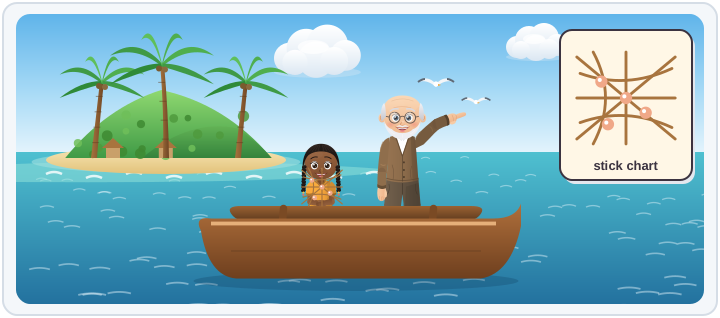
One morning he handed her a frame of thin sticks tied with string. Small shells were tied where some of the sticks crossed. “This is a stick chart,” he said. “The curved sticks show the swells, which bend around the islands. The shells are the islands.” Lijon turned it over in her hands. It looked like a puzzle, not a map.
That afternoon they paddled out beyond the reef. Grandfather asked her to close her eyes. The canoe lurched, then rocked in a new rhythm. “Feel that?” he said. “That is the swell that bends around Motu Island.”
Lijon opened her eyes and looked at the chart. The shell that stood for Motu sat just where the swell had turned. She grinned. The puzzle was starting to make sense. A girl whose grandfather could read the sea, she thought, should learn to read it too.
Talk about the story
1. What is a stick chart? What do the sticks and the shells show?
2. Why did Grandfather ask Lijon to close her eyes?
Hint: What did he want her to feel?
3. The canoe lurched. What do you think ‘lurched’ means? What clue helps you?
Hint: Look at what the canoe did next.
4. How did Lijon know that the chart matched the sea?
5. Why does Lijon think she should learn to read the sea?
Part 2: Relative Pronouns (Grammar)
A relative pronoun starts a clause that tells us more about a noun.
who is for people: Her grandfather, who had sailed every reef, was teaching her.
which is for things and animals: The swells, which bend around the islands, are shown by sticks.
that can be for people or things: That is the swell that bends around Motu Island.
whose shows belonging: a girl whose grandfather could read the sea
whom is a formal word for people, used after a word such as to or with: the man with whom she sailed
1. Underline the relative pronoun in each sentence.
a) The shell that stood for Motu sat where the swell turned.
b) Lijon, who was holding the chart, opened her eyes.
c) The reef, which was full of fish, lay beside the island.
2. Write who, which or whose.
a) The navigator ______ guided the canoe was Lijon’s grandfather.
b) The canoe, ______ was made of wood, rocked on the swell.
c) Lijon is the girl ______ grandfather made the chart.
3. Join the two sentences with who or which.
a) The stick chart was old. It hung on the wall.
______________________________________________
b) Grandfather smiled. He had made the chart.
______________________________________________
4. Write your own sentence about an explorer, using who or whose.
______________________________________________
Notes for Parents and Teachers
Show notes for parents and teachers
These notes cover this section only. How every lesson runs is explained in How to Use This Material.
Use the Challenge when the lessons feel easy, or to stretch the learner after Lesson 2.12. The story is for you to read aloud. It uses some harder words on purpose, so talk about them as you read.
Part 1: Read-Aloud Story
Read the story aloud twice. The first time, just enjoy it. The second time, stop at the words in bold and talk about what they mean.
Answer Key
Reveal Answers
Part 1: Talk about the story
1. A frame of sticks tied with string. The curved sticks show the swells and the shells show the islands.
2. He wanted her to feel the swell through the canoe instead of looking for it.
3. It means moved suddenly and unevenly. The clue is that the canoe then “rocked in a new rhythm”.
4. The shell for Motu was just where she had felt the swell turn.
5. Because her grandfather can read the sea, and she wants to carry on what he knows. Any answer with a reason.
Part 2: Grammar
1. a) that b) who c) which
2. a) who b) which c) whose
3. a) The stick chart, which hung on the wall, was old. (or The stick chart that hung on the wall was old.) b) Grandfather, who had made the chart, smiled.
4. Any correct sentence, for example: Mau Piailug was a navigator who sailed by the stars.
Look for: who for people, which for things, and commas around a clause that adds extra information.
Try it at home
By the end of Lesson 2, you could:
- Plan a short family walk with a map you draw together. Add a compass, a key and a scale, then follow it.
- Keep a travel diary on your next trip, even a trip to a shop or a park. Write what you saw, heard and felt.
- Find out about one explorer from your own country or region and give a two-minute talk at home.
Lesson 2.12 reviews Lesson 2. Look back at the ideas from “Before you start” and talk about how they have changed.
Notes for Parents and Teachers
Show notes for parents and teachers
the Lesson 2 page and the lessons are written for the learner. How every lesson runs is explained once in How to Use This Material. Each lesson also has its own short notes, after Next Steps.
- The lessons are worksheets. The learner opens a lesson and works on paper next to the screen, or on a printout. Printable PDFs are free to download after you subscribe.
- Before you start: help the learner write down their ideas before Lesson 2.1, and keep them. In Lesson 2.12, look at them together and talk about how they have changed.
For Teachers: IB Details
Show IB and curriculum details
IB theme: Where we are in place and time. This theme is about when and where things happen, how people lived in the past, and how discoveries and journeys have shaped the world.
Central idea: Explorers travel for different reasons, and their journeys change what people know about the world.
Key concepts: Change (how is it changing?), Causation (why is it like it is?), Perspective (what are the points of view?). Related concepts: exploration, navigation, evidence.
Lines of inquiry:
- How explorers find their way
- How journeys change what people know about the world
- Why people set out to explore
What each lesson covers
| Lesson | Title | Strand | Key concept |
|---|---|---|---|
| 2.1 | Sailing by the Stars: Polynesian Wayfinders | Reading | Causation |
| 2.2 | Two Accounts of One Voyage: Firsthand and Secondhand | Reading | Perspective |
| 2.3 | Write a Ship’s Diary Entry | Writing | Perspective |
| 2.4 | Write About an Explorer: Topic Sentences and Facts | Writing | Change |
| 2.5 | Retell a Journey in Order | Speaking | Change |
| 2.6 | Paraphrase and Report: A Two-Minute Explorer Talk | Listening and speaking | Perspective |
| 2.7 | Read a Timeline of Voyages | Viewing | Change |
| 2.8 | Read a Map: Scale, Compass and Key | Viewing | Form |
| 2.9 | Greek Roots: tele, photo, graph | Reading and spelling | Form |
| 2.10 | Latin Roots: port and nav | Reading and spelling | Form |
| 2.11 | Roots: geo and meter, and Tricky Words | Reading and spelling | Form |
| 2.12 | Lesson 2 Review | All strands | Change, Causation and Perspective |
Each lesson also matches the national curriculum for England (Year 4) and the US Common Core (Grade 4). The Grade 4 Curriculum Map lists the full standards for every lesson.
Lessons – Index | Next: Lesson 3, Poems and Plays →
© 2026 Firefly Ed. All rights reserved. This page may be printed for personal, home and classroom use. It may not be sold, shared online or reproduced for commercial use without written permission. edfirefly.com


Share your thoughts or ask something..