
Term 3 | Level 3 | Phonics focus: contractions, apostrophes for owning, and -tion words
Lesson 7 – Day, Night and the Sky | Lessons – Index
Lessons
This page has the two listening and speaking lessons of Lesson 7, Day, Night and the Sky: Lessons 7.5 and 7.6. The Lesson 7 page has the Lesson 7 overview, the Lesson 7 review and the PDF download.
Select a lesson to go straight to it. Each lesson ends with a link back to the top of the page.
Lesson 7.5: Perform a Poem Together
Oral | About 20 minutes
Term 3 | Level 3
Goal
“I can mark a poem for volume and pace, plan actions, and perform it with a group, saying the shared lines in time.”
Words to know
perform, volume, pace, pause, expression, actions
Wonder
Think about this question before you start. Say your ideas. You will come back to it at the end of the lesson.
How can your voice make a poem come alive?
Let’s Learn
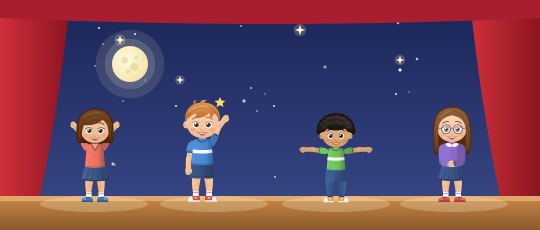
When you perform a poem, your voice and body help the audience enjoy it. Think about:
| Skill | What it means |
|---|---|
| volume | loud or soft. Use a soft voice for quiet, gentle lines. |
| pace | fast or slow. Slow down for lines that are calm or important. |
| pause | a short stop at a full stop, or at … |
| expression | making your voice sound happy, surprised, sleepy or excited |
| actions | simple movements that match the words |
| timing | in a group, everyone says the All lines at exactly the same time |
Performers often mark the poem first, with notes such as loud, soft, slow or pause.
See How It’s Done
Now Try It
1. Say Hello, night! in three ways: excited, sleepy and whispering. Which way suits the start of the poem best?
Hint: The night is just arriving. How would you greet it?
2. What action could match The Sun slides down behind the hill?
Hint: Use your hands to show the Sun going down.
Time To Practise
Name: ______________________
1. Read the poem.
Hello, Night
| Who | Line |
|---|---|
| All | Hello, night! Hello, night! |
| Voice 1 | The Sun slides down behind the hill. |
| Voice 2 | The birds fly home. The trees are still. |
| All | Hello, night! Hello, night! |
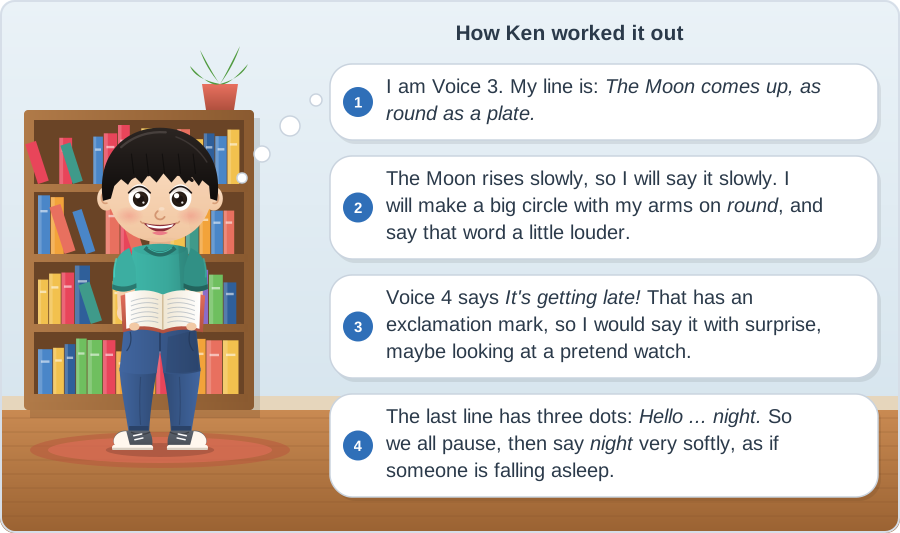
| Voice 3 | The Moon comes up, as round as a plate. |
| Voice 4 | The stars come out. It’s getting late! |
| All | Hello, night! Hello, night! |
| Voice 1 | The owl wakes up: too-whit, too-whoo! |
| Voice 2 | The fox creeps out, and the badger too. |
| All (softly) | Goodnight, Sun. Hello … night. |
2. Mark the poem.
Choose how to say each part. Write loud or soft, and fast or slow.
| Line | Volume | Pace |
|---|---|---|
| Hello, night! Hello, night! (the first time) | __________ | __________ |
| The stars come out. It’s getting late! | __________ | __________ |
| The fox creeps out, and the badger too. | __________ | __________ |
| Goodnight, Sun. Hello … night. | __________ | __________ |
Give a reason for one of your choices.
__________________________________________________________________
3. Plan your actions.
Write or draw a simple action for these lines.
a) The birds fly home. ______________________________
b) The owl wakes up. ______________________________
c) The fox creeps out. ______________________________
4. Perform together.
Perform the poem with people at home. Share out the voices. If there are only two of you, take two voices each. Practise three times, then perform for an audience, such as another family member, or record it.
An adult watches and ticks each one they notice:
☐ spoke clearly ☐ changed volume ☐ changed pace ☐ paused at the dots ☐ used actions that match the words ☐ said the All lines in time with others ☐ looked at the audience
5. Two stars and a wish.
Think about the performance. Write two things that went well and one thing to do better next time.
★ ______________________________________________
★ ______________________________________________
Wish: ______________________________________________
Reflect
Think about these questions. Talk about them with someone at home or at school.
1. Go back to the Wonder question: “How can your voice make a poem come alive?” What do you think now?
2. I was a risk-taker today when I ______________________________.
A risk-taker tries something new, even when it feels hard. For example: I was a risk-taker today when I tried a new action in front of an audience.
Take action: Perform the poem at bedtime for a younger child or a grandparent, or on a video call to a relative.
Next Steps
If this was easy, try: Learn the whole poem by heart and perform it alone, using different voices for each part.
If this was hard, go back to: Task 4. Learn the All lines only first. Then take one Voice line and practise it with your action.
Notes for Parents and Teachers
Show notes for parents and teachers
These notes cover this lesson only. How every lesson runs is explained in How to Use This Material.
Let’s Learn
Say one line of a nursery rhyme loudly, then softly, then slowly, and talk about how it changes.
See How It’s Done
Do the actions and voices as you go through Ken’s thoughts.
Time To Practise
- Task 4: Tick each one you notice.
Answer Key
Reveal Answers
Now Try It
1. Sample answer: Excited or happy, because the poem is greeting the night.
2. Sample answer: Hold up one hand as the Sun and slowly lower it behind the other arm.
2. Mark the poem
Sample answers:
Hello, night! (first time): loud, fast
It’s getting late!: loud, fast
The fox creeps out: soft, slow
Goodnight, Sun. Hello … night.: soft, slow
Reason: The fox is creeping, so it should be quiet and slow, as if we do not want to wake anyone.
Look for: choices that match the meaning of the words. Accept other choices with a sensible reason.
3. Actions
Sample answers: a) flap your arms like wings b) open your eyes wide and stretch c) tiptoe with your hands held up like paws
4. Performance
Look for: five or more ticks.
5. Two stars and a wish
Sample answer: We all said the All lines together. My owl action made people laugh. Wish: I will speak louder on my own line.
Reflect
2. Any real moment from the lesson that shows the learner was a risk-taker. Examples: “I was a risk-taker today when I tried a new action in front of an audience.” “I was a risk-taker today when I spoke my line on my own, even though I felt a bit shy.”
Lesson 7.6: Explain It: How and Why Questions
Oral | About 20 minutes
Term 3 | Level 3
Goal
“I can use a model to explain how day and night happen, step by step, and answer how and why questions in full sentences with because.”
Words to know
model, explain, how, why, what if, full sentence
Wonder
Think about this question before you start. Say your ideas. You will come back to it at the end of the lesson.
How could you show someone why we have night, using things from home?
Let’s Learn
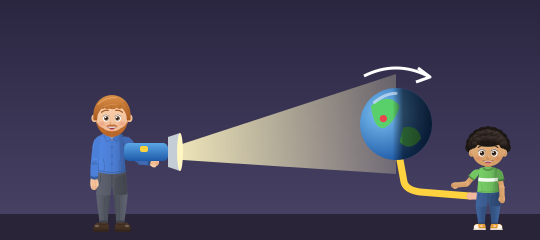
A model is a small copy that helps us see how something works. A torch can be a model of the Sun, and a ball can be a model of the Earth.
When you explain with a model:
- Say what each object stands for: The torch is the Sun.
- Show one step at a time, and say what is happening.
- Use because and so to give reasons.
- Check your listener understands: Does that make sense?
Your listener can ask questions to find out more.
| Question word | Asks about | Example |
|---|---|---|
| How | the way something happens | How does the night start? |
| Why | the reason | Why is one side dark? |
| What if | what would happen | What if the Earth stopped spinning? |
Answer a question in a full sentence, and give a reason with because.
See How It’s Done
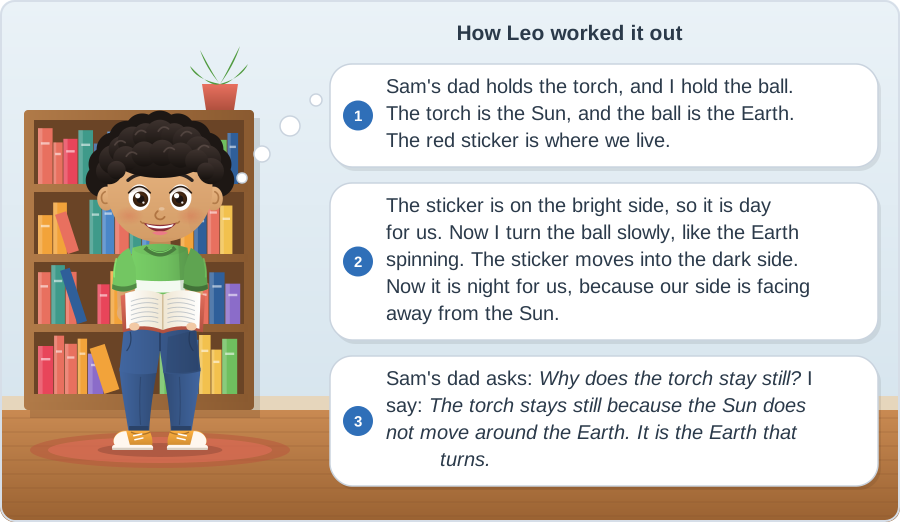
Now Try It
Use the picture in See How It’s Done.
1. Is it day or night at the red sticker in the picture? How do you know?
Hint: Which side of the ball is the sticker on, bright or dark?
2. Ask the adult one how question and one why question about the picture.
Hint: Start with How does … or Why is …
Time To Practise
Name: ______________________
1. Get ready.
You need: a torch, a ball (or an orange), a small sticker, and a dark room.
Put the sticker on the ball to show where you live. Ask an adult to shine the torch at the ball.
2. Plan your explanation.
Write key words for each step.
| Step | Key words |
|---|---|
| 1. What the objects stand for | ______________________________ |
| 2. Day for the sticker | ______________________________ |
| 3. Turning the ball | ______________________________ |
| 4. Night for the sticker | ______________________________ |
| 5. A new day | ______________________________ |
3. Explain it.
Use the torch and ball to explain day and night to someone at home. Turn the ball slowly, and talk as you turn. Use because or so at least twice.
4. Answer questions.
Your listener chooses two of these questions. Answer each one in a full sentence with because.
a) Why is one side of the ball dark?
b) How does the night end?
c) Why can people on the other side of the world be asleep when we are awake?
d) What if the Earth stopped spinning?
Write your answer to one question.
__________________________________________________________________
__________________________________________________________________
An adult listens and ticks each one they hear:
☐ said what each object stands for ☐ explained in order ☐ used because or so twice ☐ checked that the listener understood ☐ answered in full sentences ☐ gave reasons in answers
5. Ask your own question.
Swap roles. Ask the adult one how or why question about the Sun, the Earth or the Moon that you still wonder about. If neither of you knows the answer, find it out together in a book or on a website for children.
My question: ______________________________________________?
Reflect
Think about these questions. Talk about them with someone at home or at school.
1. Go back to the Wonder question: “How could you show someone why we have night, using things from home?” What do you think now?
2. I was a communicator today when I ______________________________.
A communicator shares ideas clearly by talking, writing or drawing. For example: I was a communicator today when I explained each step slowly so my listener could follow.
Take action: Explain day and night to someone who was not there, using only your hands as the Sun and the Earth.
Next Steps
If this was easy, try: Add a second ball for the Moon. Find out how the Moon moves around the Earth, then explain it with your model.
If this was hard, go back to: Task 3. Explain steps 1, 2 and 4 only, using the sentence starts: The torch is … The sticker is on the bright side, so … Now it is dark because …
Notes for Parents and Teachers
Show notes for parents and teachers
These notes cover this lesson only. How every lesson runs is explained in How to Use This Material.
Let’s Learn
Point to each question word and make up one more question together.
See How It’s Done
If you can, do the demonstration with a real torch and ball as you go through Leo’s thoughts.
Time To Practise
- Task 4: Tick each one you hear.
Answer Key
Reveal Answers
Now Try It
1. Day. The sticker is on the bright side of the ball, facing the torch.
2. Sample answers: How does the ball move? Why is the torch pointing at the ball?
2. Plan
Sample answer: 1. torch = Sun, ball = Earth, sticker = home 2. sticker faces torch, bright, day 3. turn ball slowly, Earth spins 4. sticker faces away, dark, night 5. keep turning, faces torch again, morning
4. Answers
Sample answers:
a) One side is dark because the light from the torch cannot reach it.
b) The night ends because the Earth keeps turning, so our side faces the Sun again.
c) They can be asleep because their side of the Earth is facing away from the Sun, so it is night for them.
d) Sample answer: In our model, one side of the ball would always have day and the other side would always have night, because the ball would not turn.
Look for: four or more ticks. In d), any sensible idea is fine. This is a “what if” question, so there is no fact to copy.
Reflect
2. Any real moment from the lesson that shows the learner was a communicator. Examples: “I was a communicator today when I explained each step slowly so my listener could follow.” “I was a communicator today when I checked that my listener understood.”
For Teachers: IB Details
Show IB and curriculum details
IB theme: How the world works. This theme is about the natural world and its laws: how the Earth, the Sun and the Moon move, and how people find out about the world around them.
Central idea: The movement of the Earth and the Moon causes patterns that we can see in the sky.
| Lesson | Title | Strand | Key concept |
|---|---|---|---|
| 7.5 | Perform a Poem Together | Listening and speaking | Form |
| 7.6 | Explain It: How and Why Questions | Listening and speaking | Causation |
Each lesson also matches the national curriculum for England (Year 2) and the US Common Core (Grade 2). The Grade 2 Curriculum Map lists the full standards for every lesson.
← Back to Lesson 7 – Day, Night and the Sky | Lessons – Index
© 2026 Firefly Ed. All rights reserved. This page may be printed for personal, home and classroom use. It may not be sold, shared online or reproduced for commercial use without written permission. edfirefly.com


Share your thoughts or ask something..