
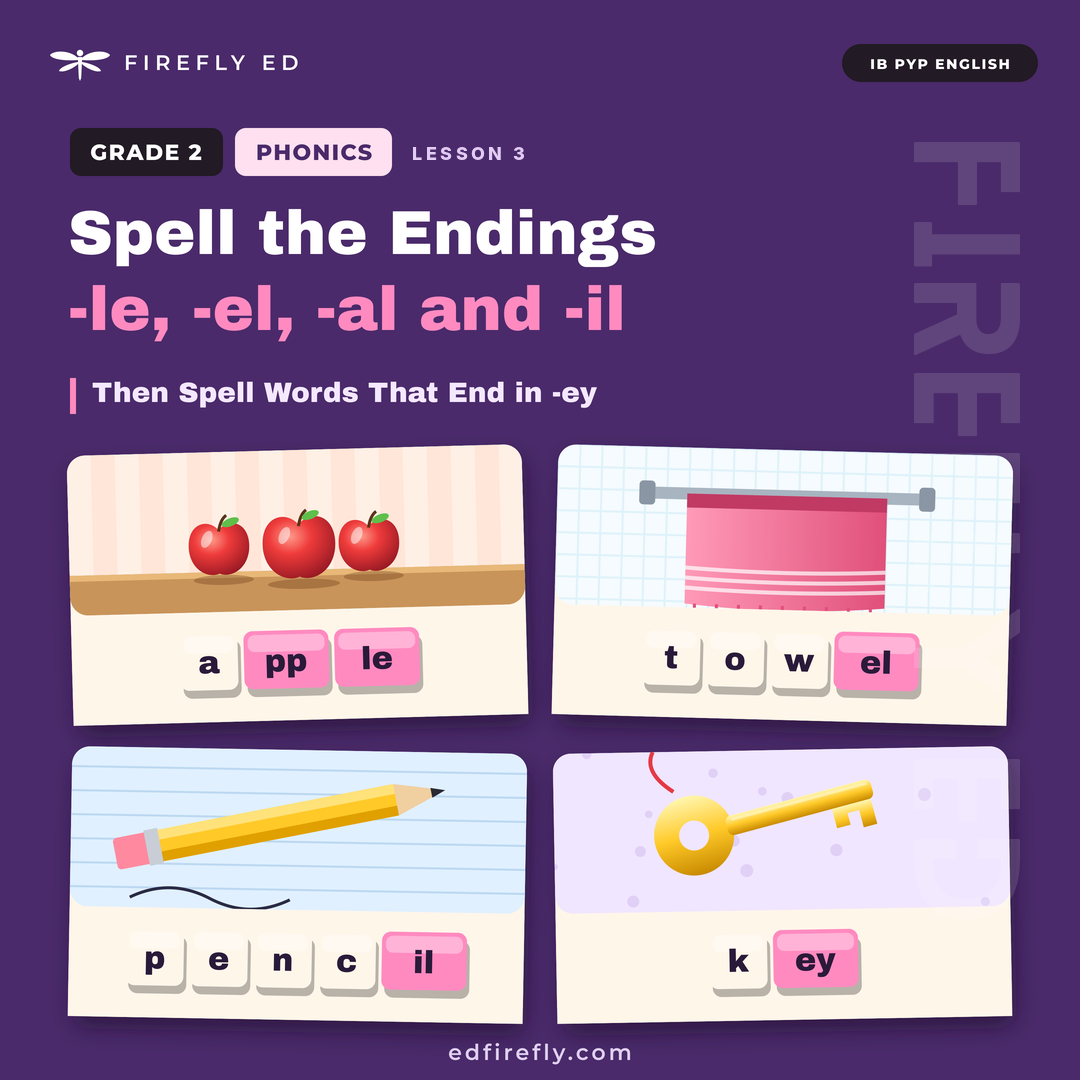
Term 1 | Level 1 | Phonics focus: -le, -el, -al, -il and -ey endings
Lesson 3 – Tales From Around the World | Lessons – Index
Lessons
This page has the three phonics lessons of Lesson 3, Tales From Around the World: Lessons 3.9, 3.10 and 3.11. The Lesson 3 page has the Lesson 3 overview, the Lesson 3 review and the PDF download.
Select a lesson to go straight to it. Each lesson ends with a link back to the top of the page.
- Lesson 3.9: -le Endings
- Lesson 3.10: -el, -al and -il Endings
- Lesson 3.11: ey and y Endings, and Tricky Words
Lesson 3.9: -le Endings
Phonics | About 20 minutes
Term 1 | Level 1
Goal
“I can spell words that end in le, deciding whether to double the letter before it by clapping syllables and listening to the vowel.”
Words to know
le, syllable, short vowel, long vowel, double letter
Wonder
Think about this question before you start. Say your ideas. You will come back to it at the end of the lesson.
Why does little have two t’s but table has only one b?
Let’s Learn
Many words end with an “ul” sound, as in apple and table. The most common way to spell this sound at the end of a word is le.
Split the word into two syllables. Look at the first syllable to decide what comes before le.
| First syllable | Spelling | Examples |
|---|---|---|
| ends in a short vowel | double the consonant before le | ap|ple, lit|tle, bot|tle, mid|dle, bub|ble |
| ends in a long vowel | one consonant before le | ta|ble, ti|tle, ca|ble |
| already has a consonant after the vowel | one consonant before le | can|dle, jun|gle, han|dle, sim|ple |
The doubled letter keeps the first vowel short. Without it, little would look like it should be said “lie-tle”.
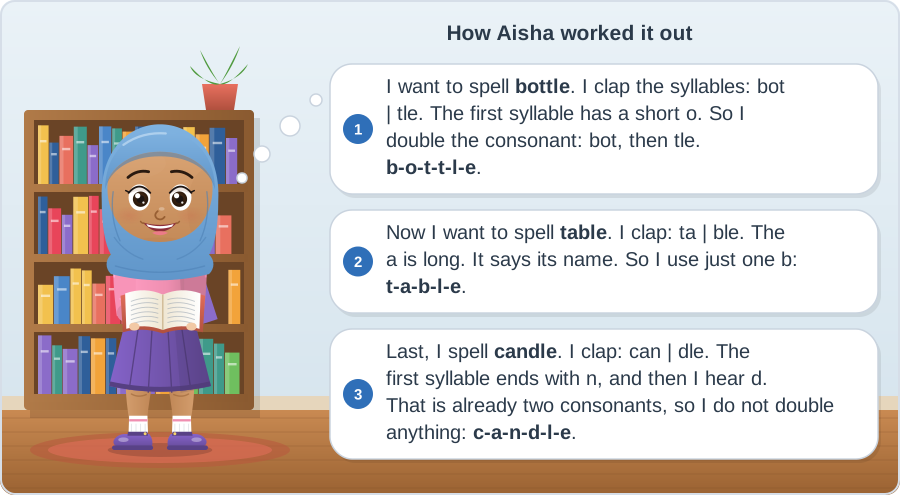
See How It’s Done
Now Try It
1. One of these words has a double letter before le. Which one, and why?
Hint: Clap the syllables. Is the first vowel short or long?
Listen as an adult names each picture.
2. How many syllables are in puzzle? Where do you split it?
Hint: Clap it slowly.
Time To Practise
Name: ______________________
1. Write the word for each picture.
Hint: Clap the syllables first. Then decide: double letter or not?
Listen as an adult names each picture.
1. ______________ 2. ______________ 3. ______________ 4. ______________
2. Sort the words.
Words: little | table | puzzle | title | middle | cable | bubble | jungle | handle | simple
| short vowel, double letter | long vowel, one letter | two different consonants |
|---|---|---|
| __________ | __________ | __________ |
| __________ | __________ | __________ |
| __________ | __________ | __________ |
| __________ |
3. Find the le words.
Read the start of a folk tale. Underline at least eight words that end in le.
Once, in the middle of a jungle, there lived a little turtle. She was gentle and humble, but she was always in trouble. One day, she saw a purple beetle stuck in a puddle.
Which two of your words have a long vowel or two different consonants before le? ______________ and ______________
4. Listen and write the sentence.
Listen as an adult says a sentence twice. Write it.
__________________________________________________________________
Reflect
Think about these questions. Talk about them with someone at home or at school.
1. Go back to the Wonder question: “Why does little have two t’s but table has only one b?” What do you think now?
2. I was a thinker today when I ______________________________.
A thinker thinks carefully to work things out. For example: I was a thinker today when I clapped the syllables to decide whether to double the letter before le.
Take action: Look at food packets and labels at home. Find three words that end in le, such as apple, noodle or vegetable.
Next Steps
If this was easy, try: Write a short silly poem where every line ends in an le word, such as little, giggle, wiggle and puddle.
If this was hard, go back to: Let’s Learn. Work on the double letter words first: apple, little, bottle. Clap and spell each one. Then try table.
Notes for Parents and Teachers
Show notes for parents and teachers
These notes cover this lesson only. How every lesson runs is explained in How to Use This Material.
Let’s Learn
Clap the syllables of each example together.
See How It’s Done
Write bottle, table and candle on paper, with a line between the syllables, as you go through Aisha’s thoughts.
Now Try It
Point to each picture and name it first. The full words are in the Answer Key.
Time To Practise
- Task 1: Point to each picture and name it first. The full words are in the Answer Key.
- Task 4: Read the sentence from the Answer Key aloud twice.
Answer Key
Reveal Answers
Now Try It
1. apple. In ap|ple, the a is short, so the p is doubled. In ta|ble, the a is long, so there is only one b.
2. Two syllables: puz | zle.
1. Pictures
1. candle
2. bottle
3. kettle
4. turtle
Look for: candle and turtle have no double letter, because the first syllable already ends in a consonant (n, r).
2. Sort the words
short vowel, double letter: little, puzzle, middle, bubble
long vowel, one letter: table, title, cable
two different consonants: jungle, handle, simple
3. Find the le words
middle, jungle, little, turtle, gentle, humble, trouble, purple, beetle, puddle (any eight)
Long vowel or two consonants: any two of jungle, turtle, gentle, humble, purple, beetle.
Look for: trouble has the “ul” sound but the vowel sound is spelt ou. Accept it as an le word.
4. Dictation
The little turtle hid a bottle under the table.
Look for: double t in little and bottle, single b in table, and rt in turtle.
Reflect
2. Any real moment from the lesson that shows the learner was a thinker. Examples: “I was a thinker today when I clapped the syllables to decide whether to double the letter before le.” “I was a thinker today when I explained why little has two t’s but table has one b.”
Lesson 3.10: -el, -al and -il Endings
Phonics | About 20 minutes
Term 1 | Level 1
Goal
“I can choose el, al or il to spell the “ul” sound at the end of a word, and use the letter before it to help me.”
Words to know
el, al, il, ending, letter before
Wonder
Think about this question before you start. Say your ideas. You will come back to it at the end of the lesson.
Why do camel and table end in the same sound but different letters?
Let’s Learn
In Lesson 3.9, you learned that the “ul” sound at the end of a word is most often spelt le. It can also be spelt el, al or il.
| Ending | When we use it | Examples |
|---|---|---|
| el | after m, n, r, v, w, and often after s. The le spelling is never used after m, n, r, v or w. | camel, tunnel, squirrel, travel, towel, tinsel |
| al | in a group of words we learn by heart, many with two or more syllables | metal, pedal, petal, animal, hospital |
| il | in only a few words | pencil, fossil, nostril, April |
Tip: Look at the letter just before the “ul” sound. If it is m, n, r, v or w, choose el. If not, try le first. If the word looks wrong, check a word list or a dictionary.
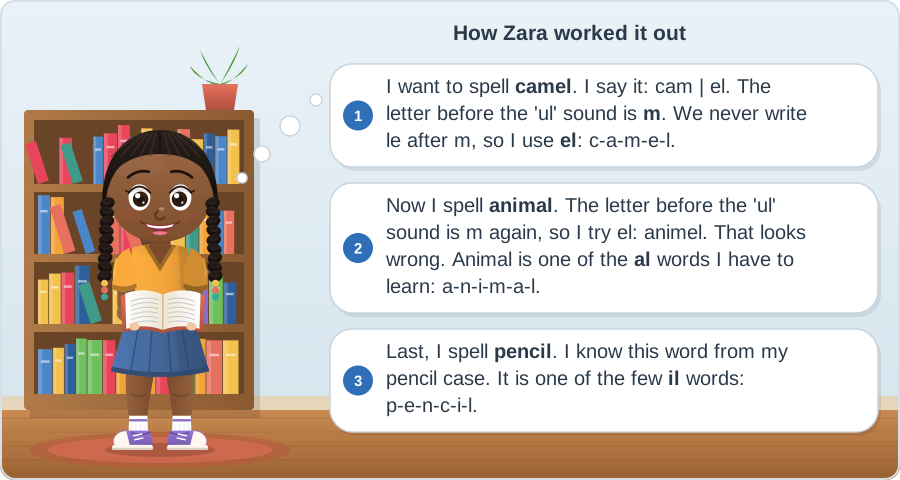
See How It’s Done
Now Try It
1. Which ending does each word have: el, al or il?
Hint: Look at the table in Let’s Learn. Check the letter before the “ul” sound.
Listen as an adult names each picture.
2. Sam wrote tunnle. Why is this wrong?
Hint: Which letter comes just before the “ul” sound?
Time To Practise
Name: ______________________
1. Write the word for each picture.
Hint: Choose le, el, al or il for the end of each word.
Listen as an adult names each picture.
1. ______________ 2. ______________ 3. ______________ 4. ______________
2. Add el, al or il.
Listen as an adult reads each word. Then add el, al or il.
a) trav ______ b) anim ______ c) squirr ______ d) hospit ______
e) nostr ______ f) tins ______ g) ped ______ h) Apr ______
3. Fix the spelling mistakes.
Mia wrote about a folk tale. She made five mistakes with “ul” endings. Find them and write them correctly.
A clever camle and a little squirrle loved to travle. They crossed a metal bridge and went through a dark tunnle. In the end, they found a magic pencel.
| Mistake | Correct spelling |
|---|---|
| __________ | __________ |
| __________ | __________ |
| __________ | __________ |
| __________ | __________ |
| __________ | __________ |
4. Listen and write the sentence.
Listen as an adult says a sentence twice. Write it.
__________________________________________________________________
Reflect
Think about these questions. Talk about them with someone at home or at school.
1. Go back to the Wonder question: “Why do camel and table end in the same sound but different letters?” What do you think now?
2. I was a thinker today when I ______________________________.
A thinker thinks carefully to work things out. For example: I was a thinker today when I chose el for camel because the letter before the ending is m.
Take action: Make a four-column word wall at home: le, el, al and il. Add a word each time you find one in a book.
Next Steps
If this was easy, try: Use a dictionary to find two more words for each ending: el, al and il. Write a sentence with each one.
If this was hard, go back to: Let’s Learn. Start with el only: camel, tunnel and towel. Point to the m, n or w before the ending. Then learn three al words.
Notes for Parents and Teachers
Show notes for parents and teachers
These notes cover this lesson only. How every lesson runs is explained in How to Use This Material.
Let’s Learn
Say each example and point to the letter before the “ul” sound.
See How It’s Done
Write camel, animal and pencil on paper as you go through Zara’s thoughts.
Now Try It
Point to each picture and name it first. The full words are in the Answer Key.
Time To Practise
- Task 1: Point to each picture and name it first. The full words are in the Answer Key. For picture 2, point to the part the arrow shows.
- Task 2: Read each word aloud first. The words are in the Answer Key.
- Task 4: Read the sentence from the Answer Key aloud twice.
Answer Key
Reveal Answers
Now Try It
1. towel: el (after w). fossil: il.
2. The letter before the “ul” sound is n. We never write le after n, so it is spelt tunnel.
1. Pictures
1. camel
2. petal
3. tunnel
4. pencil
2. Add el, al or il
a) travel
b) animal
c) squirrel
d) hospital
e) nostril
f) tinsel
g) pedal
h) April
3. Fix the mistakes
camle: camel
squirrle: squirrel
travle: travel
tunnle: tunnel
pencel: pencil
Look for: “little” and “metal” are already correct.
4. Dictation
The animal dropped a pencil and a towel in the tunnel.
Look for: al in animal, il in pencil and el in towel and tunnel. A capital letter at the start and a full stop at the end.
Reflect
2. Any real moment from the lesson that shows the learner was a thinker. Examples: “I was a thinker today when I chose el for camel because the letter before the ending is m.” “I was a thinker today when I found the five spelling mistakes in Mia’s folk tale.”
Lesson 3.11: ey and y Endings, and Tricky Words
Phonics | About 20 minutes
Term 1 | Level 1
Goal
“I can read and spell words ending in ey, tell ey and y endings apart, and spell eight tricky words.”
Words to know
ey, y, long e, plural, tricky word
Wonder
Think about this question before you start. Say your ideas. You will come back to it at the end of the lesson.
Why do donkey and happy end with the same sound but different letters?
Let’s Learn
In Grade 1, you learned that y at the end of a word can say long i (cry, fly) or long e (happy, funny).
The long e sound at the end of a word can also be spelt ey.
| Spelling | Sound | Examples |
|---|---|---|
| y | long e at the end of a longer word | happy, funny, baby, puppy |
| ey | long e, in a smaller group of words | key, donkey, monkey, chimney, valley |
| ey | sometimes says ai, as in play | they, grey, obey |
Most words that end in the long e sound use y. Learn the ey words by heart. To make an ey word plural, just add s: keys, donkeys, monkeys.
Tricky words. Learn these by heart: old, cold, gold, hold, told, every, everybody, even. In old, cold, gold, hold and told, the o says its name, even though there is no e at the end. Every and everybody have a letter e in the middle that we hardly hear.
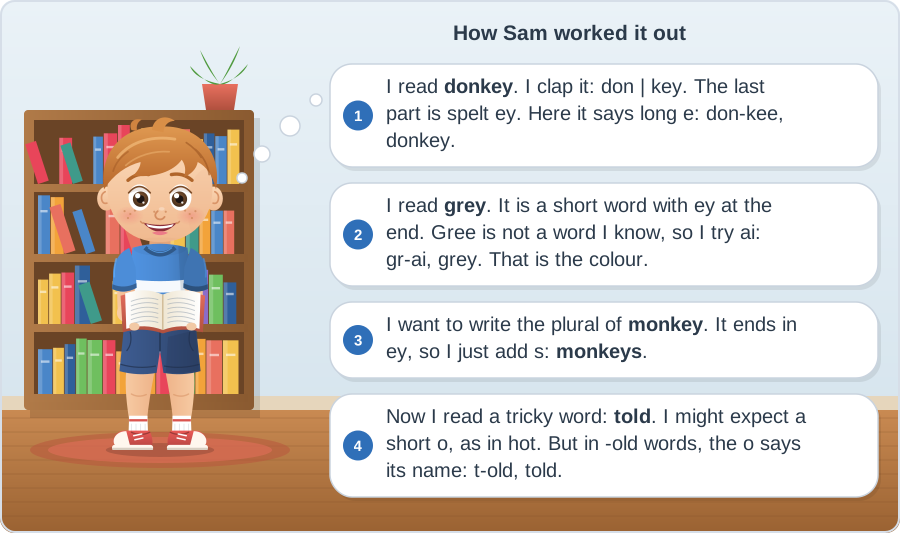
See How It’s Done
Now Try It
1. Both words end with a long e sound. Which word is spelt with ey, and which with y?
Hint: Look at the table in Let’s Learn. Which word is in the ey group?
Listen as an adult names each picture.
2. Read everybody. How many syllables does it have?
Hint: Clap it. Listen for every, then body.
Time To Practise
Name: ______________________
1. Write the word for each picture.
Hint: Every word ends in ey.
Listen as an adult names each picture.
1. ______________ 2. ______________ 3. ______________ 4. ______________
2. y or ey? Sort the words.
Hint: Look carefully at the last letters of each word.
Words: happy | valley | funny | jockey | baby | they | sunny | grey | turkey | cry
| y says long e (happy) | y says long i (cry) | ey says long e (key) | ey says ai (they) |
|---|---|---|---|
| __________ | __________ | __________ | __________ |
| __________ | __________ | __________ | |
| __________ | __________ | ||
| __________ |
3. Make it plural.
a) one key, two ______________ b) one donkey, three ______________ c) one chimney, two ______________
4. Tricky words.
Look at each word. Say it. Cover it. Write it. Check it.
| Word | Write it | Word | Write it |
|---|---|---|---|
| old | ______________ | told | ______________ |
| cold | ______________ | every | ______________ |
| gold | ______________ | everybody | ______________ |
| hold | ______________ | even | ______________ |
Fill each gap with a tricky word.
a) The king kept his ______________ coins in a chest.
b) Gran ______________ me a story about a clever hare.
c) ______________ clapped at the end of the play.
d) The tortoise won, ______________ though he was slow.
5. Listen and write the sentence.
Listen as an adult says a sentence twice. Write it.
__________________________________________________________________
Reflect
Think about these questions. Talk about them with someone at home or at school.
1. Go back to the Wonder question: “Why do donkey and happy end with the same sound but different letters?” What do you think now?
2. I was knowledgeable today when I ______________________________.
Being knowledgeable means knowing things and using what you know. For example: I was knowledgeable today when I learned that key, donkey and monkey end in ey but happy ends in y.
Take action: Start an ey word collection. Each time you find a word ending in ey in a book, add it and draw a small picture.
Next Steps
If this was easy, try: Find three more ey words in a dictionary, such as hockey, chimney and trolley. Write a silly sentence using all three.
If this was hard, go back to: Let’s Learn. Learn four ey words first: key, donkey, monkey, they. Read them with an adult, then try Task 1.
Notes for Parents and Teachers
Show notes for parents and teachers
These notes cover this lesson only. How every lesson runs is explained in How to Use This Material.
Let’s Learn
Say happy, key and they, and listen to the ending of each.
See How It’s Done
Write donkey, grey and monkeys on paper as you go through Sam’s thoughts.
Now Try It
Point to each picture and name it first. The full words are in the Answer Key.
Time To Practise
- Task 1: Point to each picture and name it first. The full words are in the Answer Key. For picture 2, point to the part the arrow shows.
- Task 5: Read the sentence from the Answer Key aloud twice.
Answer Key
Reveal Answers
Now Try It
1. key is spelt with ey. baby is spelt with y.
2. Four syllables: ev | ery | bo | dy. Accept five (ev | er | y | bo | dy) if the learner says it slowly.
1. Pictures
1. monkey
2. chimney
3. donkey
4. honey
2. Sort the words
y says long e: happy, funny, baby, sunny
y says long i: cry
ey says long e: valley, jockey, turkey
ey says ai: they, grey
3. Plurals
a) keys
b) donkeys
c) chimneys
Look for: no “ies” endings. With ey words, we just add s.
4. Tricky words
a) gold
b) told
c) Everybody
d) even
Look for: a capital E for Everybody at the start of c).
5. Dictation
Every monkey told the old donkey to hold the key.
Look for: ey in monkey, donkey and key, and the tricky words every, told, old and hold.
Reflect
2. Any real moment from the lesson that shows the learner was knowledgeable. Examples: “I was knowledgeable today when I learned that key, donkey and monkey end in ey but happy ends in y.” “I was knowledgeable today when I spelt every and everybody from memory.”
For Teachers: IB Details
Show IB and curriculum details
IB theme: How we express ourselves. This theme is about the ways in which we discover and express ideas, feelings, beliefs and values, and how we enjoy and share stories and art.
Central idea: People all over the world tell stories to share ideas, feelings and lessons about life.
| Lesson | Title | Strand | Key concept |
|---|---|---|---|
| 3.9 | -le Endings | Reading and spelling | Form |
| 3.10 | -el, -al and -il Endings | Reading and spelling | Form |
| 3.11 | ey and y Endings, and Tricky Words | Reading and spelling | Form |
Each lesson also matches the national curriculum for England (Year 2) and the US Common Core (Grade 2). The Grade 2 Curriculum Map lists the full standards for every lesson.
← Back to Lesson 3 – Tales From Around the World | Lessons – Index
© 2026 Firefly Ed. All rights reserved. This page may be printed for personal, home and classroom use. It may not be sold, shared online or reproduced for commercial use without written permission. edfirefly.com

Share your thoughts or ask something..