
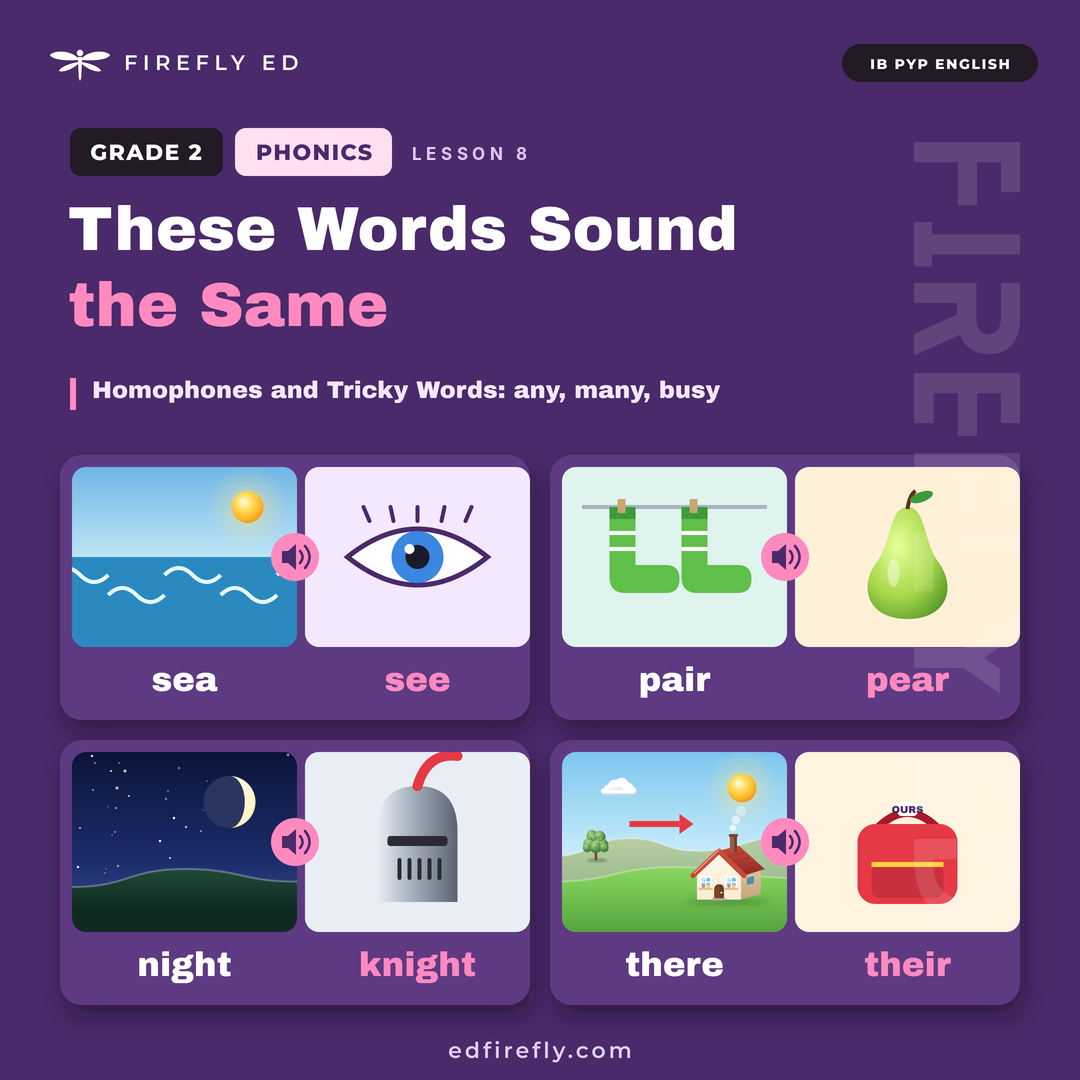
Term 3 | Level 3 | Phonics focus: homophones, and the tricky words any, many, clothes, busy, people, water, again, half and money
Lesson 8 – Keeping Healthy | Lessons – Index
Lessons
This page has the three phonics lessons of Lesson 8, Keeping Healthy: Lessons 8.9, 8.10 and 8.11. The Lesson 8 page has the Lesson 8 overview, the Lesson 8 review and the PDF download.
Select a lesson to go straight to it. Each lesson ends with a link back to the top of the page.
- Lesson 8.9: Homophones: there, their, they’re
- Lesson 8.10: More Homophones
- Lesson 8.11: Tricky Words: any, many, busy, people
Lesson 8.9: Homophones: there, their, they’re
Phonics | About 20 minutes
Term 3 | Level 3
Goal
“I can choose there, their or they’re correctly by testing each sentence, and explain how I know.”
Words to know
homophone, there, their, they’re, contraction, test
Wonder
Think about this question before you start. Say your ideas. You will come back to it at the end of the lesson.
How can three words sound the same but mean different things?
Let’s Learn
Homophones are words that sound the same but have different spellings and meanings. There, their and they’re are three of the most common.
| Word | Meaning | Example | Memory trick |
|---|---|---|---|
| there | a place, or with is and are | Put it over there. There are five apples. | there has here inside it, and both are places |
| their | belonging to them | The children ate their lunch. | their has an i, and I am a person: it is about people owning things |
| they’re | they are | They’re going swimming. | the apostrophe shows a missing letter, as in Lesson 7.9 |
How to check:
- Can you say they are instead? Use they’re.
- Does it mean belonging to them? Use their.
- If not, use there.
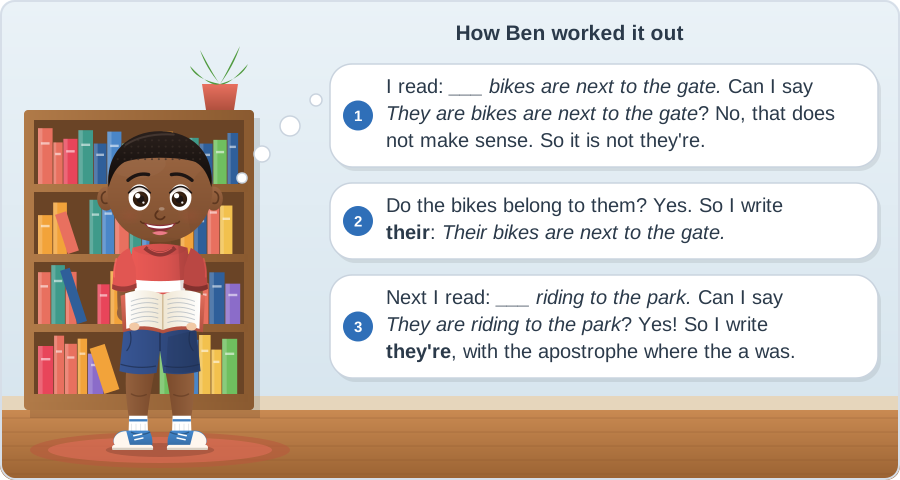
See How It’s Done
Now Try It
1. Which word fits? Is ___ any water left?
Hint: Try they are. Try belonging to them.
2. Which word fits? The twins brushed ___ teeth.
Hint: Whose teeth are they?
Time To Practise
Name: ______________________
1. Choose the right word.
Write there, their or they’re.
a) The players drank ______________ water at half time.
b) ______________ is a new swimming pool in town.
c) My cousins say ______________ going to walk to school every day.
d) Leave your wet coats over ______________ .
e) Mia and Ava washed ______________ hands before lunch.
f) ______________ very tired after the sports day.
2. Explain how you know.
Choose one answer from Task 1. Explain why you chose that word.
__________________________________________________________________
3. Find and fix the mistakes.
Each sentence has one wrong word. Cross it out and write the right word.
a) The children ate there fruit at break time. ______________
b) Their are lots of ways to keep fit. ______________
c) Sam and Leo said their ready for the race. ______________
d) Put the oranges over they’re, on the table. ______________
4. Write your own sentences.
Write one sentence about keeping healthy for each word.
there: __________________________________________________
their: __________________________________________________
they’re: __________________________________________________
5. Listen and write the sentences.
Listen as an adult says each sentence twice. Then write it.
__________________________________________________________________
__________________________________________________________________
Reflect
Think about these questions. Talk about them with someone at home or at school.
1. Go back to the Wonder question: “How can three words sound the same but mean different things?” What do you think now?
2. I was a thinker today when I ______________________________.
A thinker thinks carefully to work things out. For example: I was a thinker today when I tested each gap with they are.
Take action: Look for there, their and they’re in a book or on a sign. Test each one: is it a place, belonging, or they are?
Next Steps
If this was easy, try: Write a short report about a family picnic that uses there, their and they’re at least twice each. Ask someone to check them.
If this was hard, go back to: Task 1. Test only for they’re first: can you say they are? Write those answers. Then do the rest with an adult.
Notes for Parents and Teachers
Show notes for parents and teachers
These notes cover this lesson only. How every lesson runs is explained in How to Use This Material.
Let’s Learn
Say each example sentence and point to the memory trick.
See How It’s Done
As you go through Ben’s thoughts, write each sentence on paper and test the gap.
Time To Practise
- Task 5: Read each sentence from the Answer Key aloud twice.
Answer Key
Reveal Answers
Now Try It
1. there
2. their
1. Choose
a) their b) There c) they’re d) there e) their f) They’re
2. Explain
Sample answer: In c), I chose they’re because I can say “they are going to walk to school”.
3. Mistakes
a) their b) There c) they’re d) there
4. Own sentences
Sample answers: There is a fruit bowl in our kitchen. The children packed their water bottles. They’re learning to swim.
5. Dictation
My friends left their bikes over there. They’re going to play football.
Look for: their for belonging, there for a place, and they’re with an apostrophe.
Reflect
2. Any real moment from the lesson that shows the learner was a thinker. Examples: “I was a thinker today when I tested each gap with they are.” “I was a thinker today when I explained how I knew which word to choose.”
Lesson 8.10: More Homophones
Phonics | About 20 minutes
Term 3 | Level 3
Goal
“I can choose the right spelling for to, too and two, hear and here, see and sea, one and won, pair and pear, and night and knight.”
Words to know
homophone, meaning, to, too, two, hear, here, see, sea, memory trick
Wonder
Think about this question before you start. Say your ideas. You will come back to it at the end of the lesson.
How do you know which spelling to use when words sound the same?
Let’s Learn
Here are more homophones: words that sound the same but have different spellings and meanings.
| Words | Meanings | Memory trick |
|---|---|---|
| to / too / two | to: towards, or before a verb (go to school, to run) too: also, or more than enough (me too, too hot) two: the number 2 | too has one o too many. two has a w, like twin and twelve. |
| hear / here | hear: with your ears here: this place | You hear with your ear. |
| see / sea | see: with your eyes sea: salty water | see has two e’s, like two eyes. |
| one / won | one: the number 1 won: past tense of win | won and win both start with w. |
| pair / pear | pair: two that go together pear: a fruit | You can eat a pear. |
| night / knight | night: when it is dark knight: a soldier in armour, long ago | knight has a silent k, like knee and knock. |
Read the whole sentence to work out the meaning, then choose the spelling.
See How It’s Done
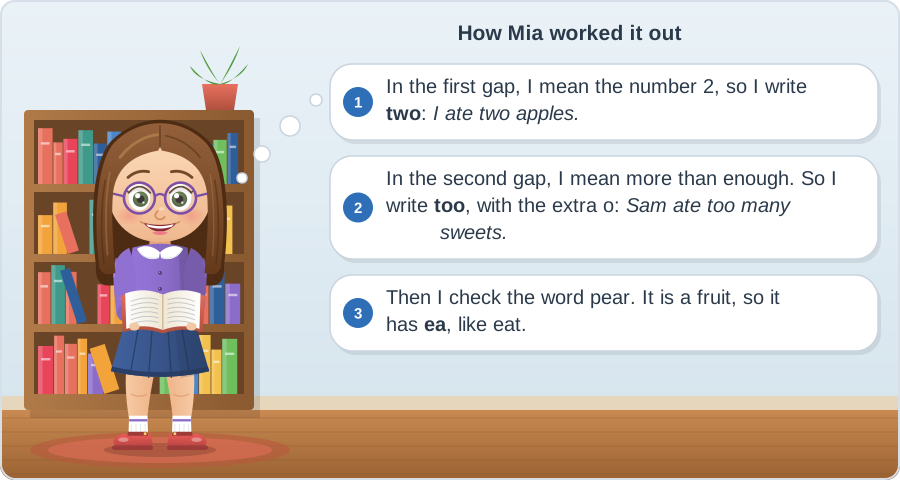
I ate ___ apples and a pear. Sam ate ___ many sweets and felt ill.
Now Try It
1. Which word fits? Come over ___ and sit down. (hear / here)
Hint: Is it about your ears or a place?
2. Which word fits? Our team ___ the match! (one / won)
Hint: Is it a number, or about winning?
Time To Practise
Name: ______________________
1. Write the word for each picture.
Hint: Each answer is one word from Let’s Learn. Think about the meaning.
1. ______________ 2. ______________ 3. a ______________ of socks 4. ______________
2. to, too or two?
a) I walk ______ school every day.
b) This bath is ______ hot!
c) Drink ______ glasses of water at lunch.
d) Can I come ______ ?
e) We went ______ the park ______ play.
3. Choose the right word.
Circle the correct word.
a) I can (see / sea) the (see / sea) from my window.
b) Did you (hear / here) the bell?
c) Ava (one / won) the race by (one / won) second.
d) The (night / knight) rode his horse into battle.
4. Write a sentence that uses both words.
a) pair, pear: __________________________________________________
b) hear, here: __________________________________________________
5. Listen and write the sentences.
Listen as an adult says each sentence twice. Then write it.
__________________________________________________________________
__________________________________________________________________
Reflect
Think about these questions. Talk about them with someone at home or at school.
1. Go back to the Wonder question: “How do you know which spelling to use when words sound the same?” What do you think now?
2. I was knowledgeable today when I ______________________________.
Being knowledgeable means knowing things and using what you know. For example: I was knowledgeable today when I used a memory trick for too and two.
Take action: Play homophone snap: write each word on a card, mix them up and find the pairs. Say a sentence for each word in the pair.
Next Steps
If this was easy, try: Find three more homophone pairs, such as sun and son, or blue and blew. Make a memory trick for each pair.
If this was hard, go back to: Task 2. Do a), b) and c) first, using the memory tricks. Then try d) and e).
Notes for Parents and Teachers
Show notes for parents and teachers
These notes cover this lesson only. How every lesson runs is explained in How to Use This Material.
Let’s Learn
Say each memory trick together and make up an action for it.
See How It’s Done
Write the two sentences on paper and fill the gaps as you go through Mia’s thoughts.
Time To Practise
- Task 1: Point to each picture and name it first: s…, p…, a p… of socks, n… (the full words are in the Answer Key).
- Task 5: Read each sentence from the Answer Key aloud twice.
Answer Key
Reveal Answers
Now Try It
1. here
2. won
1. Pictures
1. sea
2. pear
3. pair
4. night
2. to, too or two
a) to b) too c) two d) too e) to, to
3. Choose
a) see, sea
b) hear
c) won, one
d) knight
4. Sentences
Sample answers: a) I bought a pair of pears. b) Come here so I can hear you.
5. Dictation
I ate two pears too. Can you hear the sea from here?
Look for: two for the number, too for also, ea in pears, hear with ear, sea for the water and here for the place.
Reflect
2. Any real moment from the lesson that shows the learner was knowledgeable. Examples: “I was knowledgeable today when I used a memory trick for too and two.” “I was knowledgeable today when I read the whole sentence before choosing the spelling.”
Lesson 8.11: Tricky Words: any, many, busy, people
Phonics | About 20 minutes
Term 3 | Level 3
Goal
“I can read and spell any, many, clothes, busy, people, water, again, half and money, and use them in a short report.”
Words to know
tricky word, common exception word, silent letter, look, say, cover, write, check
Wonder
Think about this question before you start. Say your ideas. You will come back to it at the end of the lesson.
How can you remember a word that does not follow the rules?
Let’s Learn
Tricky words do not follow the usual spelling rules, so we learn them by heart. Look for the tricky part in each word.
| Word | The tricky part |
|---|---|
| any, many | the a says e, as in egg |
| again | the ai says e as well, in most accents |
| busy | the u says i, as in bin |
| people | the eo says ee, and it ends in le |
| water | the a says or, as in ball (Lesson 5.9) |
| half | the l is silent |
| money | the o says u, as in mother (Lesson 5.10), and it ends in ey (Lesson 3.11) |
| clothes | it has th and an e before the s, unlike the word close |
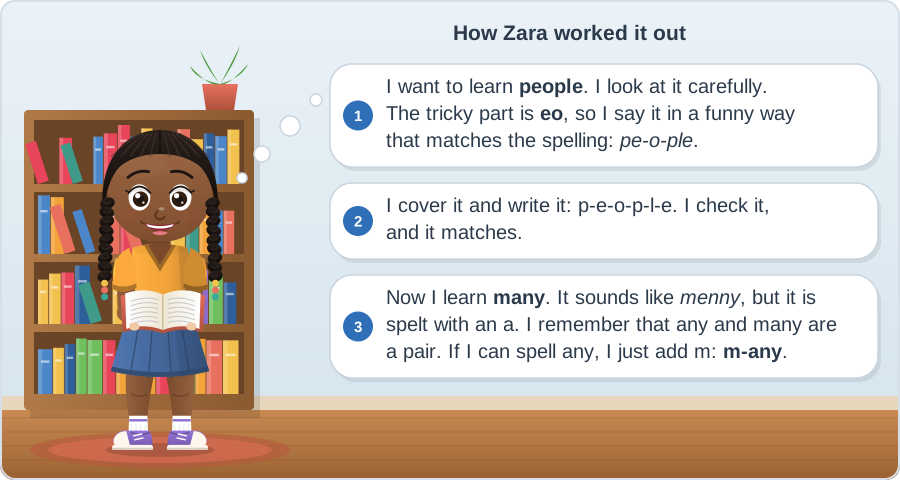
Look, say, cover, write, check works well. Say the word in a funny way that matches the spelling, too: pe-o-ple, Wed-nes-day.
See How It’s Done
Now Try It
1. Which letter in half is silent?
Hint: Say it slowly. Which letter can you not hear?
2. Spell many by adding one letter to another tricky word.
Hint: Look at the first row of the table.
Time To Practise
Name: ______________________
1. Look, say, cover, write, check.
| Word | Write it | Write it again |
|---|---|---|
| any | ______________ | ______________ |
| many | ______________ | ______________ |
| clothes | ______________ | ______________ |
| busy | ______________ | ______________ |
| people | ______________ | ______________ |
| water | ______________ | ______________ |
| again | ______________ | ______________ |
| half | ______________ | ______________ |
| money | ______________ | ______________ |
2. Complete the health report.
Fill each gap with a tricky word from Task 1. Use each word once.
How Our Family Keeps Healthy
Our family is very ______________ , but we try hard to stay healthy. We drink ______________ with every meal. We eat ______________ kinds of fruit and vegetables, and ______________ of each dinner plate is vegetables. We do not spend ______________ on fizzy drinks.
At the weekend, we put on our sports ______________ and go to the park. Lots of ______________ go running there. Then we come home and do it all ______________ the next week! Do you have ______________ healthy habits?
3. Spot the tricky part.
Underline the tricky part of each word.
busy people half water money
4. Write your own report.
Write three or four sentences about how you keep healthy. Use at least four of the tricky words. Underline them.
__________________________________________________________________
__________________________________________________________________
__________________________________________________________________
5. Listen and write the sentences.
Listen as an adult says each sentence twice. Then write it.
__________________________________________________________________
__________________________________________________________________
Reflect
Think about these questions. Talk about them with someone at home or at school.
1. Go back to the Wonder question: “How can you remember a word that does not follow the rules?” What do you think now?
2. I was reflective today when I ______________________________.
Being reflective means looking back at your work and thinking how to make it better. For example: I was reflective today when I practised three tricky words each day.
Take action: Write the nine tricky words on sticky notes and hide them around the house. Read each one aloud when you find it.
Next Steps
If this was easy, try: Make a word search with all nine tricky words. Give it to someone at home to solve.
If this was hard, go back to: Task 1. Learn three words a day for three days: any, many, again first; then busy, people, water; then half, money, clothes.
Notes for Parents and Teachers
Show notes for parents and teachers
These notes cover this lesson only. How every lesson runs is explained in How to Use This Material.
Let’s Learn
Say each word normally, then in a funny way that matches its spelling.
See How It’s Done
Write people and many on paper as you go through Zara’s thoughts.
Time To Practise
- Task 5: Read each sentence from the Answer Key aloud twice.
Answer Key
Reveal Answers
Now Try It
1. l
2. m + any = many
2. Report
busy, water, many, half, money
clothes, people, again, any
Look for: each word used once and spelt correctly.
3. Tricky parts
busy, people, half, water, money
4. Own report
Sample answer: I am busy at school, so I drink lots of water. I take my sports clothes on Tuesdays. Many people in my class like to play tag. I eat half an orange at break time.
5. Dictation
Many people drink water when they are busy. I ate half an apple, then I had some again.
Look for: many, people, water, busy, half and again spelt correctly.
Reflect
2. Any real moment from the lesson that shows the learner was reflective. Examples: “I was reflective today when I practised three tricky words each day.” “I was reflective today when I checked my spelling after I wrote each word.”
For Teachers: IB Details
Show IB and curriculum details
IB theme: Who we are. It covers our bodies and feelings, our families and friends, where we belong, and how we learn and grow.
Central idea: The choices we make each day about food, exercise, rest and hygiene help us to stay healthy.
| Lesson | Title | Strand | Key concept |
|---|---|---|---|
| 8.9 | Homophones: there, their, they’re | Reading and spelling | Function |
| 8.10 | More Homophones | Reading and spelling | Function |
| 8.11 | Tricky Words: any, many, busy, people | Reading and spelling | Function |
Each lesson also matches the national curriculum for England (Year 2) and the US Common Core (Grade 2). The Grade 2 Curriculum Map lists the full standards for every lesson.
← Back to Lesson 8 – Keeping Healthy | Lessons – Index
© 2026 Firefly Ed. All rights reserved. This page may be printed for personal, home and classroom use. It may not be sold, shared online or reproduced for commercial use without written permission. edfirefly.com

Share your thoughts or ask something..