
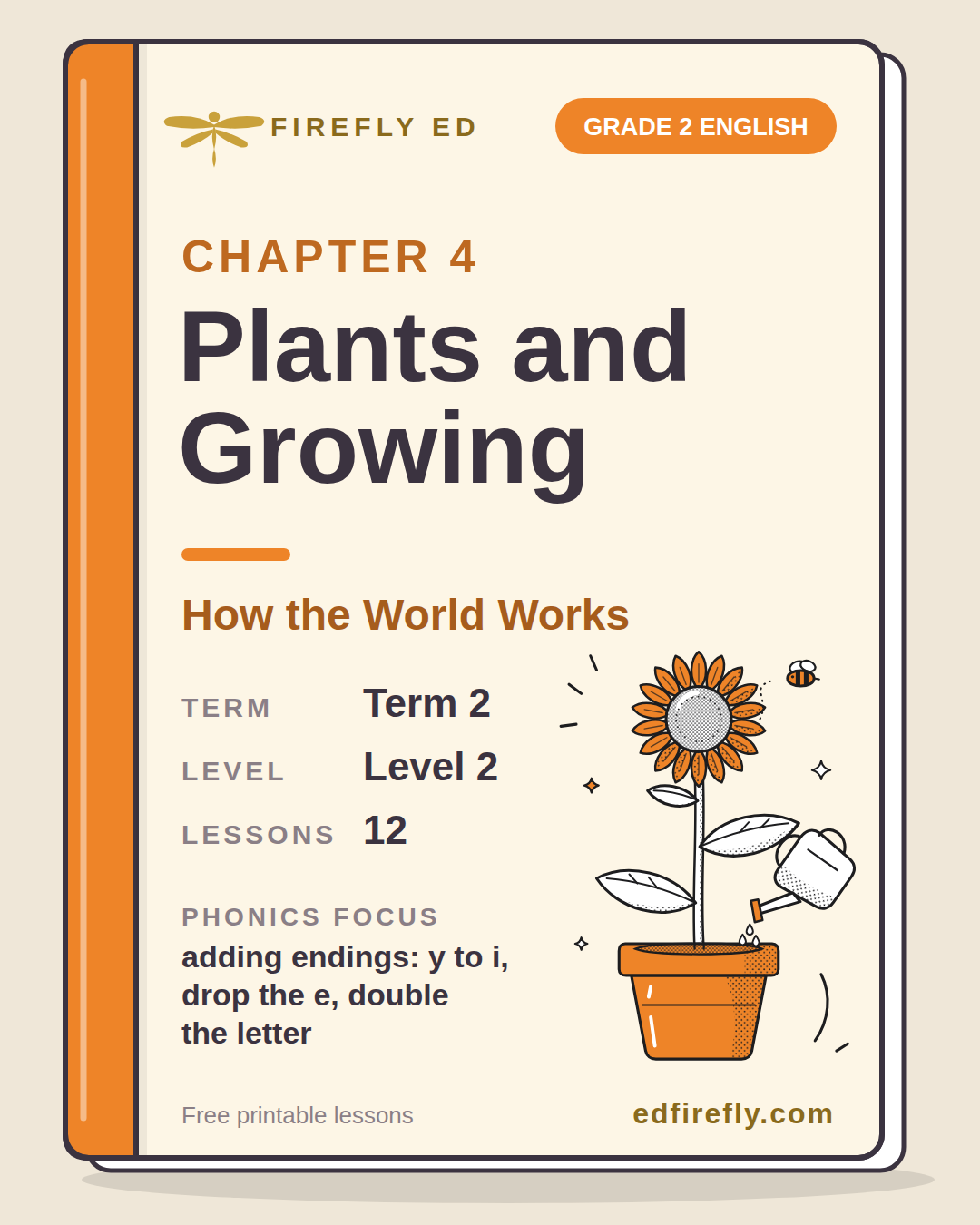
In this chapter – How the world works
Term 2 | Level 2 | Phonics focus: adding -ing, -ed, -er and -est: drop the e, double the letter, y to i
For the adult: these lessons are worksheets. Open a lesson and work on paper next to the screen. Printable PDFs are free to download after you subscribe.
All Grade 2 English chapters and lessons | Download lesson PDFs
Unit of inquiry
Transdisciplinary theme: How the world works
In short: This theme is about the natural world and its laws: how living things grow and change, and how people find out about the world around them.
Central idea: Plants are living things that need the right conditions to grow, change and make new plants.
Lines of inquiry
- What plants need to grow
- How plants change during their life cycle
- How we can find out about plants and share what we learn
Key concepts
- Function: How does it work?
- Change: How is it transforming?
- Causation: Why is it as it is?
Related concepts: life cycles, growth, investigation
Learner profile attributes
Inquirers, Thinkers, Communicators, Knowledgeable, Reflective
Approaches to learning
Research skills, Thinking skills, Communication skills, Self-management skills
Language: Phase 2 conceptual understandings
- Reading: People read to learn.
- Reading: The words we see and hear enable us to create pictures in our minds.
- Writing: People write to communicate.
- Oral language: Everyone has the right to speak and be listened to.
- Visual language: People use static and moving images to communicate ideas and information.
Tuning in
For the adult: do this before Lesson 4.1.
Plant a bean or a few cress seeds together in a pot or on damp cotton wool. Ask: What do you think the seed needs to grow? What will happen first? How long will it take? Write down the learner’s ideas and keep them. Look at them again at the end of the chapter, and check them against what the seed did.
Lessons in this chapter
| Lesson | Title | PYP strand | Line of inquiry | Key concept | Learner profile |
|---|---|---|---|---|---|
| 4.1 | From Seed to Plant: Headings and a Glossary | Written language: receptive (reading) | 2 | Change | Inquirers |
| 4.2 | Mia’s Sunflower Diary | Written language: receptive (reading) | 2 | Change | Thinkers |
| 4.3 | Write a Plant Fact File | Written language: expressive (writing) | 3 | Function | Inquirers |
| 4.4 | Explain Why: What Plants Need | Written language: expressive (writing) | 1 | Causation | Thinkers |
| 4.5 | Present a Plant Fact Talk | Oral language: receptive and expressive (listening and speaking) | 3 | Function | Communicators |
| 4.6 | Plant Riddles: Describe and Guess | Oral language: receptive and expressive (listening and speaking) | 3 | Function | Communicators |
| 4.7 | Read a Life Cycle Diagram | Visual language: receptive (viewing) | 2 | Change | Thinkers |
| 4.8 | Draw a Labelled Plant Diagram | Visual language: receptive and expressive (viewing and presenting) | 1 | Function | Communicators |
| 4.9 | Adding Endings to Words Ending in e | Written language: receptive and expressive (reading and spelling) | 2 | Change | Thinkers |
| 4.10 | Doubling the Last Letter | Written language: receptive and expressive (reading and spelling) | 2 | Change | Thinkers |
| 4.11 | y to i, and Tricky Words | Written language: receptive and expressive (reading and spelling) | 2 | Change | Knowledgeable |
| 4.12 | Chapter 4 Review | All strands: receptive and expressive | All | Function, Change and Causation | Reflective |
How each lesson works
PYP organises language into three strands: oral language, visual language and written language. Each strand has a receptive side (understanding: listening, viewing, reading) and an expressive side (sharing: speaking, presenting, writing). Every lesson names its strand and side.
Every lesson starts with a Wonder question. The learner then moves through Let’s Learn, Watch Me, Let’s Try Together and Your Turn. Each lesson ends with Reflect, where the learner returns to the Wonder question, names a learner profile attribute they showed, and chooses an action to take.
The 12 lessons
For the adult: tap a lesson to open it. Each lesson takes about 20 minutes. Tap the lesson title again, or use the link at the end of the lesson, to close it. An optional Challenge section with a read-aloud story and a grammar task follows Lesson 4.12.
Lesson 4.1: From Seed to Plant: Headings and a Glossary | Reading | About 20 minutes
Term 2 | Level 2
Unit of inquiry: How the world works | Line of inquiry: How plants change during their life cycle
Key concept: Change (How is it transforming?) | Learner profile: Inquirers | ATL skills: Research skills
PYP strand: Written language: receptive (reading)
I can use headings, bold words and a glossary to find facts in an information text, and put two facts together to answer a why question.
Curriculum links: IB PYP Language, Reading, Phase 2: read and understand the meaning of self-selected and teacher-selected texts at an appropriate level. Reading, Phase 3: recognize a range of different text types. England Year 2: read non-fiction books that are structured in different ways; recognise simple recurring literary language; discuss and clarify the meanings of words. Common Core RI.2.5: know and use various text features (e.g., captions, bold print, subheadings, glossaries, indexes, electronic menus, icons) to locate key facts or information in a text efficiently.
Key words: information text | heading | bold word | glossary | germination | seedling
Wonder
For the adult: ask this question before you start. Accept every idea. You will come back to it in Reflect.
What happens inside a seed before we can see anything grow?
Let’s Learn
For the adult: read this part aloud. Find a non-fiction book at home and look for its headings and glossary together.
An information text gives facts about a topic. It has features that help you find facts quickly, without reading every word.
| Feature | How it helps |
|---|---|
| title | tells you the topic of the whole text |
| headings | tell you what each part is about, so you can go straight to the part you need |
| bold words | show important topic words. They are often explained in the glossary. |
| glossary | a list of topic words and their meanings, usually at the end, in alphabetical order |
| pictures and captions | show what the words describe |
To find a fact: read the question, choose the heading that matches it, then read only that part carefully.
Watch Me
For the adult: read the thinking aloud. Point to the heading, the sentence and the glossary as you go.
Question: What makes the seed coat split open?
“I look at the headings in the text in Your Turn. The question is about what happens to a seed when it starts to grow. The heading What does a seed need? looks right.”
“I read that part. It says: When a seed takes in water, it swells and its coat splits open. So the answer is: the seed takes in water and swells.”
“There is a bold word next to it: germination. I am not sure what it means, so I check the glossary at the end: when a seed starts to grow.”
Let’s Try Together
For the adult: use the text in Your Turn.
1. Which heading would you read to find out about pollen?
Hint: Look for the heading about the part of the plant that bees visit.
2. Use the glossary. What is a seedling?
Hint: The glossary is the table at the end of the text.
Your Turn
Name: ______________________
1. Read the information text.
From Seed to Plant
What is a seed?
A seed is a tiny package. Inside it, there is a baby plant called an embryo and a store of food. A hard coat on the outside keeps the seed safe until it is ready to grow. Seeds come in many sizes. An avocado seed is as big as an egg, but a mustard seed is smaller than a grain of rice.
What does a seed need?
To start growing, a seed needs water, air and warmth. It does not need light yet, because it is under the soil. When a seed takes in water, it swells and its coat splits open. This is called germination.
Roots and shoots
First, a root grows down into the soil. The root holds the plant in place and takes in water. Next, a shoot grows up towards the light. When the shoot pushes through the soil, its first leaves open. Now the young plant is called a seedling.
Leaves and flowers
A seedling needs light to keep growing. Its green leaves use sunlight, air and water to make food for the plant. As the plant grows taller, it makes flowers. Bees and other insects visit the flowers and carry pollen from one flower to another.
New seeds
When the pollen has done its job, the petals fall off and new seeds grow in their place. Some seeds drop to the ground. Others are carried away by the wind, by water or by animals. If a seed lands in a good place, the whole life cycle starts again.
| Glossary | |
|---|---|
| embryo | the tiny baby plant inside a seed |
| germination | when a seed starts to grow |
| pollen | a yellow powder that flowers need to make seeds |
| seedling | a young plant with its first leaves |
2. Use the features.
a) Which heading tells you what grows first, the root or the shoot? ______________________________
b) How many headings are there? ______
c) Use the glossary. What is an embryo? ______________________________
3. Find the facts.
a) What three things does a seed need to start growing?
______________ ______________ ______________
b) Write two jobs that a root does.
__________________________________________________________________
c) Name three ways that seeds can be carried away.
__________________________________________________________________
4. Think about it.
a) Why does a seed not need light when it first starts to grow?
__________________________________________________________________
b) What might happen to plants if there were no bees? Use facts from the text to explain.
Hint: Read the parts about flowers and new seeds again.
__________________________________________________________________
__________________________________________________________________
Reflect
For the adult: talk about these with the learner.
1. Go back to the Wonder question: “What happens inside a seed before we can see anything grow?” What do you think now?
2. I was an inquirer today when I ______________________________.
For the adult: An inquirer asks questions and finds things out. Example: I was an inquirer today when I used the headings to find out what a seed needs.
Take action: Plant a bean in a clear jar with a damp paper towel. Watch for the root and the shoot. Which comes first?
Answer Key
Reveal Answers
Let’s Try Together
1. Leaves and flowers
2. A young plant with its first leaves.
2. Use the features
a) Roots and shoots
b) 5
c) The tiny baby plant inside a seed.
3. Find the facts
a) water, air and warmth
b) It holds the plant in place. It takes in water.
c) By the wind, by water and by animals.
4. Think about it
a) It is under the soil, where there is no light. It uses its own store of food until its leaves can reach the light.
b) Sample answer: Fewer flowers would get pollen, so fewer new seeds would grow. Then there would be fewer new plants.
Look for: in 4a, accept “because it is under the soil”. In 4b, the learner links bees to pollen and pollen to new seeds. This answer is not written in the text, so it needs two facts put together.
Reflect
2. Any real moment from the lesson that shows the learner was an inquirer. Examples: “I was an inquirer today when I used the headings to find out what a seed needs.” “I was an inquirer today when I looked up germination in the glossary when I did not know it.”
Next Steps
If this was easy, try: Find a non-fiction book about plants. Use its contents, headings and glossary to find three new facts.
If this was hard, go back to: Let’s Learn. Read the text one heading at a time with an adult. After each part, say one fact you learned.
Download this lesson as a PDF (free after you subscribe)
Lesson 4.2: Mia’s Sunflower Diary | Reading | About 20 minutes
Term 2 | Level 2
Unit of inquiry: How the world works | Line of inquiry: How plants change during their life cycle
Key concept: Change (How is it transforming?) | Learner profile: Thinkers | ATL skills: Thinking skills
PYP strand: Written language: receptive (reading)
I can read a diary over time, compare how something changed from one entry to the next, and explain why with clues from the text.
Curriculum links: IB PYP Language, Reading, Phase 2: make connections between personal experience and storybook characters; read and understand the meaning of self-selected and teacher-selected texts at an appropriate level. England Year 2: discuss the sequence of events in books and how items of information are related; make inferences on the basis of what is being said and done. Common Core RI.2.3: describe the connection between a series of historical events, scientific ideas or concepts, or steps in technical procedures in a text.
Key words: diary | entry | date | first person | compare | change
Wonder
For the adult: ask this question before you start. Accept every idea. You will come back to it in Reflect.
How can a diary show us how something changes over time?
Let’s Learn
For the adult: read this part aloud. If you have kept a diary or a calendar, look at it together.
A diary is a record of what happens over time. A growing diary shows how something changes from one entry to the next.
- Each entry starts with a date, so the reader knows when it was written.
- Diaries are written in the first person, using I, my and we.
- Most of a diary is in the past tense, because it tells what has already happened.
- Diary writers often say how they feel.
To compare entries, look at the same thing in each one, such as the height of a plant, and ask: What changed? Why did it change?
Watch Me
For the adult: read the two entries aloud, then read the thinking aloud.
The adult reads the entries for 9th June and 16th June in Your Turn.
“On 9th June, the shoots had only just poked through the soil. On 16th June, they were 10 centimetres tall with four leaves each. So in one week, they grew from nothing to 10 centimetres.”
“How did Mia feel on 9th June? At first she was worried: the text says I was worried that the seeds were broken. Then the exclamation mark after poked up through the soil! tells me she felt excited.”
Let’s Try Together
For the adult: use the diary in Your Turn.
1. How many seeds did Mia plant, and how many came up?
Hint: Read the first two entries.
2. Find a sentence that shows the diary is written in the first person.
Hint: Look for I, my or we.
Your Turn
Name: ______________________
1. Read the diary.
Mia’s Sunflower Diary
Monday 2nd June
Today Gran and I planted three sunflower seeds in a big pot. We pushed each seed into the soil, about as deep as my finger. Then we put the pot by the back door, where it gets lots of sun, and I watered the soil. Gran says sunflowers love warm, sunny weather. I can’t wait to see them grow!
Monday 9th June
Nothing happened for six whole days. I was worried that the seeds were broken. Then, this morning, two green shoots poked up through the soil! The third seed never came up. Gran says that not every seed grows, and that is normal.
Monday 16th June
My two seedlings are 10 centimetres tall now. Each one has four leaves. Gran told me to pull out the smaller one, so the bigger one has more space and water. I felt a bit sad, but I did it.
Monday 23rd June
Disaster! We went to my cousin’s house for the weekend. It was very hot, and nobody was at home to water my sunflower. When we came back, its leaves were floppy and the top was bent over. I gave it two full cans of water. By bedtime, it was standing up straight again. Phew!
Monday 30th June
My sunflower is 1 metre tall now. That is taller than my little brother! A big green bud has appeared at the top. Gran says it will open into a yellow flower soon. I check it every morning before school.
2. Find the answers.
a) Where did Mia and Gran put the pot? Why there? ______________________________
b) How tall was the sunflower on 30th June? ______________
c) On which date did Mia pull out a seedling? ______________
3. Compare the entries.
| Date | What the sunflower looked like |
|---|---|
| 9th June | ______________________________ |
| 16th June | ______________________________ |
| 23rd June (when Mia came home) | ______________________________ |
| 30th June | ______________________________ |
4. Think about it.
a) Why were the leaves floppy on 23rd June? Use two clues from the entry.
__________________________________________________________________
b) Why did Gran tell Mia to pull out the smaller seedling?
__________________________________________________________________
c) Mia felt “a bit sad” on 16th June. Why do you think she felt that way?
__________________________________________________________________
d) What do you think Mia will write in her next entry? Write one sentence, starting with a date.
__________________________________________________________________
Reflect
For the adult: talk about these with the learner.
1. Go back to the Wonder question: “How can a diary show us how something changes over time?” What do you think now?
2. I was a thinker today when I ______________________________.
For the adult: A thinker thinks carefully to work things out. Example: I was a thinker today when I worked out why the sunflower’s leaves were floppy.
Take action: Keep a growing diary for your own seed. Write the date, the height and how you feel, once a week.
Answer Key
Reveal Answers
Let’s Try Together
1. She planted three seeds. Two came up.
2. Any sentence with I, my or we, for example: Today Gran and I planted three sunflower seeds in a big pot.
2. Find the answers
a) By the back door, because it gets lots of sun.
b) 1 metre
c) 16th June
3. Compare the entries
9th June: two green shoots had just come up.
16th June: 10 centimetres tall, with four leaves each.
23rd June: floppy leaves and the top bent over.
30th June: 1 metre tall, with a big green bud at the top.
4. Think about it
a) It had no water. Clues: it was very hot, and nobody was at home to water it.
b) So the bigger one would have more space and water to grow.
c) Sample answer: She had looked after both seedlings and did not want to throw one away.
d) Sample answer: Monday 7th July: My sunflower has opened into a big yellow flower!
Look for: in 4a, two clues, not just one. In 4d, a date, the first person and a prediction that fits the bud on 30th June.
Reflect
2. Any real moment from the lesson that shows the learner was a thinker. Examples: “I was a thinker today when I worked out why the sunflower’s leaves were floppy.” “I was a thinker today when I compared how the sunflower changed from week to week.”
Next Steps
If this was easy, try: Write two more diary entries for Mia: one when the flower opens, and one when the seeds are ready.
If this was hard, go back to: Task 3. Read one entry at a time with an adult. After each one, draw a quick sketch of the sunflower before you write.
Download this lesson as a PDF (free after you subscribe)
Lesson 4.3: Write a Plant Fact File | Writing | About 20 minutes
Term 2 | Level 2
Unit of inquiry: How the world works | Line of inquiry: How we can find out about plants and share what we learn
Key concept: Function (How does it work?) | Learner profile: Inquirers | ATL skills: Research skills
PYP strand: Written language: expressive (writing)
I can sort facts under headings, leave out opinions, turn notes into sentences and write my own plant fact file.
Curriculum links: IB PYP Language, Writing, Phase 2: write to communicate a message to a particular audience; create illustrations to match their own written text. Writing, Phase 3: use graphic organizers to plan writing. England Year 2: develop positive attitudes towards and stamina for writing by writing for different purposes; write down ideas and/or key words, including new vocabulary. Common Core W.2.7: participate in shared research and writing projects; W.2.8: recall information from experiences or gather information from provided sources to answer a question.
Key words: fact file | heading | fact | opinion | notes | caption
Wonder
For the adult: ask this question before you start. Accept every idea. You will come back to it in Reflect.
How do writers organise facts so readers can find them quickly?
Let’s Learn
For the adult: read this part aloud. Read the sunflower fact file together and point to each heading.
A fact file is a short information page about one topic. The facts are grouped under headings, so the reader can find them quickly.
Fact file: The Sunflower
| What it looks like | Sunflowers have a tall green stem, big rough leaves and a large yellow flower with a brown middle. |
| Where it grows | Sunflowers first grew wild in North America. Now people grow them all over the world. |
| What it needs | Sunflowers need lots of sun, water and space to grow. |
| Amazing fact | Some sunflowers grow taller than 3 metres. That is nearly twice as tall as a grown-up! |
A fact file uses:
- facts, not opinions. A fact can be checked: Sunflowers need sun. An opinion is what someone thinks: Sunflowers are the prettiest flowers.
- full sentences in the present tense: sunflowers grow, need and have.
- a picture with a caption.
Watch Me
For the adult: read the thinking aloud. Write the four headings on paper and sort the notes under them.
Notes for a fact file on the apple tree: grows in cool places, white or pink flowers in spring, needs rain and sun, apples in autumn.
“I sort my notes under the headings. White or pink flowers is about what it looks like. Cool places is about where it grows. Rain and sun is about what it needs.”
“Now I turn a note into a full sentence in the present tense: Apple trees grow in places with cool winters.“
“I check each sentence. Is it a fact or an opinion? Apples are delicious is an opinion, so I leave it out.”
Let’s Try Together
1. Fact or opinion? a) Roses have thorns on their stems. b) Roses smell the nicest of all flowers.
Hint: Could you check it? Or is it what someone thinks?
2. Turn this note into a full sentence: oak trees, acorns, autumn.
Hint: Use the present tense: Oak trees…
Your Turn
Name: ______________________
1. Sort the facts about the cactus.
Write the letter of each fact under the right heading. One sentence is an opinion. Write it in the last row.
a) Cacti grow in hot, dry deserts. b) A cactus stores water inside its thick stem. c) Cacti are the best plants to have at home. d) Most cacti have sharp spines instead of leaves. e) Cacti need lots of sun and only a little water. f) Some cacti live for more than 100 years.
| Heading | Letters |
|---|---|
| What it looks like | __________ |
| Where it grows | __________ |
| What it needs | __________ |
| Amazing fact | __________ |
| Opinion (leave it out) | __________ |
2. Turn the notes into sentences.
a) bamboo, grows very fast → ______________________________________________
b) water lily, floats on ponds → ______________________________________________
c) tomato plant, needs sun, warm → ______________________________________________
3. Make your own fact file.
Choose a plant. Find facts with an adult in a book or on a website for children. Write at least one full sentence under each heading. Draw a picture and write a caption.
Fact file: ______________________________
What it looks like: __________________________________________________
Where it grows: __________________________________________________
What it needs: __________________________________________________
Amazing fact: __________________________________________________
Hint: Check every sentence. Is it a fact or an opinion?
Caption: ______________________________________________
For the adult: tick each one you see.
☐ a title ☐ a sentence under each heading ☐ facts only, no opinions ☐ present tense ☐ a picture with a caption
Reflect
For the adult: talk about these with the learner.
1. Go back to the Wonder question: “How do writers organise facts so readers can find them quickly?” What do you think now?
2. I was an inquirer today when I ______________________________.
For the adult: An inquirer asks questions and finds things out. Example: I was an inquirer today when I found facts about my plant in a book with an adult.
Take action: Put your fact file on the wall or the fridge. Ask someone at home to find one fact using only the headings.
Answer Key
Reveal Answers
Let’s Try Together
1. a) fact b) opinion
2. Sample answer: Oak trees grow acorns in autumn.
1. Sort the facts
What it looks like: d
Where it grows: a
What it needs: e (accept b)
Amazing fact: f (accept b)
Opinion: c
Look for: b can go under “What it needs” or “Amazing fact” if the learner explains why.
2. Notes to sentences
Sample answers:
a) Bamboo grows very fast.
b) Water lilies float on ponds.
c) Tomato plants need sun and warm weather.
3. Fact file
Answers will vary. Look for: four or more ticks, and facts that the learner can show came from a book or website.
Reflect
2. Any real moment from the lesson that shows the learner was an inquirer. Examples: “I was an inquirer today when I found facts about my plant in a book with an adult.” “I was an inquirer today when I sorted the cactus facts under the right headings.”
Next Steps
If this was easy, try: Make a two-page fact file comparing two plants, such as a cactus and a water lily. Use the same headings for both.
If this was hard, go back to: Task 1. Read each fact aloud with an adult. Say which heading it belongs to before you write the letter.
Download this lesson as a PDF (free after you subscribe)
Lesson 4.4: Explain Why: What Plants Need | Writing | About 20 minutes
Term 2 | Level 2
Unit of inquiry: How the world works | Line of inquiry: What plants need to grow
Key concept: Causation (Why is it as it is?) | Learner profile: Thinkers | ATL skills: Thinking skills
PYP strand: Written language: expressive (writing)
I can write an explanation using because, so and if … then, and use evidence from an experiment.
Curriculum links: IB PYP Language, Writing, Phase 2: write to communicate a message to a particular audience. Writing, Phase 3: organize ideas in a logical sequence; write about a range of topics for a variety of purposes, using literary forms and structures modelled by the teacher. England Year 2: use subordination (using when, if, that, or because) and co-ordination (using or, and, or but); write for different purposes. Common Core W.2.2: write informative/explanatory texts in which they introduce a topic, use facts and definitions to develop points, and provide a concluding statement or section.
Key words: explanation | cause | effect | because | so | if … then
Wonder
For the adult: ask this question before you start. Accept every idea. You will come back to it in Reflect.
What would happen to a plant with no light or no water?
Let’s Learn
For the adult: read this part aloud. Say each example sentence together.
An explanation tells the reader how or why something happens.
- It starts with a title, often a question: Why Do Plants Need Light?
- An opening sentence says what will be explained.
- The middle explains each step or reason. It uses cause and effect words.
- A closing sentence sums up.
| Word | What it shows | Example |
|---|---|---|
| because | the reason (the cause) | The cress turned brown because it had no water. |
| so | what happened next (the effect) | The cress had no water, so it turned brown. |
| if … then | what will happen | If a plant has no light, then its leaves turn yellow. |
Watch Me
For the adult: look at the three pots together, then read the thinking aloud.
Ava and Sam grew cress in three pots for one week. Each pot had something different.
“I compare Pot A and Pot C. Both had light. Only Pot A had water. Pot A is green and strong. Pot C is brown and drooping.”
“So the cause is: no water. The effect is: the cress drooped and turned brown.”
“I write it with because: The cress in Pot C drooped because it had no water. I write it with so: Pot C had no water, so the cress drooped.“
Let’s Try Together
For the adult: use the picture of the three pots in Watch Me.
1. Which two pots had water? Which one of those had no light?
Hint: Read the label under each pot.
2. Finish the sentence: “The cress in Pot B is pale yellow because…”
Hint: What was missing in the cupboard?
Your Turn
Name: ______________________
1. Look at the experiment again.
a) Which pot grew the healthiest cress? Pot ______
b) The cress in Pot B grew tall, thin and pale. Why do you think it did that?
Hint: Plants try to grow towards something they need.
__________________________________________________________________
c) What two things do plants need, according to this experiment?
______________________ and ______________________
2. Join the cause and the effect.
Use because or so. Write the full sentence.
a) The soil was dry. The seeds did not grow. (so)
__________________________________________________________________
b) The plant leaned towards the window. It needed light. (because)
__________________________________________________________________
c) Bees carried the pollen. New seeds could grow. (so)
__________________________________________________________________
3. Write an explanation.
Title: Why Do Plants Need Light and Water?
Write an opening sentence, three sentences that explain, and a closing sentence. Use because, so, and if … then. Use the experiment as your evidence.
__________________________________________________________________
__________________________________________________________________
__________________________________________________________________
__________________________________________________________________
__________________________________________________________________
For the adult: tick each one you see.
☐ an opening sentence ☐ because ☐ so ☐ if … then ☐ evidence from the experiment ☐ a closing sentence
Reflect
For the adult: talk about these with the learner.
1. Go back to the Wonder question: “What would happen to a plant with no light or no water?” What do you think now?
2. I was a thinker today when I ______________________________.
For the adult: A thinker thinks carefully to work things out. Example: I was a thinker today when I used the cress experiment as evidence in my explanation.
Take action: Try the cress experiment yourself with three pots. After one week, compare your results with Ava and Sam’s.
Answer Key
Reveal Answers
Let’s Try Together
1. Pots A and B had water. Pot B had no light.
2. …because it was in a dark cupboard with no light.
1. The experiment
a) A
b) Sample answer: It was trying to reach light. In the dark, plants grow tall and thin to find light.
c) light and water
Look for: in b), the learner links the shape of the cress to looking for light.
2. Cause and effect
a) The soil was dry, so the seeds did not grow.
b) The plant leaned towards the window because it needed light.
c) Bees carried the pollen, so new seeds could grow.
3. Explanation
Sample answer: Plants need light and water to grow well. Leaves use light to make food, so a plant with no light turns pale and weak. Water travels up from the roots, and if a plant has no water, then it droops. In our experiment, the cress in the dark cupboard turned yellow because it had no light. That is why the healthiest cress was on the window and was watered.
Look for: five or more ticks.
Reflect
2. Any real moment from the lesson that shows the learner was a thinker. Examples: “I was a thinker today when I used the cress experiment as evidence in my explanation.” “I was a thinker today when I worked out why the cress in the cupboard grew tall and pale.”
Next Steps
If this was easy, try: Plan a new experiment: what would happen to cress grown in a cold fridge? Predict the result and explain why using if … then.
If this was hard, go back to: Task 2. Say each joined sentence aloud with an adult before you write it. Then write two sentences only for Task 3.
Download this lesson as a PDF (free after you subscribe)
Lesson 4.5: Present a Plant Fact Talk | Oral | About 20 minutes
Term 2 | Level 2
Unit of inquiry: How the world works | Line of inquiry: How we can find out about plants and share what we learn
Key concept: Function (How does it work?) | Learner profile: Communicators | ATL skills: Communication skills
PYP strand: Oral language: receptive and expressive (listening and speaking)
I can give a short talk from cue cards with a clear start, three facts and an end, and answer a question in a full sentence.
Curriculum links: IB PYP Language, Oral language, Phase 2: describe personal experiences; ask questions to gain information and respond to inquiries directed to themselves or to the class. Oral language, Phase 3: use language to explain, inquire and compare. England Years 1 to 6, spoken language: speak audibly and fluently with an increasing command of Standard English; give well-structured descriptions, explanations and narratives. Common Core SL.2.4: tell a story or recount an experience with appropriate facts and relevant, descriptive details, speaking audibly in coherent sentences.
Key words: talk | cue card | key words | start | end | listener
Wonder
For the adult: ask this question before you start. Accept every idea. You will come back to it in Reflect.
How do people speak to a group without reading every word?
Let’s Learn
For the adult: read this part aloud. Show what a cue card looks like with a small piece of paper.
A talk shares information with listeners. A good talk is planned, but it is not read out word for word.
Cue cards are small cards with key words, not full sentences. A quick look at a card reminds you what to say next.
| Part of the talk | What to say |
|---|---|
| start | Say hello and your topic: “Today I will tell you about…” |
| middle | Give three facts, one from each cue card. Use joining words: also, another fact is, because. |
| end | Sum up and ask for questions: “Does anyone have a question?” |
When you speak: stand still, look at your listeners, speak loudly enough for the back of the room, and do not rush.
Watch Me
For the adult: give the sunflower talk, looking at the cards and then at the learner. Then read the explanation.
“I made three cue cards from my fact file on the sunflower.”
“Card 1 says: tall stem, big yellow flower, brown middle. I look at it, then look up and say: Sunflowers have a tall stem and a big yellow flower with a brown middle.“
“Card 2 says: sun, water, space. I say: Another fact is that sunflowers need lots of sun, water and space.“
“Card 3 says: over 3 metres! I say: Also, some sunflowers grow taller than 3 metres. Then I finish: That is my talk about sunflowers. Does anyone have a question?“
Let’s Try Together
1. Turn this sentence into key words for a cue card: Bamboo is a kind of grass, and it can grow very fast.
Hint: Keep only the most important words. Three or four words is enough.
2. Which is a better way to start a talk? a) “Um, cactus.” b) “Hello. Today I will tell you about the cactus.”
Hint: Which one tells the listener what the talk is about?
Your Turn
Name: ______________________
1. Make your cue cards.
Use your fact file from Lesson 4.3, or choose a new plant. Write key words only.
| Card 1: What it looks like | Card 2: Where it grows and what it needs | Card 3: Amazing fact |
|---|---|---|
| ______________ | ______________ | ______________ |
| ______________ | ______________ | ______________ |
2. Plan your start and your end.
Start: ______________________________________________________________
End: ______________________________________________________________
3. Give your talk.
Practise once on your own. Then give your talk to someone at home. It should last about one minute. When you finish, ask for a question and answer it in a full sentence.
For the adult: listen to the whole talk, then ask one question about the plant. Tick each one you notice.
☐ started by saying the topic ☐ gave three facts ☐ used a joining word ☐ looked up from the cards ☐ spoke loudly and clearly ☐ did not rush ☐ answered a question in a full sentence
4. Think about your talk.
Which part went well? Which part would you change next time?
__________________________________________________________________
Reflect
For the adult: talk about these with the learner.
1. Go back to the Wonder question: “How do people speak to a group without reading every word?” What do you think now?
2. I was a communicator today when I ______________________________.
For the adult: A communicator shares ideas clearly by talking, writing or drawing. Example: I was a communicator today when I looked up from my cue cards and spoke clearly.
Take action: Give your plant talk to a family member who was not there the first time, or on a video call to a relative.
Answer Key
Reveal Answers
Let’s Try Together
1. Sample answer: bamboo, grass, grows fast
2. b), because it says hello and tells the listener the topic.
1. Cue cards
Sample answer for the cactus: Card 1: spines, thick stem. Card 2: deserts, sun, little water. Card 3: over 100 years.
Look for: key words, not full sentences.
2. Start and end
Sample answer: Start: Hello. Today I will tell you about the cactus. End: That is my talk about the cactus. Does anyone have a question?
3. Talk
Look for: five or more ticks. The learner looks at a card, then looks up to speak, instead of reading aloud.
4. Think about your talk
Sample answer: My start went well because I spoke clearly. Next time I will look at my listener more.
Reflect
2. Any real moment from the lesson that shows the learner was a communicator. Examples: “I was a communicator today when I looked up from my cue cards and spoke clearly.” “I was a communicator today when I answered a question about my plant in a full sentence.”
Next Steps
If this was easy, try: Give a two-minute talk with five cue cards and a picture or real plant to show. Answer two questions.
If this was hard, go back to: Task 1. Make just two cue cards and say one fact from each. Practise the start sentence until it feels easy.
Download this lesson as a PDF (free after you subscribe)
Lesson 4.6: Plant Riddles: Describe and Guess | Oral | About 20 minutes
Term 2 | Level 2
Unit of inquiry: How the world works | Line of inquiry: How we can find out about plants and share what we learn
Key concept: Function (How does it work?) | Learner profile: Communicators | ATL skills: Communication skills
PYP strand: Oral language: receptive and expressive (listening and speaking)
I can describe a fruit or vegetable with exact words for colour, shape, size, texture, taste and where it grows, and make a riddle.
Curriculum links: IB PYP Language, Oral language, Phase 2: listen and respond in small or large groups for increasing periods of time; use oral language to communicate during classroom activities, conversations and imaginative play. Oral language, Phase 3: use language to explain, inquire and compare. England Years 1 to 6, spoken language: use relevant strategies to build their vocabulary; give well-structured descriptions, explanations and narratives. Common Core SL.2.4: tell a story or recount an experience with appropriate facts and relevant, descriptive details, speaking audibly in coherent sentences; L.2.5: demonstrate understanding of word relationships and nuances in word meanings.
Key words: describe | riddle | clue | texture | taste | exact words
Wonder
For the adult: ask this question before you start. Accept every idea. You will come back to it in Reflect.
How can you help someone picture a thing they cannot see?
Let’s Learn
For the adult: read this part aloud. Hold a real fruit and find a word for each clue type together.
When you describe something clearly, your listener can picture it without seeing it. Use exact describing words, not general words like nice or good.
| Clue type | Useful words |
|---|---|
| colour and shape | round, long, curved, oval, heart-shaped, green, purple |
| size | tiny, as big as a ball, smaller than my hand |
| texture (how it feels) | smooth, bumpy, hairy, waxy, juicy, crunchy |
| taste | sweet, sour, bitter |
| where it grows | on a tree, under the ground, on a vine, in a pod |
A good riddle gives three or four clues. Start with clues that could fit many things, and save the best clue for last. Never say the name!
Watch Me
For the adult: say the potato riddle aloud, one clue at a time, then read the explanation.
“I will make a riddle about a potato. I will not say its name.”
“Clue 1, where it grows: I grow under the ground. That could be a carrot or an onion too, so it is a good first clue.”
“Clue 2, colour and texture: My skin is brown and a little bumpy.“
“Clue 3, the best clue: You can mash me, bake me or cut me into chips.“
“Then I ask: What am I? I used three types of clue and exact words: under, brown, bumpy, mash.”
Let’s Try Together
1. Which clue is more useful? a) “I am nice to eat.” b) “I am long and yellow, and I grow in bunches.”
Hint: Which one helps you picture the fruit?
2. Think of a peach. Say one texture word and one taste word for it.
Hint: How does the skin feel? Is it sweet or sour?
Your Turn
Name: ______________________
1. Solve the riddles.
Read each riddle. Write the letter of the picture it describes.
Hint: Read all the clues before you choose. Some pictures are not used.
a) I am small and round. I grow in a pod with my brothers and sisters. I am green. What am I? ____
b) I grow on a vine, in bunches. I can be green or purple. If you dry me, I become a raisin. What am I? ____
c) I grow under the ground. I am long and orange, with a leafy green top. What am I? ____
d) I am red and shaped like a heart. My tiny seeds are on the outside of my skin. What am I? ____
e) I am yellow and oval, with a waxy skin. I taste very sour. What am I? ____
2. Write two riddles.
Choose two pictures that are left over. Write a riddle for each. Use at least three types of clue. Do not say the name.
Riddle 1: ______________________________________________________________
__________________________________________________________________ What am I?
Riddle 2: ______________________________________________________________
__________________________________________________________________ What am I?
3. Play the riddle game.
Take turns with someone at home. Choose a fruit or vegetable from the kitchen without showing it. Describe it with three clues. Your partner guesses after each clue.
For the adult: tick each one you hear when it is the learner’s turn.
☐ colour or shape ☐ size ☐ texture or taste ☐ where it grows ☐ exact words, not nice or good ☐ saved the best clue for last ☐ did not say the name
Reflect
For the adult: talk about these with the learner.
1. Go back to the Wonder question: “How can you help someone picture a thing they cannot see?” What do you think now?
2. I was a communicator today when I ______________________________.
For the adult: A communicator shares ideas clearly by talking, writing or drawing. Example: I was a communicator today when I used exact words like waxy and sour in my riddle.
Take action: At the next shopping trip or market visit, describe a fruit or vegetable to someone with three clues for them to guess.
Answer Key
Reveal Answers
Let’s Try Together
1. b), because it tells the shape, the colour and how it grows.
2. Sample answer: Texture: soft and fuzzy. Taste: sweet.
1. Riddles
a) A
b) G
c) C
d) E
e) H
2. Riddles
Sample answers:
B: I grow on a tree. I am round and my skin is smooth and shiny. I can be red or green, and I am crunchy when you bite me. What am I?
D: I grow in bunches on a tall plant. I am long and curved. You peel my yellow skin before you eat me. What am I?
F: I grow on a tall plant with long leaves. I am covered in rows of small yellow seeds. You can pop my seeds to make a snack. What am I?
Look for: three types of clue, exact words and no name.
3. Riddle game
Look for: five or more ticks.
Reflect
2. Any real moment from the lesson that shows the learner was a communicator. Examples: “I was a communicator today when I used exact words like waxy and sour in my riddle.” “I was a communicator today when I saved my best clue for last so my partner had to listen carefully.”
Next Steps
If this was easy, try: Write a riddle book of six fruits and vegetables. Put each answer on the back of the page with a drawing.
If this was hard, go back to: Task 1. Read each riddle one clue at a time. After each clue, cross out the pictures that do not fit.
Download this lesson as a PDF (free after you subscribe)
Lesson 4.7: Read a Life Cycle Diagram | Visual | About 20 minutes
Term 2 | Level 2
Unit of inquiry: How the world works | Line of inquiry: How plants change during their life cycle
Key concept: Change (How is it transforming?) | Learner profile: Thinkers | ATL skills: Research skills
PYP strand: Visual language: receptive (viewing)
I can read a life cycle diagram by following the arrows, explain why it is a circle, and use it to write an explanation.
Curriculum links: IB PYP Language, Visual language, Phase 2: realize that shapes, symbols and colours have meaning and include them in presentations. Visual language, Phase 3: realize that text and illustrations in reference materials work together to convey information. England Year 2: discuss the sequence of events in books and how items of information are related; be introduced to non-fiction books that are structured in different ways. Common Core RI.2.7: explain how specific images (e.g., a diagram showing how a machine works) contribute to and clarify a text.
Key words: life cycle | diagram | stage | label | arrow | cycle
Wonder
For the adult: ask this question before you start. Accept every idea. You will come back to it in Reflect.
Why does a plant’s life go round in a circle?
Let’s Learn
For the adult: read this part aloud. Trace the circle of arrows in Your Turn with your finger.
A life cycle diagram shows the stages a living thing goes through as it grows.
- Each stage has a picture and a label.
- Arrows show the order. Follow them from one stage to the next.
- It is drawn as a circle, not a line, because it never ends. The last stage makes new seeds, and each seed can start the cycle again.
A diagram can show in one picture what would take many sentences to explain. Read the title first, then start at stage 1 and follow the arrows.
Watch Me
For the adult: read the thinking aloud. Follow the arrows on the diagram with your finger.
For the adult: use the diagram in Your Turn.
“I read the title in the middle: The life cycle of a bean plant.”
“I start at stage 1, the seed, at the top. I follow the arrow round to the right. Stage 2 is the seedling: a small shoot with two leaves.”
“I keep following the arrows. After stage 5, the arrow goes back to stage 1. That shows that the seeds in the pods can grow into new bean plants.”
Let’s Try Together
For the adult: use the diagram in Your Turn.
1. Which stage comes straight after the young plant?
Hint: Find the young plant and follow its arrow.
2. How many stages are there in this life cycle?
Hint: Count the numbered stages.
Your Turn
Name: ______________________
1. Read the life cycle diagram.
a) What is stage 3 called? ______________________________
b) Which stage comes before the flowering plant? ______________________________
c) In which stage do new seeds appear? ______________________________
d) Why is a life cycle drawn as a circle and not a straight line?
__________________________________________________________________
e) Use Lesson 4.1. What does a plant need between stage 1 and stage 2 to start growing?
__________________________________________________________________
2. Fill in the missing labels.
Two labels are missing. Write them in the dashed boxes.
3. Explain the life cycle.
Write four sentences that explain the life cycle of a bean plant. Use first, next, then and finally.
__________________________________________________________________
__________________________________________________________________
__________________________________________________________________
__________________________________________________________________
Reflect
For the adult: talk about these with the learner.
1. Go back to the Wonder question: “Why does a plant’s life go round in a circle?” What do you think now?
2. I was a thinker today when I ______________________________.
For the adult: A thinker thinks carefully to work things out. Example: I was a thinker today when I followed the arrows to explain the bean’s life cycle.
Take action: Look for different stages of plants in a park or garden: seeds, seedlings, flowers and seed pods. Which stages can you find?
Answer Key
Reveal Answers
Let’s Try Together
1. The flowering plant
2. Five
1. Read the diagram
a) young plant
b) young plant
c) stage 5, seed pods
d) Because it never ends. The seeds from the pods grow into new plants, so the cycle starts again.
e) water, air and warmth
2. Missing labels
Stage 2: seedling
Stage 4: flowering plant
3. Explain
Sample answer: First, a seed takes in water and starts to grow. Next, a seedling pushes up through the soil. Then it grows into a young plant, and later it makes flowers. Finally, seed pods grow, and the new seeds can start the cycle again.
Look for: the stages in the right order and all four time words.
Reflect
2. Any real moment from the lesson that shows the learner was a thinker. Examples: “I was a thinker today when I followed the arrows to explain the bean’s life cycle.” “I was a thinker today when I explained why a life cycle is drawn as a circle.”
Next Steps
If this was easy, try: Draw the life cycle of another living thing, such as a frog or a butterfly, with pictures, labels and arrows.
If this was hard, go back to: Task 1. Point to each stage in order with an adult and say its name before you answer the questions.
Download this lesson as a PDF (free after you subscribe)
Lesson 4.8: Draw a Labelled Plant Diagram | Visual | About 20 minutes
Term 2 | Level 2
Unit of inquiry: How the world works | Line of inquiry: What plants need to grow
Key concept: Function (How does it work?) | Learner profile: Communicators | ATL skills: Communication skills
PYP strand: Visual language: receptive and expressive (viewing and presenting)
I can label the parts of a plant on a diagram with neat label lines, write captions that say what each part does, and draw my own diagram.
Curriculum links: IB PYP Language, Visual language, Phase 2: realize that shapes, symbols and colours have meaning and include them in presentations. Visual language, Phase 3: select and use suitable shapes, colours, symbols and layout for presentations. England Year 2: write for different purposes; discuss and clarify the meanings of words. Common Core RI.2.7: explain how specific images (e.g., a diagram showing how a machine works) contribute to and clarify a text.
Key words: diagram | label | label line | caption | root | stem
Wonder
For the adult: ask this question before you start. Accept every idea. You will come back to it in Reflect.
How can one drawing teach someone the parts of a plant?
Let’s Learn
For the adult: read this part aloud. If you have a real plant, point to each part as you read the table.
A labelled diagram is a drawing that names the parts of something.
- Draw clearly, but simply. A diagram is for information, so you do not need lots of colour or background.
- Draw a straight label line from each part to its label. The line should touch the part.
- Write labels neatly, all on the same side if you can, so they are easy to read.
- Add a caption to tell the reader something more, such as what a part does.
| Part | What it does |
|---|---|
| root | holds the plant in the soil and takes in water |
| stem | holds the plant up and carries water to the leaves |
| leaf | uses sunlight to make food for the plant |
| flower | attracts insects and makes seeds |
| seed | can grow into a new plant |
Watch Me
For the adult: read the thinking aloud. Trace each label line with your finger.
For the adult: use the diagram in Your Turn.
“I start at the bottom. The pale lines under the soil are the roots. I find the label line that touches them and write roots in its box.”
“The thick green line going up is the stem. I check: does the label line touch the stem, not a leaf? Yes.”
“Then I add a caption under the diagram: The roots take in water, and the stem carries it up to the leaves.“
Let’s Try Together
1. Which part of a plant makes food using sunlight?
Hint: Look at the table in Let’s Learn.
2. Why should a label line touch the part it names?
Hint: Think about a part that is close to another part.
Your Turn
Name: ______________________
1. Label the diagram.
Write these labels in the boxes: flower, leaf, stem, roots, seed pod.
Hint: Follow each label line to the part it touches.
2. Write a caption for each part.
Write what each part does, in a full sentence.
roots: ______________________________________________
stem: ______________________________________________
leaf: ______________________________________________
flower: ______________________________________________
seed pod: ______________________________________________
3. Draw and label a real plant.
Look closely at a real plant at home or outside. Draw it as a diagram. Add at least four labels with label lines, and one caption.
Caption: ______________________________________________
For the adult: tick each one you see.
☐ a clear, simple drawing ☐ four or more labels ☐ straight label lines that touch the parts ☐ neat labels ☐ a caption
Reflect
For the adult: talk about these with the learner.
1. Go back to the Wonder question: “How can one drawing teach someone the parts of a plant?” What do you think now?
2. I was a communicator today when I ______________________________.
For the adult: A communicator shares ideas clearly by talking, writing or drawing. Example: I was a communicator today when I drew label lines that touched the right parts.
Take action: Put your plant diagram next to the real plant. Can someone at home find each part using only your diagram?
Answer Key
Reveal Answers
Let’s Try Together
1. The leaf
2. So the reader knows exactly which part the label names, even when parts are close together.
1. Labels
From the top left: flower, leaf, stem, roots. Top right: seed pod.
2. Captions
Sample answers:
roots: The roots hold the plant in the soil and take in water.
stem: The stem holds the plant up and carries water to the leaves.
leaf: The leaves use sunlight to make food for the plant.
flower: The flower attracts insects and makes seeds.
seed pod: The seed pod holds the new seeds.
3. Your diagram
Look for: four or more ticks.
Reflect
2. Any real moment from the lesson that shows the learner was a communicator. Examples: “I was a communicator today when I drew label lines that touched the right parts.” “I was a communicator today when I wrote captions to say what each part of a plant does.”
Next Steps
If this was easy, try: Draw and label a cut-open fruit, such as an apple, showing the skin, flesh, core and seeds. Add a caption for each part.
If this was hard, go back to: Task 1. Label the flower, the leaf and the roots first. Then try the stem and the seed pod.
Download this lesson as a PDF (free after you subscribe)
Lesson 4.9: Adding Endings to Words Ending in e | Phonics | About 20 minutes
Term 2 | Level 2
Unit of inquiry: How the world works | Line of inquiry: How plants change during their life cycle
Key concept: Change (How is it transforming?) | Learner profile: Thinkers | ATL skills: Thinking skills
PYP strand: Written language: receptive and expressive (reading and spelling)
I can add -ing, -ed, -er, -est and -y to words ending in e by dropping the e, and know when to keep it.
Curriculum links: IB PYP Language, Writing, Phase 2: connect written codes with the sounds of spoken language and reflect this understanding when recording ideas. Writing, Phase 3: use familiar aspects of written language with increasing confidence and accuracy, for example, spelling patterns, high-frequency words, high-interest words. England Year 2: adding -ing, -ed, -er, -est and -y to words ending in -e with a consonant before it; the -e at the end of the root word is dropped before a suffix beginning with a vowel letter. Common Core RF.2.3d: decode words with common prefixes and suffixes; L.2.2d: generalize learned spelling patterns when writing words.
Key words: suffix | root word | drop the e | vowel | consonant
Wonder
For the adult: ask this question before you start. Accept every idea. You will come back to it in Reflect.
Why does hike lose its e when it becomes hiking?
Let’s Learn
For the adult: read this part aloud. Point to the crossed-out e in each word sum.
A suffix is a group of letters added to the end of a word. In Grade 1, you added -ing, -ed, -er and -est to words like jump and tall.
When a word ends in e, and the suffix starts with a vowel, drop the e before you add the suffix.
The suffixes -ing, -ed, -er, -est and -y all start with a vowel (y works like a vowel here), so the e goes.
Watch out: if the suffix starts with a consonant, keep the e: hope + ful = hopeful, late + ly = lately.
Watch Me
For the adult: say the thinking aloud. Write each word sum on paper and cross out the e.
“I want to add -ing to bake. Bake ends in e, and -ing starts with i, a vowel. So I drop the e: bak + ing = baking.”
“Now -er on wide. Wide ends in e. Er starts with e, a vowel. Drop the e: wid + er = wider.”
“Last, -ful on care. Ful starts with f, a consonant. So I keep the e: careful.”
Let’s Try Together
1. Add -ing to ride. Do you keep the e or drop it?
Hint: Does -ing start with a vowel?
2. Sam wrote larger for large + er, and safely for safe + ly. Are both right? Why?
Hint: Look at the first letter of each suffix.
Your Turn
Name: ______________________
1. Add the suffixes.
| Word | + ing | + ed |
|---|---|---|
| dance | ______________ | ______________ |
| skate | ______________ | ______________ |
| chase | ______________ | ______________ |
| hope | ______________ | ______________ |
| Word | + er | + est |
|---|---|---|
| late | ______________ | ______________ |
| wise | ______________ | ______________ |
| brave | ______________ | ______________ |
2. Keep the e or drop it?
Hint: Look at the first letter of the suffix: vowel or consonant?
a) hope + ful = ______________ b) stone + y = ______________ c) close + ly = ______________
d) make + er = ______________ e) use + ful = ______________ f) bone + y = ______________
3. Fix the plant diary.
Leo wrote about his seeds. He made five spelling mistakes with suffixes. Write the five words correctly.
On Monday I was writeing in my diary. My bean had made the bigest leaf yet! I placeed the pot nearer the window. The sun was shineing, and the leaves looked shiney and green.
1. ______________ 2. ______________ 3. ______________ 4. ______________ 5. ______________
Hint: One mistake is a doubling word, which you will learn about in Lesson 4.10.
4. Listen and write the sentence.
For the adult: the sentence is in the Answer Key. Say it twice.
__________________________________________________________________
Reflect
For the adult: talk about these with the learner.
1. Go back to the Wonder question: “Why does hike lose its e when it becomes hiking?” What do you think now?
2. I was a thinker today when I ______________________________.
For the adult: A thinker thinks carefully to work things out. Example: I was a thinker today when I worked out when to drop the e and when to keep it.
Take action: Find five words with -ing or -ed in a book. Write the root word for each one. Did the root word end in e?
Answer Key
Reveal Answers
Let’s Try Together
1. riding. Drop the e, because -ing starts with a vowel.
2. Yes, both are right. Er starts with a vowel, so the e of large is dropped and er is added: larger. Ly starts with a consonant, so the e of safe stays: safely.
1. Add the suffixes
dancing, danced; skating, skated; chasing, chased; hoping, hoped
later, latest; wiser, wisest; braver, bravest
2. Keep or drop
a) hopeful (keep)
b) stony (drop)
c) closely (keep)
d) maker (drop)
e) useful (keep)
f) bony (drop)
3. Fix the diary
writeing: writing
bigest: biggest
placeed: placed
shineing: shining
shiney: shiny
Look for: “nearer” and “looked” are already correct.
4. Dictation
We were hiking and the sun was shining, so we smiled.
Look for: the e dropped in hiking, shining and smiled.
Reflect
2. Any real moment from the lesson that shows the learner was a thinker. Examples: “I was a thinker today when I worked out when to drop the e and when to keep it.” “I was a thinker today when I found the five mistakes in Leo’s plant diary.”
Next Steps
If this was easy, try: Make a list of ten words ending in e. Add a suffix to each, and sort them into keep the e and drop the e.
If this was hard, go back to: Let’s Learn. Practise with -ing only first: hike, ride, bake, smile. Cross out the e each time before adding -ing.
Download this lesson as a PDF (free after you subscribe)
Lesson 4.10: Doubling the Last Letter | Phonics | About 20 minutes
Term 2 | Level 2
Unit of inquiry: How the world works | Line of inquiry: How plants change during their life cycle
Key concept: Change (How is it transforming?) | Learner profile: Thinkers | ATL skills: Thinking skills
PYP strand: Written language: receptive and expressive (reading and spelling)
I can double the last letter of a short word before -ing, -ed, -er, -est or -y when it has one short vowel and one final consonant.
Curriculum links: IB PYP Language, Writing, Phase 2: connect written codes with the sounds of spoken language and reflect this understanding when recording ideas. Writing, Phase 3: use familiar aspects of written language with increasing confidence and accuracy, for example, spelling patterns, high-frequency words, high-interest words. England Year 2: adding -ing, -ed, -er, -est and -y to words of one syllable ending in a single consonant letter after a single vowel letter; the last consonant letter of the root word is doubled to keep the short vowel sound. Common Core RF.2.3d: decode words with common prefixes and suffixes; L.2.2d: generalize learned spelling patterns when writing words.
Key words: suffix | double | short vowel | consonant | root word
Wonder
For the adult: ask this question before you start. Accept every idea. You will come back to it in Reflect.
Why does hop become hopping, but hope becomes hoping?
Let’s Learn
For the adult: read this part aloud. Check the three rules with your fingers: one syllable, short vowel, one consonant.
Some short words double their last letter before a suffix that starts with a vowel (-ing, -ed, -er, -est, -y).
Double the last letter when the word has:
- one syllable,
- one short vowel,
- and ends in one consonant.
Do not double when:
- the word ends in two consonants: jump → jumping, help → helped
- the vowel sound is long, spelt with two letters: rain → raining, cool → cooler
- the word ends in x: mix → mixing, box → boxer
The double letter keeps the vowel short. Compare hoping (from hope) and hopping (from hop).
Watch Me
For the adult: say the thinking aloud. Write each word and its new form on paper.
“I want to add -ing to swim. One syllable? Yes. Short vowel? Yes, i as in sit. Ends in one consonant, m? Yes. So I double the m: swimming.”
“Now -ing on jump. It ends in two consonants, m and p. So I do not double: jumping.”
“Last, -ed on tape. It ends in e, so I drop the e, like in Lesson 4.9: taped. If I wrote tapped, it would mean I tapped on a door!”
Let’s Try Together
1. Add -ing to sit and to sing. Which one doubles? Why?
Hint: How many consonants are at the end of each word?
2. Add -er to fat and to fast.
Hint: Check the three rules for each word.
Your Turn
Name: ______________________
1. Double or not? Add -ing.
| Word | + ing | Doubled? (yes or no) |
|---|---|---|
| run | ______________ | ______ |
| clap | ______________ | ______ |
| help | ______________ | ______ |
| wait | ______________ | ______ |
| fix | ______________ | ______ |
| dig | ______________ | ______ |
2. Add the suffix.
a) sad + est = ______________ b) drop + ed = ______________ c) fun + y = ______________
d) hot + er = ______________ e) plant + ed = ______________ f) green + er = ______________
3. Which word is it?
Circle the right word. Think about the root word.
a) The rabbit was (hoping / hopping) across the garden.
b) I am (hoping / hopping) my seeds will grow.
c) Mia (taped / tapped) her drawing to the wall.
d) Leo (taped / tapped) on the window to say hello.
4. Listen and write the sentence.
For the adult: the sentence is in the Answer Key. Say it twice.
__________________________________________________________________
Reflect
For the adult: talk about these with the learner.
1. Go back to the Wonder question: “Why does hop become hopping, but hope becomes hoping?” What do you think now?
2. I was a thinker today when I ______________________________.
For the adult: A thinker thinks carefully to work things out. Example: I was a thinker today when I checked the three rules before doubling the last letter.
Take action: Play a doubling game with someone at home: one person says a short word, the other spells it with -ing.
Answer Key
Reveal Answers
Let’s Try Together
1. sitting doubles, because sit ends in one consonant after a short vowel. singing does not, because sing ends in two consonants, n and g.
2. fatter, faster
1. Double or not
running, yes
clapping, yes
helping, no (two consonants)
waiting, no (long vowel ai)
fixing, no (x is never doubled)
digging, yes
2. Add the suffix
a) saddest
b) dropped
c) funny
d) hotter
e) planted
f) greener
3. Which word
a) hopping
b) hoping
c) taped
d) tapped
Look for: the learner names the root word each time: hop or hope, tap or tape.
4. Dictation
The runner was hopping and skipping in the sunny garden.
Look for: the double letters in runner, hopping, skipping and sunny.
Reflect
2. Any real moment from the lesson that shows the learner was a thinker. Examples: “I was a thinker today when I checked the three rules before doubling the last letter.” “I was a thinker today when I chose hopping or hoping by thinking about the root word.”
Next Steps
If this was easy, try: Write five pairs like hoping and hopping, or taping and tapping. Use each word in a sentence.
If this was hard, go back to: Let’s Learn. Practise with -ing on four words that double: hop, run, sit, dig. Then try two that do not: jump, rain.
Download this lesson as a PDF (free after you subscribe)
Lesson 4.11: y to i, and Tricky Words | Phonics | About 20 minutes
Term 2 | Level 2
Unit of inquiry: How the world works | Line of inquiry: How plants change during their life cycle
Key concept: Change (How is it transforming?) | Learner profile: Knowledgeable | ATL skills: Research skills
PYP strand: Written language: receptive and expressive (reading and spelling)
I can change y to i before -es, -ed, -er and -est, keep the y before -ing or after a vowel, and spell six tricky words.
Curriculum links: IB PYP Language, Writing, Phase 2: write an increasing number of frequently used words or ideas independently. Writing, Phase 3: use familiar aspects of written language with increasing confidence and accuracy, for example, spelling patterns, high-frequency words, high-interest words. England Year 2: adding -es to nouns and verbs ending in -y; adding -ed, -ing, -er and -est to a root word ending in -y with a consonant before it; learn to spell common exception words. Common Core L.2.2d: generalize learned spelling patterns when writing words; RF.2.3f: recognize and read grade-appropriate irregularly spelled words.
Key words: suffix | y to i | consonant | vowel | tricky word
Wonder
For the adult: ask this question before you start. Accept every idea. You will come back to it in Reflect.
Why does cry become cries, but play becomes plays?
Let’s Learn
For the adult: read this part aloud. Point to the y that changes in each word sum.
When a word ends in a consonant + y, change the y to i before you add -es, -ed, -er or -est.
- Keep the y before -ing, or the word would have two i’s: cry → crying, copy → copying.
- Keep the y when there is a vowel before it: play → plays, played; key → keys; enjoy → enjoyed.
Tricky words. Learn these by heart: great, break, steak, pretty, beautiful, after. In great, break and steak, the ea says ai. In pretty, the e says i. Beautiful has eau, which says “yoo”.
Watch Me
For the adult: say the thinking aloud. Write carried, carrying and stayed on paper.
“I want to add -ed to carry. The letter before the y is r, a consonant. So I change the y to i, then add ed: carried.”
“Now -ing on carry. If I changed the y, I would get carriing, with two i’s. So with -ing, I keep the y: carrying.”
“Last, -ed on stay. The letter before the y is a, a vowel. So I keep the y: stayed.”
Let’s Try Together
1. Add -es to fly. Do you change the y?
Hint: Is the letter before the y a vowel or a consonant?
2. Add -ing to fly. Do you change the y this time? Why?
Hint: What would happen if you did?
Your Turn
Name: ______________________
1. Add the suffixes.
| Word | + es | + ed | + ing |
|---|---|---|---|
| try | ______________ | ______________ | ______________ |
| hurry | ______________ | ______________ | ______________ |
| reply | ______________ | ______________ | ______________ |
| Word | + er | + est |
|---|---|---|
| funny | ______________ | ______________ |
| tiny | ______________ | ______________ |
| early | ______________ | ______________ |
2. Change the y or keep it?
Hint: Check the letter before the y, and check the suffix.
a) pony + es = ______________ b) play + ed = ______________ c) dry + ing = ______________
d) berry + es = ______________ e) monkey + s = ______________ f) lucky + est = ______________
3. Tricky words.
Look at each word. Say it. Cover it. Write it. Check it.
| Word | Write it | Word | Write it |
|---|---|---|---|
| great | ______________ | pretty | ______________ |
| break | ______________ | beautiful | ______________ |
| steak | ______________ | after | ______________ |
Fill each gap with a tricky word.
a) Be careful not to ______________ the flower’s stem.
b) The garden looked ______________ when all the roses opened.
c) We water the plants ______________ school.
d) Mia’s sunflower grew to a ______________ height.
4. Listen and write the sentence.
For the adult: the sentence is in the Answer Key. Say it twice.
__________________________________________________________________
Reflect
For the adult: talk about these with the learner.
1. Go back to the Wonder question: “Why does cry become cries, but play becomes plays?” What do you think now?
2. I was knowledgeable today when I ______________________________.
For the adult: Being knowledgeable means knowing things and using what you know. Example: I was knowledgeable today when I knew to keep the y in crying so there are not two i’s.
Take action: Look at food labels and books for plurals ending in -ies, such as berries or cherries. What was the root word?
Answer Key
Reveal Answers
Let’s Try Together
1. Yes: flies. The letter before the y is l, a consonant.
2. No: flying. If you changed the y, the word would have two i’s next to each other.
1. Add the suffixes
try: tries, tried, trying
hurry: hurries, hurried, hurrying
reply: replies, replied, replying
funny: funnier, funniest
tiny: tinier, tiniest
early: earlier, earliest
2. Change or keep
a) ponies (change)
b) played (keep, vowel before y)
c) drying (keep, -ing)
d) berries (change)
e) monkeys (keep, vowel before y)
f) luckiest (change)
3. Tricky words
a) break
b) beautiful (accept pretty or great)
c) after
d) great
Look for: accept any tricky word that makes sense and is spelt correctly.
4. Dictation
After the rain, the pretty flowers looked happier and the berries were bigger.
Look for: y to i in happier and berries, the double g in bigger, and the tricky words after and pretty.
Reflect
2. Any real moment from the lesson that shows the learner was knowledgeable. Examples: “I was knowledgeable today when I knew to keep the y in crying so there are not two i’s.” “I was knowledgeable today when I spelt beautiful and pretty from memory.”
Next Steps
If this was easy, try: Write a short plant story with five words that change y to i and two that keep the y. Underline them.
If this was hard, go back to: Let’s Learn. Work on -es only first: cry, fly, try, dry. Then try -ing with the same words.
Download this lesson as a PDF (free after you subscribe)
Lesson 4.12: Chapter 4 Review | All strands | About 20 minutes
Term 2 | Level 2
Unit of inquiry: How the world works | Line of inquiry: All three lines of inquiry
Key concept: Function, Change and Causation | Learner profile: Reflective | ATL skills: Self-management skills
PYP strand: All strands: receptive and expressive
I can show what I learned in Chapter 4 in reading, writing, speaking, looking and phonics.
Curriculum links: This review checks the outcomes from Lessons 4.1 to 4.11. IB PYP Language, Phases 2 and 3, across reading, writing, oral language and visual language. England Year 2: write from memory simple sentences dictated by the teacher that include words using the GPCs, common exception words and punctuation taught so far. Common Core RI.2.5, RI.2.3, W.2.2, W.2.7, SL.2.4, RI.2.7, RF.2.3d and L.2.2d.
Key words: glossary | fact | opinion | because | cue card | life cycle | suffix
Wonder
For the adult: ask this question before you start. Accept every idea. You will come back to it in Reflect.
What do plants need, and how do they change as they grow?
Let’s Learn
For the adult: read this part aloud. There are six short tasks. Do them in one sitting or split them over two days.
This page checks what you learned in Chapter 4.
There is one task for each part: reading, writing, oral, visual and phonics. The last task is a spelling check.
Read each task with an adult. Do your best on your own first.
Watch Me
For the adult: show how the spelling check in Task 6 works, using the word “shopping”.
“You will hear a word. I say: shopping. I say it again: shopping.”
“The root word is shop. It has one syllable, a short vowel and one consonant at the end. So I double the p before -ing.”
“I write s-h-o-p-p-i-n-g. I read it back: shopping. It matches.”
Let’s Try Together
1. The adult says “smiling”. What is the root word? Does it drop an e, double a letter or change a y?
Hint: Say the root word without -ing.
2. Write “smiling” in the air with your finger.
Hint: s, m, i, l, then the suffix.
Your Turn
Name: ______________________
1. Reading: An information text
How Do Seeds Travel?
Blowing in the wind
Some seeds are very light. Dandelion seeds have tiny parachutes, so the wind can carry them a long way.
Hitching a ride
Some seeds have little hooks. They stick to an animal’s fur and fall off somewhere new.
Inside fruit
Birds eat berries, but the seeds inside are not broken down. They pass through the bird and land far away in its droppings.
| Glossary | |
|---|---|
| droppings | an animal’s poo |
| hooks | tiny curved spikes that catch on things |
a) Which heading would you read to find out about dandelion seeds? ______________________________
b) Use the glossary. What are hooks? ______________________________
c) Why is it good for a plant if its seeds land far away from it?
Hint: Think about space, water and light, from Mia’s Sunflower Diary.
__________________________________________________________________
2. Writing: Facts and reasons
a) Tick the opinion. ☐ Dandelions have yellow flowers. ☐ Dandelions are the prettiest weeds. ☐ Dandelion seeds float on the wind.
b) Join with so: The seeds are very light. The wind can carry them.
__________________________________________________________________
3. Oral: Talks and riddles
a) Write key words for a cue card: Birds eat berries and drop the seeds far away.
______________________________________________
b) Write a riddle about a pumpkin with three clues. Do not say its name.
__________________________________________________________________
4. Visual: Life cycles and diagrams
a) Write the letters in order to show the life cycle, starting with the seed.
Hint: Look at how big each plant is.
______ ______ ______ ______
b) On a labelled diagram, which part of a plant should the label “roots” point to, and what do roots do?
__________________________________________________________________
5. Phonics: Adding suffixes and tricky words
a) bake + ing = ______________ b) sit + ing = ______________ c) carry + ed = ______________
d) play + ing = ______________ e) big + est = ______________ f) happy + er = ______________
g) Circle the tricky words. After the break, we saw a great, beautiful garden.
6. Spelling check
For the adult: the words and the sentence are in the Answer Key. Say each word twice, then say the sentence twice. Do not stretch the sounds for the learner.
1. ______________
2. ______________
3. ______________
__________________________________________________________________
Reflect
For the adult: talk about these with the learner.
1. Go back to the Wonder question: “What do plants need, and how do they change as they grow?” What do you think now?
2. I was reflective today when I ______________________________.
For the adult: Being reflective means looking back at your work and thinking how to make it better. Example: I was reflective today when I looked back at what I learned in this chapter.
Take action: Look back at the ideas you had in Tuning in at the start of the chapter. Did your seed grow the way you predicted? Tell someone at home what happened.
Answer Key
Reveal Answers
Let’s Try Together
1. smile. It drops the e.
2. s m i l i n g
1. Reading (Lessons 4.1 and 4.2)
a) Blowing in the wind
b) Tiny curved spikes that catch on things.
c) Sample answer: The new plant will have more space, water and light, because it is not growing right next to its parent plant.
2. Writing (Lessons 4.3 and 4.4)
a) Dandelions are the prettiest weeds.
b) The seeds are very light, so the wind can carry them.
3. Oral (Lessons 4.5 and 4.6)
a) Sample answer: birds, berries, seeds far away
b) Sample answer: I am big, round and orange. I grow on the ground on a long vine. People carve faces in me. What am I?
4. Visual (Lessons 4.7 and 4.8)
a) B, D, A, C
b) It should point to the roots under the soil. Roots hold the plant in place and take in water.
5. Phonics (Lessons 4.9, 4.10 and 4.11)
a) baking
b) sitting
c) carried
d) playing
e) biggest
f) happier
g) After, break, great, beautiful
6. Spelling check (Lessons 4.9, 4.10 and 4.11)
1. hiking
2. hopped
3. babies
After lunch, we planted the prettiest seeds in a great big pot.
Look for: the dropped e in hiking, the double p in hopped, y to i in babies and prettiest, and the tricky words after, pretty and great.
For any task the learner missed, repeat the lesson shown in brackets before starting Chapter 5.
Reflect
2. Any real moment from the lesson that shows the learner was reflective. Examples: “I was reflective today when I looked back at what I learned in this chapter.” “I was reflective today when I found the tasks I need to practise again.”
Next Steps
If this was easy, try: Start Chapter 5: Homes Around the World. It begins with Lesson 5.1.
If this was hard, go back to: The lesson named next to each missed task in the answer key. Redo the Your Turn page from that lesson, then try this review again.
Download this lesson as a PDF (free after you subscribe)
Challenge: Read-Aloud Story and Grammar | Optional | About 20 minutes
For the adult: this section is optional. Use it when the lessons feel easy, or to stretch the learner after Lesson 4.12. The story is for you to read aloud. It uses some harder words on purpose. Talk about them as you read.
Part 1: Read-Aloud Story
For the adult: read the story aloud twice. The first time, just enjoy it. The second time, stop at the words in bold and talk about what they mean.
The Biggest Pumpkin
Every autumn, the village held a pumpkin competition. This year, Leo and Grandpa decided to enter.
They planted one seed in rich, dark soil. Leo watered it every evening, pulled out the weeds and checked for slugs. By July, a fat orange pumpkin was growing steadily bigger. Leo named it Big Bob.
One night, a storm blew in. Rain lashed the garden, and the wind bent the leaves flat. Leo could not sleep. In the morning, he ran outside, expecting the worst.
The pumpkin was unharmed. Grandpa had tucked a thick sack around it before bed.
On competition day, pumpkins were lined up on long tables. The judge measured every pumpkin. Leo held his breath. Their pumpkin came second, beaten by Mrs Patel’s enormous one.
Leo felt disappointed for a moment. Then Grandpa winked. “Second prize, and we grew it together,” he said. “That is a triumph to me.”
Talk about the story
1. Name three things Leo did to look after the pumpkin.
2. Why could Leo not sleep on the night of the storm?
Hint: What was he worried might happen to the pumpkin?
3. The pumpkin was unharmed. What does unharmed mean? Which clue in the story helps you?
Hint: Look at the letters un at the start, and at what Grandpa did before bed.
4. Why do you think Grandpa called coming second a triumph?
5. Have you ever felt proud of something even though you did not win? Tell the story.
Part 2: Commas in Lists (Grammar)
For the adult: read this part aloud.
When we write a list of three or more things in a sentence, we put a comma between the items. Before the last item, we write and (or or) instead of a comma.
- Leo watered it, pulled out the weeds and checked for slugs.
- Plants need water, light, air and warmth.
The comma tells the reader to pause briefly between the items.
1. Add the missing commas.
a) We grew peas carrots beans and potatoes.
b) The judge looked at the size colour and shape of each pumpkin.
c) Grandpa brought a spade a rake a sack and some string.
2. Write each list as one sentence with commas and and.
a) Things in a seed packet: seeds, a label, instructions
______________________________________________
b) What Leo did on Saturday: watered the plants, fed the cat, read a book
______________________________________________
Hint: No comma before and.
3. Write a sentence that lists four things you would grow in your own garden.
______________________________________________
Answer Key
Reveal Answers
Part 1: Talk about the story
1. Any three of: he watered it every evening, pulled out the weeds, checked for slugs, planted it in rich soil.
2. He was worried that the storm would damage or break the pumpkin.
3. Unharmed means not hurt or damaged. The clues are un at the start (not), and that Grandpa had tucked a sack around it to protect it.
4. Example: Because he and Leo had worked hard and grown it together, and that mattered more to him than winning.
5. Any personal story. Encourage a “because” sentence.
Part 2: Grammar
1. a) We grew peas, carrots, beans and potatoes.
b) The judge looked at the size, colour and shape of each pumpkin.
c) Grandpa brought a spade, a rake, a sack and some string.
2. a) A seed packet has seeds, a label and instructions.
b) On Saturday, Leo watered the plants, fed the cat and read a book.
3. Any sentence with four items, commas between the first three and and before the last, for example: I would grow tomatoes, strawberries, sunflowers and peas.
Taking action
By the end of this chapter, learners might:
- Grow a plant from a seed and keep a growing diary with dates and drawings.
- Look after a plant at home: water it, turn it to the light and notice how it changes.
- Save seeds from a fruit or vegetable you eat, such as a pepper or an apple, and try to grow them.
Lesson 4.12 reviews the chapter. Look back at the ideas from Tuning in and talk about how they have changed.
← Previous: Chapter 3, Tales From Around the World | All Grade 2 English chapters and lessons | Next: Chapter 5, Homes Around the World →
© 2026 Firefly Ed. All rights reserved. This page may be printed for personal, home and classroom use. It may not be sold, shared online or reproduced for commercial use without written permission. edfirefly.com


Share your thoughts or ask something..