
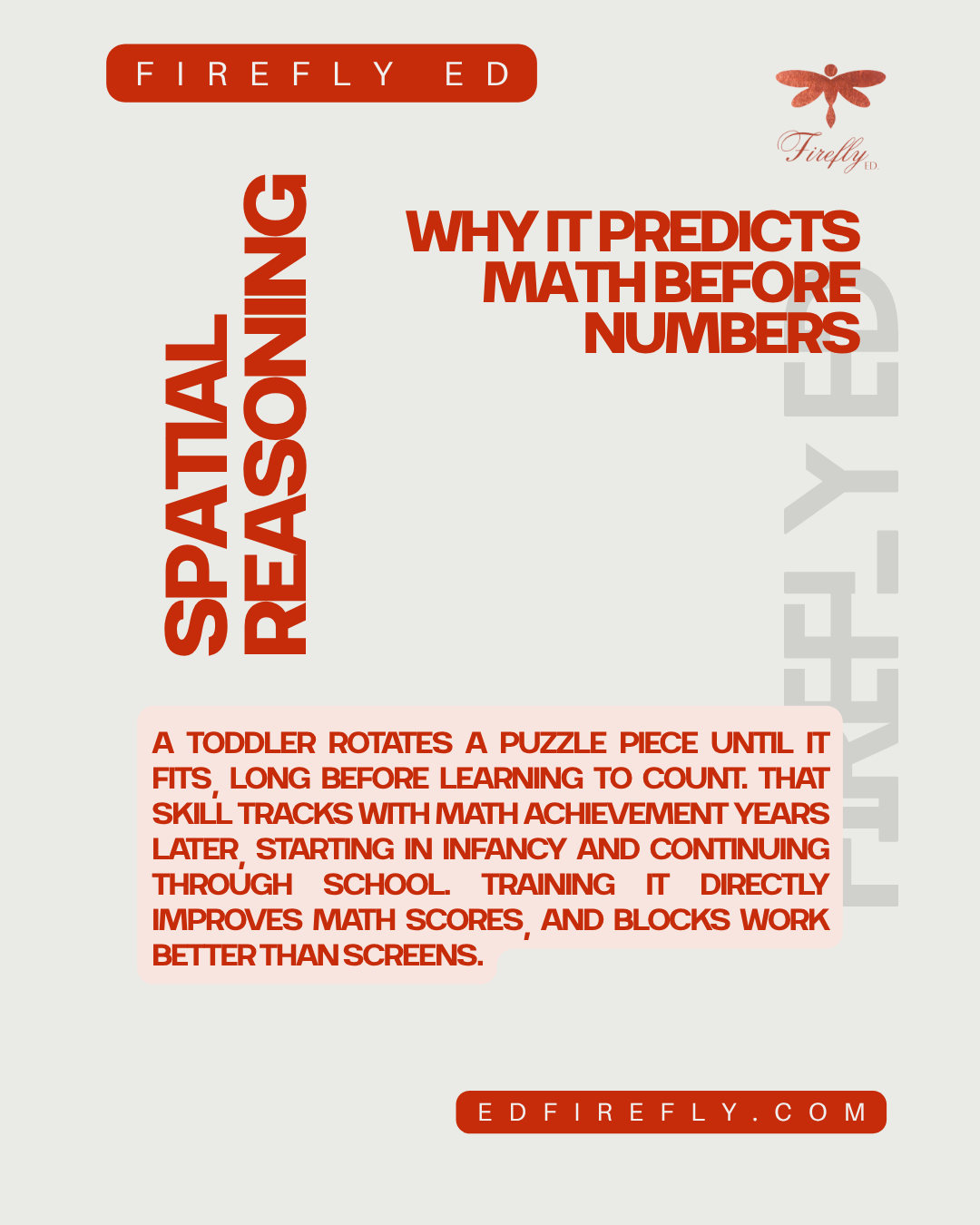
Spatial Reasoning in Children Predicts Math Before Numbers Do
- Spatial reasoning in children means mentally rotating, comparing, and fitting shapes and objects together.
- Spatial processing measured in infancy predicts both spatial skill and math skill years later.
- The link to math holds up after accounting for general intelligence and verbal ability.
- Training spatial skill directly improves math performance, not just correlates alongside it.
- Concrete materials like blocks build this skill more effectively than screen-based practice.
A toddler turns a puzzle piece over and over until it finally fits. No counting is involved. That skill is spatial reasoning, and it tracks with math achievement years before a learner sees a number line.
Spatial reasoning in children covers how a learner mentally moves, compares, and fits shapes and objects together. It happens entirely in the mind, without needing to touch anything at all.
What Spatial Reasoning Covers
Mentally rotating and moving shapes
One core piece of spatial reasoning is mental rotation. It means picturing how a shape looks after it turns, without physically turning it. A learner uses this constantly during puzzle play and block building.
Judging distance, direction, and fit
Spatial reasoning also covers judging how far apart two things sit. It includes which way an object needs to turn to fit, and how several pieces combine into a whole. These skills develop together rather than in isolation.
Spatial Reasoning Versus Being Good at One Puzzle
The skill generalizes across different tasks
A learner strong in spatial reasoning tends to do well across many different tasks, not just one favorite puzzle. The underlying ability transfers between block building, map reading, and shape sorting.
Practice on one task still helps the broader skill
Repeated practice with a single type of puzzle still strengthens the general skill underneath it. The transfer runs in both directions, from general skill to specific task and back again.
Why It Predicts Math Before Formal Instruction
The link appears as early as infancy
A study tracked children from around ten months old through preschool. It found early differences in spatial processing. Infants who performed better on a simple spatial task went on to score higher on mental rotation tasks years later.
Infant spatial skill predicts math skill years later
The same infants’ spatial scores also predicted their math performance at age four. That later test used actual numbers and symbols. The connection held even after accounting for the infants’ general cognitive scores and age.
Spatial Skill Predicts Math Independent of Other Factors
The link holds after accounting for general ability
Spatial reasoning does not simply track alongside overall intelligence. Studies that control for verbal skill and general cognitive ability still find a distinct, separate link between spatial reasoning and math performance.
It shows up across different areas of math
The connection is not limited to geometry, where a spatial link seems obvious. It shows up in arithmetic and word problems too, areas that look number-based on the surface.
Block Play and Early Math Skill
Block-building performance relates directly to math skill
A study of three-year-olds building block models found spatial skill predicted math performance on its own. That link held even after accounting for verbal ability. Counting tasks showed the strongest connection to block-building success.
Certain block tasks prove harder than others
Preschoolers in that study struggled most with translation, the precise sliding of a piece into position. That specific challenge linked to weaker counting and measurement skills.
No Meaningful Gender Gap in Early Spatial Skill
Boys and girls performed about the same
The same block-building study found no meaningful difference between boys and girls at age three. Early spatial skill developed along a similar path for both.
Spatial language at home varied more by background than gender
Family use of words like above, below, and between varied more by household income than by a learner’s gender. Learners who heard more spatial language performed better on spatial tasks.
The Skill Causes Better Math, Not Just Correlates With It
A large review of training studies confirmed lasting transfer
A meta-analysis pooled 29 training studies. It found that spatial training produces a genuine improvement in math performance, not just spatial test scores. The size of the improvement compared favorably with other well-established educational interventions.
Concrete materials work better than screens
Training with physical blocks and shapes produced larger math gains than the same training delivered on a screen. Handling actual objects appears to matter, not just seeing them represented.
Even short training periods show a benefit
Longer training programs did not outperform shorter ones in the review. A brief, consistent period of spatial play can produce a measurable benefit without requiring a long-term commitment.
Typical Development of Spatial Skill
Simple shape and puzzle play comes first
Fitting a round peg into a round hole, or a triangle into a triangle-shaped slot, usually develops during the toddler years. This early matching skill lays the groundwork for more complex spatial tasks.
Mental rotation and complex assembly develop later
Picturing how a shape looks after a turn, without touching it, takes longer to develop. This skill continues to strengthen well into the school years, alongside formal math instruction.
Spatial Reasoning and Everyday Navigation
Reading a simple map or floor plan
Following a map from one point to another asks a learner to match a flat drawing to an actual space. This skill draws on the same mental rotation used in puzzle play.
Giving directions from memory
Describing the route from a bedroom to the kitchen, without walking it first, requires holding a spatial layout in mind and translating it into words. Both skills strengthen each other with practice.
When Extra Support Might Help
A wide gap from same-age peers on basic shape tasks
A learner who struggles well past the toddler years to fit simple shapes or complete basic puzzles, compared with peers of the same age, may benefit from more structured spatial practice.
Trouble with directional words like above and behind
Confusing basic position words, even after repeated exposure at home, can point to a spatial language gap that benefits from direct practice rather than time alone.
Activities That Build Spatial Reasoning at Home
Building with blocks and construction toys
Open-ended building gives a learner repeated practice fitting, rotating, and judging how pieces relate to each other. Skipping step-by-step instructions leaves more room for this kind of practice.
Puzzles with rotating pieces
Jigsaw and shape puzzles ask a learner to picture how a piece needs to turn. Doing this before it physically turns builds mental rotation directly.
Using directional language during everyday tasks
Words like above, below, between, and behind describe spatial relationships out loud. Learners who hear this language often tend to use spatial concepts more fluently themselves.
Board games that involve a grid or path
Games that move a piece along a path or grid give a learner practice tracking position. That practice feels like play rather than instruction.
What Does Not Build This Skill
Passive screen time
Watching shapes move on a screen without touching or manipulating anything gives far less practice than handling an actual object. The training research points specifically to physical materials.
Praising the finished result without discussing the process
Praise for a completed tower or puzzle skips something important when it stops there. Talking through how the pieces fit or turned gives a learner language for their own spatial thinking.
Why This Still Matters in Later School Years
Geometry leans on it directly
Picturing a shape from a different angle, or imagining what a folded net looks like assembled, draws on spatial reasoning at its most obvious. This link continues well past the early grades.
Science diagrams and graphs use the same skill
Reading a cross-section diagram, interpreting a graph, or picturing a molecule in three dimensions all lean on the same underlying ability. The skill built through early block play keeps paying off years later.
Signs a Learner Has Strong Spatial Reasoning
Solving puzzles with little trial and error
A learner who places a puzzle piece correctly on the first or second try, rather than testing every rotation, is showing strong mental rotation skill.
Giving clear directions or descriptions of position
Describing where an object sits relative to another reflects solid spatial language. So does giving directions that make sense to follow.
Noticing symmetry or pattern without being prompted
A learner who points out that two halves of a design match, or continues a pattern on their own, is applying spatial reasoning without any adult cue to do so.
Spatial reasoning in children builds through hands-on play with physical shapes and objects, well before formal math instruction begins. Blocks, puzzles, and everyday directional language all give this skill room to grow.
The payoff stretches far beyond early math. A learner who builds strong spatial reasoning early carries that advantage into geometry, science, and everyday navigation for years afterward.
Firefly Ed runs academic classes, workshops, and events for children aged 3 to 14. It also keeps a library of articles for parents, teens, and young adults.
Research Sources
Spatial Skill in Infancy Predicting Later Math
Lauer, J.E., & Lourenco, S.F. (2016). Spatial Processing in Infancy Predicts Both Spatial and Mathematical Aptitude in Childhood. Psychological Science, 27(10), 1291-1298.
Block Play and Early Mathematical Skill
Verdine, B.N., Golinkoff, R.M., Hirsh-Pasek, K., Newcombe, N.S., Filipowicz, A.T., & Chang, A. (2014). Deconstructing Building Blocks: Preschoolers’ Spatial Assembly Performance Relates to Early Mathematical Skills. Child Development, 85(3), 1062-1076.
Evidence That Spatial Training Transfers to Math
Hawes, Z.C.K., Gilligan-Lee, K.A., & Mix, K.S. (2022). Effects of Spatial Training on Mathematics Performance: A Meta-Analysis. Developmental Psychology, 58(1), 112-137.


Share your thoughts or ask something..