
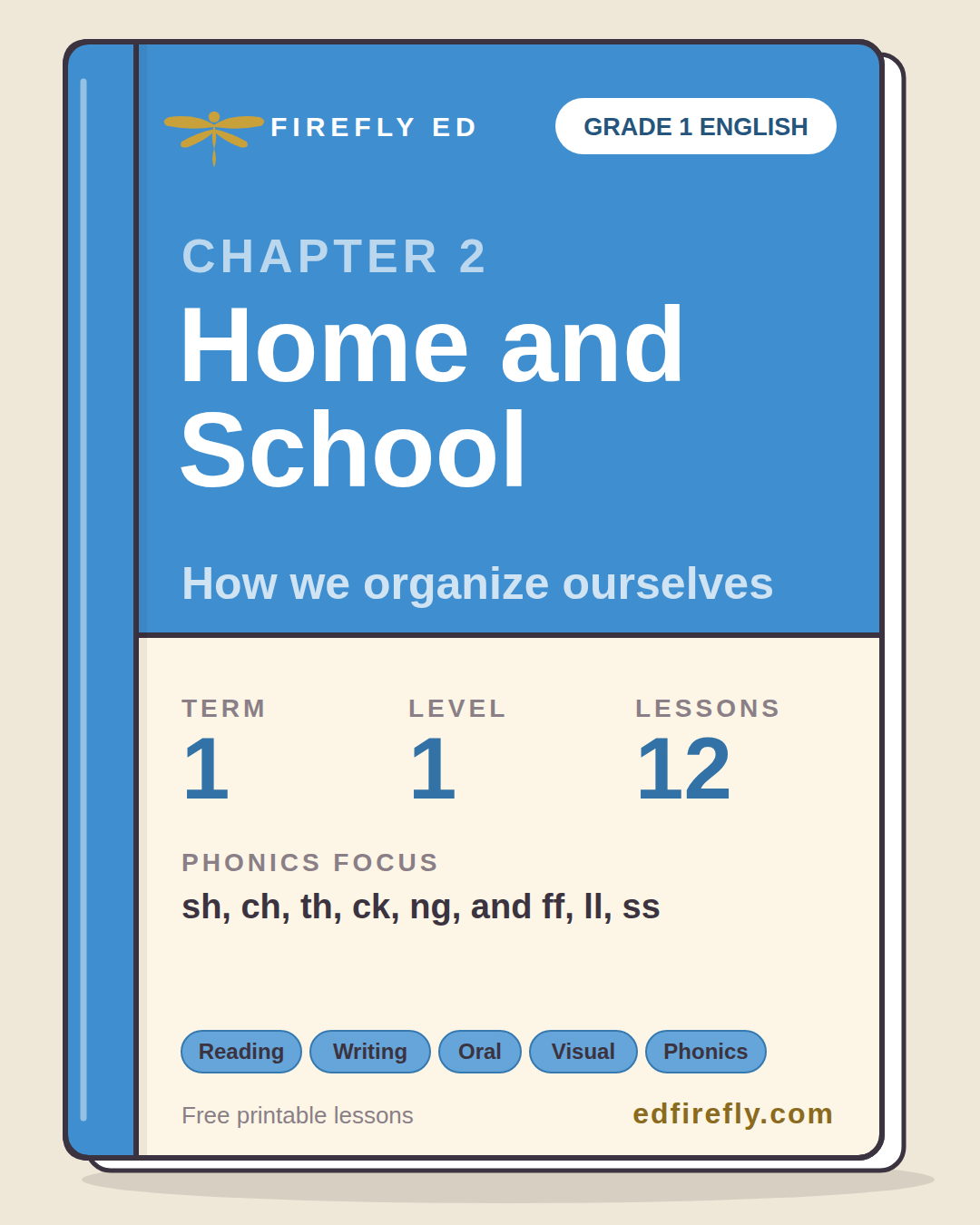
In this chapter – How we organize ourselves
Term 1 | Level 1 | Phonics focus: sh, ch, th, ck, ng, and ff, ll, ss
Unit of inquiry
Transdisciplinary theme: How we organize ourselves
In short: This theme is about the systems people make and how they work: how people live and work together, share jobs and make decisions.
Central idea: Homes and schools use routines, spaces and clear communication to help people live and learn together.
Lines of inquiry
- The routines that organize our day
- How spaces at home and school are set out
- How clear communication helps us work together
Key concepts
- Function: How does it work?
- Form: What is it like?
- Responsibility: What are our obligations?
Related concepts: routine, order, systems
Learner profile attributes
Inquirers, Balanced, Communicators, Principled, Thinkers, Risk-takers, Reflective
Approaches to learning
Research skills, Self-management skills, Communication skills, Social skills, Thinking skills
Language: Phase 1 conceptual understandings
- Reading: Printed information can tell about the real world.
- Writing: Writing conveys meaning.
- Oral language: Spoken words connect us with others.
- Visual language: Visual language is all around us.
Tuning in
For the adult: do this before Lesson 2.1.
Walk around your home or the classroom together. Ask: How do we know where things go? What would happen if nothing had a place and nobody knew what came next? Write down the learner’s ideas and keep them.
Lessons in this chapter
| Lesson | Title | PYP strand | Line of inquiry | Key concept | Learner profile |
|---|---|---|---|---|---|
| 2.1 | Find the Answer | Written language: receptive (reading) | 1 | Function | Inquirers |
| 2.2 | A Day at School | Written language: receptive (reading) | 1 | Function | Balanced |
| 2.3 | My Day in Order | Written language: expressive (writing) | 1 | Function | Balanced |
| 2.4 | Fix the Sentence | Written language: expressive (writing) | 3 | Function | Communicators |
| 2.5 | Listen and Do: Two-Step Instructions | Oral language: receptive (listening) | 3 | Responsibility | Principled |
| 2.6 | Talk About My Home | Oral language: expressive (speaking) | 2 | Form | Communicators |
| 2.7 | Put the Pictures in Order | Visual language: receptive (viewing) | 1 | Function | Thinkers |
| 2.8 | Draw and Label My Classroom | Visual language: expressive (presenting) | 2 | Form | Inquirers |
| 2.9 | sh and ch | Written language: receptive and expressive (reading and spelling) | 3 | Form | Thinkers |
| 2.10 | th, ck and ng | Written language: receptive and expressive (reading and spelling) | 3 | Form | Risk-takers |
| 2.11 | Double Letters: ff, ll, ss | Written language: receptive and expressive (reading and spelling) | 3 | Form | Thinkers |
| 2.12 | Chapter 2 Review | All strands: receptive and expressive | All | Function, Form and Responsibility | Reflective |
How each lesson works
PYP organises language into three strands: oral language, visual language and written language. Each strand has a receptive side (understanding: listening, viewing, reading) and an expressive side (sharing: speaking, presenting, writing). Every lesson names its strand and side.
Every lesson starts with a Wonder question. The learner then moves through Let’s Learn, Watch Me, Let’s Try Together and Your Turn. Each lesson ends with Reflect, where the learner returns to the Wonder question, names a learner profile attribute they showed, and chooses an action to take.
The 12 lessons
For the adult: tap a lesson to open it. Each lesson takes about 20 minutes. Tap the lesson title again, or use the link at the end of the lesson, to close it.
Lesson 2.1: Find the Answer | Reading | About 20 minutes
Term 1 | Level 1
Unit of inquiry: How we organize ourselves | Line of inquiry: The routines that organize our day
Key concept: Function (How does it work?) | Learner profile: Inquirers | ATL skills: Research skills
PYP strand: Written language: receptive (reading)
I can read a short story and answer who, what, where and why questions.
Curriculum links: IB PYP Language, Reading, Phase 1: listen attentively and respond to stories read aloud; show curiosity and ask questions about pictures or text. England Year 1: participate in discussion about what is read to them, taking turns and listening to what others say. Common Core RL.1.1: ask and answer questions about key details in a text.
Key words: question | who | what | where | why
Wonder
For the adult: ask this question before you start. Accept every idea. You will come back to it in Reflect.
What happens when the school bell rings?
Let’s Learn
For the adult: read this part aloud. Point to each question word card as you explain it.
A question word tells us what kind of answer to look for.
Who asks about a person or an animal. What asks about a thing.
Where asks about a place. Why asks for a reason. The answer often starts with “because”.
Read the question. Then go back to the story and find the words that answer it.
Watch Me
For the adult: read the short text aloud, then say the thinking aloud for each question.
Sam sat on the mat. Sam had a hot bun.
“Question: Who sat on the mat? Who asks about a person. I find the word before ‘sat’. It says Sam. So the answer is Sam.”
“Question: What did Sam have? What asks about a thing. I find ‘had’. The words after it say ‘a hot bun’. So the answer is a hot bun.”
“Question: Where did Sam sit? Where asks about a place. The story says ‘on the mat’. So the answer is on the mat.”
Let’s Try Together
For the adult: read the text aloud. The learner answers each question.
Pam and Dan got in the van. The van went to school.
1. Who got in the van?
Hint: Who asks about people. Look for names at the start.
2. Where did the van go?
Hint: Where asks about a place. Look at the end of the story.
Your Turn
Name: ______________________
Read with an adult.
Ben and his mum went to school. Ben had his red bag. The bell rang. Ben ran in. His bag fell in the mud. Mum got it back for him.
1. Circle the answer.
a) Who went to school?
Ben and Dad Ben and his mum Pam
b) What did Ben have?
a hat a bat a red bag
2. Where and why?
a) Where did Ben and Mum go? Tick the picture.
☐ A ☐ B ☐ C
b) Why did Ben run in? Tick the answer.
☐ The bell rang.
☐ Ben was sad.
☐ Mum ran.
3. Write the answer.
What did Mum do at the end of the story?
Word bank: mud | bag | back | red
Mum got the ____________ ____________.
Reflect
For the adult: talk about these with the learner.
1. Go back to the Wonder question: “What happens when the school bell rings?” What do you think now?
2. I was an inquirer today when I ______________________________.
Take action: Ask a family member a who, a what, a where and a why question about their day.
Answer Key
Reveal Answers
Let’s Try Together
1. Pam and Dan
2. to school
Look for: the learner goes back to the text to find the answer rather than guessing from the picture.
1. Circle the answer
a) Ben and his mum
b) a red bag
2. Where and why?
a) C (the school)
b) The bell rang.
Look for: for b), the learner points to “The bell rang” in the story. This is the reason Ben ran in, so it answers “why”.
3. Write the answer
Mum got the bag back.
Look for: “bag” and “back” copied from the word bank in the right order. Accept “Mum got it back.” as a correct spoken answer.
Next Steps
If this was easy, try: Read a picture book together. Ask one who, one what, one where and one why question about it. Then let the learner ask you.
If this was hard, go back to: Watch Me. Use only who and what questions for two days. Add where, then why, when those are easy.
Lesson 2.2: A Day at School | Reading | About 20 minutes
Term 1 | Level 1
Unit of inquiry: How we organize ourselves | Line of inquiry: The routines that organize our day
Key concept: Function (How does it work?) | Learner profile: Balanced | ATL skills: Self-management skills
PYP strand: Written language: receptive (reading)
I can read a picture timetable and say what comes before and after.
Curriculum links: IB PYP Language, Reading, Phase 1: begin to discriminate between visual representations such as symbols, numbers, ICT iconography, letters and words. Visual language, Phase 1: observe visual cues that indicate context; show understanding by matching pictures with context. England Year 1: link what they read or hear read to their own experiences. Common Core RI.1.7: use the illustrations and details in a text to describe its key ideas.
Key words: timetable | order | first | last | before | after
Wonder
For the adult: ask this question before you start. Accept every idea. You will come back to it in Reflect.
How do we know what comes next in our day?
Let’s Learn
For the adult: read this part aloud. Show the timetable in Watch Me as you explain.
A timetable shows what happens in a day, in order.
We read it from the top to the bottom. The top is first. The bottom is last.
After means the one below. Before means the one above.
The pictures help us read the words.
Watch Me
For the adult: point to each row as you say the thinking aloud.
“Question: What comes after Read? I find Read. It is number 1.”
“After means the one below. I move my finger down one. It says Maths, with the 1+2 picture.”
“So Maths comes after Read.”
Let’s Try Together
Use the timetable in Watch Me.
1. What comes first?
Hint: First is at the top. Look at number 1.
2. What comes before Lunch?
Hint: Find Lunch. Before means the one above it.
Your Turn
Name: ______________________
Read with an adult.
This is our day at school. First, we read. Then we do maths. Then we play. Next, it is lunch. After lunch, we do art. We like art. Last, we go home.
1. Circle the answer.
a) What comes after lunch?
Art Play Read
b) What comes last?
Read Maths Home
2. Tick yes or no.
Look at the timetable again.
Read is last. ☐ yes ☐ no
Play is after Maths. ☐ yes ☐ no
Lunch is after Play. ☐ yes ☐ no
Art is first. ☐ yes ☐ no
3. Write.
Word bank: play | home | lunch | read
a) After art, we go ______________.
b) What do you like best at school?
I like ______________________.
Reflect
For the adult: talk about these with the learner.
1. Go back to the Wonder question: “How do we know what comes next in our day?” What do you think now?
2. I was balanced today when I ______________________________.
Take action: Make a picture timetable for a weekend day at home and put it on the wall.
Answer Key
Reveal Answers
Let’s Try Together
1. Read
2. Play
Look for: the learner moves a finger up for “before” and down for “after”.
1. Circle the answer
a) Art
b) Home
2. Tick yes or no
Read is last. no
Play is after Maths. yes
Lunch is after Play. yes
Art is first. no
Look for: for each “no”, the learner can say the right answer. Read is first. Home is last.
3. Write
a) After art, we go home.
b) Sample answer: I like art.
Look for: a full stop at the end of each sentence. Accept any true answer for b).
Next Steps
If this was easy, try: Make a picture timetable for a day at home. Ask the learner three before and after questions about it.
If this was hard, go back to: Watch Me. Cut the timetable into six strips and put them in order together. Ask only “What comes after…?” questions until those are easy.
Lesson 2.3: My Day in Order | Writing | About 20 minutes
Term 1 | Level 1
Unit of inquiry: How we organize ourselves | Line of inquiry: The routines that organize our day
Key concept: Function (How does it work?) | Learner profile: Balanced | ATL skills: Self-management skills
PYP strand: Written language: expressive (writing)
I can write about my morning in order using First, Next, Then and Last.
Curriculum links: IB PYP Language, Writing, Phase 1: use their own experience as a stimulus when drawing and “writing”; participate in shared writing, observing the teacher’s writing and making suggestions. England Year 1: sequencing sentences to form short narratives. Common Core W.1.3: write narratives in which they recount two or more appropriately sequenced events and use temporal words to signal event order.
Key words: order | First | Next | Then | Last
Wonder
For the adult: ask this question before you start. Accept every idea. You will come back to it in Reflect.
Why do we do some things in the same order every morning?
Let’s Learn
For the adult: read this part aloud. Point to each order word card.
We can write about our day in order.
Order words tell the reader what happened when. We use First, Next, Then and Last.
Put a comma after the order word. Then write what you did.
Each sentence starts with a capital letter and ends with a full stop.
Watch Me
For the adult: point to each picture and say the thinking aloud. Write each sentence where the learner can see it.
“I look at picture 1. Sam gets up. It happens first. I write: First, I get up.“
“Picture 2 comes next. Sam washes. I write: Next, I wash.“
“Picture 3: Then, I eat an egg. Picture 4 is the end, so I use Last: Last, I get my bag.“
“I check each sentence. Capital letter, comma, full stop.”
Let’s Try Together
1. Which order word do we use at the start?
Hint: Look at the order word cards. Which one is on the left?
2. Finish the sentence for the picture: Next, I ____________.
Hint: What is the child doing at the sink? Say the whole sentence first.
Your Turn
Name: ______________________
1. Put the order words in order.
Write 1, 2, 3 or 4 in each box.
☐ Last ☐ First ☐ Then ☐ Next
2. Finish the sentences.
Word bank: bag | teeth | up | egg
a) First, I get ____________.
b) Next, I brush my ____________.
c) Then, I eat an ____________.
d) Last, I get my ____________.
3. Write about your morning.
Think about this morning. Say each sentence out loud first. Then write it.
Draw one thing you did this morning.
First, ______________________________.
Next, ______________________________.
Then, ______________________________.
Last, ______________________________.
Reflect
For the adult: talk about these with the learner.
1. Go back to the Wonder question: “Why do we do some things in the same order every morning?” What do you think now?
2. I was balanced today when I ______________________________.
Take action: Draw your morning routine as four pictures. Use it to get ready on your own.
Answer Key
Reveal Answers
Let’s Try Together
1. First
2. Next, I wash.
1. Put the order words in order
4 Last, 1 First, 3 Then, 2 Next
Look for: the learner says the words in order: First, Next, Then, Last.
2. Finish the sentences
a) up
b) teeth
c) egg
d) bag
3. Write about your morning
Sample answer: First, I get up. Next, I wash. Then, I eat. Last, I get my bag.
Look for: the four order words used in order, a capital letter at the start and a full stop at the end of each sentence. The events should be true and in the order they happened. Accept sound-based spelling, such as “brekfust” for breakfast.
Next Steps
If this was easy, try: Write about the end of the day, from dinner to bed, using the same four order words.
If this was hard, go back to: Watch Me. Say the four sentences about your own morning together, using your fingers to count First, Next, Then, Last. Write only the first two sentences.
Lesson 2.4: Fix the Sentence | Writing | About 20 minutes
Term 1 | Level 1
Unit of inquiry: How we organize ourselves | Line of inquiry: How clear communication helps us work together
Key concept: Function (How does it work?) | Learner profile: Communicators | ATL skills: Communication skills
PYP strand: Written language: expressive (writing)
I can add capital letters and end marks to fix a sentence.
Curriculum links: IB PYP Language, Writing, Phase 1: participate in shared writing, observing the teacher’s writing and making suggestions; listen and respond to shared books (enlarged texts), observing conventions of print. England Year 1: beginning to punctuate sentences using a capital letter and a full stop, question mark or exclamation mark; using a capital letter for names of people and the personal pronoun “I”. Common Core L.1.2a: capitalize dates and names of people; L.1.2b: use end punctuation for sentences.
Key words: capital letter | end mark | full stop | question mark | name
Wonder
For the adult: ask this question before you start. Accept every idea. You will come back to it in Reflect.
How do capital letters and full stops help a reader?
Let’s Learn
For the adult: read this part aloud. Point to the red capital letter and the red full stop.
A sentence starts with a capital letter.
A sentence ends with an end mark. A telling sentence ends with a full stop. An asking sentence ends with a question mark.
Names of people always start with a capital letter, such as Sam and Meg. The word “I” is always a capital letter.
Watch Me
For the adult: write the sentence where the learner can see it. Fix it as you say the thinking aloud.
the cat is sleeping
“I read it: the cat is sleeping. It is a sentence, so it needs a capital letter at the start. I change t to T.”
“Does it tell or ask? It tells me about the cat. So it ends with a full stop.”
“Now it says: The cat is sleeping. I read it again to check.”
Let’s Try Together
1. Fix this sentence: i can hop
Hint: What is special about the word “I”? What end mark does a telling sentence need?
2. Fix this sentence: is it hot
Hint: Does it tell or ask? Pick the end mark that fits.
Your Turn
Name: ______________________
1. Tick the sentence that is right.
a)
☐ the dog is big.
☐ The dog is big.
☐ The dog is big
b)
☐ Can I pat the cat?
☐ can I pat the cat?
☐ Can I pat the cat.
2. Circle the letters that need to be capitals.
a) the bus is red.
b) I am six. i can run.
c) sam and pam sat.
3. Write the sentence the right way.
a) the dog is wet
______________________________________
b) can i have a bun
______________________________________
c) meg has a red hat
______________________________________
Reflect
For the adult: talk about these with the learner.
1. Go back to the Wonder question: “How do capital letters and full stops help a reader?” What do you think now?
2. I was a communicator today when I ______________________________.
Take action: Before you give someone a note or a card this week, check it for capital letters and end marks.
Answer Key
Reveal Answers
Let’s Try Together
1. I can hop.
2. Is it hot?
1. Tick the sentence that is right
a) The dog is big.
b) Can I pat the cat?
Look for: the learner says what is wrong with the other two. One has no capital letter. One has the wrong end mark or no end mark.
2. Circle the letters that need to be capitals
a) t (the)
b) i (i can run)
c) s (sam) and p (pam)
Look for: in c), the learner knows that both names need a capital, not only the first word.
3. Write the sentence the right way
a) The dog is wet.
b) Can I have a bun?
c) Meg has a red hat.
Look for: in b), both “Can” and “I” have capitals, and the sentence ends with a question mark. In c), “Meg” has a capital because it is a name and the first word.
Next Steps
If this was easy, try: Write three sentences about your family. Include each person’s name. Ask the learner to check your capitals and end marks.
If this was hard, go back to: Watch Me. Fix only capital letters first, using sentences that start with a name, such as “sam is six”. Add end marks when that is easy.
Lesson 2.5: Listen and Do: Two-Step Instructions | Oral | About 20 minutes
Term 1 | Level 1
Unit of inquiry: How we organize ourselves | Line of inquiry: How clear communication helps us work together
Key concept: Responsibility (What are our obligations?) | Learner profile: Principled | ATL skills: Social skills
PYP strand: Oral language: receptive (listening)
I can listen to an instruction with two steps and do both steps in order.
Curriculum links: IB PYP Language, Oral language, Phase 1: follow classroom directions and routines, using context cues; understand simple questions and respond with actions or words. England Year 1: listen and respond appropriately to adults and their peers. Common Core SL.1.2: ask and answer questions about key details in information presented orally.
Key words: instruction | step | then | listen
Wonder
For the adult: ask this question before you start. Accept every idea. You will come back to it in Reflect.
Why is it important to listen to the whole instruction?
Let’s Learn
For the adult: read this part aloud.
An instruction tells us what to do.
Some instructions have two steps. The word then tells us where the second step starts.
Listen to the whole instruction before you start. Do the first step. Then do the second step.
If you forget, you can ask: “Can you say it again, please?”
Watch Me
For the adult: say the instruction, then say the thinking aloud and do each step.
“Touch your toes, then clap twice.”
“I listen to the whole thing first. I hear the word ‘then’, so there are two steps.”
“Step 1 is before ‘then’: touch my toes. Step 2 is after ‘then’: clap twice.”
“I do step 1. I touch my toes. Now I do step 2. Clap, clap. I did both steps in order.”
Let’s Try Together
For the adult: say each instruction once. The learner does it.
1. “Clap once, then touch your nose.”
Hint: Hold up one finger for each step as the adult says it.
2. “Stand up, then sit down.”
Hint: Which step comes before “then”? Do that one first.
Your Turn
Name: ______________________
1. Listen and do.
For the adult: read each instruction once. The learner does both steps, then ticks the box.
☐ a) Touch your toes, then clap twice.
☐ b) Pat your head, then hop.
☐ c) Say your name, then wave.
☐ d) Sit down, then fold your arms.
2. Listen and colour.
For the adult: read each instruction once. Do not point to the pictures.
a) “Colour the hat red, then colour the bag blue.”
b) “Colour the sun yellow, then draw a line under the cup.”
3. Listen and draw.
For the adult: say “Draw a big box, then draw a cat in the box.”
Now you give an instruction with two steps to an adult. Watch them do it.
First, ______________________, then ______________________.
Reflect
For the adult: talk about these with the learner.
1. Go back to the Wonder question: “Why is it important to listen to the whole instruction?” What do you think now?
2. I was principled today when I ______________________________.
Take action: Help at home by doing a two-step job, such as “Set the table, then call everyone.”
Answer Key
Reveal Answers
Let’s Try Together
1. The learner claps once, then touches their nose.
2. The learner stands up, then sits down.
1. Listen and do
Look for: both steps done, in the right order, after one listen. Note any instruction where the learner did only the last step. That shows they started before the adult finished.
2. Listen and colour
a) The hat is red. The bag is blue.
b) The sun is yellow. There is a line under the cup.
Look for: the cup is not coloured. A coloured cup means the learner mixed up “colour” and “draw a line”.
3. Listen and draw
Look for: a big box with a cat inside it. The cat should be in the box, not next to it.
Sample instruction: First, stand up, then jump.
Look for: two clear steps joined by “then”.
Next Steps
If this was easy, try: Try three-step instructions, such as “Clap, then hop, then sit down.” Then let the learner give you one.
If this was hard, go back to: Let’s Try Together. Use one-step instructions first, such as “Clap.” Add the second step only when the first is easy.
Lesson 2.6: Talk About My Home | Oral | About 20 minutes
Term 1 | Level 1
Unit of inquiry: How we organize ourselves | Line of inquiry: How spaces at home and school are set out
Key concept: Form (What is it like?) | Learner profile: Communicators | ATL skills: Communication skills
PYP strand: Oral language: expressive (speaking)
I can describe my favourite room using three describing words.
Curriculum links: IB PYP Language, Oral language, Phase 1: tell their own stories using words, gestures, and objects/artifacts; interact effectively with peers and adults in familiar social settings. England Year 1: use relevant strategies to build their vocabulary. Common Core SL.1.4: describe people, places, things, and events with relevant details, expressing ideas and feelings clearly.
Key words: describe | describing word | room | favourite
Wonder
For the adult: ask this question before you start. Accept every idea. You will come back to it in Reflect.
What makes a room at home special to you?
Let’s Learn
For the adult: read this part aloud.
We describe a place to help someone picture it.
A describing word tells us more about a thing. It can tell us the size, such as big or small. It can tell us the colour, such as red. It can tell us how a thing feels, such as soft or hot.
Use three describing words to tell someone about your favourite room.
Watch Me
For the adult: point to each part of the picture as you say the thinking aloud.
“This is my bedroom. It is my favourite room. I want to describe it.”
“First, the size. The room is not big. I say: My bedroom is small.“
“Next, how something feels. I say: My teddy is soft.“
“Last, a colour. I say: My rug is red. I used three describing words: small, soft and red.”
Let’s Try Together
For the adult: point to the picture. The learner answers out loud.
1. Say a word that tells the size of the kitchen.
Hint: Is it big or small? Say “The kitchen is…”
2. Say a colour word for the cupboards.
Hint: Look at the colour. Say “The cupboards are…”
Your Turn
Name: ______________________
1. Circle the describing word.
a) I have a red rug.
b) The big bed is blue.
c) My teddy is soft.
2. Pick three describing words.
Circle three words that fit this room.
wet red sad big hot soft
Now say a sentence for each word. Start with “The sofa is…” or “The cushions are…”
3. Talk about your favourite room.
a) Draw your favourite room at home.
b) Write three describing words for your room.
Word bank: soft | big | red | small | warm | blue
1. ____________ 2. ____________ 3. ____________
c) Say three sentences about your room to an adult. Use one describing word in each. Tick each box when you did it.
☐ I said three sentences.
☐ I used three describing words.
☐ I looked at my listener.
Reflect
For the adult: talk about these with the learner.
1. Go back to the Wonder question: “What makes a room at home special to you?” What do you think now?
2. I was a communicator today when I ______________________________.
Take action: Help tidy one room at home. Then describe it to a family member using three describing words.
Answer Key
Reveal Answers
Let’s Try Together
1. The kitchen is big.
2. The cupboards are yellow.
Look for: a whole sentence, not one word.
1. Circle the describing word
a) red
b) big (also accept blue)
c) soft
Look for: in b), “big” and “blue” are both describing words. Accept either, or both.
2. Pick three describing words
big, red, soft
Look for: the learner says why wet, sad and hot do not fit. Sample sentences: The sofa is big. The sofa is red. The cushions are soft.
3. Talk about your favourite room
Sample answer: My bedroom is small. My bed is soft. My walls are blue.
Look for: three different describing words that match the drawing. The learner speaks clearly and looks at the listener. Accept sound-based spelling in the written words.
Next Steps
If this was easy, try: Describe a room in a friend’s home or at school. Ask the listener to guess which room it is.
If this was hard, go back to: Let’s Try Together. Use one type of describing word at a time. Start with colours, then sizes, then how things feel.
Lesson 2.7: Put the Pictures in Order | Visual | About 20 minutes
Term 1 | Level 1
Unit of inquiry: How we organize ourselves | Line of inquiry: The routines that organize our day
Key concept: Function (How does it work?) | Learner profile: Thinkers | ATL skills: Thinking skills
PYP strand: Visual language: receptive (viewing)
I can look at picture cards and put them in the order they happen.
Curriculum links: IB PYP Language, Visual language, Phase 1: attend to visual information showing understanding through play, gestures, facial expression; observe visual cues that indicate context; show understanding by matching pictures with context. England Year 1: sequencing sentences to form short narratives. Common Core RL.1.7: use illustrations and details in a story to describe its characters, setting, or events.
Key words: order | first | next | last | picture card
Wonder
For the adult: ask this question before you start. Accept every idea. You will come back to it in Reflect.
How do we know what happened first?
Let’s Learn
For the adult: read this part aloud.
Pictures can tell a story. The pictures happen in an order.
Look at each picture. Ask: What is happening here?
Find the picture that happens first. Then find what happens next. The last picture shows the end.
Say the story out loud to check that it makes sense.
Watch Me
For the adult: point to each card as you say the thinking aloud.
“I look at each card. A has a sock. B has no sock. C has a sock and a shoe.”
“What happens first? The foot is bare before we put anything on. So B is first.”
“Next, we put on a sock. That is A. Last, the shoe goes on top of the sock. That is C.”
“The order is B, A, C. I check it: First, a bare foot. Next, a sock. Last, a shoe. It makes sense.”
Let’s Try Together
1. Which card comes first?
Hint: Look for the apple before anyone ate it.
2. Which card comes last?
Hint: What is left at the end, when the apple is eaten?
Your Turn
Name: ______________________
1. Which comes first? Circle A or B.
a) A B b) A B
2. Put the morning in order.
The cards are mixed up. Write the letters in order.
1st ____ 2nd ____ 3rd ____ 4th ____
3. Draw what comes last.
a) Draw card 3 in the empty box. What happens at the end?
b) Finish the sentence.
Word bank: big | gone | red
Last, the ice cream is ______________.
Reflect
For the adult: talk about these with the learner.
1. Go back to the Wonder question: “How do we know what happened first?” What do you think now?
2. I was a thinker today when I ______________________________.
Take action: Draw a job at home in four steps, such as making a sandwich. Use your pictures to teach someone how to do it.
Answer Key
Reveal Answers
Let’s Try Together
1. B (the whole apple)
2. A (the core)
Look for: the full order is B, C, A. The learner can say why C is in the middle.
1. Which comes first?
a) B (the egg)
b) A (the full cup)
2. Put the morning in order
1st C, 2nd D, 3rd A, 4th B
Look for: the learner tells the story using the cards: First, the child is asleep. Next, the child gets up. Then, the child eats. Last, the child gets a bag and goes out.
3. Draw what comes last
a) A cone with no ice cream left, or an empty hand.
b) Last, the ice cream is gone.
Look for: the drawing shows less ice cream than card 2. Accept a drawing of the cone only.
Next Steps
If this was easy, try: Take four photos of a task at home, such as making a sandwich. Mix them up and ask the learner to put them in order and tell the story.
If this was hard, go back to: Watch Me. Use only two cards at a time and ask: Which happens first? Add a third card when that is easy.
Lesson 2.8: Draw and Label My Classroom | Visual | About 20 minutes
Term 1 | Level 1
Unit of inquiry: How we organize ourselves | Line of inquiry: How spaces at home and school are set out
Key concept: Form (What is it like?) | Learner profile: Inquirers | ATL skills: Research skills
PYP strand: Visual language: expressive (presenting)
I can draw a simple map of my classroom and label the door, the board and the desks.
Curriculum links: IB PYP Language, Visual language, Phase 1: select and incorporate colours, shapes, symbols and images into visual presentations; recognize familiar signs, labels and logos. England Key Stage 1 Geography: devise a simple map; use and construct basic symbols in a key. Common Core SL.1.5: add drawings or other visual displays to descriptions when appropriate to clarify ideas, thoughts, and feelings.
Key words: map | from above | label | symbol
Wonder
For the adult: ask this question before you start. Accept every idea. You will come back to it in Reflect.
How is our classroom set out, and why?
Let’s Learn
For the adult: read this part aloud. If you can, stand on a chair with the learner and look down at a table together.
A map shows a place from above, the way a bird sees it when it looks down.
From above, things look flat. A desk looks like a rectangle. A door looks like a gap in the wall with a curved line.
A label is a word that names a thing on the map. It helps other people read the map.
Watch Me
For the adult: point to each part of the bedroom map as you say the thinking aloud.
“This is a map of my bedroom. I am looking down from above.”
“I drew the walls first. Then I drew the bed as a long rectangle with a pillow. The rug is a round shape, so I drew a circle.”
“The door is a gap in the wall. The curved line shows how it opens.”
“Last, I wrote a label for each thing: bed, rug, door.”
Let’s Try Together
1. Point to the door.
Hint: Look for a gap in the wall with a curved line.
2. How many desks can you count?
Hint: A desk is a yellow rectangle. Touch each one as you count.
Your Turn
Name: ______________________
1. Circle the name of each map symbol.
a) desk door rug
b) desk board bed
c) rug bed board
2. Label the classroom map.
Word bank: board | window | desk | door
1. ____________ 2. ____________
3. ____________ 4. ____________
3. Draw and label your classroom.
Draw a map of your classroom from above. Label the door, the board and the desks.
Tick what you labelled:
☐ door ☐ board ☐ desks
Reflect
For the adult: talk about these with the learner.
1. Go back to the Wonder question: “How is our classroom set out, and why?” What do you think now?
2. I was an inquirer today when I ______________________________.
Take action: Use your map to show a visitor or a new classmate around your classroom.
Answer Key
Reveal Answers
Let’s Try Together
1. The door is at the bottom right of the map.
2. Six desks
1. Circle the name of each map symbol
a) door
b) desk
c) board
2. Label the classroom map
1. desk
2. door
3. board
4. window
Look for: labels copied from the word bank and written next to the right number.
3. Draw and label your classroom
Look for: a map drawn from above, with walls, a door, a board and desks. Each label sits next to its thing. The desks can be simple rectangles. Accept sound-based spelling, such as “bord” for board.
Next Steps
If this was easy, try: Draw a map of your bedroom or kitchen. Add a key that shows what each symbol means.
If this was hard, go back to: Watch Me. Put three objects on a table, such as a book, a cup and a plate. Look at them from above. Draw their shapes, then label each one.
Lesson 2.9: sh and ch | Phonics | About 20 minutes
Term 1 | Level 1
Unit of inquiry: How we organize ourselves | Line of inquiry: How clear communication helps us work together
Key concept: Form (What is it like?) | Learner profile: Thinkers | ATL skills: Communication skills
PYP strand: Written language: receptive and expressive (reading and spelling)
I can hear, read and write the sounds sh and ch.
Curriculum links: IB PYP Language, Writing, Phase 1: show an awareness of sound–symbol relationships and begin to recognize the way that some familiar sounds can be recorded. England Year 1: respond speedily with the correct sound to graphemes for all 40+ phonemes. Common Core RF.1.3a: know the spelling-sound correspondences for common consonant digraphs.
Key words: digraph | sh | ch | sound
Wonder
For the adult: ask this question before you start. Accept every idea. You will come back to it in Reflect.
Can two letters make just one sound?
Let’s Learn
For the adult: read this part aloud. Make each sound with the learner: put a finger on your lips for /sh/ and move your arms like a train for /ch/.
Sometimes two letters make one sound. We call them a digraph.
s and h together say /sh/. It is the quiet sound, like “shh” with a finger on your lips.
c and h together say /ch/. It is the train sound: ch, ch, ch.
A line under the two letters shows they make one sound.
Watch Me
For the adult: point to each picture and say the thinking aloud. Write each word where the learner can see it.
“I say the first word: shed. The first sound is /sh/, the quiet sound. I write sh. Then e, then d: shed.”
“Now chips. The first sound is /ch/, the train sound. I write ch. Then i, p, s: chips.”
“Shed and chips start with different sounds: /sh/ is quiet, /ch/ is like a train.”
Let’s Try Together
For the adult: point to each picture and name it first: shop, chat.
1. Say the word for picture 1. Does it start with /sh/ or /ch/?
Hint: Is it the quiet sound or the train sound?
2. Say the word for picture 2. Does it start with /sh/ or /ch/?
Hint: The two children are talking. What is another word for talking?
Your Turn
Name: ______________________
1. Circle the sound you hear.
For the adult: point to each picture and name it first: chips, shed, dish, lunch, shop.
a) sh ch b) sh ch c) sh ch d) sh ch e) sh ch
2. Sort the words.
Read each word. Write it in the right list.
Words: shop | chat | dish | much | shut | chop
sh words: ____________ ____________ ____________
ch words: ____________ ____________ ____________
3. Write sh or ch.
For the adult: point to each picture and name it first: shed, fish, chips, lunch.
a) ___ ___ e d b) f i ___ ___ c) ___ ___ i p s d) l u n ___ ___
e) Read the sentence. Underline the sh and ch words.
The fish is in the dish. I had chips for lunch.
Reflect
For the adult: talk about these with the learner.
1. Go back to the Wonder question: “Can two letters make just one sound?” What do you think now?
2. I was a thinker today when I ______________________________.
Take action: Make labels for sh and ch things at home, such as the dish and the shed. Stick them in place.
Answer Key
Reveal Answers
Let’s Try Together
1. shop, /sh/
2. chat, /ch/
1. Circle the sound you hear
a) ch (chips)
b) sh (shed)
c) sh (dish)
d) ch (lunch)
e) sh (shop)
Look for: in c) and d), the sound is at the end of the word. The learner should still circle it.
2. Sort the words
sh words: shop, dish, shut
ch words: chat, much, chop
Look for: the learner reads “dish” and “much” correctly, even though the digraph is at the end.
3. Write sh or ch
a) shed
b) fish
c) chips
d) lunch
e) fish, dish, chips, lunch
Look for: both letters of the digraph written, one on each line.
Next Steps
If this was easy, try: Find three things at home or at school that have sh or ch in their name, such as a brush or a bench. Write each word.
If this was hard, go back to: Let’s Learn. Practise the two sounds with actions only. Then sort real objects or pictures into a sh pile and a ch pile before reading words.
Lesson 2.10: th, ck and ng | Phonics | About 20 minutes
Term 1 | Level 1
Unit of inquiry: How we organize ourselves | Line of inquiry: How clear communication helps us work together
Key concept: Form (What is it like?) | Learner profile: Risk-takers | ATL skills: Communication skills
PYP strand: Written language: receptive and expressive (reading and spelling)
I can hear, read and write words with th, ck and ng.
Curriculum links: IB PYP Language, Writing, Phase 1: show an awareness of sound–symbol relationships and begin to recognize the way that some familiar sounds can be recorded. England Year 1: respond speedily with the correct sound to graphemes for all 40+ phonemes. Common Core RF.1.3a: know the spelling-sound correspondences for common consonant digraphs.
Key words: th | ck | ng | last sound
Wonder
For the adult: ask this question before you start. Accept every idea. You will come back to it in Reflect.
What sounds can you hear at the end of bath, duck and ring?
Let’s Learn
For the adult: read this part aloud. Say each sound clearly and let the learner copy you.
Here are three more pairs of letters that make one sound.
th: put your tongue between your teeth and blow gently. We hear it in “this” and “bath”.
ck says /k/. We use it at the end of a short word, right after a short vowel, as in “duck” and “sock”.
ng is the sound at the end of “ring”. Say it through your nose.
Watch Me
For the adult: point to each picture and say the thinking aloud. Write each word where the learner can see it.
“I say duck slowly: d-u-/k/. The last sound is /k/. It comes right after the short vowel u, so I write ck: duck.”
“Now ring: r-i-ng. The last sound is /ng/. Two letters, one sound: ng. The word is ring.”
Let’s Try Together
For the adult: point to each picture and name it first: sock, bath.
1. Say the word for picture 1. Which two letters make the last sound?
Hint: It ends like “duck”. Is it ck, th or ng?
2. Say the word for picture 2. Which two letters make the last sound?
Hint: Is your tongue between your teeth at the end?
Your Turn
Name: ______________________
1. Circle the last sound.
For the adult: point to each picture and name it first: ring, duck, bath, sock.
a) ck ng th b) ck th ng c) ng ck th d) th ck ng
2. Finish the word.
Write th, ck or ng.
For the adult: point to each picture and name it first: duck, ring, bath, sing.
a) d u ___ ___ b) r i ___ ___ c) b a ___ ___ d) s i ___ ___
3. Read and match.
Write the letter of the matching picture.
a) The duck is in the bath. ____
b) Mum has a ring. ____
c) I got a sock. ____
Reflect
For the adult: talk about these with the learner.
1. Go back to the Wonder question: “What sounds can you hear at the end of bath, duck and ring?” What do you think now?
2. I was a risk-taker today when I ______________________________.
Take action: Go on a sound hunt at home. Find things with th, ck or ng, such as a sock or the bath, and write their names.
Answer Key
Reveal Answers
Let’s Try Together
1. sock, ck
2. bath, th
1. Circle the last sound
a) ng (ring)
b) ck (duck)
c) th (bath)
d) ck (sock)
2. Finish the word
a) duck
b) ring
c) bath
d) sing
Look for: a learner who writes only “k” for duck. Remind them that /k/ right after a short vowel at the end of a short word is spelled ck.
3. Read and match
a) C
b) A
c) B
Look for: the learner reads each sentence aloud and points to the th, ck and ng words.
Next Steps
If this was easy, try: Make new words by changing the first letter: sock, rock, lock; ring, king, sing. Write each one.
If this was hard, go back to: Let’s Learn. Practise one sound a day: th on day one, ck on day two, ng on day three. Use the pictures from Let’s Try Together.
Lesson 2.11: Double Letters: ff, ll, ss | Phonics | About 20 minutes
Term 1 | Level 1
Unit of inquiry: How we organize ourselves | Line of inquiry: How clear communication helps us work together
Key concept: Form (What is it like?) | Learner profile: Thinkers | ATL skills: Self-management skills
PYP strand: Written language: receptive and expressive (reading and spelling)
I can spell short words that end in ff, ll or ss.
Curriculum links: IB PYP Language, Writing, Phase 1: show an awareness of sound–symbol relationships and begin to recognize the way that some familiar sounds can be recorded. England Year 1: the sounds /f/, /l/, /s/, /z/ and /k/ spelt ff, ll, ss, zz and ck. Common Core L.1.2d: use conventional spelling for words with common spelling patterns.
Key words: double letter | ff | ll | ss | short vowel
Wonder
For the adult: ask this question before you start. Accept every idea. You will come back to it in Reflect.
Why do some words end with two of the same letter?
Let’s Learn
For the adult: read this part aloud. Write each example word so the learner can see the double letter.
Some short words end with a double letter. The two letters make one sound.
After a short vowel, we often double f, l and s at the end of a short word: puff, bell, kiss.
So when you hear /f/, /l/ or /s/ at the end of a short word, try the double letter first.
Watch Me
For the adult: point to each picture and say the thinking aloud. Write each word as you spell it.
“Bell: b-e-/l/. The /l/ is at the end, right after the short vowel e. So I write the double letter: bell.”
“Puff: p-u-/f/. /f/ at the end, after a short vowel. Double it: puff.”
“Kiss: k-i-/s/. Same rule. Double s: kiss.”
Let’s Try Together
For the adult: point to each picture and name it first: doll, mess.
1. Spell the word for picture 1 out loud.
Hint: The last sound is /l/. It comes after a short vowel.
2. Look at the messy floor. Spell “mess” out loud.
Hint: Which letter makes /s/? How many do we write at the end?
Your Turn
Name: ______________________
1. Circle the right spelling.
For the adult: point to each picture and name it first: bell, kiss, doll, puff.
a) bel bell b) kiss kis c) dol doll d) puf puff
2. Add ff, ll or ss.
For the adult: point to each picture and name it first: bell, doll, mess, puff.
a) b e ___ ___ b) d o ___ ___ c) m e ___ ___ d) p u ___ ___
3. Spell and read.
For the adult: point to each picture and name it first: bell, kiss.
Write the word for each picture.
a) ________________ b) ________________
c) Read the sentence. Circle every double letter.
The doll fell off the bed.
Reflect
For the adult: talk about these with the learner.
1. Go back to the Wonder question: “Why do some words end with two of the same letter?” What do you think now?
2. I was a thinker today when I ______________________________.
Take action: Make a word family poster for -ell, -oll and -ess words and put it up at home.
Answer Key
Reveal Answers
Let’s Try Together
1. d-o-l-l, doll
2. m-e-s-s, mess
1. Circle the right spelling
a) bell
b) kiss
c) doll
d) puff
2. Add ff, ll or ss
a) bell
b) doll
c) mess
d) puff
3. Spell and read
a) bell
b) kiss
c) doll (ll), fell (ll), off (ff)
Look for: three words circled in c). “off” has a double f even though it is a very short word.
Note for the adult: a few short words do not follow this pattern, such as bus, yes and if. Teach these as exceptions when they come up.
Next Steps
If this was easy, try: Make word families by changing the first letter: bell, fell, well, tell; hill, fill, will; mess, less. Read and write each one.
If this was hard, go back to: Watch Me. Work on one double letter at a time, starting with ll. Say the word, tap the sounds, and write the last two letters together.
Lesson 2.12: Chapter 2 Review | All strands | About 20 minutes
Term 1 | Level 1
Unit of inquiry: How we organize ourselves | Line of inquiry: All three lines of inquiry
Key concept: Function, Form and Responsibility | Learner profile: Reflective | ATL skills: Self-management skills
PYP strand: All strands: receptive and expressive
I can show what I learned in Chapter 2 in reading, writing, speaking, looking and phonics.
Curriculum links: This review checks the outcomes from Lessons 2.1 to 2.11. IB PYP Language, Phase 1, across reading, writing, oral language and visual language. England Year 1: write from memory simple sentences dictated by the teacher that include words using the GPCs and common exception words taught so far. Common Core RF.1.3a and L.1.2b.
Key words: who | order | capital letter | instruction | sh | ch
Wonder
For the adult: ask this question before you start. Accept every idea. You will come back to it in Reflect.
How do routines, spaces and clear words help us live and learn together?
Let’s Learn
For the adult: read this part aloud. There are six short tasks. Do them in one sitting or split them over two days.
This page checks what you learned in Chapter 2.
There is one task for each part: reading, writing, oral, visual and phonics. The last task is a sentence to write from memory after the adult says it.
Read each task with an adult. Do your best on your own first.
Watch Me
For the adult: show how the dictation in Task 6 works, using the sentence “I had a chip.”
“You will hear a sentence. I say: I had a chip. I say it again: I had a chip.”
“I count the words on my fingers: I, had, a, chip. Four words.”
“I write each word and leave a finger space. I start with a capital I. For chip, I hear /ch/, so I write ch, then i, p.”
“I put a full stop at the end. I read it back: I had a chip. It matches.”
Let’s Try Together
For the adult: say the sentence aloud. The learner answers.
1. The adult says “Josh has a fish.” Count the words on your fingers.
Hint: Say the sentence slowly, one word at a time.
2. Which two words have /sh/? Is the /sh/ at the start or the end?
Hint: Stretch each word and listen for the quiet sound.
Your Turn
Name: ______________________
1. Reading: Find the answer
Read with an adult.
Josh and his dad went to the shop. Josh got a bun. Dad got a big bag of chips.
a) Who went to the shop?
Josh and his dad Mum Pam
b) What did Josh get?
chips a bag a bun
2. Writing: Fix the sentence
Write the sentence the right way.
can i get a fish
______________________________________
3. Oral: Listen and talk
For the adult: say “Touch your nose, then hop.” Then show the picture of the ball.
a) ☐ I did both steps in order.
b) Say two describing words for the ball.
☐ I said two describing words.
4. Visual: Order and map
a) Write the letters in order. 1st ____ 2nd ____ 3rd ____
b) What does this map symbol show? Circle it.
desk board door
5. Phonics: Finish the words
For the adult: point to each picture and name it first: duck, bell, shed.
Write the missing letters: ck, ll or sh.
a) d u ___ ___ b) b e ___ ___ c) ___ ___ e d
6. Write the sentence you hear
For the adult: say the sentence twice: “The fish is in the dish.” Do not stretch the sounds.
______________________________________________
Reflect
For the adult: talk about these with the learner.
1. Go back to the Wonder question: “How do routines, spaces and clear words help us live and learn together?” What do you think now?
2. I was reflective today when I ______________________________.
Take action: Choose one routine at home that could work better. Make a plan for it with your family.
Answer Key
Reveal Answers
Let’s Try Together
1. Four words: Josh, has, a, fish
2. Josh and fish. The /sh/ is at the end of both words.
Look for: the learner stretches each word to find the sound.
1. Reading (Lesson 2.1)
a) Josh and his dad
b) a bun
Look for: in b), a learner who circles “chips” has picked what Dad got.
2. Writing (Lesson 2.4)
Can I get a fish?
Look for: capital C, capital I and a question mark.
3. Oral (Lessons 2.5 and 2.6)
a) The learner touches their nose, then hops.
b) Sample answer: big, red. Accept round.
4. Visual (Lessons 2.7 and 2.8)
a) 1st B, 2nd C, 3rd A
b) door
5. Phonics (Lessons 2.9, 2.10 and 2.11)
a) duck
b) bell
c) shed
6. Write the sentence you hear (Lessons 2.4 and 2.9)
The fish is in the dish.
Look for: sh in “fish” and “dish”, a capital T, finger spaces and a full stop.
For any task the learner missed, repeat the lesson shown in brackets before starting Chapter 3.
Next Steps
If this was easy, try: Start Chapter 3: Stories and Rhymes. It begins with Lesson 3.1, Story Order: Beginning, Middle, End.
If this was hard, go back to: The lesson named next to each missed task in the answer key. Redo the Your Turn page from that lesson, then try this review again.
Taking action
By the end of this chapter, learners might:
- Make a picture timetable for a day at home.
- Help with a two-step job at home.
- Draw a map of a room and use it to guide a visitor.
Lesson 2.12 reviews the chapter. Look back at the ideas from Tuning in and talk about how they have changed.
← Previous: Chapter 1, All About Me | Next: Chapter 3, Stories and Rhymes →
© 2026 Firefly Ed. All rights reserved. This page may be printed for personal, home and classroom use. It may not be sold, shared online or reproduced for commercial use without written permission. edfirefly.com





Share your thoughts or ask something..