
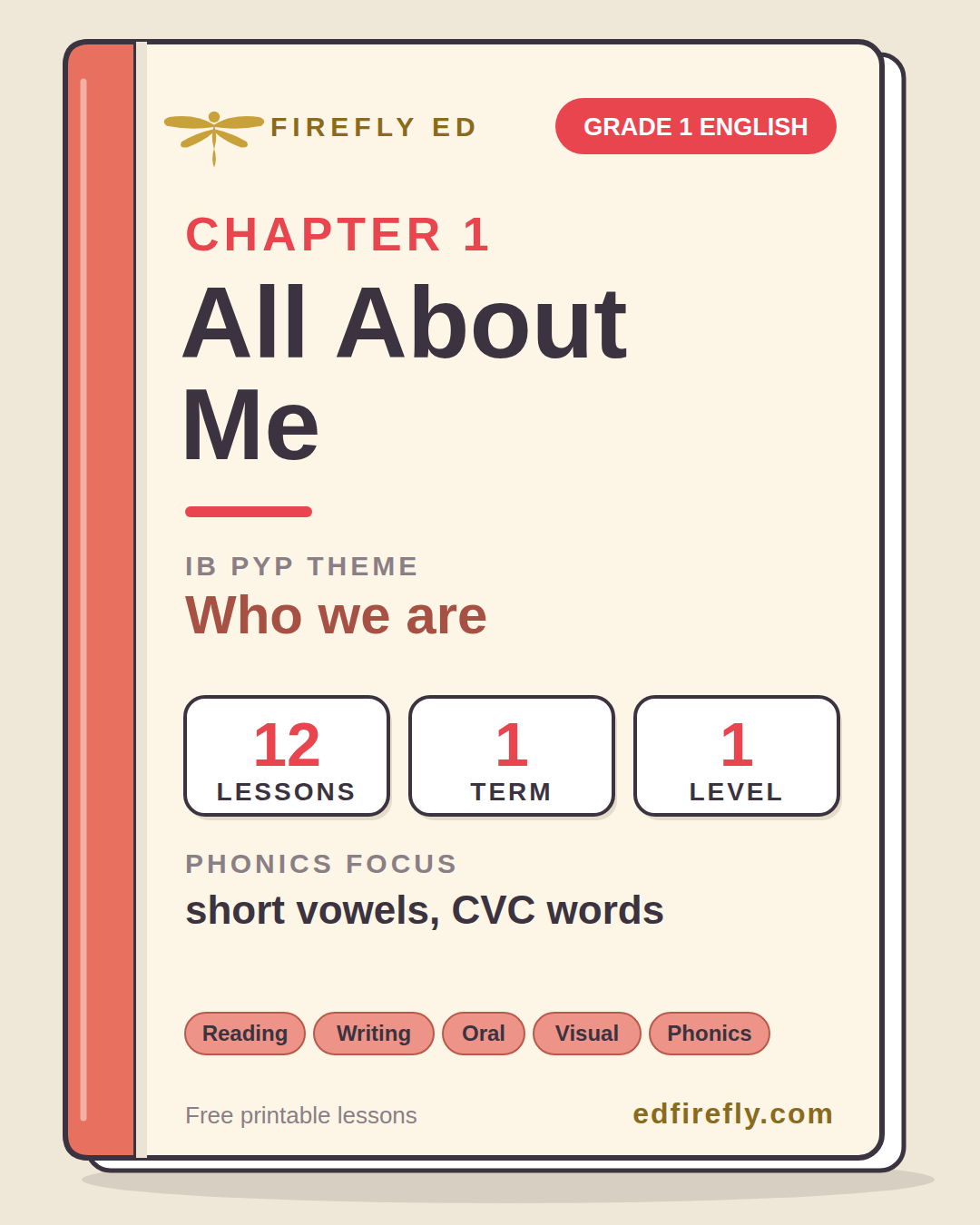
In this chapter – Who we are
Term 1 | Level 1 | Phonics focus: short vowels, CVC words
Unit of inquiry
Transdisciplinary theme: Who we are
In short: This theme is about who we are: our bodies and feelings, our families and friends, where we belong, and how we learn and grow.
Central idea: Each of us is unique, and we can share who we are with others.
Lines of inquiry
- What makes each of us unique
- How we share who we are with others
- How we notice and respect feelings
Key concepts
- Form: What is it like?
- Connection: How is it linked to other things?
- Perspective: What are the points of view?
Related concepts: identity, communication, feelings
Learner profile attributes
Inquirers, Communicators, Reflective, Risk-takers, Caring, Thinkers, Knowledgeable
Approaches to learning
Research skills, Communication skills, Social skills, Thinking skills, Self-management skills
Language: Phase 1 conceptual understandings
- Reading: There are established ways of setting out print and organizing books.
- Reading: Print conveys meaning.
- Writing: People write to tell about their experiences, ideas and feelings.
- Oral language: People listen and speak to share thoughts and feelings.
- Oral language: People ask questions to learn from others.
- Visual language: The pictures, images, and symbols in our environment have meaning.
Tuning in
For the adult: do this before Lesson 1.1.
Put a mirror, a family photo and a favourite toy in a bag. Take them out one at a time. Ask: What can these things tell us about a person? Write down the learner’s ideas and keep them. Look at them again at the end of the chapter.
Lessons in this chapter
| Lesson | Title | PYP strand | Line of inquiry | Key concept | Learner profile |
|---|---|---|---|---|---|
| 1.1 | All About the Book | Written language: receptive (reading) | 2 | Form | Inquirers |
| 1.2 | Read My Name Tag | Written language: receptive (reading) | 1 | Form | Communicators |
| 1.3 | I Am, I Like | Written language: expressive (writing) | 1 | Form | Reflective |
| 1.4 | Label My Picture | Written language: expressive (writing) | 2 | Connection | Communicators |
| 1.5 | Telling or Asking? | Oral language: receptive and expressive (listening and speaking) | 2 | Connection | Inquirers |
| 1.6 | Show and Tell: My Favourite Thing | Oral language: expressive (speaking) | 2 | Connection | Risk-takers |
| 1.7 | How Do They Feel? | Visual language: receptive (viewing) | 3 | Perspective | Caring |
| 1.8 | My Self-Portrait and Caption | Visual language: expressive (presenting) | 1 | Form | Reflective |
| 1.9 | Sound It Out: Beginning Sounds | Written language: receptive and expressive (reading and spelling) | 1 | Form | Thinkers |
| 1.10 | Middle Sounds: Short Vowels | Written language: receptive and expressive (reading and spelling) | 1 | Form | Thinkers |
| 1.11 | Tricky Words: the, I, said, was | Written language: receptive and expressive (reading and spelling) | 2 | Form | Knowledgeable |
| 1.12 | Chapter 1 Review | All strands: receptive and expressive | All | Form, Connection and Perspective | Reflective |
How each lesson works
PYP organises language into three strands: oral language, visual language and written language. Each strand has a receptive side (understanding: listening, viewing, reading) and an expressive side (sharing: speaking, presenting, writing). Every lesson names its strand and side.
Every lesson starts with a Wonder question. The learner then moves through Let’s Learn, Watch Me, Let’s Try Together and Your Turn. Each lesson ends with Reflect, where the learner returns to the Wonder question, names a learner profile attribute they showed, and chooses an action to take.
The 12 lessons
For the adult: tap a lesson to open it. Each lesson takes about 20 minutes. Tap the lesson title again, or use the link at the end of the lesson, to close it.
Lesson 1.1: All About the Book | Reading | About 20 minutes
Term 1 | Level 1
Unit of inquiry: Who we are | Line of inquiry: How we share who we are with others
Key concept: Form (What is it like?) | Learner profile: Inquirers | ATL skills: Research skills
PYP strand: Written language: receptive (reading)
I can find the front cover, the title and the author of a book.
Curriculum links: IB PYP Language, Reading, Phase 1: handle books, showing an understanding of how a book works, for example, cover, beginning, directional movement, end. England Year 1: discuss the significance of the title. Common Core RI.K.5 and RL.K.6 (review from Kindergarten).
Key words: book | front cover | title | author
Wonder
For the adult: ask this question before you start. Accept every idea. You will come back to it in Reflect.
How can we tell what a book is about before we open it?
Let’s Learn
For the adult: read this part aloud. Hold up a real book and point to each part as you name it.
This is the front cover. It is the first page you see.
The title is the name of the book. It has big letters.
The author is the person who wrote the book.
The picture on the cover can match the title.
Watch Me
For the adult: read the thinking aloud and point as you go.
“This is the front cover. It is the first page I see.”
“I look for the big letters. They say The Big Bag. That is the title. The picture shows a big bag, so the title and the picture match.”
“Now I look for a name. I see Jim Cox at the bottom. Jim Cox is the author. He wrote the book.”
Let’s Try Together
1. Point to the title. Say it.
Hint: Look for the big letters at the top.
2. Point to the author. Say the name.
Hint: Look for a name at the bottom.
Your Turn
Name: ______________________
Read with an adult.
This is a book. The title is Sam and the Red Hat. The author is Tom Fox. The title is on the front cover. The author is on the front cover.
1. Tick the box.
Look at the book cover.
a) Which one is the title?
☐ Tom Fox ☐ Sam and the Red Hat ☐ Sam
b) Which one is the author?
☐ Sam and the Red Hat ☐ Sam ☐ Tom Fox
2. Match.
Write the letter on the line.
1. Title ____
2. Front cover ____
3. Author ____
A. The first page you see, with the picture and the title
B. The name of the book
C. The person who wrote the book
3. Write.
Look at the Sam and the Red Hat cover again.
Word bank: red | Tom Fox | hat | Sam
a) The author is ______________________.
b) What is the book about? Look at the title and the picture.
This book is about ______________________________________.
Reflect
For the adult: talk about these with the learner.
1. Go back to the Wonder question: “How can we tell what a book is about before we open it?” What do you think now?
2. I was an inquirer today when I ______________________________.
Take action: Make a front cover for a book about you. Add a title and write your name as the author.
Answer Key
Reveal Answers
Let’s Try Together
1. A Pig in a Wig
2. Pam Dot
Look for: the learner points to the big letters for the title and to the name for the author.
1. Tick the box
a) Sam and the Red Hat
b) Tom Fox
Look for: a learner who ticks “Sam” has picked a name from the picture. Point to the whole title on the cover.
2. Match
1. Title = B
2. Front cover = A
3. Author = C
Look for: the learner says each meaning aloud before writing the letter.
3. Write
a) Tom Fox
Look for: the name copied from the cover with a capital letter on each word.
b) Sample answer: This book is about Sam and a red hat.
Look for: a guess linked to the title or picture. Accept “This book is about Sam.” or “This book is about a red hat.” Check for a capital letter, finger spaces and a full stop.
Next Steps
If this was easy, try: Pick three books at home. Find the front cover, the title and the author on each one.
If this was hard, go back to: Let’s Learn with one real book. Find the front cover first, then the title, then the author.
Lesson 1.2: Read My Name Tag | Reading | About 20 minutes
Term 1 | Level 1
Unit of inquiry: Who we are | Line of inquiry: What makes each of us unique
Key concept: Form (What is it like?) | Learner profile: Communicators | ATL skills: Communication skills
PYP strand: Written language: receptive (reading)
I can read a name tag and answer questions about it.
Curriculum links: IB PYP Language, Reading, Phase 1: recognize their own first name; make connections to their own experience when listening to or “reading” texts. England Year 1: apply phonic knowledge and skills as the route to decode words. Common Core RI.1.1: ask and answer questions about key details in a text.
Key words: name tag | name | capital letter | question
Wonder
For the adult: ask this question before you start. Accept every idea. You will come back to it in Reflect.
How can people find out who you are when they first meet you?
Let’s Learn
For the adult: read this part aloud. If you can, show a real name tag or write one together.
A name tag tells us about a person.
It shows the person’s name. A name starts with a capital letter.
It can also tell us how old the person is and what they can do.
To answer a question, we read the tag again and find the words.
Watch Me
For the adult: read the thinking aloud and point to each word as you go.
“This is a name tag. I read it one line at a time: I am Sam. I am six. I can dig.”
“Question: Who is it? I look for a word with a capital letter after I am. It says Sam. So it is Sam.”
“Question: How old is Sam? I find the line with a number word. It says I am six. So Sam is six.”
Let’s Try Together
1. What is the name on the tag? Say it.
Hint: Look after the words “I am”. A name starts with a capital letter.
2. What can Pam do? Say it.
Hint: Find the word “can”. Read the word after it.
Your Turn
Name: ______________________
Read with an adult.
1. Circle the answer.
a) What is the name on the tag?
Rex Kit Pam
b) How old is Kit?
6 9 10
2. Tick yes or no.
Kit can hop. ☐ yes ☐ no
Rex is a cat. ☐ yes ☐ no
The cap is red. ☐ yes ☐ no
Rex is big. ☐ yes ☐ no
3. Write.
Word bank: mat | cap | dog | red
a) What did Kit get? Read the tag again.
Kit got a ____________ ____________.
b) Now make your own name tag. Draw your face in the circle.
Reflect
For the adult: talk about these with the learner.
1. Go back to the Wonder question: “How can people find out who you are when they first meet you?” What do you think now?
2. I was a communicator today when I ______________________________.
Take action: Make name tags for your family and use them to play a game of meeting new friends.
Answer Key
Reveal Answers
Let’s Try Together
1. Pam
2. Pam can jog.
Look for: the learner points to the word before saying it.
1. Circle the answer
a) Kit
b) 6
Look for: a learner who circles “Rex” has picked a name from the tag that is not the person. Ask: Who says “I am”?
2. Tick yes or no
Kit can hop. yes
Rex is a cat. no
The cap is red. yes
Rex is big. yes
Look for: the learner finds the line on the tag before ticking. For “Rex is a cat”, the learner can say that Rex is a dog.
3. Write
a) Kit got a red cap.
Look for: both words copied from the word bank in the right order.
b) Sample answer: I am Ava. I am six.
Look for: the learner’s own name with a capital letter, and their age as a word or a number. Accept any true answer. Do not mark spelling of the age word.
Next Steps
If this was easy, try: Make a name tag for someone at home with three lines. Ask them two questions about it.
If this was hard, go back to: Watch Me with Sam’s tag. Read one line at a time and point to each word. Then answer one question only: Who is it?
Lesson 1.3: I Am, I Like | Writing | About 20 minutes
Term 1 | Level 1
Unit of inquiry: Who we are | Line of inquiry: What makes each of us unique
Key concept: Form (What is it like?) | Learner profile: Reflective | ATL skills: Communication skills
PYP strand: Written language: expressive (writing)
I can finish a sentence that starts with “I am” or “I like” and leave a finger space between words.
Curriculum links: IB PYP Language, Writing, Phase 1: use their own experience as a stimulus when drawing and “writing”; participate in shared writing, observing the teacher’s writing and making suggestions. England Year 1: leaving spaces between words; using a capital letter for the personal pronoun “I”; write sentences by composing a sentence orally before writing it. Common Core L.1.2b: use end punctuation for sentences.
Key words: sentence | finger space | capital letter | full stop
Wonder
For the adult: ask this question before you start. Accept every idea. You will come back to it in Reflect.
What makes you, you?
Let’s Learn
For the adult: read this part aloud. Show a finger space with your own finger on paper.
A sentence is a group of words that makes sense.
The word “I” is always a capital letter.
We leave a finger space between each word.
A sentence ends with a full stop.
Say the sentence out loud first. Then write it.
Watch Me
For the adult: say the thinking aloud as you write the sentence on paper.
“I want to write about jam. I say my sentence first: I like jam. It has three words.”
“I start with I. It is a capital letter.”
“I put my finger down after it. Then I write like.”
“Finger down again. Then I write jam, j-a-m.”
“I put a full stop at the end. I read it back: I like jam. It makes sense.”
Let’s Try Together
1. Count the candles. Finish the sentence together.
I am ____________.
Hint: Say “I am” and the number out loud. Put a finger space after “am”.
For the adult: point to each picture and name it first: cat.
2. Finish the sentence together.
I like the ____________.
Hint: Say the whole sentence first. Then say the sounds in the last word.
Your Turn
Name: ______________________
1. Tick the sentence with finger spaces.
a)
☐ Ilikemydog.
☐ I li kemy dog.
☐ I like my dog.
b)
☐ I am hot.
☐ Iam hot.
☐ I amhot.
2. Finish the sentence.
For the adult: point to each picture and name it first: wet, bus, pig.
Word bank: pig | wet | bus | hot
a)
I am ____________.
b)
I like the ____________.
c)
I like the ____________.
3. Write about you.
Word bank: jam | six | dog | red | cat | big
a) I am ______________________.
b) I like ______________________.
c) Draw a picture of something you like.
Reflect
For the adult: talk about these with the learner.
1. Go back to the Wonder question: “What makes you, you?” What do you think now?
2. I was reflective today when I ______________________________.
Take action: Make an “All about me” page with three sentences and share it with someone at home.
Answer Key
Reveal Answers
Let’s Try Together
1. I am six.
2. I like the cat.
Look for: the learner says the sentence before writing it and puts a finger down after each word.
1. Tick the sentence with finger spaces
a) I like my dog.
b) I am hot.
Look for: the learner can point to each space. Ask them to count the words in the ticked sentence.
2. Finish the sentence
a) I am wet.
b) I like the bus.
c) I like the pig.
Look for: a finger space before the new word and a full stop at the end. “hot” is not used.
3. Write about you
Sample answer: I am six. I like my dog.
Look for: a capital “I”, finger spaces between words and a full stop at the end of each sentence. The drawing matches the “I like” sentence. Accept any true answer. Accept sound-based spelling of words not in the word bank, such as “I like frogs” written as “I lik frogz”.
Next Steps
If this was easy, try: Write three “I like” sentences about people at home, such as “I like Mum.” Check each one for finger spaces and a full stop.
If this was hard, go back to: Say “I am six.” and tap the table once for each word. Then write only that sentence, putting a finger down after each word.
Lesson 1.4: Label My Picture | Writing | About 20 minutes
Term 1 | Level 1
Unit of inquiry: Who we are | Line of inquiry: How we share who we are with others
Key concept: Connection (How is it linked to other things?) | Learner profile: Communicators | ATL skills: Communication skills
PYP strand: Written language: expressive (writing)
I can write a label for a thing in a picture by writing one letter for each sound.
Curriculum links: IB PYP Language, Writing, Phase 1: differentiate between illustrations and written text; show an awareness of sound–symbol relationships and begin to recognize the way that some familiar sounds can be recorded. England Year 1: spell words containing each of the phonemes already taught. Common Core L.1.2d: use conventional spelling for words with common spelling patterns.
Key words: label | picture | sound | word
Wonder
For the adult: ask this question before you start. Accept every idea. You will come back to it in Reflect.
Why do we put labels on things?
Let’s Learn
For the adult: read this part aloud. Point to the labels on the picture in Watch Me.
A label is a word that names a thing in a picture.
We write the label next to the thing. Then we draw a line from the label to the thing.
To write a label, we say the word slowly. We write one letter for each sound.
A label is one word. It does not need a full stop.
Watch Me
For the adult: say the thinking aloud. Write the labels on paper as you go.
“I want to label the thing on the head. It is a hat. I say it slowly: h-a-t. I hear three sounds, so I write three letters: hat.”
“I write it next to the hat. Then I draw a line from the word to the hat.”
“Now the thing in the hand. It is a bag: b-a-g. Three sounds, three letters: bag. I draw a line to the bag.”
Let’s Try Together
For the adult: point to each picture and name it first: pig.
1. Write the label in the box. Draw a line to the picture.
Hint: Say the word slowly and tap once for each sound. Write one letter for each tap.
For the adult: point to each picture and name it first: cup.
2. Write the label in the box. Draw a line to the picture.
Hint: The first sound is /c/. What sound comes next?
Your Turn
Name: ______________________
1. Circle the right label.
For the adult: point to each picture and name it first: cat, sun, bed.
a)
cot cat cut
b)
sun sat run
c)
bad bud bed
2. Label the picture.
Write the label next to each number.
Word bank: pen | box | cup | hat
For the adult: point to each picture and name it first: cup, hat, box, pen.
1. ____________ 2. ____________
3. ____________ 4. ____________
3. Draw and label.
Draw your bag. Draw three things in it. Write a label for each thing.
Word bank: map | pen | bun | cap | cup | bag
Reflect
For the adult: talk about these with the learner.
1. Go back to the Wonder question: “Why do we put labels on things?” What do you think now?
2. I was a communicator today when I ______________________________.
Take action: Label five things in your room so a visitor knows what they are.
Answer Key
Reveal Answers
Let’s Try Together
1. pig
2. cup
Look for: three letters for three sounds, and a line that joins the label to the thing.
1. Circle the right label
a) cat
b) sun
c) bed
Look for: the learner says each option aloud. The wrong options change only one sound, so a wrong circle shows which sound to practise. For example, “cut” for the cat means the middle sound needs work.
2. Label the picture
1. cup
2. hat
3. box
4. pen
Look for: each label copied from the word bank next to the right number.
3. Draw and label
Sample answer: a bag with a pen, a cup and a map inside, labelled “pen”, “cup” and “map”.
Look for: three things drawn and three labels, each joined with a line. Accept any sensible things. Accept sound-based spelling for words not in the word bank, such as “bok” for book.
Next Steps
If this was easy, try: Draw your room and label five things in it, such as bed, rug and lamp. Use the word bank only if you need it.
If this was hard, go back to: Watch Me. Say “hat” slowly and hold up one finger for each sound. Write one letter for each finger. Then do the same with “bag”.
Lesson 1.5: Telling or Asking? | Oral | About 20 minutes
Term 1 | Level 1
Unit of inquiry: Who we are | Line of inquiry: How we share who we are with others
Key concept: Connection (How is it linked to other things?) | Learner profile: Inquirers | ATL skills: Research skills
PYP strand: Oral language: receptive and expressive (listening and speaking)
I can listen to a sentence and say if it tells or asks.
Curriculum links: IB PYP Language, Oral language, Phase 1: understand simple questions and respond with actions or words; use gestures, actions, body language and/or words to communicate needs and to express ideas. England Year 1: ask relevant questions to extend their understanding and knowledge; beginning to punctuate sentences using a question mark. Common Core SL.1.6: produce complete sentences when appropriate to task and situation.
Key words: tell | ask | question | question mark
Wonder
For the adult: ask this question before you start. Accept every idea. You will come back to it in Reflect.
How do we find out things about other people?
Let’s Learn
For the adult: read this part aloud. Say each example sentence in a natural voice.
Some sentences tell us something. “I have a cat.” tells us about a cat. A telling sentence ends with a full stop.
Some sentences ask something. “Can I have water?” asks for water. An asking sentence is a question. The person wants an answer.
A question ends with a question mark.
Many questions start with words like Can, Is, Who or What. Our voice often goes up at the end of a question.
Watch Me
For the adult: say each sentence, then say the thinking aloud.
“I say: I have a cat. This tells me something. Nobody needs to answer. It is a telling sentence.”
“I say: Can I have water? This starts with Can. My voice goes up at the end. The person wants someone to answer. It is an asking sentence, a question.”
Let’s Try Together
For the adult: say each sentence aloud. The learner points to the tell bubble or the ask bubble.
1. “Is it hot?” Does it tell or ask?
Hint: Does the person want an answer? Listen to the first word.
2. “The dog is big.” Does it tell or ask?
Hint: Say it again. Does your voice go up at the end?
Your Turn
Name: ______________________
1. Listen. Tick tell or ask.
For the adult: read each sentence aloud once. The learner can look at the picture.
a) I got a red hat. ☐ tell ☐ ask
b) Can I have water? ☐ tell ☐ ask
c) Is the cat in the bag? ☐ tell ☐ ask
d) The sun is hot. ☐ tell ☐ ask
2. Circle the end mark.
Say each sentence. Circle the full stop or the question mark that belongs at the end.
a) Is the bus red . ?
b) Dad is in the van . ?
c) Pam can hop . ?
d) Has Dad got a cap . ?
3. Say it as a question.
a) Change the telling sentence into a question. Say it out loud.
The dog is in the box.
Is the dog ______________________?
b) You want the bun. Ask for it. Say it, then write it.
Can I have ______________________?
Reflect
For the adult: talk about these with the learner.
1. Go back to the Wonder question: “How do we find out things about other people?” What do you think now?
2. I was an inquirer today when I ______________________________.
Take action: Ask a family member three questions about when they were six. Tell someone what you found out.
Answer Key
Reveal Answers
Let’s Try Together
1. ask
2. tell
Look for: the learner gives a reason, such as “It starts with Is” or “Nobody needs to answer”.
1. Listen. Tick tell or ask.
a) tell
b) ask
c) ask
d) tell
Look for: the learner answers after one listen. If the learner guesses, say the sentence again and ask: Does this person want an answer?
2. Circle the end mark
a) ? (question mark)
b) . (full stop)
c) . (full stop)
d) ? (question mark)
Look for: the learner links the first word to the mark. “Is” and “Has” at the start point to a question mark. In b) and c), the sentence tells, so it takes a full stop.
3. Say it as a question
a) Is the dog in the box?
Look for: the voice goes up at the end.
b) Sample answer: Can I have the bun?
Look for: a question mark at the end. Accept “Can I have a bun?” and “Can I have it?”. A learner who adds “please” is doing well.
Next Steps
If this was easy, try: Play a game at home. One person says a sentence. The other says “tell” or “ask”. Then swap and make up your own questions.
If this was hard, go back to: Watch Me. Say “I have a cat.” and “Can I have water?” many times. Nod for telling. Put a hand up for asking.
Lesson 1.6: Show and Tell: My Favourite Thing | Oral | About 20 minutes
Term 1 | Level 1
Unit of inquiry: Who we are | Line of inquiry: How we share who we are with others
Key concept: Connection (How is it linked to other things?) | Learner profile: Risk-takers | ATL skills: Communication skills
PYP strand: Oral language: expressive (speaking)
I can plan and say three sentences about my favourite thing.
Curriculum links: IB PYP Language, Oral language, Phase 1: tell their own stories using words, gestures, and objects/artifacts; interact effectively with peers and adults in familiar social settings. England Year 1: speak audibly and fluently; give well-structured descriptions, explanations and narratives for different purposes, including for expressing feelings. Common Core SL.1.4: describe people, places, things and events with relevant details, expressing ideas and feelings clearly.
Key words: favourite | show and tell | plan | listener
Wonder
For the adult: ask this question before you start. Accept every idea. You will come back to it in Reflect.
What can a favourite thing tell other people about us?
Let’s Learn
For the adult: read this part aloud. Hold up one of your own things as you explain.
In show and tell, we show a thing and talk about it.
Our favourite thing is the one we like best.
We plan three sentences. First, say what it is. Next, say what it looks like. Last, say why you like it.
Look at your listener. Speak so they can hear every word.
Watch Me
For the adult: hold up the picture or a real soft toy. Say the thinking aloud, then say the three sentences.
“Step 1: What is it? It is a teddy. I say: This is my teddy.“
“Step 2: What does it look like? It is brown and soft. I say: It is brown and soft.“
“Step 3: Why do I like it? I hug it at bedtime. I say: I like it because I hug it at bedtime.“
“Now I say all three sentences. I look at my listener and speak clearly.”
Let’s Try Together
1. Say what it is. Start with “This is my…”
Hint: Look at the picture. What toy is it?
2. Say what it looks like. Start with “It is…”
Hint: Say the colour. You can also say if it is big or small.
Your Turn
Name: ______________________
1. Tick the sentence.
Which sentence tells what the ball looks like?
☐ I like to kick it.
☐ This is my ball.
☐ It is big and red.
2. Put the plan in order.
Write 1, 2 or 3 in each box. Then say the sentences in order.
☐ I like it because it is fun.
☐ This is my bus.
☐ It is red and big.
3. Plan your show and tell.
a) Draw your favourite thing.
b) Finish the plan.
Word bank: soft | red | fun | big | pink | bed
1. This is my ______________________.
2. It is ______________________.
3. I like it because ______________________.
c) Say your three sentences to an adult. Tick each box when you did it.
☐ I looked at my listener.
☐ I spoke so they could hear me.
☐ I said three sentences.
Reflect
For the adult: talk about these with the learner.
1. Go back to the Wonder question: “What can a favourite thing tell other people about us?” What do you think now?
2. I was a risk-taker today when I ______________________________.
Take action: Share your favourite thing with a friend. Then listen while they share theirs, and ask one question.
Answer Key
Reveal Answers
Let’s Try Together
1. This is my car.
2. Sample answer: It is green and small.
Look for: a whole sentence, not one word. If the learner says “car”, ask them to say it with “This is my”.
1. Tick the sentence
It is big and red.
Look for: the learner can say what the other two sentences do. “This is my ball.” says what it is. “I like to kick it.” says why they like it.
2. Put the plan in order
3 I like it because it is fun.
1 This is my bus.
2 It is red and big.
Look for: the learner says the three sentences in order: This is my bus. It is red and big. I like it because it is fun.
3. Plan your show and tell
Sample answer: This is my teddy. It is soft and pink. I like it because I hug it in bed.
Look for: sentence 1 names the thing, sentence 2 describes it and sentence 3 gives a reason. The learner speaks clearly and looks at the listener. Accept sound-based spelling. The writing is a plan only; the spoken sentences are what count.
Next Steps
If this was easy, try: Add a fourth sentence that tells where you got it or where you keep it. Then answer one question from your listener.
If this was hard, go back to: Say only sentence 1 while holding the thing. When that is easy, add sentence 2. Use the three picture steps in Let’s Learn as a guide.
Lesson 1.7: How Do They Feel? | Visual | About 20 minutes
Term 1 | Level 1
Unit of inquiry: Who we are | Line of inquiry: How we notice and respect feelings
Key concept: Perspective (What are the points of view?) | Learner profile: Caring | ATL skills: Social skills
PYP strand: Visual language: receptive (viewing)
I can look at a face and name the feeling it shows.
Curriculum links: IB PYP Language, Visual language, Phase 1: attend to visual information showing understanding through play, gestures, facial expression; reveal their own feelings in response to visual presentations. England Year 1: no direct statement; links to spoken language, articulate and justify answers. Common Core RL.1.7: use illustrations and details in a story to describe its characters.
Key words: feeling | face | happy | sad | angry | surprised
Wonder
For the adult: ask this question before you start. Accept every idea. You will come back to it in Reflect.
How can we tell how someone feels without them telling us?
Let’s Learn
For the adult: read this part aloud. Make each face yourself as you say the word.
Our faces show how we feel.
Look at the mouth, the eyes and the eyebrows.
Happy: the mouth goes up in a smile. Sad: the mouth goes down. There may be a tear.
Angry: the eyebrows point down in the middle. Surprised: the eyes and the mouth open wide.
Watch Me
For the adult: point to each part of the face as you say the thinking aloud.
“First I look at the mouth. It goes up at the ends. That is a smile.”
“Next I look at the eyes. They look calm and the eyebrows are not pointing down.”
“A smile means this person is happy.”
Let’s Try Together
1. How does this person feel?
Hint: Look at the mouth. Does it go up or down? What is on the cheek?
2. How does this person feel?
Hint: Look at the eyes and the mouth. Are they open wide?
Your Turn
Name: ______________________
1. Circle the feeling.
a)
sad happy angry
b)
angry happy surprised
2. Write the feeling.
Look at each face. Write the feeling it shows.
Word bank: sad | angry | happy | surprised
A. ______________ B. ______________
C. ______________ D. ______________
3. Look and write.
a) How does Ben feel? Look at his face.
Ben is ______________________.
b) How do you feel today? Draw your face.
I am ______________________.
Reflect
For the adult: talk about these with the learner.
1. Go back to the Wonder question: “How can we tell how someone feels without them telling us?” What do you think now?
2. I was caring today when I ______________________________.
Take action: This week, notice when someone looks sad. Ask them if they are okay.
Answer Key
Reveal Answers
Let’s Try Together
1. sad
2. surprised
Look for: the learner names a part of the face to explain, such as “The mouth goes down” or “There is a tear”.
1. Circle the feeling
a) happy
b) angry
Look for: the learner points to the mouth for a) and the eyebrows for b).
2. Write the feeling
A. surprised
B. sad
C. happy
D. angry
Look for: words copied from the word bank. Do not mark the spelling of “surprised” or “angry”; learners copy these as whole words.
3. Look and write
a) Ben is sad.
Look for: the learner links the feeling to the picture. Accept “Ben is upset.” Ask: Why is Ben sad? A good answer mentions the ice cream on the ground.
b) Sample answer: I am happy.
Look for: the drawn face matches the word. Accept any feeling the learner names.
Next Steps
If this was easy, try: Look at the pictures in a storybook. Name how one character feels on each page and say which part of the face tells you.
If this was hard, go back to: Let’s Learn. Stand in front of a mirror. Make a happy face and a sad face. Then try angry and surprised.
Lesson 1.8: My Self-Portrait and Caption | Visual | About 20 minutes
Term 1 | Level 1
Unit of inquiry: Who we are | Line of inquiry: What makes each of us unique
Key concept: Form (What is it like?) | Learner profile: Reflective | ATL skills: Communication skills
PYP strand: Visual language: expressive (presenting)
I can draw a picture of myself and write a caption for it.
Curriculum links: IB PYP Language, Visual language, Phase 1: select and incorporate colours, shapes, symbols and images into visual presentations. Writing, Phase 1: use their own experience as a stimulus when drawing and “writing”. England Year 1: write sentences by composing a sentence orally before writing it. Common Core SL.1.5: add drawings or other visual displays to descriptions when appropriate to clarify ideas, thoughts, and feelings.
Key words: self-portrait | caption | detail | mirror
Wonder
For the adult: ask this question before you start. Accept every idea. You will come back to it in Reflect.
What makes your face your own?
Let’s Learn
For the adult: read this part aloud. Have a mirror ready if you can.
A self-portrait is a picture you draw of yourself.
Look in a mirror. Draw the shape of your face first. Then add your eyes, nose, mouth and hair.
A detail is a small part that makes the picture look like you, such as your hair colour or a hat you like.
A caption is a short sentence under a picture. It tells what the picture shows.
Watch Me
For the adult: point to each part of the portrait as you say the thinking aloud.
“Sam looked in a mirror. He drew a big round face first.”
“Then he added two eyes, a nose and a smile. He has brown hair, so he drew brown hair on top. He likes his blue top, so he drew that too.”
“Last, he wrote a caption under the picture. It says: This is me. I am Sam. The caption tells us who is in the picture.”
Let’s Try Together
1. Point to the caption. Read it together.
Hint: The caption is the words under the picture, not the picture.
2. Say a caption for this picture.
Hint: Start with “This is…” Say who and what you can see.
Your Turn
Name: ______________________
1. Match the picture to the caption.
Write the letter next to each number.
1. ____ 2. ____ 3. ____
A. The cat is on the mat.
B. I am wet.
C. Pam can hop.
2. Tick the best caption.
This is Meg’s self-portrait. Which caption tells us the most about it?
☐ Meg is sad.
☐ This is a cat.
☐ This is Meg in a red hat.
3. Draw yourself. Write a caption.
a) Look in a mirror. Draw yourself in the box.
Tick what you drew:
☐ face ☐ eyes ☐ nose ☐ mouth ☐ hair
b) Write your caption.
Word bank: six | me | happy | red | hat
This is ______________________.
I am ______________________.
Reflect
For the adult: talk about these with the learner.
1. Go back to the Wonder question: “What makes your face your own?” What do you think now?
2. I was reflective today when I ______________________________.
Take action: Make a family gallery. Draw each person at home and add a caption with their name.
Answer Key
Reveal Answers
Let’s Try Together
1. Rex is my dog.
2. Sample answer: This is a boy and a cat.
Look for: the learner points to the words, not the picture. For 2, accept any caption that names what is in the picture.
1. Match the picture to the caption
1. C
2. A
3. B
Look for: the learner reads each caption and checks it against the picture before writing the letter.
2. Tick the best caption
This is Meg in a red hat.
Look for: the learner says why the others are wrong. Meg is smiling, so she is not sad. There is no cat in the picture.
3. Draw yourself. Write a caption.
Sample answer: This is me. I am six.
Look for: a face with eyes, nose, mouth and hair, and at least one detail that matches the learner. The caption starts with a capital letter and ends with a full stop. Accept any true caption.
Next Steps
If this was easy, try: Draw a portrait of someone at home. Add two details that match them. Write a caption with their name.
If this was hard, go back to: Let’s Learn. Draw only the face shape, eyes and mouth. Say the caption “This is me.” out loud before writing it.
Lesson 1.9: Sound It Out: Beginning Sounds | Phonics | About 20 minutes
Term 1 | Level 1
Unit of inquiry: Who we are | Line of inquiry: What makes each of us unique
Key concept: Form (What is it like?) | Learner profile: Thinkers | ATL skills: Thinking skills
PYP strand: Written language: receptive and expressive (reading and spelling)
I can hear the first sound in a word and blend three sounds to read a word.
Curriculum links: IB PYP Language, Writing, Phase 1: show an awareness of sound–symbol relationships and begin to recognize the way that some familiar sounds can be recorded. England Year 1: read accurately by blending sounds in unfamiliar words containing GPCs that have been taught. Common Core RF.1.2b: orally produce single-syllable words by blending sounds; RF.1.2c: isolate and pronounce initial, medial vowel, and final sounds in spoken single-syllable words.
Key words: sound | first sound | letter | blend
Wonder
For the adult: ask this question before you start. Accept every idea. You will come back to it in Reflect.
What sound does your name start with?
Let’s Learn
For the adult: read this part aloud. Say letter sounds, not letter names. For “s”, say /s/, not “ess”.
Words are made of sounds. Each sound has a letter.
The first sound is the sound at the start of the word. Say the word slowly and listen to the start.
To blend, say each sound. Then push the sounds together fast to read the word.
The dots under the letters help. Touch each dot as you say its sound.
Watch Me
For the adult: say the thinking aloud. Stretch the first sound.
“This is my leg. I say it slowly: lll-eg. The first sound is /l/. The letter for /l/ is l.”
“Now I blend. I touch each dot: /h/, /u/, /g/. I push them together fast: h-u-g, hug. The word is hug.”
Let’s Try Together
1. What is the first sound in “dad”? Which letter makes it?
Hint: Say “dad” slowly. What do you hear before the “ad”?
2. Touch each dot and blend: n-a-p. What is the word?
Hint: Say the sounds faster each time until they join up.
Your Turn
Name: ______________________
1. Circle the first sound.
For the adult: point to each picture and name it first: mum, dad, lip, hat.
a) t m s
b) d b g
c) f d l
d) h n p
2. Blend and write. Then match.
Blend the sounds. Write the word. Write the letter of the matching picture.
For the adult: point to each picture and name it first: bed, hug, nap.
a) h – u – g = ____________ Picture: ____
b) b – e – d = ____________ Picture: ____
c) n – a – p = ____________ Picture: ____
3. Write the sound.
For the adult: point to each picture and name it first: bag, cap, mug, leg.
Write the first sound to finish each word.
a) ___ a g b) ___ a p c) ___ u g
d) Now write the whole word. Say it slowly first.
______ ______ ______
Reflect
For the adult: talk about these with the learner.
1. Go back to the Wonder question: “What sound does your name start with?” What do you think now?
2. I was a thinker today when I ______________________________.
Take action: Make a name sound page for your family. Write the first sound of each person’s name next to their picture.
Answer Key
Reveal Answers
Let’s Try Together
1. /d/, the letter d
2. nap
Look for: the learner says the sound /d/, not the letter name “dee”.
1. Circle the first sound
a) m (mum)
b) d (dad)
c) l (lip)
d) h (hat)
Look for: the learner says the word aloud before circling. If they circle the last sound, say the word slowly and stress the start.
2. Blend and write. Then match.
a) hug, picture B
b) bed, picture A
c) nap, picture C
Look for: smooth blending, not three separate sounds. A learner who says “h-u-g” but cannot join it needs more oral blending practice.
3. Write the sound
a) b (bag)
b) c (cap)
c) m (mug)
d) leg
Look for: correct letters for each sound. In d), accept “l e g” with one letter on each line. For c), “b” for bug or “r” for rug shows the learner is guessing from the ending; point back to the picture.
Next Steps
If this was easy, try: Play I Spy at home using sounds: “I spy part of my body that starts with /l/.” Then blend new words about you, such as l-i-p and h-i-p.
If this was hard, go back to: Watch Me. Practise only the first sound with three things at home, such as your hat, your bag and your bed. Then blend two sounds first, like u-p, before trying three.
Lesson 1.10: Middle Sounds: Short Vowels | Phonics | About 20 minutes
Term 1 | Level 1
Unit of inquiry: Who we are | Line of inquiry: What makes each of us unique
Key concept: Form (What is it like?) | Learner profile: Thinkers | ATL skills: Thinking skills
PYP strand: Written language: receptive and expressive (reading and spelling)
I can hear the middle sound in a three-letter word and write the vowel.
Curriculum links: IB PYP Language, Writing, Phase 1: show an awareness of sound–symbol relationships and begin to recognize the way that some familiar sounds can be recorded. Reading, Phase 1: begin to discriminate between visual representations such as symbols, numbers, ICT iconography, letters and words. England Year 1: read accurately by blending sounds in unfamiliar words containing GPCs that have been taught. Common Core RF.1.2c: isolate and pronounce initial, medial vowel, and final sounds in spoken single-syllable words.
Key words: middle sound | vowel | a e i o u
Wonder
For the adult: ask this question before you start. Accept every idea. You will come back to it in Reflect.
What happens to a word if we change one sound?
Let’s Learn
For the adult: read this part aloud. Say the short vowel sounds: /a/ as in cat, /e/ as in bed, /i/ as in pin, /o/ as in dog, /u/ as in bus.
Five letters are vowels: a, e, i, o and u.
In a word with three sounds, the vowel is often in the middle. It is the middle sound.
If we change the middle sound, we make a new word.
Pin, pen and pan start and end the same. Only the middle sound changes.
Watch Me
For the adult: say the thinking aloud. Stretch the middle sound.
“I say pin slowly: p-iii-n. The first sound is /p/. The last sound is /n/. The sound in the middle is /i/. So the middle letter is i.”
“Now pen: p-eee-n. The middle sound is /e/. The letter is e.”
“Now pan: p-aaa-n. The middle sound is /a/. The letter is a. One small sound makes three different words.”
Let’s Try Together
1. What is the middle sound in “mum”?
Hint: Say m-u-m slowly. Skip the first and the last sound. What is left?
2. What is the middle sound in “dad”?
Hint: Stretch the middle: d-aaa-d. Which vowel makes that sound?
Your Turn
Name: ______________________
1. Circle the middle sound.
For the adult: point to each picture and name it first: leg, dog, mum, lip.
a) a e i
b) o u a
c) i a u
d) e i o
2. Write the missing vowel.
Vowels: a | e | i | o | u
For the adult: point to each picture and name it first: hat, bed, hug, cot.
a) h ___ t b) b ___ d c) h ___ g d) c ___ t
3. Change the middle sound.
a) Read each word. Write the letter of the matching picture.
For the adult: point to each picture and name it first: pen, pan, pin.
pan ____ pin ____ pen ____
b) Change the middle sound. Write the new word. The pictures will help.
hat change /a/ to /o/ = ____________
big change /i/ to /a/ = ____________
Reflect
For the adult: talk about these with the learner.
1. Go back to the Wonder question: “What happens to a word if we change one sound?” What do you think now?
2. I was a thinker today when I ______________________________.
Take action: Make a word chain with words about you and your family, such as mum, mud, bud, bed.
Answer Key
Reveal Answers
Let’s Try Together
1. /u/
2. /a/
Look for: the learner says the short vowel sound, not the letter name. “a” as in apple, not “ay”.
1. Circle the middle sound
a) e (leg)
b) o (dog)
c) u (mum)
d) i (lip)
Look for: /e/ and /i/ are the easiest to mix up. If the learner circles “i” for leg, say “leg” and “lip” one after the other and ask which middle sound is which.
2. Write the missing vowel
a) a (hat)
b) e (bed)
c) u (hug)
d) o (cot)
Look for: the learner reads the whole word aloud after writing the vowel to check it.
3. Change the middle sound
a) pan B, pin C, pen A
b) hot, bag
Look for: in b), the learner keeps the first and last letters the same and changes only the middle one.
Next Steps
If this was easy, try: Make a word chain with words about you by changing one sound at a time: mum, mud, bud, bed. Write each new word.
If this was hard, go back to: Let’s Learn. Say only two vowels, /a/ and /i/, with pan and pin. When the learner hears the difference every time, add /e/ with pen.
Lesson 1.11: Tricky Words: the, I, said, was | Phonics | About 20 minutes
Term 1 | Level 1
Unit of inquiry: Who we are | Line of inquiry: How we share who we are with others
Key concept: Form (What is it like?) | Learner profile: Knowledgeable | ATL skills: Self-management skills
PYP strand: Written language: receptive and expressive (reading and spelling)
I can read, trace and find the tricky words the, I, said and was.
Curriculum links: IB PYP Language, Reading, Phase 1: begin to discriminate between visual representations such as symbols, numbers, ICT iconography, letters and words. Writing, Phase 1: show curiosity and ask questions about written language. England Year 1: read common exception words, noting unusual correspondences between spelling and sound and where these occur in the word. Common Core RF.1.3g: recognize and read grade-appropriate irregularly spelled words.
Key words: tricky word | tricky part | trace
Wonder
For the adult: ask this question before you start. Accept every idea. You will come back to it in Reflect.
Which words do we use most when we talk about ourselves?
Let’s Learn
For the adult: read this part aloud. Point to each word card as you say it.
We can sound out most words. A tricky word has a part that does not sound the way we expect.
The tricky part is shown in red. In “said”, the letters a and i say /e/. In “was”, the letter a says /o/.
“I” is one letter. It is always a capital letter when it means me. In “the”, the e makes a short, soft sound.
We learn tricky words by looking, saying and writing them many times.
Watch Me
For the adult: say the thinking aloud. Then cover the word, write it and check.
“I try to sound it out: s-ai-d. That says ‘sayd’. That is not a word I know.”
“I know this word. We say it ‘sed’. The tricky part is the a and i. They say /e/.”
“I look at the word. I say it. I cover it. I write it. Then I uncover it and check each letter.”
Let’s Try Together
1. Read this word: was
Hint: The a does not say /a/ here. Say it like “woz”.
2. How many times can you find “the”?
The cat is on the mat.
Hint: Look for “the” with a capital T too.
Your Turn
Name: ______________________
1. Trace the tricky words.
Say each word as you trace it.
2. Read and circle.
Read with an adult. Circle every tricky word: the, I, said, was.
I had a cat. The cat was big. The cat sat on the mat. Mum said, “The cat is fun!”
How many times did you circle “the”? ______
3. Fill the gap.
Word bank: was | the | said | I
a) ________ am six.
b) Pam ________, “Hop!”
c) The pig ________ in the mud.
d) Sit on ________ mat.
Reflect
For the adult: talk about these with the learner.
1. Go back to the Wonder question: “Which words do we use most when we talk about ourselves?” What do you think now?
2. I was knowledgeable today when I ______________________________.
Take action: Make tricky word cards for the, I, said and was. Play a matching game with someone at home.
Answer Key
Reveal Answers
Let’s Try Together
1. was
2. Two times: The, the
Look for: the learner counts “The” at the start of the sentence as well as “the” before “mat”.
1. Trace the tricky words
Look for: each word traced in one go, left to right, with the learner saying the word. Check the capital “I”.
2. Read and circle
Circled words: I, The, was, The, the, said, The. That is seven words in total.
“the” is circled four times.
Look for: a learner who misses “The” with a capital T. Point out that it is the same word.
3. Fill the gap
a) I am six.
b) Pam said, “Hop!”
c) The pig was in the mud.
d) Sit on the mat.
Look for: a capital “I” in a). The learner reads each sentence aloud after filling the gap.
Next Steps
If this was easy, try: Hunt for the, I, said and was in a storybook. Keep a tally of each word on one page.
If this was hard, go back to: Watch Me with one word at a time. Write “the” on a card and read it every day for three days before adding “I”, then “said”, then “was”.
Lesson 1.12: Chapter 1 Review | All strands | About 20 minutes
Term 1 | Level 1
Unit of inquiry: Who we are | Line of inquiry: All three lines of inquiry
Key concept: Form, Connection and Perspective | Learner profile: Reflective | ATL skills: Self-management skills
PYP strand: All strands: receptive and expressive
I can show what I learned in Chapter 1 in reading, writing, speaking, looking and phonics.
Curriculum links: This review checks the outcomes from Lessons 1.1 to 1.11. IB PYP Language, Phase 1, across reading, writing, oral language and visual language. England Year 1: spell words containing each of the phonemes already taught. Common Core RF.1.2c and RF.1.3g.
Key words: title | author | finger space | question | feeling | sound
Wonder
For the adult: ask this question before you start. Accept every idea. You will come back to it in Reflect.
What have you learned about yourself and other people in this chapter?
Let’s Learn
For the adult: read this part aloud. There are six short tasks. Do them in one sitting or split them over two days.
This page checks what you learned in Chapter 1.
There is one task for each part: reading, writing, oral, visual and phonics. The last task is a spelling check.
Read each task with an adult. Do your best on your own first.
Watch Me
For the adult: show how the spelling check in Task 6 works, using the word “sat”.
“You will hear a word. I say: sat. I say it again: sat.”
“I stretch it: sss-aaa-t. I count the sounds on my fingers: /s/, /a/, /t/. Three sounds.”
“I write one letter for each sound: s a t. I read it back: sat. It matches.”
Let’s Try Together
1. The adult says “map”. Count the sounds on your fingers.
Hint: Stretch the word: mmm-aaa-p.
2. Write “map” in the air with your finger.
Hint: One letter for each finger you held up.
Your Turn
Name: ______________________
1. Reading: All about the book
a) Circle the title.
Tim Tan The Hen in the Box Box
b) Circle the author.
Tim Tan Hen The Hen in the Box
2. Writing: Finish the sentence
For the adult: point to each picture and name it first: cup.
Write the missing word. Leave finger spaces. End with a full stop.
I like my ____________
3. Oral: Tell or ask?
For the adult: read each sentence aloud once.
a) Can I sit here? ☐ tell ☐ ask
b) The van is red. ☐ tell ☐ ask
4. Visual: How do they feel?
Word bank: happy | sad | surprised | angry
A. ______________ B. ______________
5. Phonics: Sounds and tricky words
a) Circle the first sound in “net”. m t n
b) Circle the middle sound in “bed”. e a i
c) Circle the tricky word “said”. Mum said, “Get in bed.”
6. Spelling check
For the adult: say each word twice. Do not stretch the sounds for the learner. Words: hot, pen, bug.
1. ______ ______ ______
2. ______ ______ ______
3. ______ ______ ______
Reflect
For the adult: talk about these with the learner.
1. Go back to the Wonder question: “What have you learned about yourself and other people in this chapter?” What do you think now?
2. I was reflective today when I ______________________________.
Take action: Tell someone at home three things you learned about yourself in this chapter.
Answer Key
Reveal Answers
Let’s Try Together
1. Three sounds: /m/, /a/, /p/
2. m a p
1. Reading (Lesson 1.1)
a) The Hen in the Box
b) Tim Tan
2. Writing (Lessons 1.3 and 1.4)
I like my cup.
Look for: a finger space before “cup” and a full stop at the end.
3. Oral (Lesson 1.5)
a) ask
b) tell
4. Visual (Lesson 1.7)
A. surprised
B. sad
5. Phonics (Lessons 1.9, 1.10 and 1.11)
a) n
b) e
c) said
6. Spelling check (Lessons 1.9 and 1.10)
1. hot
2. pen
3. bug
Look for: the right first, middle and last letters. If only the vowel is wrong, such as “pin” for pen, go back to Lesson 1.10.
For any task the learner missed, repeat the lesson shown in brackets before starting Chapter 2.
Next Steps
If this was easy, try: Start Chapter 2: Home and School. It begins with Lesson 2.1, Find the Answer.
If this was hard, go back to: The lesson named next to each missed task in the answer key. Redo the Your Turn page from that lesson, then try this review again.
Taking action
By the end of this chapter, learners might:
- Make an “All about me” book with a cover, a self-portrait and three sentences.
- Ask family members questions to learn something new about them.
- Notice how other people feel and show care.
Lesson 1.12 reviews the chapter. Look back at the ideas from Tuning in and talk about how they have changed.
← All Grade 1 English chapters | Next: Chapter 2, Home and School →
© 2026 Firefly Ed. All rights reserved. This page may be printed for personal, home and classroom use. It may not be sold, shared online or reproduced for commercial use without written permission. edfirefly.com





Share your thoughts or ask something..