
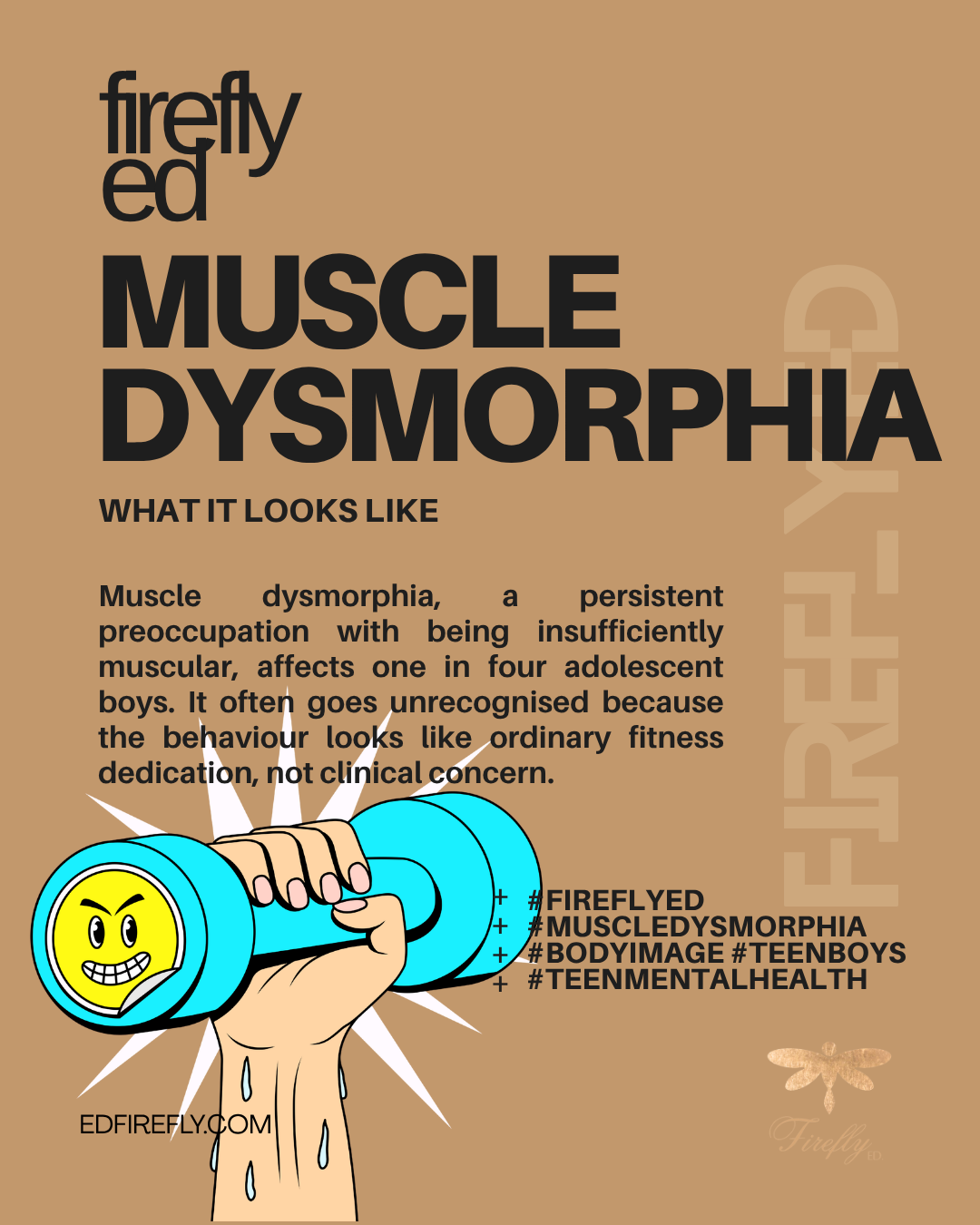
Muscle Dysmorphia in Adolescence: What It Is and Who Is at Risk
- Muscle dysmorphia is a specifier of body dysmorphic disorder characterised by preoccupation with being insufficiently muscular.
- One in four adolescent boys are at clinical risk for muscle dysmorphia.
- Symptoms often go unrecognised because muscle-building behaviour is socially normalised among boys.
- The condition is linked to compulsive exercise, rigid dietary control, and in some cases steroid use.
- Social media exposure to muscularity ideals is a significant risk factor.
What Muscle Dysmorphia Is
A preoccupation that persists even in muscular individuals
Muscle dysmorphia is classified as a specifier of body dysmorphic disorder. It centres on a persistent preoccupation with being too small or insufficiently muscular. That preoccupation persists even when the person is typically or unusually muscular.
It involves compulsive exercise and rigid dietary control. In more severe cases, it involves the use of anabolic-androgenic steroids.
One in four adolescent boys sit at clinical risk
An analysis of data from over 2,000 participants found a striking figure. One in four adolescent boys and young adult men sit at clinical risk for muscle dysmorphia.
This pattern is a growing concern. Related conditions, eating disorders, compulsive weightlifting, and supplement use, have all increased among adolescent boys over the past three decades.
Muscle dysmorphia sits within the body dysmorphic disorder spectrum
Body dysmorphic disorder centres on a preoccupation with perceived flaws in appearance that are invisible or minor to other people. In muscle dysmorphia, the specific focus is muscularity.
Like other forms of body dysmorphic disorder, muscle dysmorphia distorts body perception. The person genuinely does not see their body accurately, and the preoccupation causes real functional impairment.
Why It Develops
The male body ideal has shifted toward muscularity
The lean, muscular physique has become the dominant cultural standard for male bodies over the past three decades. This ideal shows up in fitness media, advertising, social media content, and entertainment.
Exposure to this standard starts early. Idealised male body representations appear in action figures, video games, and media directed at boys from as young as six. By adolescence, boys navigate these standards with a brain already heightened in its sensitivity to social evaluation and comparison.
Social media reinforces muscularity ideals continuously
Exposure to muscularity-oriented social media content links to muscle dysmorphia symptoms. Fitness influencers and gym content create a continuous visual environment of idealised male physiques.
The mechanism mirrors what happens with girls and thinness ideals. Repeated exposure installs a standard against which the self gets measured unfavourably. The difference is that muscle-building gets framed as health behaviour, which makes it harder to identify as a problem.
Adverse experiences raise the risk
Adolescent and young adult males who experienced adverse childhood experiences show a higher likelihood of developing muscle dysmorphia.
The drive toward muscularity appears to serve a psychological function for some. Being physically large and strong carries cultural associations with masculine power and protection.
For boys whose sense of masculine identity feels fragile, the pursuit of muscularity responds to that underlying need.
Bullying and social exclusion link to it too
Teenagers who have been bullied, excluded socially, or who have felt physically inadequate or threatened are more likely to push muscle-building toward compulsive behaviour.
The gym becomes a controlled environment where effort produces visible, measurable results, a compelling experience for someone whose social world has felt uncontrollable.
Coaches and gym culture can reinforce the behaviour
Coaches, trainers, and gym peer groups sometimes praise the very behaviours that mark a problem. Training through pain, extreme dietary discipline, and pushing past fatigue signals can all earn approval. This praise makes the behaviour harder to question from the inside.
A supportive gym environment can still hold high standards without treating every form of restraint as weakness.
How It Manifests
Compulsive exercise is a central sign
Boys with muscle dysmorphia symptoms train despite injury, illness, or significant social disruption. Missing a gym session produces disproportionate distress.
Exercise stops feeling like a choice and starts feeling like a compulsion. Missing it feels like a threat to self-image rather than a normal recovery day.
Dietary control turns rigid and inflexible
Protein intake gets tracked carefully, often to excess. Caloric intake gets managed precisely, and social eating situations, where control over food content is limited, get avoided.
The dietary behaviour orients entirely toward muscle gain and resists flexibility. These patterns often grow more intense rather than settle over time.
Supplement use is common and sometimes risky
Protein supplements, creatine, pre-workout products, and other fitness supplements see wide use among adolescent boys engaged in muscle-building. Most carry little risk in moderate use, though they are largely unnecessary for teenagers eating adequately.
At the more serious end, anabolic-androgenic steroids or other performance-enhancing substances come into play. Here, the health risks grow significant, and the commitment to the muscularity goal becomes clinically concerning.
Steroid use carries specific risks in adolescence
Adolescence is a particularly risky window for steroid use, because the hormonal system is already undergoing significant change. Introducing external hormones during this period can disrupt that process in ways that persist beyond the teenage years.
Documented long-term effects include hormonal disruption, cardiovascular strain, and stunted growth in boys who have not yet completed puberty.
It stays consistently under-identified
Muscle-building behaviour in boys gets socially normalised and frequently praised, by peers, by adults, and by broader culture.
Boys are also less likely than girls to seek help for appearance-related concerns. This comes down partly to norms around masculine self-disclosure, and partly because the behaviour itself does not read as disordered. By the time symptoms become significant, the pattern is often well established.
Sport-Specific Risk
Weight-class and aesthetic sports carry particular risk
Certain sports layer additional pressure onto the general cultural push toward muscularity. Wrestling, powerlifting, and other weight-class sports require making a specific number on the scale. That requirement introduces a level of body monitoring beyond what recreational training involves.
Bodybuilding and physique-focused training carry a similar risk. The entire activity is organised around visible muscularity as an end goal, rather than as a byproduct of participation.
Coaches and team culture set the tone
A coach who treats a boy’s body as a project to optimise, rather than as something that supports a sport he enjoys, can tip ordinary athletic commitment toward something more compulsive.
Teams that normalise extreme cutting, rigid weigh-ins, or public comparison of physiques carry this risk more than those that do not.
Parents and coaches who keep the focus on performance and enjoyment, rather than on appearance or a number on a scale, reduce this specific pressure. A boy does not need to give up competitive sport for that to happen.
Distinguishing It From Healthy Fitness
The distinction is psychological, not physical
The line between muscle dysmorphia and healthy fitness does not show up in the body or in the fact of regular exercise. It shows up in the psychology.
The key question is whether the pursuit of muscularity is driven by genuine wellbeing and enjoyment, or by distress and an inability to perceive the body accurately.
A teenager who trains because it makes him feel good sits in a different position. He can miss a session without significant distress, and he does not experience a settled physique as perpetually inadequate. For another teenager, training feels like obligation rather than choice, something he cannot stop.
A few signs point to a growing concern
A few patterns point to a growing concern. Exercise that consistently overrides injury or illness is one. Social withdrawal from situations where diet control is impractical is another.
Growing inflexibility around food choices, significant distress when training gets missed, and persistent dissatisfaction with a physique others would consider well-developed round out the list.
None of these alone confirms a diagnosis. A consistent pattern of several calls for professional assessment.
Mental Health and Co-occurring Conditions
Anxiety and depression often come with it
Muscle dysmorphia frequently comes with anxiety and depression. The preoccupation with the body produces intrusive thoughts, and the compulsive behaviour offers only temporary relief.
The gap between the desired and actual body generates persistent dissatisfaction. This pattern fits with OCD-spectrum conditions, and treatment increasingly targets the compulsive and avoidant behaviours directly.
Eating disorder behaviours can overlap
Restricting food groups is one feature. Cycling between controlled eating and episodes of normal eating experienced as failure is another. A preoccupation with food composition in every situation often joins both.
These same features also characterise eating disorder presentations. The overlap between muscle dysmorphia and eating disorder behaviour in adolescent boys draws increasing clinical attention.
Sleep and mood problems often go unnoticed alongside it
Poor sleep frequently accompanies muscle dysmorphia, driven by early training schedules, anxiety about missed sessions, or supplement use that disrupts normal sleep patterns.
Low mood and irritability can follow from this sleep disruption on top of the underlying preoccupation, compounding the difficulty of everyday functioning.
Sexual Orientation and Additional Pressure
Gay and bisexual boys face a distinct layer of pressure
Research on gay and bisexual men consistently finds higher rates of muscle dysmorphia symptoms compared with heterosexual men. This pattern appears to begin in adolescence rather than emerging later.
Part of the explanation involves the specific body ideals prominent within some gay male communities. These add a further layer of appearance pressure on top of the broader cultural muscularity standard already affecting boys generally.
Overlapping pressures compound rather than cancel out
A gay or bisexual teenager may be navigating identity development, potential family or social rejection, and muscularity pressure at the same time. That means managing several demanding processes together. Each one draws on the same limited emotional resources.
Adults supporting a boy through this period benefit from staying alert to body image concern as a distinct issue. It will not resolve automatically alongside broader identity support.
When and How to Raise Concern
A calm, non-confrontational approach works best
Adults who notice concerning patterns in a teenager’s exercise behaviour, dietary rigidity, or supplement use often meet resistance if they address it directly as a problem.
A teenager who has built significant parts of his identity around fitness and muscularity will not respond well to the pursuit being labelled as disordered.
A more effective starting point is curiosity, without immediate evaluation or alarm. Useful questions include how the training makes him feel, what he is trying to achieve, and how he thinks about his body.
Professional support matters when functioning is affected
When muscle-building behaviour interferes with school, relationships, health, or daily functioning, and cannot be moderated regardless of consequence, professional support is appropriate.
A GP is a reasonable first point of contact. Cognitive behavioural therapy adapted for body dysmorphic presentations carries the strongest evidence base.
Family involvement supports recovery without controlling it
Families who stay involved without taking over tend to see better outcomes. This holds true compared with those who disengage entirely, or who attempt to police every meal and gym session.
A useful role for parents is staying present and interested in the teenager’s life beyond fitness, while leaving the clinical work to trained professionals.
The Firefly Ed article library covers more on body image, identity, and confidence during adolescence, for parents, teens, and young adults to explore further.





Share your thoughts or ask something..