
Social Media and Adolescent Body Image: How It Works and What Reduces the Effect
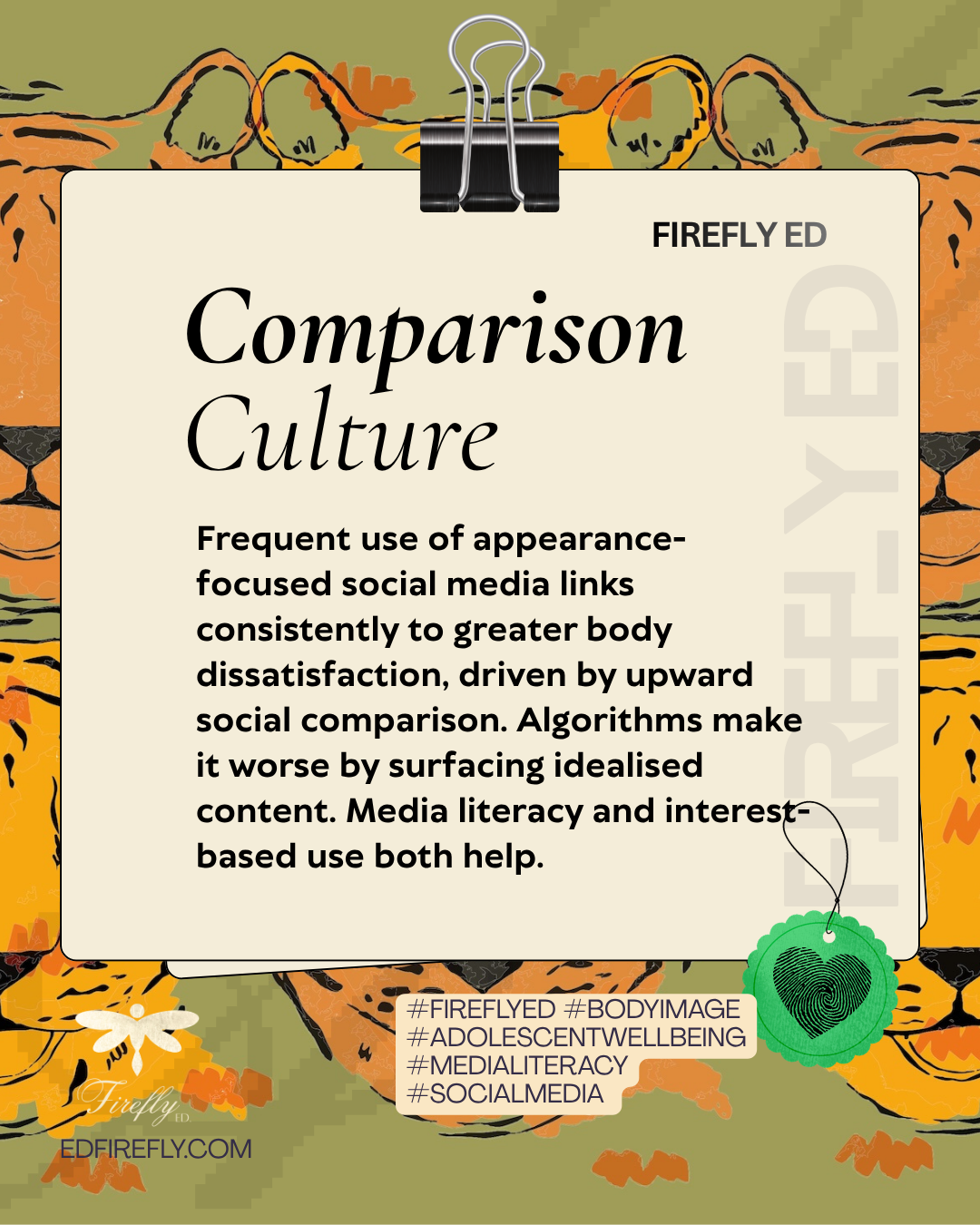
- Frequent use of appearance-focused social media platforms is consistently linked to greater body dissatisfaction.
- Upward social comparison, comparing oneself unfavourably to others, is the primary mechanism.
- Social media images have a stronger effect on body image than traditional media because they feature peers rather than celebrities.
- Girls are more vulnerable to social media’s body image effects than boys, though boys are increasingly affected.
- Media literacy, the ability to critically evaluate what is seen, reduces the impact of exposure.
Social Media and Body Image
A consistent link across international research
A 2025 review found a strong and consistent link between frequent social media use and negative body image in adolescents. Both male and female adolescents reported greater body dissatisfaction with higher social media use.
Frequent users of appearance-focused platforms also showed reduced self-esteem and heightened anxiety and depression. Social comparison behaviour worsened these effects across the studies reviewed.
Appearance comparison is the primary mechanism
Upward social comparison is the primary mechanism through which social media affects body image. It means judging one’s own appearance unfavourably relative to others seen online. This is not incidental to how appearance-focused platforms are used.
It is built into the experience of scrolling through curated images of others’ bodies, faces, and lives.
The effect is cumulative, not event-based
Social media’s body image effects build up over time rather than arising from single exposure events. Repeated exposure to idealised images, over months and years, gradually installs a standard. The adolescent then evaluates their own body against it.
This narrowing is not experienced as a change in standards. It becomes the standard itself. The process is largely unconscious, which is one reason awareness of the mechanism does not reliably prevent it.
Why Social Media Has a Stronger Effect Than Traditional Media
Peers are more influential than celebrities
Social media’s body image effects run stronger than those of traditional media: magazines, television, and advertising. The reason comes down to who appears in the images. Social media features peers rather than celebrities. Peers are experienced as more relatable, more relevant, and more comparable.
The influencer dynamic drives the effect more strongly than comparison with close friends. Influencers feel simultaneously aspirational and attainable in a way that celebrities do not.
Images feel more real even when they are not
Adolescents who viewed manipulated social media photographs reported lower body image following exposure. This effect showed up most strongly in those with higher baseline levels of social comparison.
Filters, editing tools, and carefully selected angles produce images experienced as realistic even when substantially altered. The subjective sense that these are real people makes the comparison more psychologically potent. Comparison with obviously produced celebrity imagery does not carry the same weight.
Volume of exposure is without historical precedent
The frequency with which contemporary adolescents encounter appearance-based imagery has no equivalent in previous generations. Access to curated, idealised images of bodies and faces was historically limited. Print media and broadcast television both carried physical constraints on volume.
Social media removes those constraints. A teenager who scrolls for an hour encounters more appearance-based comparison content than previous generations saw in a week.
Algorithmic Amplification
Algorithms surface the most aspirational content
Social media algorithms surface content that generates strong engagement. That tends to mean aspirational, idealised, emotionally charged content rather than ordinary life. The feed a teenager sees is not a representative sample of what peers and others actually look like.
It is a curated selection of the most visually striking, most aspirational, most engagement-generating images available. Comparing oneself against this selection is structurally rigged from the start.
Appearance-focused content generates the most engagement
Appearance-focused content generates more likes, comments, and shares than content that does not foreground physical appearance. Algorithms that optimise for engagement therefore favour appearance-focused content.
Teenagers who primarily engage with fashion, fitness, beauty, or lifestyle content get shown progressively more of it. This creates a feedback loop that narrows the range of appearance content in their feed toward increasingly idealised presentations.
The algorithm is not designed with adolescent wellbeing in mind
Social media platforms are designed to maximise engagement, not to support adolescent body image or wellbeing. The algorithmic logic that amplifies appearance-based content is commercially rational and psychologically harmful.
The platform’s design incentives run directly counter to adolescent wellbeing. Understanding this is a useful piece of knowledge, for teenagers and the adults around them.
How Body Dissatisfaction Develops Through Social Media
Ideal internalisation is the long-term mechanism
Excessive social media use leads to internalisation of ideal body standards. This internalisation then increases appearance comparison, which increases social appearance anxiety.
The effect of social media on body image is not simply about the images seen. It is about the standards those images install. Those standards then become the lens through which teenagers evaluate their own bodies, independent of ongoing social media use.
Sexualised imagery adds another dimension
Sexualised imagery on social media platforms adds a dimension to body image effects that goes beyond simple appearance comparison. This includes mainstream platforms not specifically designated as adult content.
Images that present bodies primarily in sexual terms encourage a specific mode of self-evaluation. The teenager begins to evaluate their body based on how it is perceived as a sexual object. This objectified self-evaluation is consistently linked to lower body satisfaction and higher rates of depression.
The Path Toward Disordered Eating Content
Algorithms can surface harmful content once interest is signalled
Engagement with dieting, weight loss, or extreme fitness content can lead algorithms to surface increasingly extreme material, including content that promotes disordered eating directly. What begins as ordinary interest in health or fitness can shift quickly toward content that normalises restriction and rapid weight loss.
This pathway does not require a teenager to seek out pro-eating-disorder content deliberately. The recommendation system can arrive there on its own, following engagement signals rather than any conscious search.
Coded language lets harmful communities stay visible
Communities that promote disordered eating often use coded language and altered spellings to avoid content moderation, which allows this material to persist on mainstream platforms despite policies against it.
Adults unfamiliar with this coded language may not recognise the content a teenager is engaging with, even when looking directly at their feed. Asking a teenager to explain unfamiliar terms or trends, without alarm, opens a more useful conversation than searching for red flags alone.
Gender Differences
Girls are more affected, but boys are increasingly so
Girls are more vulnerable to social media’s body image effects than boys. This reflects higher rates of appearance-focused platform use and greater susceptibility to social comparison in the appearance domain. The specific nature of the body ideals promoted in content directed at girls plays a role too.
Boys are increasingly affected as muscularity-oriented fitness and lifestyle content becomes more prevalent on platforms they use regularly.
The specific content matters as much as the time spent
Research has compared girls who use social media mainly for appearance-focused content with those who use it mainly for interest-based purposes. The first group consistently shows worse body image outcomes.
The relevant variable is not how much time is spent on social media but what that time consists of. A teenager who uses social media to maintain friendships and discuss shared interests is having a fundamentally different experience. One who spends the same time scrolling appearance-centred feeds is not.
Boys face a distinct set of pressures
Muscularity and leanness dominate the body ideals boys encounter online, often presented through fitness influencers and transformation content. These images carry their own comparison dynamic, distinct from the thinness-focused imagery that shapes girls’ feeds. The effect is comparable in strength.
Boys are less likely to describe what they are experiencing as body image concern. That makes the effect harder for parents and teachers to notice.
AI-Generated and Heavily Altered Imagery
Some bodies online no longer belong to a real person
AI image generation and increasingly sophisticated editing tools now produce images of bodies that never existed in that form, and sometimes never existed at all. This differs from a filtered photograph of a real person, where the underlying body is still real.
A teenager comparing themselves to a fully synthetic or radically altered image is measuring themselves against a standard with no biological ceiling. Traditional advice about recognising filters does not fully address this newer, more extreme version of the same problem.
Awareness of the technology matters more than ever
Teenagers who understand that some images are generated or altered beyond any real person’s proportions are better equipped to discount them as a meaningful comparison point.
Adults do not need deep technical knowledge to have this conversation. Naming the existence of this kind of imagery, and asking a teenager what they think of it, opens the door to a more critical relationship with what they see.
What Reduces the Effect
Media literacy is protective
The capacity to critically evaluate what is seen reduces social media’s body image effects. This means understanding how images are produced, filtered, and selected.
Adolescents who understand that images are curated and edited are less likely to use them as direct benchmarks for self-evaluation. Media literacy does not eliminate the effect. It does reduce the degree to which idealised images are internalised as realistic standards.
Reducing exposure to appearance-focused content is directly effective
Unfollowing or muting accounts that consistently produce appearance comparison changes the nature of the social media environment a teenager inhabits. Replacing appearance-focused feed content with interest or skill-based content does the same.
Research has found that brief experimental reductions in social media use produce improvements in body image and mood. This applies particularly to passive scrolling. The change does not require quitting social media. It requires changing what the use consists of.
Parental conversations that are specific rather than general work better
Conversations about social media and body image work better when they address specific mechanisms rather than offering general warnings. Explaining how algorithms work and why images are filtered gives teenagers something specific to notice. Understanding how comparison content gets amplified adds to that.
A teenager who understands why their feed looks the way it does is better positioned to relate to it critically. Simply knowing that social media is bad for body image does less on its own.
Curating the feed is a concrete first step
Actively shaping a feed changes what a teenager sees day to day. Following accounts that show a range of body types and unfiltered content is one way. Choosing interest-based creators over exclusively appearance-focused ones is another.
This is a small, achievable action a teenager can take without needing to leave the platform altogether. Over time, it shifts the baseline of what feels normal.
None of this requires a teenager to leave social media altogether. Small, deliberate changes to what gets followed and how the feed gets used can shift the day-to-day experience meaningfully.
Firefly Ed works with teenagers through discussion-based learning that builds critical thinking and self-awareness. That foundation supports a more grounded relationship with their own body and identity, independent of external approval.
Research Sources
Social Media and Body Dissatisfaction
Barakat, S. et al. (2025). The Impact of Social Media on Adolescent Body Image: A Comprehensive Review. European Psychiatry, 68(S1), S183.
Instagram and Upward Social Comparison
Marengo, D. et al. (2022). Instagram Use and Body Dissatisfaction: The Mediating Role of Upward Social Comparison With Peers and Influencers Among Young Females. Frontiers in Psychology, 12, 831781.
Cognitive-Affective Mechanisms
Bornioli, A. et al. (2020). Effects of Social Media and Smartphone Use on Body Esteem in Female Adolescents: Testing a Cognitive and Affective Model. International Journal of Environmental Research and Public Health, 17(21), 8142.
Peers vs. Celebrities in Appearance Comparison
Wick, M.R. & Harriger, J.A. (2022). “Why Don’t I Look Like Her?” How Adolescent Girls View Social Media and Its Connection to Body Image. BMC Women’s Health, 22(1), 261.





Share your thoughts or ask something..