
Bilingual Language Acquisition in Children Reshapes Attention and Focus
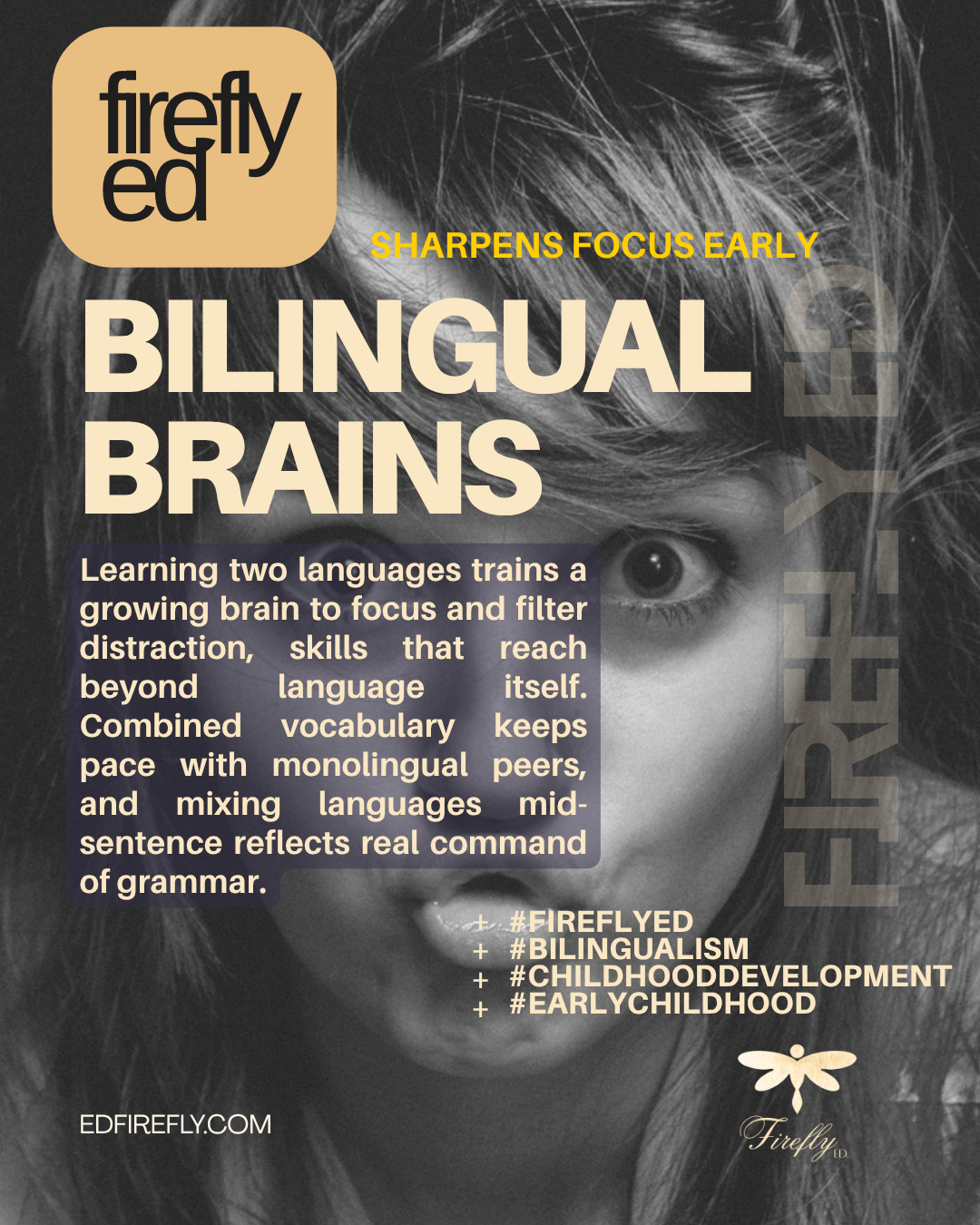
- Bilingual language acquisition in children builds stronger attention and mental flexibility, alongside two vocabularies.
- Combined vocabulary across both languages usually matches monolingual peers, even when each single language looks smaller.
- Two languages do not create language delay. Bilingual and monolingual children hit spoken milestones within a similar range.
- Mixing two languages mid-sentence, called code-switching, reflects strong command of grammar in both systems.
Parents raising bilingual children hear plenty of warnings. Two languages will confuse young minds or slow speech, people say. None of that holds up against what happens inside a bilingual brain. Two languages sharpen a specific mental skill: attention.
Two Paths to Two Languages
Simultaneous bilingual learners start from birth
Some children hear two languages from birth, often one from each parent or one at home and one in the wider community. These learners build both language systems side by side from the very first words. This path has a name: simultaneous bilingual acquisition.
Sequential bilingual learners add a language later
Other children learn one language first, then add a second once preschool or school starts. This path has a name too: sequential bilingual acquisition. The attention gains linked to bilingual language acquisition in children show up on this path. The timeline shifts to match when the second language begins.
Neither path has an edge over the other
Simultaneous and sequential paths both lead to real bilingual skill. What matters most is steady, everyday practice in both languages, regardless of the starting path.
Why Everyday Use Matters More Than Class Time
Regular use across settings drives the gains
The attention benefits linked to bilingual language acquisition in children build up through regular, everyday use of both languages. A weekly language class asks far less of the brain. Living inside two languages at home or with extended family asks much more.
Both languages need real purpose
Bilingual language acquisition in children works best when each language serves a real purpose. Talking with a grandparent in one language and reading a bedtime story in the other both count. Drilling a language in isolation rarely reaches the same depth.
The Language Delay Myth
Milestones arrive on a similar timeline
A common worry sounds simple. Two languages split attention and slow speech, people assume. Bilingual and monolingual children reach spoken milestones within a similar range. First words and full sentences arrive on comparable timelines.
Why parents notice a gap
The gap starts with counting. Checking vocabulary in a single language makes bilingual children look behind. A young learner might know fifty words in English and forty in Spanish, and score low on an English-only test. Add both languages together and the picture changes.
Real delays trace back to individual development
A genuine speech delay can still happen in bilingual children, the same as it does in children who speak one language. It relates to a learner’s individual development. Exposure to two languages does not cause it.
Signs that call for a closer look
A few signals point beyond typical bilingual development, in one language or two. Very few words by eighteen months, or no two-word phrases by age two, fall into that category. The same signals apply whether a learner speaks one language or several.
A speech-language pathologist can test both languages together to get an accurate picture. Testing only one language can make a bilingual learner look delayed when overall language skill sits right on track.
Adding Up Vocabulary Across Both Languages
Combined vocabulary usually matches peers
Add up every word a bilingual learner knows in both languages, and the total usually lines up with monolingual peers. This combined count has a name: total vocabulary across languages. Word for word in a single language, the count looks smaller. Word for word across both, it evens out.
Vocabulary often splits by setting
Bilingual learners often know certain words in one language and different words in the other, based on where they use them. A learner might know “homework” and “recess” in English from school, and “abuela” and “cena” in Spanish from home. Both sets count toward the same growing mind.
How the measurement method changes the count
The numbers shift depending on how someone measures them. Count every word in both languages, and bilingual learners often come out ahead. Count unique ideas rather than words, and monolingual peers sometimes edge ahead slightly. Either way, two languages build a full and capable vocabulary system.
The gap narrows with more overlap over time
Early on, the two languages cover different territory, so overlap between them stays low. As a bilingual learner grows, more words land in both languages at once. That overlap closes much of the early gap in concept counts.
The Real Effect: Attention and Executive Function
Constant switching trains focus
A bilingual brain runs two language systems at once. Both stay active even when only one is in use. Selecting the right word in the right language, over and over, trains a set of attention skills called executive function. That skill supports focus and self-control well beyond language itself.
A control room that keeps running in the background
Picture a mental control room that decides which language gets the microphone at any moment. In a bilingual brain, that control room runs constantly, even during a conversation in just one language. The system stays warmed up, ready for whichever language comes next.
Any two languages carry the same cognitive load
The attention gains apply to any two languages a learner speaks, regardless of how the wider culture views each one. A home dialect paired with a school language builds the same kind of practice that two widely spoken world languages build.
Better at blocking out distraction
Children who grow up with two languages tend to filter out irrelevant information more efficiently. Their attention systems get daily practice suppressing one language while producing the other. That practice appears to carry over into unrelated tasks, like sorting objects by shape rather than color.
Flexible thinking outside language tasks
Switching between two languages many times a day builds comfort with switching in general. Bilingual children often adapt faster when a task’s rules change partway through. This flexibility shows up in early childhood and continues through the school years.
Where the gains show up day to day
These attention gains rarely announce themselves. They show up in ordinary moments. Finishing homework with the television on, or switching from math to reading without losing focus, both take the same skill. A bilingual brain has practiced that kind of switch thousands of times already.
Code-Switching Signals Skill
Mixing follows its own rules
Bilingual children often mix languages mid-sentence, dropping in a word from one language while speaking the other. This pattern has a name: code-switching. It follows grammatical patterns that respect the rules of both languages at once, and pulling it off takes real command of grammar.
An example most bilingual families recognize
A learner might say, “I want the pelota, not that one,” swapping in a Spanish word for ball mid-sentence. The sentence still follows English word order. The switch lands in a spot both languages allow grammatically, which points to strong control over both systems.
A gap-filler switch counts too
Sometimes a bilingual learner reaches for a word in the stronger language. The matching word simply has not landed yet in the other. This kind of switch counts as ordinary problem-solving. A vocabulary in two languages naturally has stronger and weaker spots, the same way any growing vocabulary does.
A steady response helps more than a correction
Interrupting a switch mid-sentence breaks the thought a learner is already building. Letting the sentence land, then offering the word in the other language afterward, keeps the conversation moving. It also shows a learner that both languages have a place in the same conversation.
What This Looks Like in the Classroom
Switching between tasks gets easier
Group activities that move between tasks, like a game that changes its rules halfway through, tend to suit bilingual learners well. The same attention control that manages two languages helps manage a sudden change in instructions.
Group talk can welcome both languages
A classroom that allows some code-switching during group talk helps too. Bilingual learners can reach for an idea in whichever language gets there first. That flexibility keeps the focus on the idea itself, rather than on hunting for a single word.
Working with peers builds flexible thinking further
Bilingual learners often pick up on non-verbal cues quickly, since tracking context becomes part of following two languages at once. That same skill helps during group work, where reading a room matters as much as reading a page.
Two languages take real, sustained exposure to build well. The payoff shows up as sharper attention and a vocabulary that adds up to something whole across both.
Firefly Ed runs academic classes, workshops, and events for children aged 3 to 14. It also publishes a library of articles for parents, teens, and young adults. These explore how children learn and grow across more than one language.
Research Sources
Attention and Executive Function
Bialystok, E. (2015). Bilingualism and the Development of Executive Function: The Role of Attention. Child Development Perspectives, 9(2), 117-121.
Vocabulary and Language Delay
Byers-Heinlein, K., & Lew-Williams, C. (2013). Bilingualism in the Early Years: What the Science Says. LEARNing Landscapes, 7(1), 95-112.
Pearson, B.Z., Fernandez, S.C., & Oller, D.K. (1993). Lexical Development in Bilingual Infants and Toddlers: Comparison to Monolingual Norms. Language Learning, 43(1), 93-120.
Byers-Heinlein, K., Gonzalez-Barrero, A.M., Schott, E., & Killam, H. (2024). Sometimes Larger, Sometimes Smaller: Measuring Vocabulary in Monolingual and Bilingual Infants and Toddlers. First Language, 44(1), 74-95.
Code-Switching
Yow, W.Q., Tan, J.S.H., & Flynn, S. (2018). Code-Switching as a Marker of Linguistic Competence in Bilingual Children. Bilingualism: Language and Cognition, 21(5), 1075-1090.




Share your thoughts or ask something..