
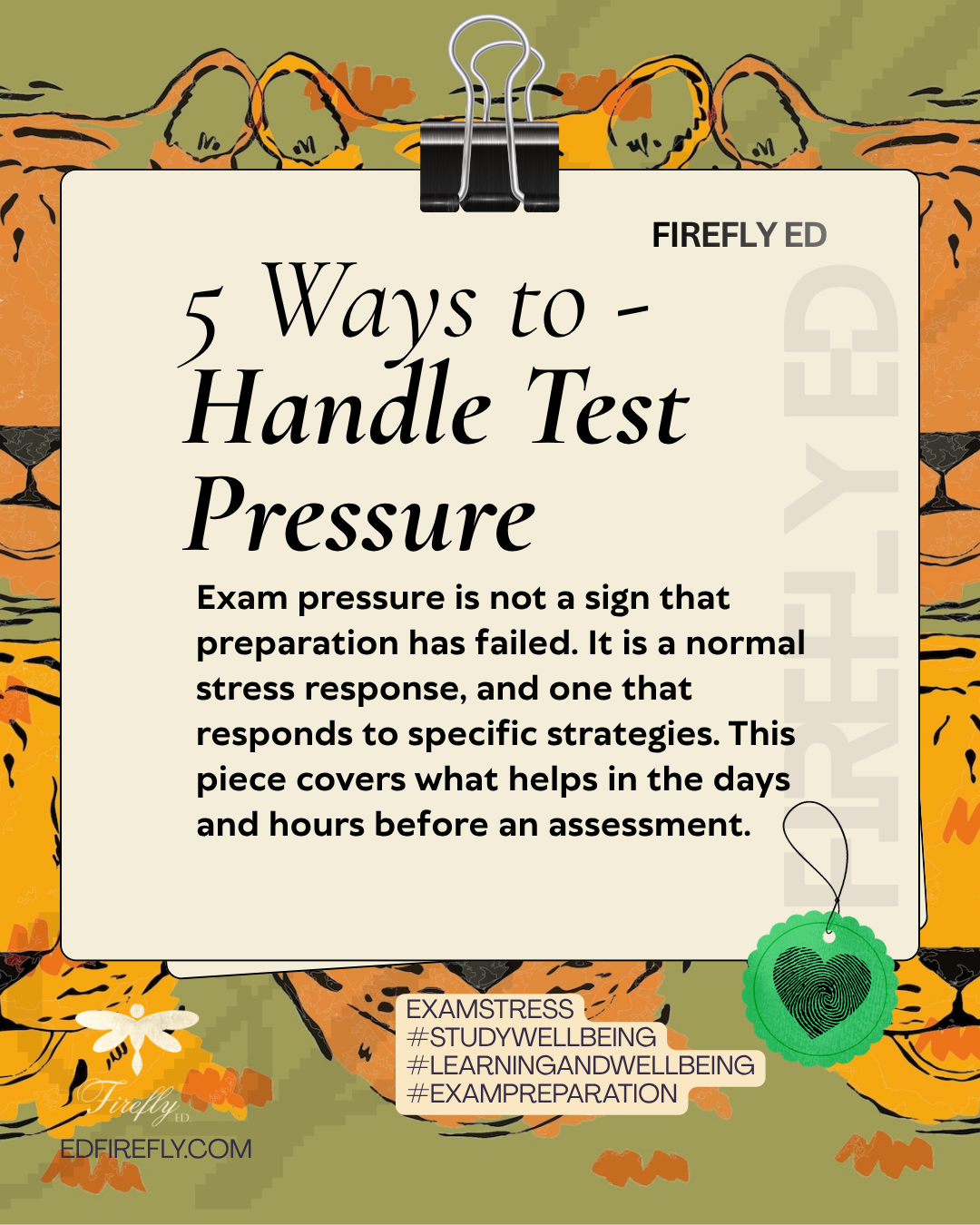
Four Ways to Handle Pressure Before a Test
- Exam pressure is a stress response. It is not evidence that preparation has failed.
- The physical symptoms of anxiety and readiness are almost identical. Interpretation matters.
- Several practical strategies reduce the impact of pressure on performance.
- None of them require more time at a desk.
What Exam Pressure Is
Pressure is a physiological stress response
Before an assessment, the body activates a stress response. Heart rate rises. Breathing quickens. Alertness increases. This is the same response the body uses to prepare for any demanding situation. It is not a malfunction. It is the system working as it should.
The stress response evolved to mobilise the body for action. In an exam context, that mobilisation is not always welcome. But the response itself is not the problem. What matters is what happens to it.
Worry consumes working memory
Pressure becomes a problem when anxious thought occupies cognitive space needed for the task. Ruminating on the possibility of failure uses the same mental resources required for retrieving and applying knowledge. The more attention worry consumes, the less is available for the exam itself.
Working memory has limited capacity. When it is occupied by anxious thought, less of it is available for recalling facts, constructing arguments, or solving problems. This is why high pressure does not just feel difficult. It functionally reduces the cognitive resources available during a test.
The goal is not to eliminate pressure
Trying to feel completely calm before an exam is not a useful target. Some activation improves performance. A moderate level of arousal tends to sharpen focus and increase effort. The strategies below do not aim to remove pressure entirely. They redirect it and reduce its interference with working memory.
Performance anxiety follows a pattern
Learners who experience significant pre-exam anxiety often develop a reinforcing cycle. Anxiety impairs performance. Poor performance confirms the fear. The fear intensifies before the next assessment. Understanding how the stress response works, and that it can be worked with rather than suppressed, can interrupt this cycle.
None of the strategies below require extended preparation or specialist support. They are practical, evidence-informed, and applicable in the days and hours before an assessment.
1. Write Out the Worry Beforehand
Externalising worry reduces its cognitive load
Writing freely about exam fears for ten minutes before an assessment reduces the cognitive burden of anxious thought. The act of putting worry onto paper appears to offload it from working memory. This frees cognitive space that would otherwise have been occupied by rumination.
The effect has been observed in both laboratory and classroom settings. Learners who write expressively about their concerns before an assessment tend to perform better than those who do not. The mechanism is not emotional release. It is cognitive offloading.
The content does not need to be organised
There is no correct format for this kind of writing. Writing freely about concerns, fears, or worst-case scenarios is sufficient. The content does not need to be structured or coherent. The transfer of anxious thought from mind to page is what matters, not the quality of the writing itself.
Some learners find it helpful to write specifically about what they are afraid of: failing a particular section, running out of time, forgetting key information. Others write more broadly. Both approaches appear to produce the same benefit.
Ten minutes is sufficient
Ten minutes is enough. This does not need to replace revision time. It can happen on the morning of an exam, during a break between sessions, or in the minutes before entering the room. All it requires is a page and a pen.
The benefit appears to be dose-limited. Writing for longer does not produce proportionally greater effects. Ten minutes before an assessment is the timeframe supported by the available evidence.
This strategy is particularly useful for high-stakes tests
The expressive writing effect is strongest when the stakes feel high. Learners who experience significant test anxiety tend to benefit most. The more cognitive space worry is occupying beforehand, the more is freed by writing it down. For learners who regularly experience pre-exam anxiety, this is one of the most practical tools available.
2. Reframe the Physical Sensation
Anxiety and readiness feel the same
The physiological symptoms of anxiety are almost identical to those of excitement: raised heart rate, heightened alertness, shallow breathing. The body does not produce distinct states for the two. What differs is how the sensation is interpreted. That interpretation shapes what happens next.
This matters because the typical response to pre-exam arousal is to try to suppress it. Telling oneself to calm down. Attempting to reduce the physical sensation. These strategies often backfire. They direct attention toward the feeling rather than away from it, and suppression itself consumes working memory.
Reappraisal is more effective than suppression
Reappraisal is the process of reinterpreting an emotional experience rather than suppressing it. Treating pre-exam arousal as readiness, rather than as a threat, shifts the response in a more useful direction. The physical state does not need to change. The meaning given to it does.
In practice, this means noticing the physical sensation and describing it as preparation rather than danger. Learners who do this before assessments tend to perform better than those who attempt to suppress the feeling or who receive no intervention at all.
Simple language is enough to shift the interpretation
Reappraisal does not require extended mental work or therapeutic techniques. Noticing the physical sensation and labelling it as readiness is sufficient. “I am prepared for this” or “this feeling means I am ready” are both enough. The shift is small. The effect on working memory availability is measurable.
The approach works across age groups
The reappraisal effect has been demonstrated across age groups, from secondary school learners through to adults in high-stakes professional assessments. It is not a technique that requires prior practice to be effective. A single instance of reappraisal before an assessment produces observable effects on performance.
The key is not to wait until the feeling is overwhelming. Reappraising the sensation as it builds, rather than attempting to manage it once it has peaked, tends to be more effective. Noticing the body’s response early and naming it as readiness is the practice.
3. Prepare Specifically
Last-minute cramming raises stress and produces little
The instinct to revise as much as possible in the final hours before an exam is understandable. It is rarely helpful. Cramming raises cortisol, disrupts sleep, and produces fragile short-term retention. Information absorbed under high stress is less accessible during retrieval. The very conditions cramming creates work against the performance it is intended to support.
Targeted preparation is more effective
In the day or two before an assessment, identifying the areas least confidently held and reviewing those specifically is more effective than broad, undirected revision. Two or three specific topics reviewed using retrieval practice will produce stronger results than an unfocused attempt to cover everything.
Retrieval practice is the most efficient use of limited revision time at this stage. Testing rather than re-reading. Closing the notes and writing down what can be recalled. Explaining concepts aloud. These approaches consolidate existing knowledge rather than adding new material under pressure.
Knowing what has been covered reduces anxiety
Part of pre-exam anxiety comes from a sense that preparation is incomplete. It often is. No revision process covers everything. But the anxiety that comes from grinding through material with diminishing returns tends to be greater, not smaller, than the anxiety that comes from accepting what has and has not been covered.
A clear, specific plan for the final day or two, followed by a deliberate stop, is more psychologically stable than open-ended revision that runs until exhaustion. Knowing where preparation ends is itself a form of exam readiness.
The night before has a specific purpose
The night before an assessment is not the time for intensive revision. A brief review of key points, followed by an early finish, is more useful than extended study. The purpose of the night before is to arrive at the exam with cognitive resources intact. Sleep, not revision, is what achieves this.
4. Protect Sleep in the Lead-Up
Sleep is when consolidation happens
Memory consolidation happens during sleep. This is the process that transfers learning from short-term to long-term storage. The nights before an exam matter more than most learners account for. Sacrificing sleep to study more undermines the very process that makes revision effective.
Sleep deprivation reduces working memory capacity, impairs retrieval, and increases emotional reactivity to stress. A learner who arrives at an exam after a poor night’s sleep is working with reduced cognitive resources regardless of how much revision was completed. The trade-off is not favourable.
Sleep also regulates the stress response
Beyond consolidation, sleep plays a direct role in regulating emotional reactivity. Insufficient sleep amplifies the stress response. A learner who is sleep-deprived will typically experience greater pre-exam anxiety and find it harder to reappraise that anxiety. The strategies in the preceding sections work better from a foundation of adequate sleep.
This makes sleep protection not one strategy among several but a precondition for the others. Managing pressure before a test is significantly more difficult when sleep has been compromised in the days prior.
Consistency in the lead-up matters more than one good night
A single early night before an exam does not repair the effects of a disrupted sleep pattern across the revision period. Consistent sleep, maintained throughout the weeks before an assessment, produces better cognitive and emotional outcomes than irregular sleep punctuated by a final early night.
Going to bed and waking at consistent times supports both memory consolidation and emotional regulation during a high-pressure period. Irregular sleep disrupts the architecture of the sleep cycle in ways that a single night does not correct.
The night before has a clear recommendation
A light review of key points, followed by an early finish, is more useful the night before an exam than extended revision. This is not permission to stop preparing. It is recognition that at this stage, sleep does more for performance than additional study time.
At Firefly Ed, managing the emotional side of learning is as much a part of the work as academic preparation. Pressure before a test responds to specific strategies and is something that can be actively managed, not simply endured.
Research Sources
Expressive Writing and Working Memory
Ramirez, G., & Beilock, S. L. (2011). Writing About Testing Worries Boosts Exam Performance in the Classroom. Science, 331(6014), 211–213.
Stress Reappraisal
Jamieson, J. P., Mendes, W. B., Blackstock, E., & Schmader, T. (2010). Turning the Knots in Your Stomach into Bows: Reappraising Arousal Improves Performance on the GRE. Journal of Experimental Social Psychology, 46(1), 208–212.
Anxiety and Cognitive Load
Eysenck, M. W., Derakshan, N., Santos, R., & Calvo, M. G. (2007). Anxiety and Cognitive Performance: Attentional Control Theory. Emotion, 7(2), 336–353.
Sleep and Memory Consolidation
Walker, M. P., & Stickgold, R. (2006). Sleep, Memory, and Plasticity. Annual Review of Psychology, 57, 139–166.
Stress and Retrieval
Vogel, S., & Schwabe, L. (2016). Learning and Memory Under Stress: Implications for the Classroom. Trends in Neurosciences, 39(9), 587–597.




Share your thoughts or ask something..