
Term 3 | Level 3 | Phonics focus: the roots therm, hydro, bio and eco, and ei after c
Lesson 8 – Energy for Our Planet | Lessons – Index
Lessons
This page has the two listening and speaking lessons of Lesson 8, Energy for Our Planet: Lessons 8.5 and 8.6. The Lesson 8 page has the Lesson 8 overview, the Lesson 8 review and the PDF download.
Select a lesson to go straight to it. Each lesson ends with a link back to the top of the page.
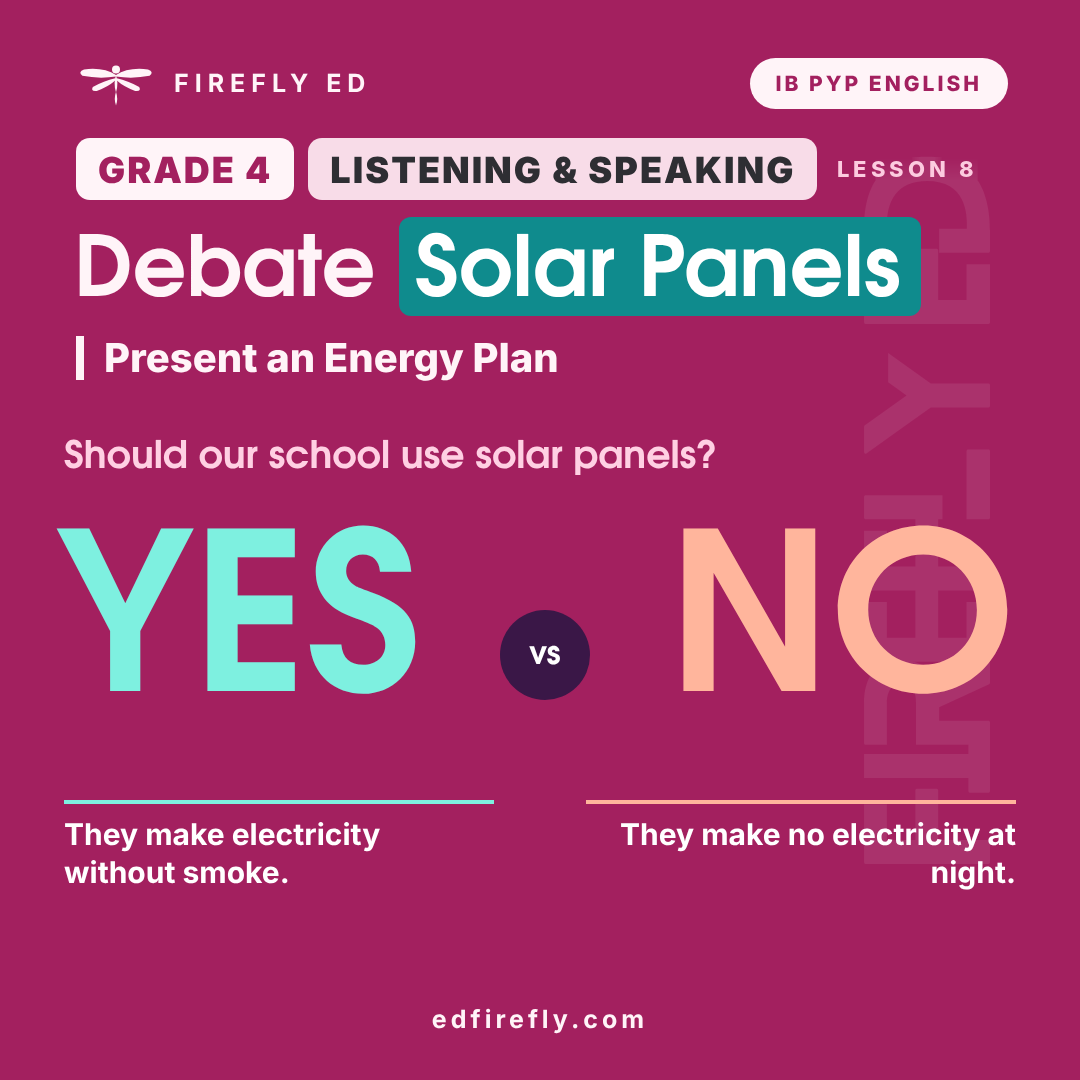
Lesson 8.5: Debate: Should Our School Use Solar Panels?
Oral | About 20 minutes
Term 3 | Level 3
Goal
“I can take part in a debate by giving reasons and evidence, listening to the other side and answering it politely.”
Words to know
debate, argument, for, against, evidence, rebuttal
Wonder
Think about this question before you start. Say your ideas. You will come back to it at the end of the lesson.
Is it possible to disagree with someone and still be kind?
Let’s Learn
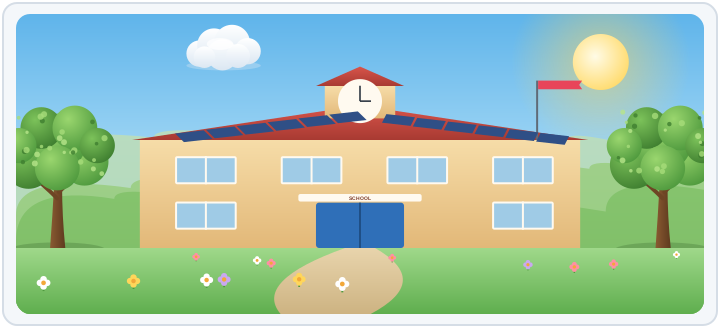
In a debate, two sides discuss a question. One side argues for it, and the other argues against it. Each speaker gives reasons and evidence, listens carefully to the other side, and then answers their points. Answering the other side is called a rebuttal. A good debater stays polite, even when they disagree.
See How It’s Done

Now Try It
1. Choose one argument for solar panels. Add your own evidence or example. ______________________________
2. Answer this point politely: Solar panels cost too much.
__________________________________________________________________
Time To Practise
Name: ______________________
1. Choose your side.
Decide whether you are for or against solar panels at your school. ______________
2. Plan three reasons.
1. __________________________________________________________
2. __________________________________________________________
3. __________________________________________________________
3. Predict and prepare.
Write one point the other side might make, and how you would answer it.
They might say: __________________________________________________
I would answer: __________________________________________________
4. Hold the debate.
Debate with an adult or a group. Each speaker has one minute to give their view, then one minute to answer the other side. Use the sentence starters.
An adult listens and ticks each one they hear.
☐ a clear view ☐ reasons with evidence ☐ listened without interrupting ☐ answered the other side politely ☐ summed up
5. Reflect.
Did the other side change your mind about anything? Write one sentence.
__________________________________________________________________
Reflect
Think about these questions. Talk about them with someone at home or at school.
1. Go back to the Wonder question: “Is it possible to disagree with someone and still be kind?” What do you think now?
2. I was open-minded today when I ______________________________.
Being open-minded means listening to other ideas and other ways of doing things. For example: I was open-minded today when I listened carefully to a view I disagreed with.
Take action: Hold a family debate on another energy question, such as whether to walk to school more often.
Next Steps
If this was easy, try: Write a short speech for the side you did not choose. Use the best arguments you heard.
If this was hard, go back to: Let’s Learn. Read the arguments for and against aloud. Choose one from each side and say why it is strong.
Notes for Parents and Teachers
Show notes for parents and teachers
These notes cover this lesson only. How every lesson runs is explained in How to Use This Material.
Let’s Learn
Read Let’s Learn aloud together. Talk about the arguments on both sides.
Time To Practise
- Task 4: Tick each one you hear.
Answer Key
Reveal Answers
Now Try It
1. Sample answer: Pupils could learn how they work. For example, a screen in the hall could show how much electricity the panels make each day. 2. Sample answer: That is true, but the school would pay less for electricity every year, so over time the panels would pay for themselves.
1 to 3. Answers will vary. Look for: three clear reasons and a sensible answer to the other side.
4. Look for: four or more ticks.
5. Answers will vary.
Reflect
2. Any real moment from the lesson that shows the learner was open-minded. Examples: “I was open-minded today when I listened carefully to a view I disagreed with.” “I was open-minded today when I answered politely with a reason.”
Lesson 8.6: Present an Energy-Saving Plan
Oral | About 20 minutes
Term 3 | Level 3
Goal
“I can present a clear plan with actions, reasons and a visual, speaking clearly to my audience.”
Words to know
plan, action, presentation, audience, visual, persuade
Wonder
Think about this question before you start. Say your ideas. You will come back to it at the end of the lesson.
What is one thing your family could do this week to save energy?
Let’s Learn
A plan says what will be done, who will do it, when, and how you will know it worked. When you present a plan, you explain each action and give a reason for it, so your audience wants to join in.
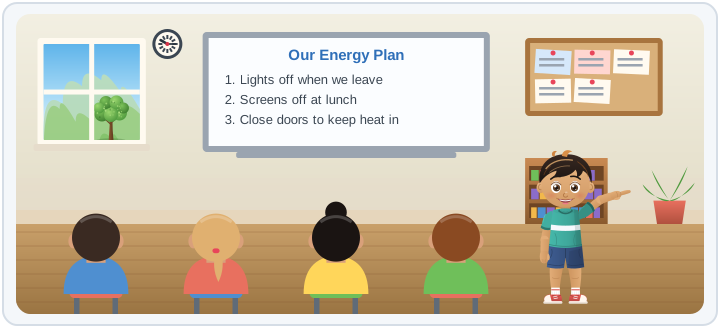
A good presentation of a plan:
- starts with the problem: Our school wastes energy every day.
- explains each action with a reason
- uses a visual, such as a table or poster
- speaks clearly, looks at the audience and pauses between points
- ends by asking the audience to help: Will you be our first energy monitors?
See How It’s Done

Now Try It
1. Why does a plan need a Who column? ______________________________
2. Write an ending that asks the audience to help. ______________________________
Time To Practise
Name: ______________________
1. Choose a place.
Choose your home, your classroom or a club. ______________
2. Make your plan.
| Action | Who | When | How we will check |
|---|---|---|---|
3. Add reasons.
Write a reason for each action.
1. ______________________________ 2. ______________________________ 3. ______________________________
4. Present it.
Present your plan to your family or class for one to two minutes, using your table as a visual.
An adult listens and ticks each one they hear or see.
☐ started with the problem ☐ a reason for each action ☐ pointed to the visual ☐ clear voice and eye contact ☐ asked the audience to help
Reflect
Think about these questions. Talk about them with someone at home or at school.
1. Go back to the Wonder question: “What is one thing your family could do this week to save energy?” What do you think now?
2. I was caring today when I ______________________________.
Being caring means being kind and helping others. For example: I was caring today when I made a plan that helps the people around me and the planet.
Take action: Put your plan into action at home for one week, then report back on what changed.
Next Steps
If this was easy, try: Add a chart to your plan that shows how you will record your progress over four weeks.
If this was hard, go back to: Let’s Learn. Read the model plan one row at a time and say each action with its reason.
Notes for Parents and Teachers
Show notes for parents and teachers
These notes cover this lesson only. How every lesson runs is explained in How to Use This Material.
Let’s Learn
Read Let’s Learn aloud together. Look at the model plan together.
Time To Practise
- Task 4: Tick each one you hear or see.
Answer Key
Reveal Answers
Now Try It
1. So everyone knows whose job it is, and the action does not get forgotten. 2. Sample answer: Please help us by switching off one thing today.
1 to 3. Answers will vary. Look for: three clear actions, each with a person, a time, a way to check and a reason.
4. Look for: four or more ticks.
Reflect
2. Any real moment from the lesson that shows the learner was caring. Examples: “I was caring today when I made a plan that helps the people around me and the planet.” “I was caring today when I asked others to join in.”
For Teachers: IB Details
Show IB and curriculum details
IB theme: Sharing the planet. This theme is about the rights and responsibilities we have as we share the planet’s resources with other people and other living things.
Central idea: People get energy from different sources, and the choices we make about energy affect the planet and everyone who shares it.
| Lesson | Title | Strand | Key concept |
|---|---|---|---|
| 8.5 | Debate: Should Our School Use Solar Panels? | Listening and speaking | Perspective |
| 8.6 | Present an Energy-Saving Plan | Speaking | Responsibility |
Each lesson also matches the national curriculum for England (Year 4) and the US Common Core (Grade 4). The Grade 4 Curriculum Map lists the full standards for every lesson.
← Back to Lesson 8 – Energy for Our Planet | Lessons – Index
© 2026 Firefly Ed. All rights reserved. This page may be printed for personal, home and classroom use. It may not be sold, shared online or reproduced for commercial use without written permission. edfirefly.com

Share your thoughts or ask something..