
Term 3 | Level 3 | Phonics focus: the roots therm, hydro, bio and eco, and ei after c
Lesson 8 – Energy for Our Planet | Lessons – Index
Lessons
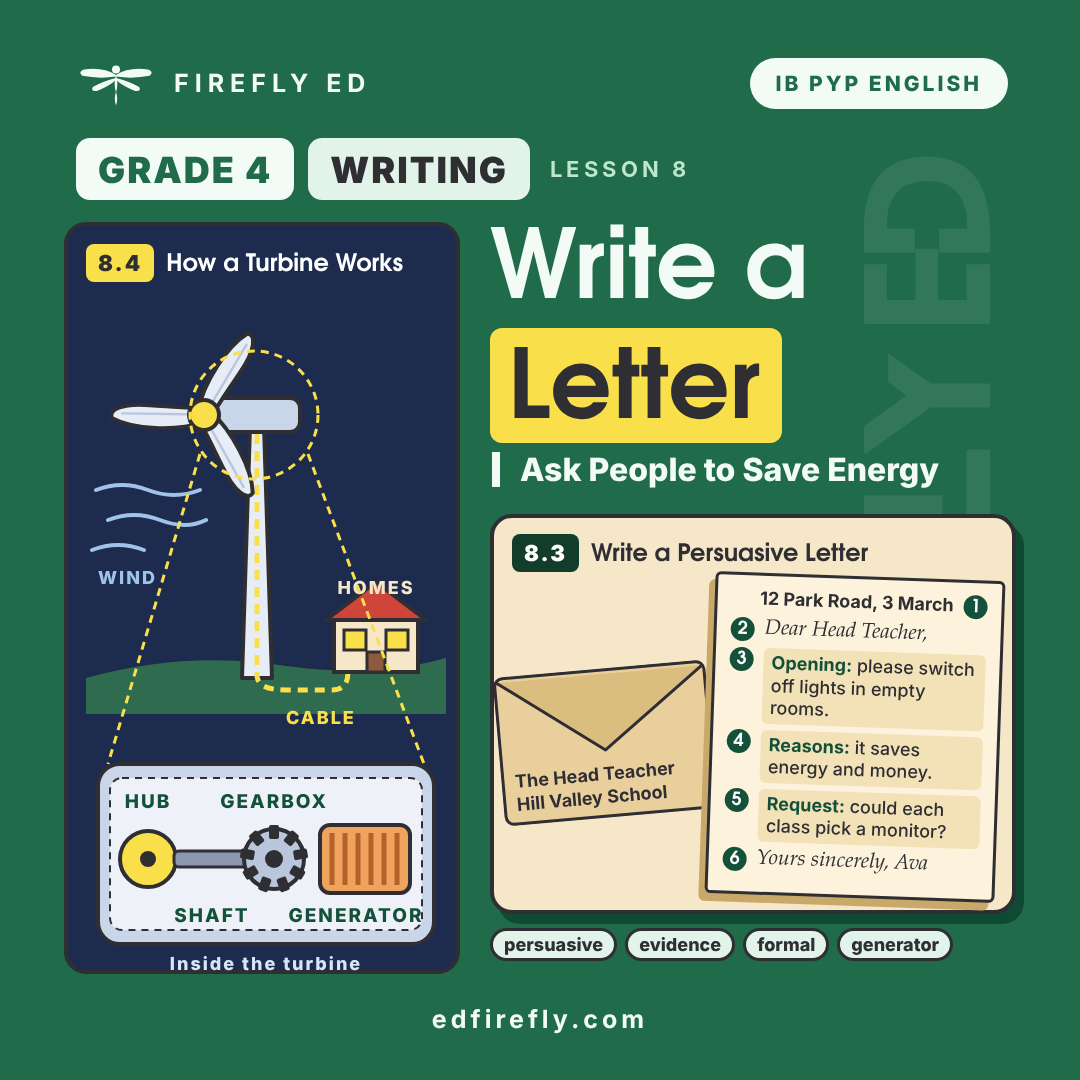
This page has the two writing lessons of Lesson 8, Energy for Our Planet: Lessons 8.3 and 8.4. The Lesson 8 page has the Lesson 8 overview, the Lesson 8 review and the PDF download.
Select a lesson to go straight to it. Each lesson ends with a link back to the top of the page.
- Lesson 8.3: Write a Persuasive Letter: Please Switch It Off
- Lesson 8.4: Explain It: How a Wind Turbine Makes Electricity
Lesson 8.3: Write a Persuasive Letter: Please Switch It Off
Writing | About 20 minutes
Term 3 | Level 3
Goal
“I can write a persuasive letter with an opinion, reasons supported by evidence, linking words and a polite request.”
Words to know
persuasive, opinion, reason, evidence, linking word, formal
Wonder
Think about this question before you start. Say your ideas. You will come back to it at the end of the lesson.
Who could you write to, to change something at your school or in your town?
Let’s Learn
A persuasive letter tries to make the reader agree and do something. It is written to a real person, so it should be formal and polite. It states an opinion, gives reasons with evidence, and links them with words such as firstly, in addition, for example and finally.

Class 4B
Riverside School
14 May
Dear Mrs Patel,
I am writing to ask you to help our school save energy by switching off lights and screens when nobody is using them.
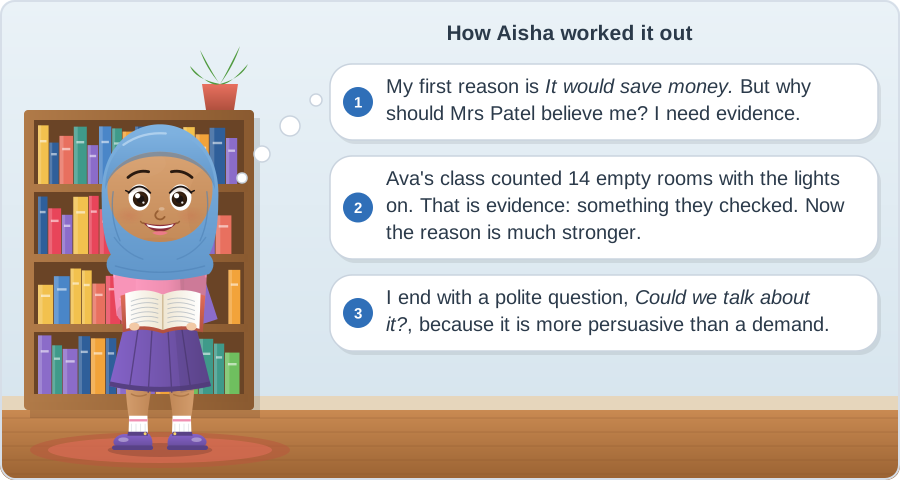
Firstly, it would save money. Last week, our class checked the school at lunchtime and found 14 rooms with the lights on and nobody inside. The money we spend on wasted electricity could buy new books for the library.
In addition, it would help the planet. A lot of electricity still comes from burning coal and gas, which releases gases that warm the Earth. For example, if every class switched off its whiteboard at lunchtime, we would use less of that electricity every day.
Finally, it is easy. We would like to make small “Switch It Off” signs for every door, and each class could choose a weekly energy monitor to check the room before break.
I hope you will agree that this small change would make a big difference. Could we talk about it at the next school council meeting?
Yours sincerely,
Ava Mendes, Class 4B
See How It’s Done
Now Try It
1. Find the evidence in the first reason. ______________________________
2. Why does Ava suggest a solution, such as signs and energy monitors?
__________________________________________________________________
Time To Practise
Name: ______________________
1. Linking words.
Choose a linking word for each gap: firstly, in addition, for example, finally.
______________, it would save water. ______________, a dripping tap wastes many litres a day. ______________, it would help the fish in the river. ______________, it would be easy to fix.
2. Reason or evidence?
Write R for reason or E for evidence.
a) It would save money. ____ b) We counted 14 empty rooms with the lights on. ____ c) It would help the planet. ____
3. Make it formal.
Rewrite in formal English: Hey, you’ve gotta turn the lights off, OK?
__________________________________________________________________
4. Write your letter.
Choose something to save energy at school or at home, such as switching off chargers or walking to school. Write a persuasive letter to someone who could make it happen. Use all six parts.
5. Check it.
Tick each one you used: ☐ a clear opinion ☐ three reasons ☐ evidence for at least one reason ☐ linking words ☐ formal language ☐ a polite request
Reflect
Think about these questions. Talk about them with someone at home or at school.
1. Go back to the Wonder question: “Who could you write to, to change something at your school or in your town?” What do you think now?
2. I was a communicator today when I ______________________________.
A communicator shares ideas clearly by talking, writing or drawing. For example: I was a communicator today when I backed up a reason with evidence.
Take action: Send your letter, or give it to the person you wrote it to. Ask them for a reply.
Next Steps
If this was easy, try: Write a reply from Mrs Patel that agrees to one idea and asks a question about another.
If this was hard, go back to: Let’s Learn. Use the model letter as a frame. Change the topic, but keep the same linking words.
Notes for Parents and Teachers
Show notes for parents and teachers
These notes cover this lesson only. How every lesson runs is explained in How to Use This Material.
Let’s Learn
Read Let’s Learn aloud together. Read the model letter together.
Answer Key
Reveal Answers
Now Try It
1. They found 14 rooms with the lights on and nobody inside. 2. A solution shows it would be easy, which makes the reader more likely to agree.
1. Linking words
Firstly, For example, In addition, Finally
2. Reason or evidence?
a) R b) E c) R
3. Sample answer: Please could you switch off the lights when you leave the room?
4 and 5. Look for: all six parts of a letter, an opinion, three reasons with linking words, evidence for at least one reason, and polite, formal language.
Reflect
2. Any real moment from the lesson that shows the learner was a communicator. Examples: “I was a communicator today when I backed up a reason with evidence.” “I was a communicator today when I used polite, formal language for a real reader.”
Lesson 8.4: Explain It: How a Wind Turbine Makes Electricity
Writing | About 20 minutes
Term 3 | Level 3
Goal
“I can write a step-by-step explanation with an introduction, linking words, precise words and a summary.”
Words to know
explanation, rotor, shaft, gearbox, generator, linking word
Wonder
Think about this question before you start. Say your ideas. You will come back to it at the end of the lesson.
How can moving air turn on a light in your home?
Let’s Learn
An explanation tells how something works. It starts with an introduction, gives the steps in order with linking words, uses precise words for the parts, and ends with a summary. A labelled diagram helps the reader follow it.

How a Wind Turbine Makes Electricity
A wind turbine is a tall machine that turns the movement of the wind into electricity. It works in several steps.
First, the wind blows against the long blades. The blades are shaped like the wings of an aeroplane, so the moving air pushes them round. The blades are joined to a hub, and together they are called the rotor.
Next, the rotor turns a strong rod called the shaft. The rotor turns quite slowly, about 15 times a minute, which means that it is too slow to make much electricity on its own.
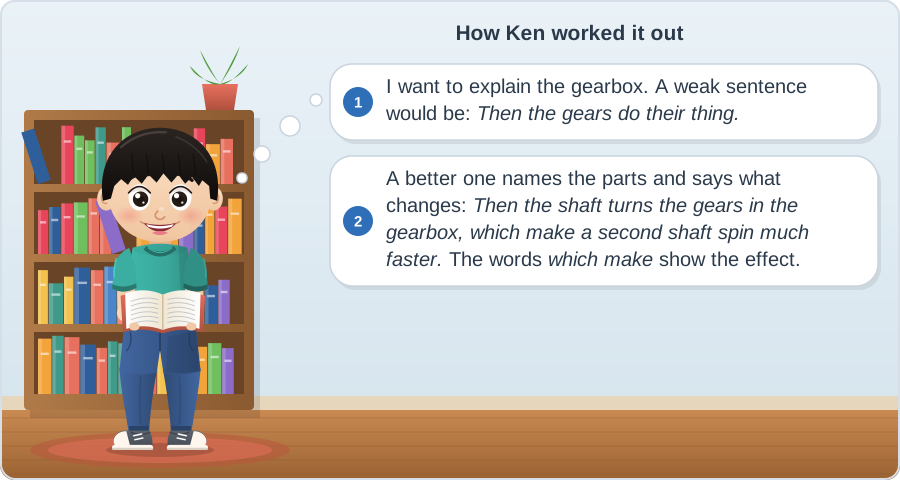
Then, the shaft turns a set of gears inside the gearbox. The gears make a second shaft spin much faster, more than 1,000 times a minute.
After that, the fast shaft spins the generator. Inside, magnets turn past coils of wire, and this makes an electric current.
Finally, the electricity travels down a cable inside the tower, and then through power lines to homes, schools and factories.
In short, the wind pushes the blades, the gears speed up the turning, and the generator changes the movement into electricity.
See How It’s Done
Now Try It
1. Which part makes the electric current? ______________
2. Why is a gearbox needed? ______________________________
Time To Practise
Name: ______________________
1. Label it.
Write the part for each job.
a) catches the wind ______________ b) speeds up the turning ______________
c) changes movement into electricity ______________ d) carries electricity down the tower ______________
2. Order the steps.
____ The generator makes a current. ____ The wind pushes the blades. ____ Electricity travels to homes. ____ The gearbox speeds up the turning. ____ The rotor turns the shaft.
3. Linking words.
Find five linking words in the model. ______________ ______________ ______________ ______________ ______________
4. Write your explanation.
Choose one: how a solar panel makes electricity, how a bicycle dynamo lights a lamp, or how a water wheel turns a mill. Write an introduction, at least four steps with linking words, and a summary. Draw a labelled diagram to go with it.
5. Check it.
Tick each one: ☐ introduction ☐ steps in order ☐ linking words ☐ precise names for parts ☐ summary ☐ labelled diagram
Reflect
Think about these questions. Talk about them with someone at home or at school.
1. Go back to the Wonder question: “How can moving air turn on a light in your home?” What do you think now?
2. I was a communicator today when I ______________________________.
A communicator shares ideas clearly by talking, writing or drawing. For example: I was a communicator today when I named each part precisely.
Take action: Make a paper windmill and blow on it. Explain to someone at home how a real turbine is different.
Next Steps
If this was easy, try: Add a paragraph explaining why turbines are often built on hills or at sea.
If this was hard, go back to: Let’s Learn. Point to each part on the diagram as you read the matching step in the model.
Notes for Parents and Teachers
Show notes for parents and teachers
These notes cover this lesson only. How every lesson runs is explained in How to Use This Material.
Let’s Learn
Read Let’s Learn aloud together. Read the model explanation together, and match each step to the diagram.
Answer Key
Reveal Answers
Now Try It
1. the generator 2. The rotor turns too slowly to make much electricity, so the gears make the second shaft spin much faster.
1. Label it
a) the blades b) the gearbox c) the generator d) the cable
2. Order the steps
4 The generator makes a current. 1 The wind pushes the blades. 5 Electricity travels to homes. 3 The gearbox speeds up the turning. 2 The rotor turns the shaft.
3. first, next, then, after that, finally (also: so, which means that, in short)
4 and 5. Look for: an introduction, at least four steps in order with linking words, precise names for the parts, a summary and a labelled diagram.
Reflect
2. Any real moment from the lesson that shows the learner was a communicator. Examples: “I was a communicator today when I named each part precisely.” “I was a communicator today when I linked the steps so the reader could follow them.”
For Teachers: IB Details
Show IB and curriculum details
IB theme: Sharing the planet. This theme is about the rights and responsibilities we have as we share the planet’s resources with other people and other living things.
Central idea: People get energy from different sources, and the choices we make about energy affect the planet and everyone who shares it.
| Lesson | Title | Strand | Key concept |
|---|---|---|---|
| 8.3 | Write a Persuasive Letter: Please Switch It Off | Writing | Responsibility |
| 8.4 | Explain It: How a Wind Turbine Makes Electricity | Writing | Causation |
Each lesson also matches the national curriculum for England (Year 4) and the US Common Core (Grade 4). The Grade 4 Curriculum Map lists the full standards for every lesson.
← Back to Lesson 8 – Energy for Our Planet | Lessons – Index
© 2026 Firefly Ed. All rights reserved. This page may be printed for personal, home and classroom use. It may not be sold, shared online or reproduced for commercial use without written permission. edfirefly.com


Share your thoughts or ask something..