
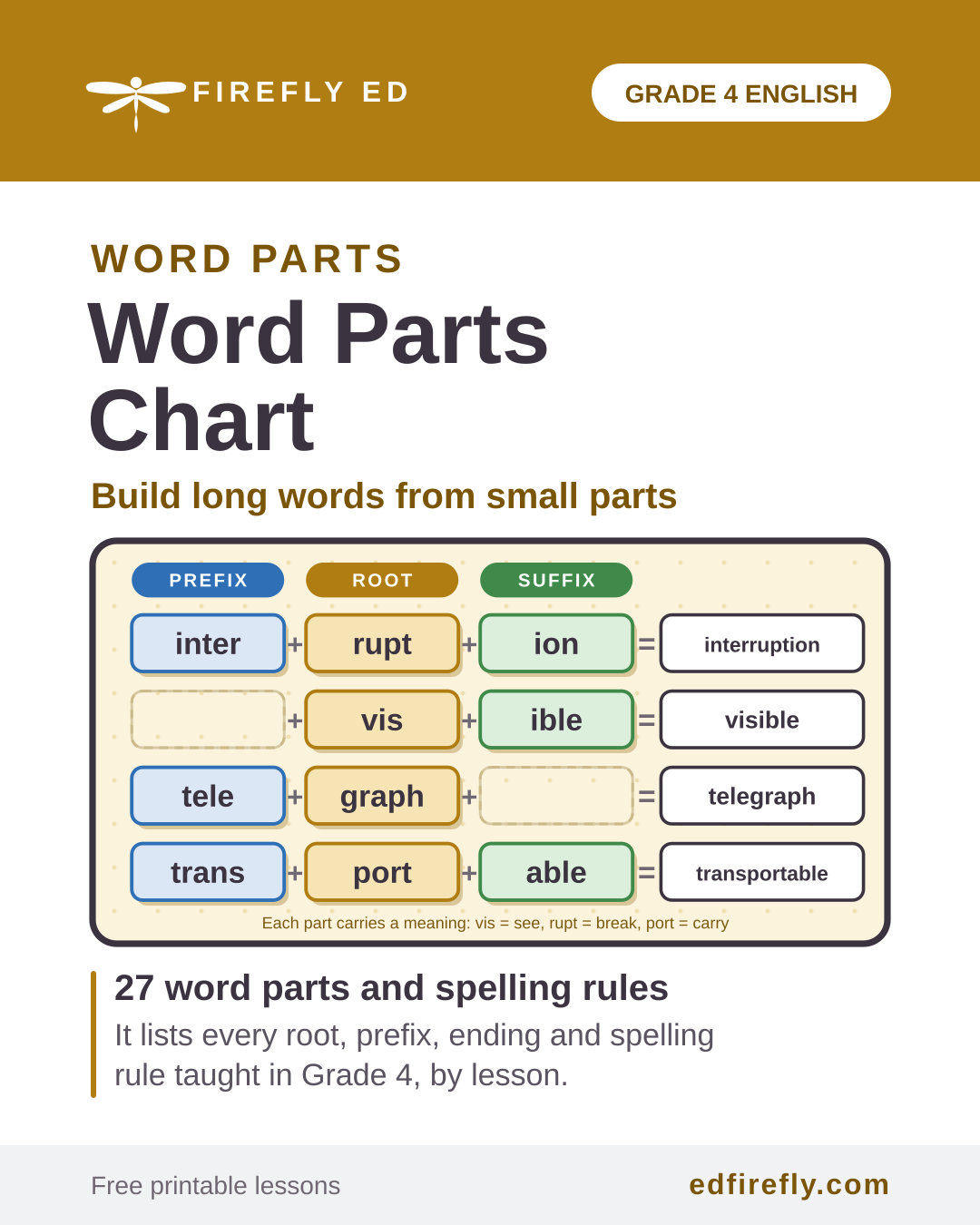
Term 3 | Level 3 | Phonics focus: the roots therm, hydro, bio and eco, and ei after c
Lesson 8 – Energy for Our Planet | Lessons – Index
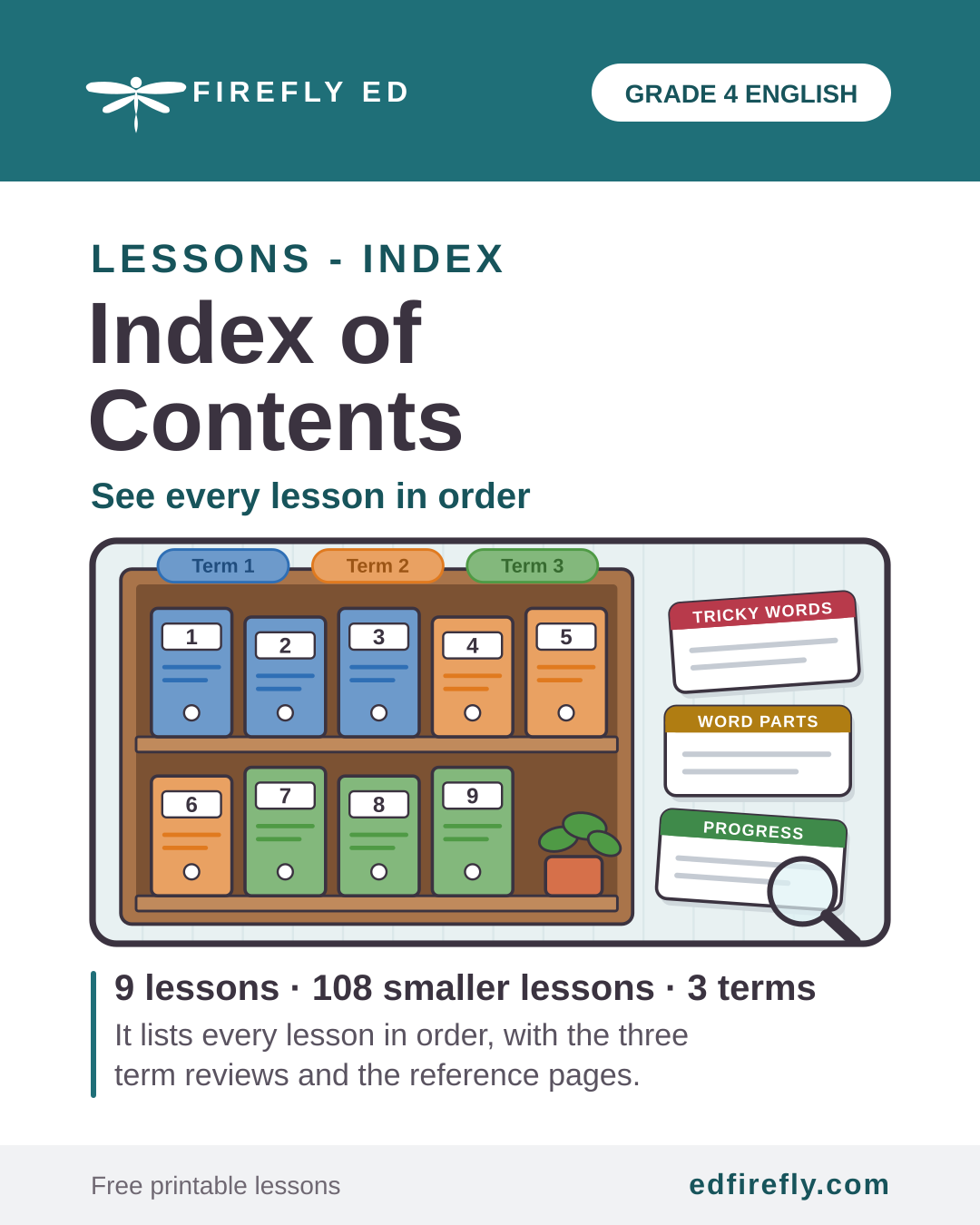
Lessons
This page has the two reading lessons of Lesson 8, Energy for Our Planet: Lessons 8.1 and 8.2. The Lesson 8 page has the Lesson 8 overview, the Lesson 8 review and the PDF download.
Select a lesson to go straight to it. Each lesson ends with a link back to the top of the page.
- Lesson 8.1: Where Does Our Energy Come From? Comparing Sources
- Lesson 8.2: The Night of the Power Cut: A Story
Lesson 8.1: Where Does Our Energy Come From? Comparing Sources
Reading | About 20 minutes
Term 3 | Level 3
Goal
“I can compare how two texts describe energy sources, including how each text is structured and what information it gives.”
Words to know
energy source, structure, sequence, problem and solution, compare, carbon dioxide
Wonder
Think about this question before you start. Say your ideas. You will come back to it at the end of the lesson.
Where do you think the electricity in your home comes from?
Let’s Learn
Two texts can be about similar topics but be built in different ways. Some texts tell events in sequence, in the order they happen. Others describe a problem and a solution. When we compare texts, we look at how they are built and what information each one gives.
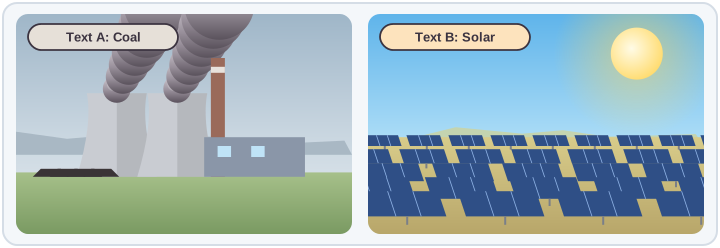
Text A: Power From Coal
Millions of years ago, giant ferns and trees grew in swamps. When they died, they sank into the mud. Over a very long time, layers of rock pressed down on them, and the heat and weight slowly turned them into a hard black rock called coal.
Today, coal is dug out of the ground in mines. It is carried by train to a power station. There, it is burned to heat water. The water turns into steam, and the steam spins a turbine, which turns a generator to make electricity.
Coal makes more of the world’s electricity than any other single source, although in 2025 all the renewable sources together made slightly more. It can make power at any time of day, in any weather. However, burning coal releases carbon dioxide, a gas that traps heat in the air and is warming the planet. It also makes smoke that can harm people’s lungs. And once coal is burned, it is gone: it took millions of years to form.
Text B: Power From the Sun
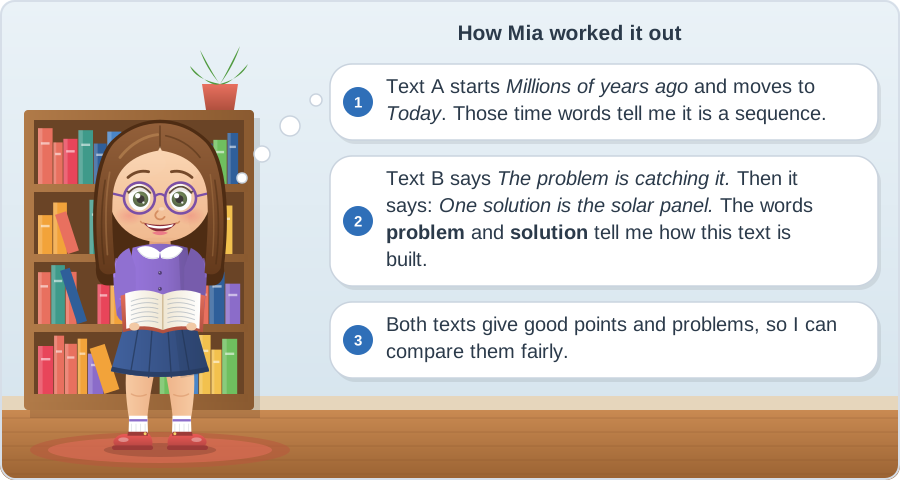
In about an hour and a half, the sunlight reaching the Earth carries more energy than all the people in the world use in a whole year. The problem is catching it.
One solution is the solar panel. A solar panel is made of thin slices of a material called silicon. When sunlight hits the silicon, it makes a small electric current. Many panels joined together can power a house, a school or even a whole town.
Solar power does not make smoke or carbon dioxide while it works, and the sunlight will not run out. But it has problems too. Panels make no electricity at night and less on cloudy days, so the energy must be stored in batteries or come from other sources. Large solar farms also take up a lot of land. Even so, solar power is the fastest-growing source of electricity in the world.
See How It’s Done
Now Try It
1. Find a time phrase in Text A. ______________________________
2. What problem does Text B describe? ______________________________
Time To Practise
Name: ______________________
1. Find the facts.
a) What was coal made from? ______________________________
b) What is a solar panel made of? ______________________________
c) Which source makes more of the world’s electricity? ______________
2. Put it in order.
Number the steps from Text A from 1 to 5.
____ Steam spins a turbine. ____ Coal is dug out of a mine. ____ Plants sink into the mud. ____ Coal is burned to heat water. ____ Rock presses the plants into coal.
3. Compare.
a) Name one thing both texts tell you. ______________________________
b) Name one thing only Text B tells you. ______________________________
4. Structure.
Why do you think the writer used a sequence for coal and problem and solution for solar power?
__________________________________________________________________
5. Your view.
Which source would you choose for a new school? Give one reason from each text.
__________________________________________________________________
__________________________________________________________________
Reflect
Think about these questions. Talk about them with someone at home or at school.
1. Go back to the Wonder question: “Where do you think the electricity in your home comes from?” What do you think now?
2. I was a thinker today when I ______________________________.
A thinker thinks carefully to work things out. For example: I was a thinker today when I compared how two texts were built.
Take action: Find out how your home or school gets its electricity. Ask an adult, or look at an energy bill.
Next Steps
If this was easy, try: Write a third short text, Power From the Wind, using the problem and solution structure.
If this was hard, go back to: Let’s Learn. Read one text at a time. After each paragraph, say one fact in your own words.
Notes for Parents and Teachers
Show notes for parents and teachers
These notes cover this lesson only. How every lesson runs is explained in How to Use This Material.
Let’s Learn
Read Let’s Learn aloud together. Read the two texts together, one at a time.
Answer Key
Reveal Answers
Now Try It
1. Any one of: millions of years ago, over a very long time, today, once coal is burned. 2. How to catch the Sun’s energy.
1. Find the facts
a) giant ferns and trees that grew in swamps b) thin slices of silicon c) coal
2. Put it in order
5 Steam spins a turbine. 3 Coal is dug out. 1 Plants sink into the mud. 4 Coal is burned. 2 Rock presses the plants into coal.
3. Compare
a) Sample answers: how each source makes electricity; the good points and problems of each. b) Any one of: the sunlight reaching Earth in about an hour and a half carries more energy than people use in a year; panels need batteries at night; solar farms take up land; solar is the fastest-growing source.
4. Sample answer: Coal forms over a long time in steps, so a sequence fits. Solar power is about catching energy that is hard to collect, so problem and solution fits.
5. Answers will vary. Look for: a choice and one reason taken from each text.
Reflect
2. Any real moment from the lesson that shows the learner was a thinker. Examples: “I was a thinker today when I compared how two texts were built.” “I was a thinker today when I weighed good points and problems before choosing.”
Lesson 8.2: The Night of the Power Cut: A Story
Reading | About 20 minutes
Term 3 | Level 3
Goal
“I can work out the theme of a story from how a character changes, and support it with details from the text.”
Words to know
theme, character, change, evidence, summary, detail
Wonder
Think about this question before you start. Say your ideas. You will come back to it at the end of the lesson.
What would your evening be like without any electricity?
Let’s Learn
The theme of a story is the big lesson or message it teaches about life. The writer does not usually say the theme out loud. We work it out by noticing how the main character changes and what they learn.
The Night of the Power Cut
The storm had been growing all afternoon. By seven o’clock, the wind was rattling the windows, and rain was pouring down the glass. Leo was halfway through a video when the screen went black. So did the lights, the fridge and the fan. The whole house went silent.
“Mum!” he shouted. “The internet’s gone!”
“Everything’s gone,” said Mum from the dark kitchen. “It’s a power cut. The storm must have brought down a cable.”
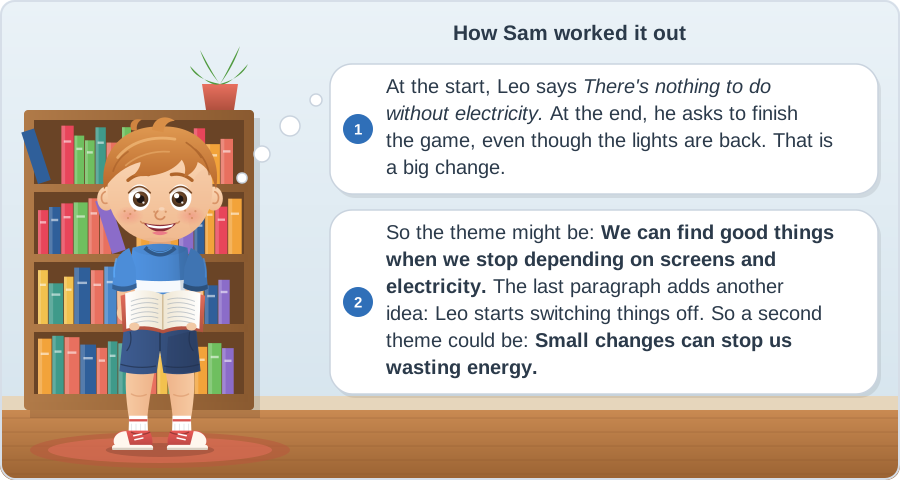
Leo felt his way to the sofa. Without the hum of the fridge and the glow of the screens, the house felt like somewhere else. “What are we supposed to do now?” he groaned. “There’s nothing to do without electricity.”
Gran laughed softly. “When I was your age, we had power cuts nearly every week,” she said. “We managed.”
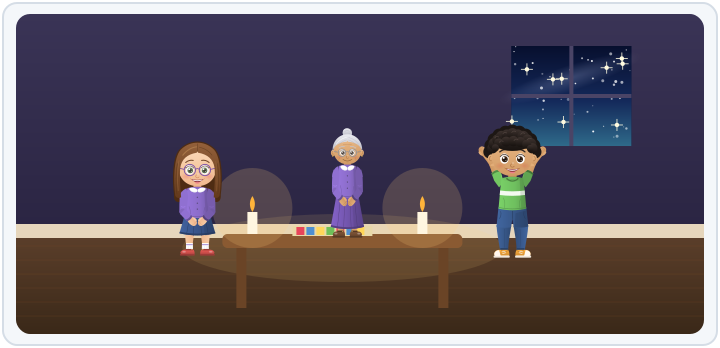
Mum found two candles and a torch in the drawer. The candles made a small circle of yellow light on the table. Leo’s sister, Mia, pulled out an old board game from the cupboard. It was dusty, and two pieces were missing, so they used buttons instead.
At first, Leo kept checking his tablet, even though it was dead. But after a while, he forgot about it. Gran told them stories about the village where she grew up, where the whole street would sit outside on hot nights and sing. Mia won the first game. Leo won the second. They laughed so much that Mum had to wipe her eyes.
Later, they went to the window. With every light in the town switched off, the sky was full of stars, more than Leo had ever seen. “I didn’t know there were so many,” he whispered.
“They’re always there,” said Gran. “We just can’t usually see them.”
At ten o’clock, the lights flickered back on. The fridge began to hum, and the router blinked green. Leo looked at the board game, still spread across the table.
“Can we finish this one first?” he asked.
The next day, Leo noticed things he had never noticed before: the charger left on all night, the television glowing in an empty room, the light in the hall that nobody needed. One by one, he switched them off.
See How It’s Done
Now Try It
1. How does Leo feel at the start? Find a word that shows it. ______________________________
2. What does Gran mean by They’re always there. We just can’t usually see them.?
__________________________________________________________________
Time To Practise
Name: ______________________
1. Find the details.
a) What caused the power cut? ______________________________
b) What did the family use instead of the missing pieces? ______________
c) What time did the power come back? ______________
2. Leo changes.
Complete the chart with evidence from the story.
| At the start, Leo… | At the end, Leo… |
|---|---|
| | |
3. The theme.
Write the theme of the story in one sentence.
__________________________________________________________________
Give two details from the story that support it.
__________________________________________________________________
__________________________________________________________________
4. Summarise.
Write a summary of the story in three sentences: beginning, middle and end.
__________________________________________________________________
__________________________________________________________________
5. Connect.
Name one thing in your home that is often left on when nobody needs it.
__________________________________________________________________
Reflect
Think about these questions. Talk about them with someone at home or at school.
1. Go back to the Wonder question: “What would your evening be like without any electricity?” What do you think now?
2. I was reflective today when I ______________________________.
Being reflective means looking back at your work and thinking how to make it better. For example: I was reflective today when I noticed how a character changed.
Take action: Have a screen-free evening with your family. Afterwards, talk about what you enjoyed.
Next Steps
If this was easy, try: Write the story from Gran’s point of view, including what she remembers from her childhood.
If this was hard, go back to: Let’s Learn. Read the first and last paragraphs. Say how Leo is different, then find the middle part that changed him.
Notes for Parents and Teachers
Show notes for parents and teachers
These notes cover this lesson only. How every lesson runs is explained in How to Use This Material.
Let’s Learn
Read Let’s Learn aloud together. Read the story together.
Answer Key
Reveal Answers
Now Try It
1. Grumpy or bored: he groaned and said there was nothing to do. 2. The stars are in the sky every night, but the town lights are so bright that we cannot see them.
1. Find the details
a) The storm brought down a cable. b) buttons c) ten o’clock
2. Leo changes
Start: bored and grumpy; kept checking his dead tablet; said there was nothing to do. End: enjoying himself; asked to finish the game; switched off things nobody needed.
3. Sample theme: We can find good things when we stop depending on electricity, or small changes can stop us wasting energy. Details: any two of Leo forgetting his tablet, the family laughing together, seeing the stars, asking to finish the game, switching things off the next day.
4. Sample answer: A storm causes a power cut, and Leo thinks there is nothing to do. The family plays a board game by candlelight, listens to Gran’s stories and sees the stars. When the power comes back, Leo wants to keep playing and starts switching off things nobody needs.
5. Answers will vary, for example a charger, a television on standby or a light in an empty room.
Reflect
2. Any real moment from the lesson that shows the learner was reflective. Examples: “I was reflective today when I noticed how a character changed.” “I was reflective today when I thought about my own energy use.”
For Teachers: IB Details
Show IB and curriculum details
IB theme: Sharing the planet. This theme is about the rights and responsibilities we have as we share the planet’s resources with other people and other living things.
Central idea: People get energy from different sources, and the choices we make about energy affect the planet and everyone who shares it.
| Lesson | Title | Strand | Key concept |
|---|---|---|---|
| 8.1 | Where Does Our Energy Come From? Comparing Sources | Reading | Causation |
| 8.2 | The Night of the Power Cut: A Story | Reading | Perspective |
Each lesson also matches the national curriculum for England (Year 4) and the US Common Core (Grade 4). The Grade 4 Curriculum Map lists the full standards for every lesson.
← Back to Lesson 8 – Energy for Our Planet | Lessons – Index
© 2026 Firefly Ed. All rights reserved. This page may be printed for personal, home and classroom use. It may not be sold, shared online or reproduced for commercial use without written permission. edfirefly.com

Share your thoughts or ask something..