

Term 2 | Level 2 | Phonics focus: word endings: -ant, -ance, -ancy, -ent, -ence and -ency
Lesson 5 – Choosing and Leading | Lessons – Index
Lessons
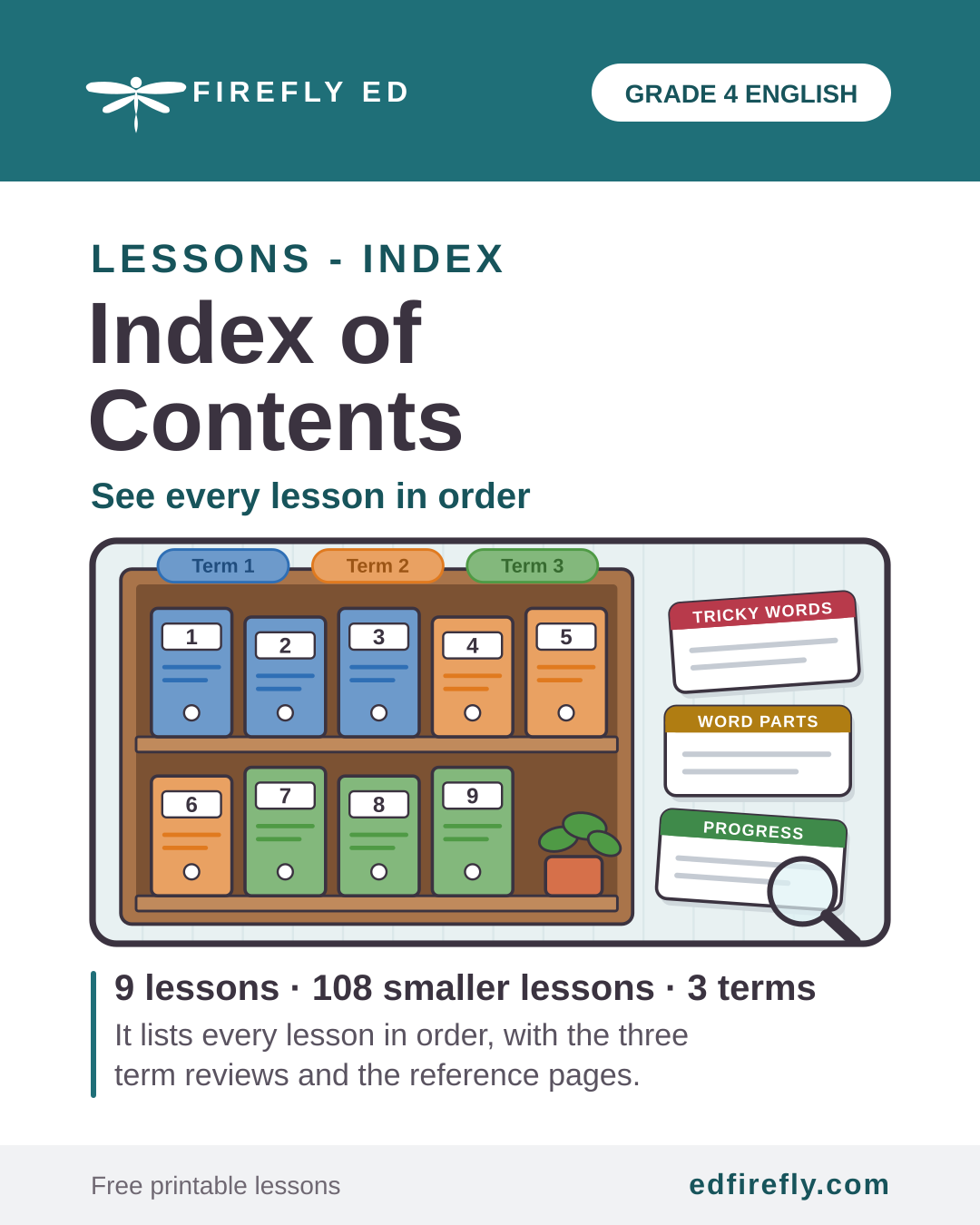
This page has the three phonics lessons of Lesson 5, Choosing and Leading: Lessons 5.9, 5.10 and 5.11. The Lesson 5 page has the Lesson 5 overview, the Lesson 5 review and the PDF download.
Select a lesson to go straight to it. Each lesson ends with a link back to the top of the page.
- Lesson 5.9: -ant, -ance and -ancy
- Lesson 5.10: -ent, -ence and -ency
- Lesson 5.11: Choosing the Ending, and Tricky Words
Lesson 5.9: -ant, -ance and -ancy
Phonics | About 20 minutes
Term 2 | Level 2
Goal
“I can read and spell words ending in -ant, -ance and -ancy, and use word families to choose the ending.”
Words to know
suffix, word family, adjective, noun, -ant, -ance, -ancy
Wonder
Think about this question before you start. Say your ideas. You will come back to it at the end of the lesson.
Is it importance or importence? How could you find out without a dictionary?
Let’s Learn
The endings -ant, -ance and -ancy often belong to the same word family:
-ant often makes an adjective or a person: observant, assistant.
-ance and -ancy often make a noun: observance, hesitancy.
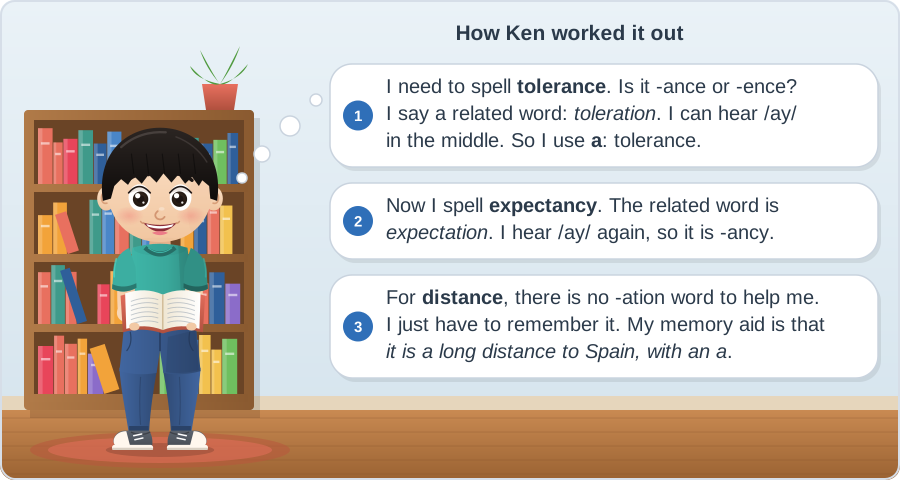
The tip: say a related word ending in -ation. If you can hear an /a/ or /ay/ sound, the ending is probably spelled with an a: hesitation → hesitant. Some words, such as elephant and balance, have no helpful relative, so learn them by sight.
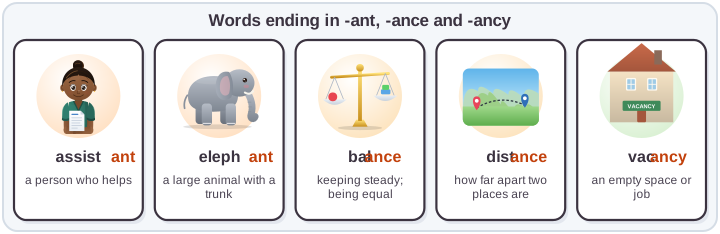
See How It’s Done
Now Try It
1. Use the family: observe → an observ______ child (adjective)
2. Which is correct? importance / importence ______________
Hint: Think of import-ant.
Time To Practise
Name: ______________________
1. Complete the family.
| Verb | -ant | -ance or -ancy |
|---|---|---|
| assist | ||
| hesitate | ||
| tolerate | ||
| observe |
2. Choose the word.
distance important assistant balance vacancy
a) There is a ______________ on the school council, so we need a new member.
b) Voting is an ______________ way to make choices.
c) The teaching ______________ handed out the ballot papers.
d) The ______________ from my house to school is two kilometres.
e) A good leader keeps a ______________ between work and fun.
3. -ant or -ent?
Use the -ation tip. Write the ending.
observ______ (observation) hesit______ (hesitation) expect______ (expectation)
4. Write a sentence.
Write a sentence about a class election. Use important and assistant.
__________________________________________________________________
5. Write from dictation.
Listen as an adult reads a sentence aloud slowly. Write it, and then check each -ant, -ance or -ancy word.
__________________________________________________________________
Reflect
Think about these questions. Talk about them with someone at home or at school.
1. Go back to the Wonder question: “Is it importance or importence? How could you find out without a dictionary?” What do you think now?
2. I was an inquirer today when I ______________________________.
An inquirer asks questions and finds things out. For example: I was an inquirer today when I used a related -ation word to choose the ending.
Take action: Look for words ending in -ant, -ance and -ancy in a newspaper or on signs, and sort them into word families.
Next Steps
If this was easy, try: Make a word family poster for one root word, such as assist, with as many related words as you can find.
If this was hard, go back to: Let’s Learn. Read each row of the word family chart aloud, and point to the ending in each word.
Notes for Parents and Teachers
Show notes for parents and teachers
These notes cover this lesson only. How every lesson runs is explained in How to Use This Material.
Let’s Learn
Say each word together and clap its syllables.
Time To Practise
- Task 5: Read the sentence in the Answer Key slowly. The learner writes it, then checks each -ant, -ance or -ancy word.
Answer Key
Reveal Answers
Now Try It
1. observant 2. importance
1. Complete the family
assistant, assistance; hesitant, hesitance or hesitancy; tolerant, tolerance; observant, observance
2. Choose the word
a) vacancy b) important c) assistant d) distance e) balance
3. -ant or -ent?
observant, hesitant, expectant
4. Sample answer: The assistant said that counting every vote was important.
5. Write from dictation
Dictation sentence: The observant assistant noticed that there was a vacancy on the council.
Reflect
2. Any real moment from the lesson that shows the learner was an inquirer. Examples: “I was an inquirer today when I used a related -ation word to choose the ending.” “I was an inquirer today when I found word families that share an ending.”
Lesson 5.10: -ent, -ence and -ency
Phonics | About 20 minutes
Term 2 | Level 2
Goal
“I can read and spell words ending in -ent, -ence and -ency, and use clues to choose e rather than a.”
Words to know
suffix, soft c, soft g, word family, -ent, -ence, -ency
Wonder
Think about this question before you start. Say your ideas. You will come back to it at the end of the lesson.
Why do you think emergency has an e and not an a in its ending?
Let’s Learn
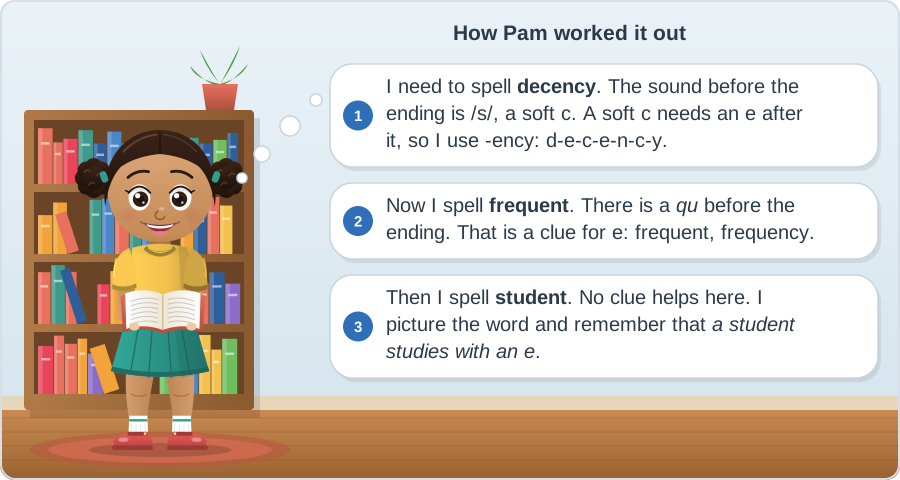
The endings -ent, -ence and -ency sound just like -ant, -ance and -ancy. Two clues tell you to use an e:
Clue 1: a soft c (as in innocent), a soft g (as in emergency) or qu (as in frequent) comes just before the ending. A soft c or g needs an e after it to keep its soft sound.
Clue 2: a related word has a clear /e/ sound: confidential → confident.

Many common words, such as student, parent and silence, have no clue. Learn them by sight, and check in a dictionary.
See How It’s Done
Now Try It
1. Which clue helps you spell innocent? ______________
2. Complete: confid____ce (Hint: think of confidential.) ______________
Time To Practise
Name: ______________________
1. -ant/-ance or -ent/-ence?
Write a or e in each gap.
innoc__nt import__nt emerg__ncy freq__ent (careful!) assist__nce confid__nce dist__nce sil__nce
2. Word families.
frequent → ______________ (noun, -ency) innocent → ______________ (noun, -ence)
decent → ______________ (noun, -ency) confident → ______________ (noun, -ence)
3. Choose the word.
emergency parent silence confidence student
a) Priya spoke with more ______________ at the end of her speech.
b) In an ______________, stay calm and follow the plan.
c) Every ______________ in the class had one vote.
d) There was ______________ while the votes were counted.
e) A ______________ came to watch the talent show.
4. Write a sentence.
Write a sentence about a meeting. Use silence and confident.
__________________________________________________________________
5. Write from dictation.
Listen as an adult reads a sentence aloud slowly. Write it, and then check each ending.
__________________________________________________________________
Reflect
Think about these questions. Talk about them with someone at home or at school.
1. Go back to the Wonder question: “Why do you think emergency has an e and not an a in its ending?” What do you think now?
2. I was a thinker today when I ______________________________.
A thinker thinks carefully to work things out. For example: I was a thinker today when I looked for a soft c or g before choosing the ending.
Take action: Make a two-column list at home: -ant/-ance words and -ent/-ence words. Add to it whenever you find a new one.
Next Steps
If this was easy, try: Find three -ency words in a dictionary, and write their -ent relatives.
If this was hard, go back to: Let’s Learn. Say each picture word, and point to the letter just before the ending.
Notes for Parents and Teachers
Show notes for parents and teachers
These notes cover this lesson only. How every lesson runs is explained in How to Use This Material.
Let’s Learn
Say each word together and clap its syllables.
Time To Practise
- Task 5: Read the sentence in the Answer Key slowly. The learner writes it, then checks each ending.
Answer Key
Reveal Answers
Now Try It
1. The soft c before the ending. 2. confidence
1. -ant/-ance or -ent/-ence?
innocent, important, emergency, frequent (the missing letter is u: frequent), assistance, confidence, distance, silence
2. Word families
frequency, innocence, decency, confidence
3. Choose the word
a) confidence b) emergency c) student d) silence e) parent
4. Sample answer: The chair waited for silence, then spoke in a confident voice.
5. Write from dictation
Dictation sentence: Each student spoke with confidence, and there was silence during the vote.
Reflect
2. Any real moment from the lesson that shows the learner was a thinker. Examples: “I was a thinker today when I looked for a soft c or g before choosing the ending.” “I was a thinker today when I used a related word to choose e or a.”
Lesson 5.11: Choosing the Ending, and Tricky Words
Phonics | About 20 minutes
Term 2 | Level 2
Goal
“I can choose between -ant, -ance, -ancy, -ent, -ence and -ency, and spell six tricky words using memory aids.”
Words to know
ending, word family, soft c, soft g, tricky word, memory aid
Wonder
Think about this question before you start. Say your ideas. You will come back to it at the end of the lesson.
Which is harder to spell, important or innocent? Why?
Let’s Learn
Part 1: a or e?
Ask three questions. Is there a related -ation word? Then use a. Is there a soft c, a soft g or qu before the ending? Then use e. No clue? Learn the word by sight and check in a dictionary.
Part 2: Tricky words
These six words are often spelled wrongly. The tricky letters are in pink. Use the memory aid, then look, say, cover, write and check.
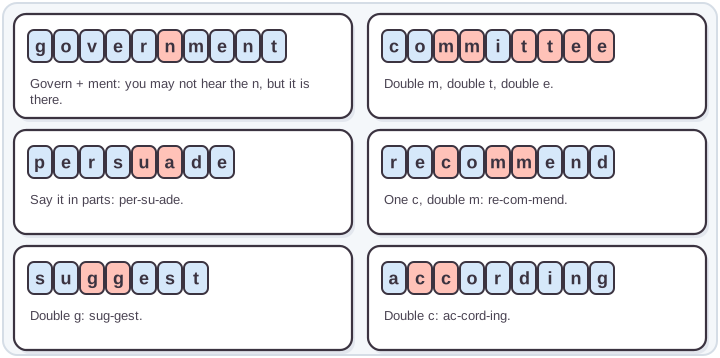
See How It’s Done
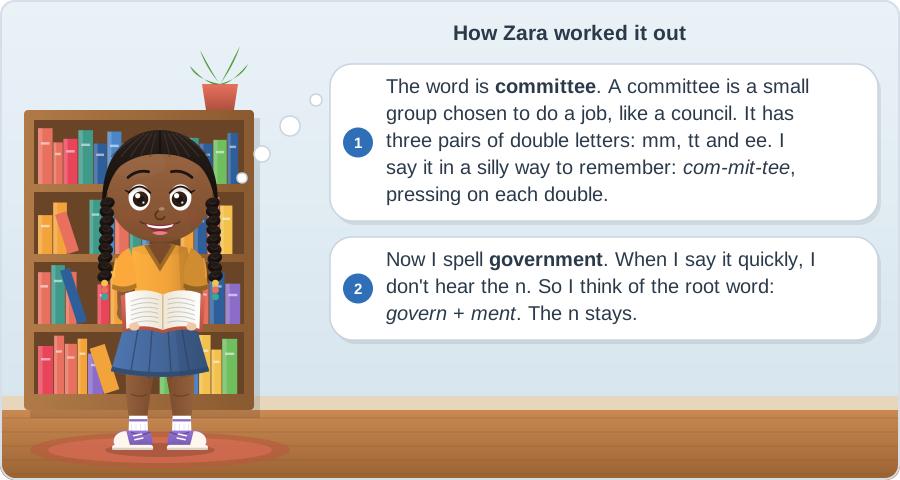
Now Try It
1. a or e? emerg__ncy ______________
Hint: Is there a soft g before the ending?
2. Which root word helps you spell government? ______________
Time To Practise
Name: ______________________
1. Choose the ending.
Write -ant, -ance, -ent or -ence.
assist______ (a helper) innoc______ (not guilty) toler______ (noun) sil______ (noun) observ______ (adjective) confid______ (noun)
2. Fix the spelling.
a) The comittee will reccomend a new rule. ______________ ______________
b) Acording to the minutes, Leo will sugest a date. ______________ ______________
c) She tried to persuaid the goverment. ______________ ______________
3. Look, say, cover, write, check.
| Word | Write it from memory | Tick |
|---|---|---|
| government | | |
| committee | | |
| persuade | | |
| recommend | | |
| suggest | | |
| according | |
4. Use the words.
Write one sentence about a class council that uses two of the tricky words.
__________________________________________________________________
5. Write from dictation.
Listen as an adult reads two sentences aloud slowly. Write them, and then check the tricky words.
__________________________________________________________________
__________________________________________________________________
Reflect
Think about these questions. Talk about them with someone at home or at school.
1. Go back to the Wonder question: “Which is harder to spell, important or innocent? Why?” What do you think now?
2. I was reflective today when I ______________________________.
Being reflective means looking back at your work and thinking how to make it better. For example: I was reflective today when I looked back at my spelling and fixed the tricky letters.
Take action: Make a set of word cards for the six tricky words. Test a family member, then let them test you.
Next Steps
If this was easy, try: Write the minutes of a pretend committee meeting, using all six tricky words.
If this was hard, go back to: Part 2 of Let’s Learn. Spell one tricky word at a time, saying the tricky letters aloud.
Notes for Parents and Teachers
Show notes for parents and teachers
These notes cover this lesson only. How every lesson runs is explained in How to Use This Material.
Let’s Learn
Say each word together.
Time To Practise
- Task 5: Read the two sentences in the Answer Key slowly. The learner writes them and checks the tricky words.
Answer Key
Reveal Answers
Now Try It
1. e (emergency): there is a soft g before the ending. 2. govern
1. Choose the ending
assistant, innocent, tolerance, silence, observant, confidence
2. Fix the spelling
a) committee, recommend b) According, suggest c) persuade, government
4. Sample answer: The committee will suggest a new bench for the playground.
5. Write from dictation
Dictation sentences: The committee will recommend a talent show. According to Priya, we should try to persuade the head teacher.
Reflect
2. Any real moment from the lesson that shows the learner was reflective. Examples: “I was reflective today when I looked back at my spelling and fixed the tricky letters.” “I was reflective today when I chose a memory aid that works for me.”
For Teachers: IB Details
Show IB and curriculum details
IB theme: How we organize ourselves. This theme is about how people work together in groups, how communities make decisions and share responsibilities, and how organisations are run.
Central idea: Groups make fair decisions in different ways, and leaders have responsibilities to the people they lead.
| Lesson | Title | Strand | Key concept |
|---|---|---|---|
| 5.9 | -ant, -ance and -ancy | Reading and spelling | Form |
| 5.10 | -ent, -ence and -ency | Reading and spelling | Form |
| 5.11 | Choosing the Ending, and Tricky Words | Reading and spelling | Form |
Each lesson also matches the national curriculum for England (Year 4) and the US Common Core (Grade 4). The Grade 4 Curriculum Map lists the full standards for every lesson.
← Back to Lesson 5 – Choosing and Leading | Lessons – Index
© 2026 Firefly Ed. All rights reserved. This page may be printed for personal, home and classroom use. It may not be sold, shared online or reproduced for commercial use without written permission. edfirefly.com


Share your thoughts or ask something..