

Term 2 | Level 2 | Phonics focus: a as in ball and father, o as in mother, after w and qu
Lesson 5 – Homes Around the World | Lessons – Index
Lessons
This page has the two listening and speaking lessons of Lesson 5, Homes Around the World: Lessons 5.5 and 5.6. The Lesson 5 page has the Lesson 5 overview, the Lesson 5 review and the PDF download.
Select a lesson to go straight to it. Each lesson ends with a link back to the top of the page.
Lesson 5.5: Would You Rather? Houseboat or Treehouse
Oral | About 20 minutes
Term 2 | Level 2
Goal
“I can share an opinion with two specific reasons, answer a question in a full sentence and listen to another opinion.”
Words to know
opinion, reason, specific, because, also, full sentence
Wonder
Think about this question before you start. Say your ideas. You will come back to it at the end of the lesson.
What would it be like to live in a very different kind of home?
Let’s Learn
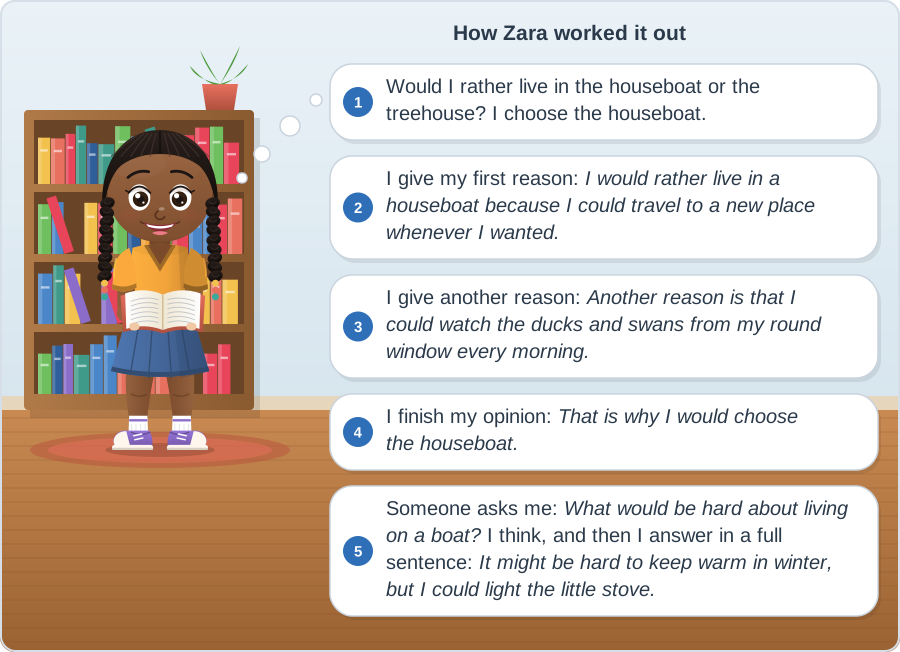
An opinion is what you think. When you share an opinion, give reasons so your listener understands why.
| Part | Talk phrase |
|---|---|
| say your choice | I would rather live in a … |
| first reason | … because … |
| second reason | Also, … Another reason is … |
| finish | That is why I would choose … |
A good reason is specific: not because it is nice, but because I could watch the ducks from my window every morning.
When someone asks you a question, listen to the whole question, think, then answer in a full sentence.
See How It’s Done
Now Try It
1. Which reason is more specific? a) “because it is fun” b) “because I could see right across the park from the top”
Hint: Which one helps you picture it?
2. Say one reason why someone might NOT want to live in a treehouse.
Hint: Think about the weather, or the ladder.
Time To Practise
Name: ______________________
1. Which home does each reason fit?
Write A for the houseboat or B for the treehouse.
a) I could fall asleep to the sound of leaves rustling. ____
b) I could move my home to a new town. ____
c) I could climb a rope ladder to get to my front door. ____
d) I could go fishing from my front deck. ____
2. Plan your opinion.
My choice: I would rather live in a ______________________________
Reason 1: because ______________________________________________
Reason 2: Also, ______________________________________________
A question someone might ask me: ______________________________________________?
My answer: ______________________________________________
3. Share your opinion.
Tell someone at home your choice and your two reasons. Then ask them to ask you one question.
An adult listens, asks you one question, and ticks each one they hear:
☐ said the choice clearly ☐ gave a reason with because ☐ gave a second reason with also or another reason ☐ reasons were specific ☐ listened to the whole question ☐ answered in a full sentence
4. Listen to the other side.
Ask your listener which home they would choose and why. Write one of their reasons.
__________________________________________________________________
Reflect
Think about these questions. Talk about them with someone at home or at school.
1. Go back to the Wonder question: “What would it be like to live in a very different kind of home?” What do you think now?
2. I was open-minded today when I ______________________________.
Being open-minded means listening to other ideas and other ways of doing things. For example: I was open-minded today when I listened to why someone else chose a different home.
Take action: At dinner, ask your family a Would You Rather question about homes, such as a castle or a lighthouse. Everyone gives two reasons.
Next Steps
If this was easy, try: Choose between three homes: a houseboat, a treehouse and a snow house. Give a reason for each one you did not choose.
If this was hard, go back to: Task 2. Give one reason only, with because. Then add a second reason when the first feels easy.
Notes for Parents and Teachers
Show notes for parents and teachers
These notes cover this lesson only. How every lesson runs is explained in How to Use This Material.
Let’s Learn
Look at both pictures and talk about what you notice.
See How It’s Done
Read Zara’s opinion aloud. When you reach the question, ask it, and then read her answer.
Time To Practise
- Task 3: Listen, then ask one question, such as “What would you miss about your house?” Tick each one you hear.
Answer Key
Reveal Answers
Now Try It
1. b), because it tells exactly what you could do.
2. Sample answer: It might be cold and wet in a storm, or the ladder might be hard to climb with shopping.
1. Which home
a) B
b) A
c) B
d) A
2. Plan
Sample answer: I would rather live in a treehouse because I could see right across the park from my window. Also, I could hear the birds singing in the morning. Question: What would you do in a storm? Answer: I would climb down and stay in the house below until it was over.
3. Share
Look for: five or more ticks.
4. Other side
Answers will vary. Look for: the learner listened and wrote the reason accurately.
Reflect
2. Any real moment from the lesson that shows the learner was open-minded. Examples: “I was open-minded today when I listened to why someone else chose a different home.” “I was open-minded today when I asked my partner a question about their choice.”
Lesson 5.6: Listen and Take Notes
Oral | About 20 minutes
Term 2 | Level 2
Goal
“I can listen to a report, take notes with key words, answer questions from my notes and retell the main ideas.”
Words to know
listen, notes, key words, notes grid, retell
Wonder
Think about this question before you start. Say your ideas. You will come back to it at the end of the lesson.
How can we remember what we hear?
Let’s Learn
When you listen to a talk or a report, you cannot remember every word. Notes help you remember the important parts.
- Write key words, not whole sentences: wooden frame, felt, sheep’s wool.
- Listen for numbers, names and reasons.
- Use a notes grid with headings, so you know what to listen for.
- If you miss something, keep listening. You can fill gaps the second time.
Afterwards, use your notes to retell the main ideas in your own words.
See How It’s Done
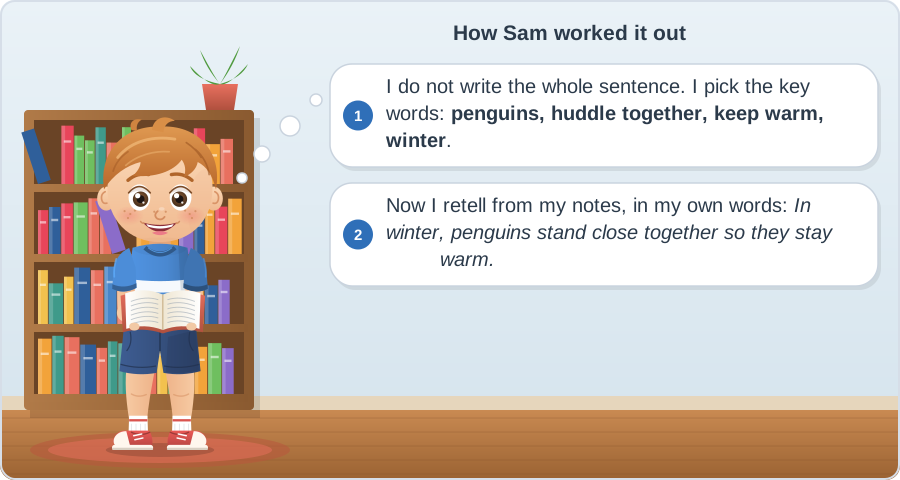
Listen as an adult says: “Penguins in Antarctica huddle together in large groups to keep warm during the long, dark winter.”
Now Try It
Listen as an adult reads each sentence once. Say the key words.
1. “Houses in hot countries often have thick walls and small windows to keep the sun out.”
Hint: Three or four words are enough.
2. “A lighthouse keeper lived in a tall tower and kept the lamp at the top shining all night.”
Hint: Who? Where? What did they do?
Time To Practise
Name: ______________________
1. Listen to the report.
Do not read the report. Listen while an adult reads it aloud twice.
Living in a Ger
In Mongolia, many herding families live in a round tent called a ger. Some people call it a yurt.
A ger has a wooden frame. The walls are made of thin wooden poles that fold out like a fence. The frame is covered with thick felt, which is made from sheep’s wool. The felt keeps the family warm in the freezing winter and cool in the hot summer.
In the middle of the ger, there is a stove for cooking and heating. Its chimney pokes out through a round hole in the roof. The door usually faces south, towards the sun.
Herding families move several times a year to find fresh grass for their sheep, goats, horses and camels. A ger can be taken down in about two hours. Then it is packed onto a truck or onto camels and carried to the next place.
Today, many people in Mongolia live in flats in the city. But many families still use a ger in the countryside, especially in summer.
2. Take notes as you listen.
| Heading | My notes (key words only) |
|---|---|
| Where | ______________________________ |
| Made of | ______________________________ |
| Inside | ______________________________ |
| Why families move | ______________________________ |
| Numbers I heard | ______________________________ |
3. Answer from your notes.
a) What is felt made from? ______________________________
b) How long does it take to take down a ger? ______________________________
c) Why do herding families move several times a year?
__________________________________________________________________
d) Why do you think a ger needs to be easy to take down?
__________________________________________________________________
4. Retell the report.
Use only your notes. Tell someone at home about gers in four or five sentences.
An adult listens and ticks each one they hear:
☐ where gers are found ☐ what they are made of ☐ something inside ☐ why families move ☐ own words, not copied sentences
Reflect
Think about these questions. Talk about them with someone at home or at school.
1. Go back to the Wonder question: “How can we remember what we hear?” What do you think now?
2. I was an inquirer today when I ______________________________.
An inquirer asks questions and finds things out. For example: I was an inquirer today when I wrote key words while I listened to the report about gers.
Take action: Listen to a short news report or a children’s radio programme. Write three key words, then tell someone what it was about.
Next Steps
If this was easy, try: Listen to a longer report or a short documentary clip and take notes under four headings you choose yourself.
If this was hard, go back to: Task 2. Fill in just two headings, Where and Made of, on the first listen. Add the rest on the second listen.
Notes for Parents and Teachers
Show notes for parents and teachers
These notes cover this lesson only. How every lesson runs is explained in How to Use This Material.
Let’s Learn
Show the learner a short shopping list as an example of notes.
See How It’s Done
Say the penguin sentence aloud before Sam’s thoughts.
Now Try It
Read each sentence aloud once. The learner says the key words.
Time To Practise
- Task 1: Read this report aloud twice, at a normal speed. Cover the report, or scroll it out of view, so the learner listens without reading it. On the second reading, pause briefly after each paragraph.
- Task 4: Tick each one you hear.
Answer Key
Reveal Answers
Now Try It
1. Sample answer: hot countries, thick walls, small windows
2. Sample answer: lighthouse keeper, top of tower, lamp, all night
2. Notes
Sample notes: Where: Mongolia. Made of: wooden frame, felt, sheep’s wool. Inside: stove, chimney through roof. Why move: fresh grass for animals. Numbers: about two hours; several times a year.
3. Answers
a) Sheep’s wool
b) About two hours
c) To find fresh grass for their sheep, goats, horses and camels.
d) Sample answer: Because the family moves several times a year, so they need to pack it up quickly and carry it with them.
Look for: in d), the learner links two facts: moving often, and taking it down quickly.
4. Retell
Look for: four or more ticks.
Reflect
2. Any real moment from the lesson that shows the learner was an inquirer. Examples: “I was an inquirer today when I wrote key words while I listened to the report about gers.” “I was an inquirer today when I used my notes to retell the report in my own words.”
For Teachers: IB Details
Show IB and curriculum details
IB theme: Where we are in place and time. This theme is about our place in space and time: our homes and journeys, and how people in different places live, and lived, in different ways.
Central idea: People build homes that suit the place where they live and the way they live.
| Lesson | Title | Strand | Key concept |
|---|---|---|---|
| 5.5 | Would You Rather? Houseboat or Treehouse | Listening and speaking | Perspective |
| 5.6 | Listen and Take Notes | Listening and speaking | Connection |
Each lesson also matches the national curriculum for England (Year 2) and the US Common Core (Grade 2). The Grade 2 Curriculum Map lists the full standards for every lesson.
← Back to Lesson 5 – Homes Around the World | Lessons – Index
© 2026 Firefly Ed. All rights reserved. This page may be printed for personal, home and classroom use. It may not be sold, shared online or reproduced for commercial use without written permission. edfirefly.com


Share your thoughts or ask something..