
Term 2 | Level 2 | Phonics focus: a as in ball and father, o as in mother, after w and qu
Lesson 5 – Homes Around the World | Lessons – Index
Lessons
This page has the two writing lessons of Lesson 5, Homes Around the World: Lessons 5.3 and 5.4. The Lesson 5 page has the Lesson 5 overview, the Lesson 5 review and the PDF download.
Select a lesson to go straight to it. Each lesson ends with a link back to the top of the page.
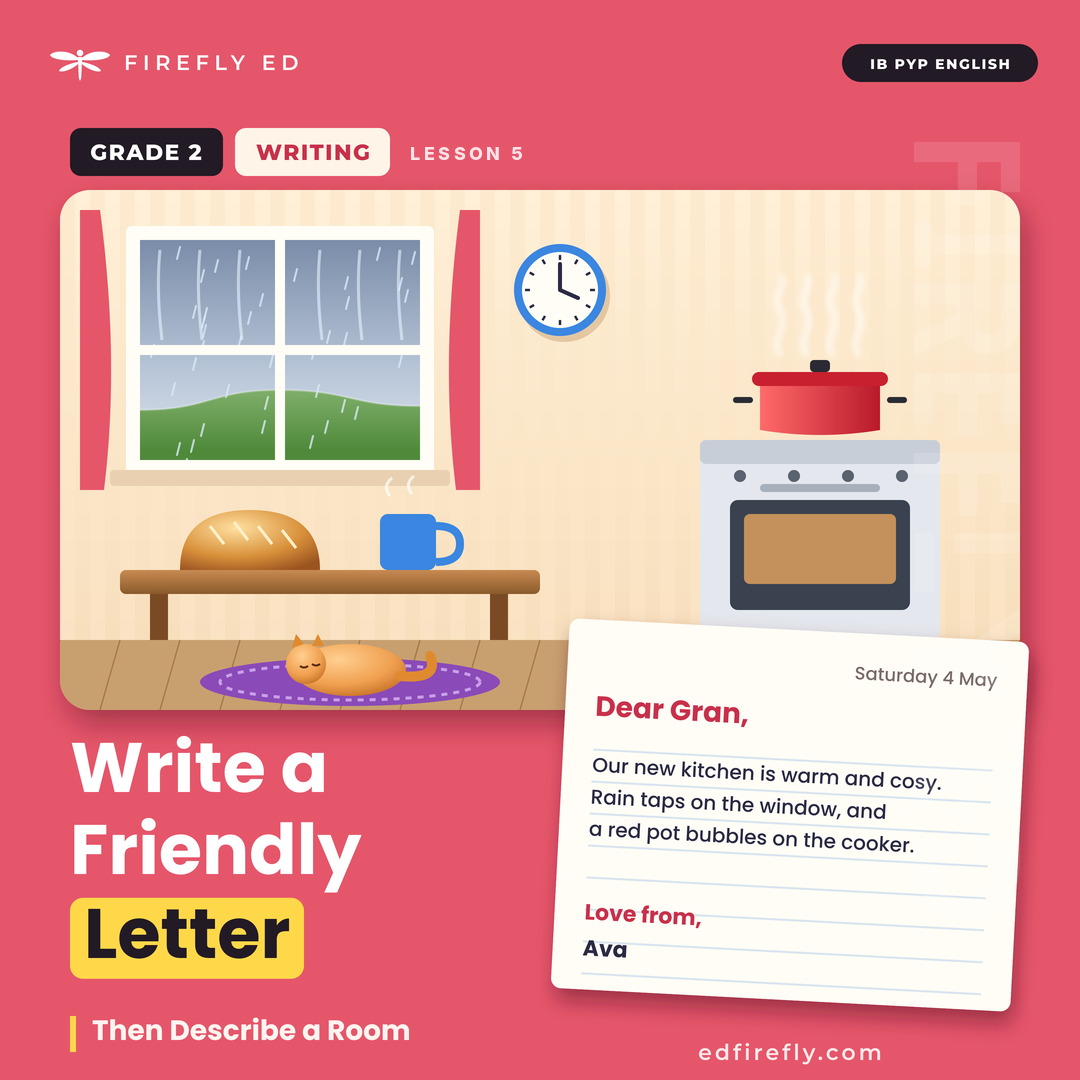
Lesson 5.3: Write a Letter About My Home
Writing | About 20 minutes
Term 2 | Level 2
Goal
“I can write a friendly letter in three paragraphs, with an address, a greeting, questions for my reader and a sign-off.”
Words to know
letter, paragraph, greeting, sign-off, question, reader
Wonder
Think about this question before you start. Say your ideas. You will come back to it at the end of the lesson.
What makes someone excited to read a letter?
Let’s Learn
A friendly letter shares your news with someone. Plan it in paragraphs, with one main idea in each.
| Part | What to write |
|---|---|
| address and date | at the top right |
| greeting | Dear …, (with a comma) |
| paragraph 1 | why you are writing, and describe your home |
| paragraph 2 | your favourite place in your home, and why |
| paragraph 3 | questions for your reader |
| sign-off | Love from, Best wishes from, or Your friend, then your name |
Start a new paragraph when you start a new idea. Leave a line, or start the first word a little way in.
Write to your reader as if you are talking to them. Use you, and ask them questions they can answer when they write back.
See How It’s Done
Now Try It
1. Which paragraph should this sentence go in? My favourite place is my bedroom, because it is cosy.
Hint: Look at the table in Let’s Learn.
2. Turn this into a question for your reader: I want to know about your garden.
Hint: Start with What, Do or Is.
Time To Practise
Name: ______________________
1. Put the letter in order.
Number the parts 1 to 6.
____ Love from your friend, Leo
____ Dear Grandpa,
____ What is your favourite room in your house? Do you still have the big armchair?
____ 5 Hill Street, Bramford. 3rd April
____ My favourite place is the garden shed, because I keep my bike and my seeds there.
____ Thank you for the postcard. We have painted my bedroom blue, and it looks like the sea.
2. Plan your letter.
Choose someone to write to: a friend, a cousin or a grandparent.
| Paragraph | My notes |
|---|---|
| 1. Why I am writing, and my home | ______________________________ |
| 2. My favourite place, and why | ______________________________ |
| 3. Questions for my reader | ______________________________ |
3. Write your letter.
Use your plan. Write three paragraphs. Ask at least two questions.
Address and date: ______________________________
__________________________________________________________________
__________________________________________________________________
__________________________________________________________________
__________________________________________________________________
__________________________________________________________________
__________________________________________________________________
Check your work. Tick each one you did.
☐ address and date ☐ greeting with a comma ☐ three paragraphs ☐ a reason with because ☐ two questions with question marks ☐ a sign-off and name
Reflect
Think about these questions. Talk about them with someone at home or at school.
1. Go back to the Wonder question: “What makes someone excited to read a letter?” What do you think now?
2. I was a communicator today when I ______________________________.
A communicator shares ideas clearly by talking, writing or drawing. For example: I was a communicator today when I wrote my letter in three paragraphs with questions for my reader.
Take action: Post your letter or give it to your reader. When they reply, check: did they answer your questions?
Next Steps
If this was easy, try: Write a letter with four paragraphs, adding one about a place near your home, such as a park or a shop.
If this was hard, go back to: Task 1. Read the parts aloud with an adult first. Then write only paragraphs 1 and 3 of your own letter.
Notes for Parents and Teachers
Show notes for parents and teachers
These notes cover this lesson only. How every lesson runs is explained in How to Use This Material.
Let’s Learn
Look at Priya’s letter in Lesson 5.2 to see the parts.
See How It’s Done
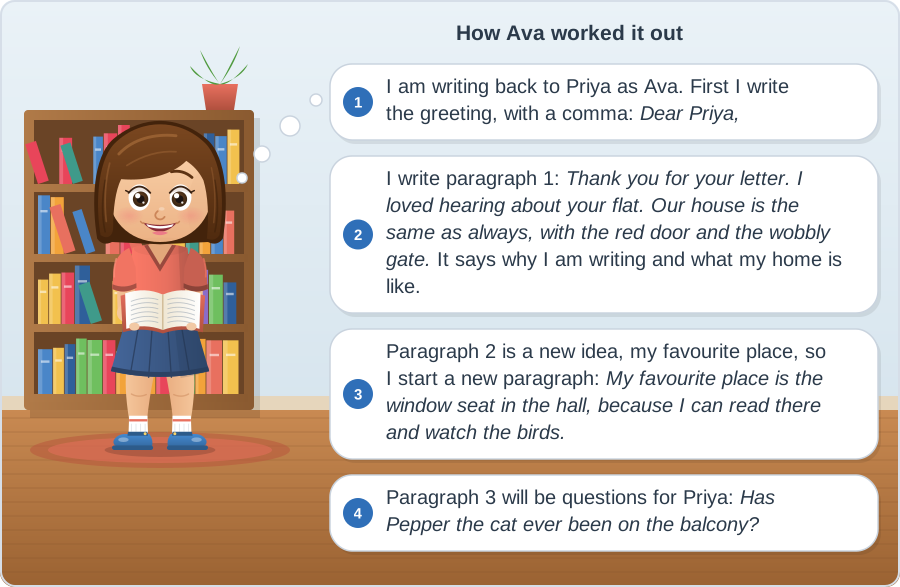
Write the greeting and paragraph 1 on paper as you go through Ava’s thoughts.
Time To Practise
- Task 3: Check the learner’s work together, and tick each one you see.
- Task 3: If you can, post the letter or send a photo of it to the reader.
Answer Key
Reveal Answers
Now Try It
1. Paragraph 2
2. Sample answer: What do you grow in your garden?
1. Order
6 Love from your friend, Leo
2 Dear Grandpa,
5 What is your favourite room in your house? Do you still have the big armchair?
1 5 Hill Street, Bramford. 3rd April
4 My favourite place is the garden shed, because I keep my bike and my seeds there.
3 Thank you for the postcard. We have painted my bedroom blue, and it looks like the sea.
2 and 3. Letter
Sample answer:
12 Park Lane, Applewick. 20th March
Dear Priya,
Thank you for your letter. Your flat sounds amazing! Our house still has the red door and the wobbly gate.
My favourite place is the window seat in the hall, because I can read there and watch the birds in the garden.
Can you see the river from your balcony? What is the best book you have borrowed from the library?
Love from your friend,
Ava
Look for: five or more ticks.
Reflect
2. Any real moment from the lesson that shows the learner was a communicator. Examples: “I was a communicator today when I wrote my letter in three paragraphs with questions for my reader.” “I was a communicator today when I read my letter aloud to check it made sense.”
Lesson 5.4: Describe a Room Using My Senses
Writing | About 20 minutes
Term 2 | Level 2
Goal
“I can describe a room using at least three senses, expanded noun phrases and strong verbs.”
Words to know
describe, senses, expanded noun phrase, strong verb, detail
Wonder
Think about this question before you start. Say your ideas. You will come back to it at the end of the lesson.
How can words make a reader feel as if they are standing in a room?
Let’s Learn
A good description helps the reader feel as if they are in the place. Use your senses, not just your eyes.
| Sense | Ask yourself | Example |
|---|---|---|
| see | What colours, shapes and things are there? | Rain trickles down the misty window. |
| hear | What sounds are there? | The old clock ticks steadily. |
| smell | What can I smell? | The kitchen smells of warm, fresh bread. |
| touch | How do things feel? | The soft rug is warm under my feet. |
Make your nouns more exact with expanded noun phrases: not a pot, but a big red pot. Choose strong verbs: not goes, but trickles, bubbles or creaks.
See How It’s Done
Now Try It
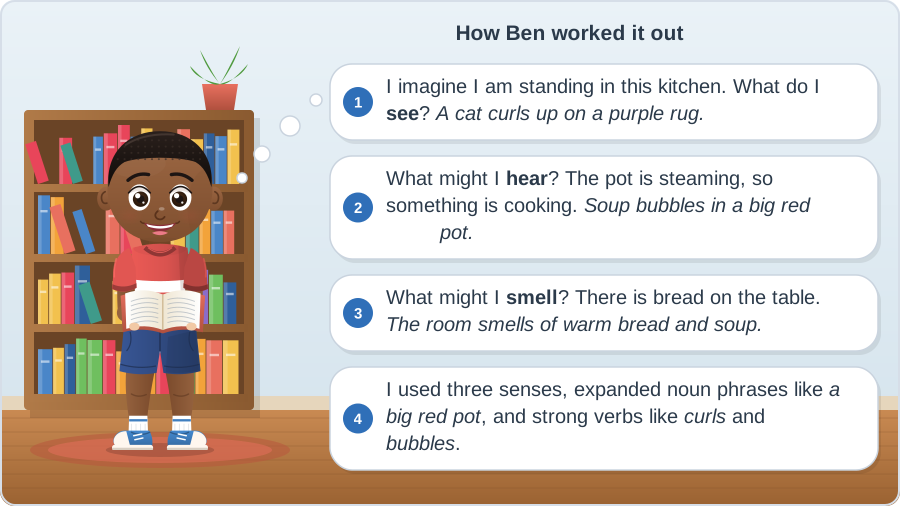
Use the kitchen picture in See How It’s Done.
1. What could you hear in this kitchen? Name two sounds.
Hint: Look at the window and the clock.
2. Make this sentence better: There is a cat.
Hint: Add describing words and a strong verb.
Time To Practise
Name: ______________________
1. Senses in the kitchen.
Look at the kitchen picture in See How It’s Done. Write one thing for each sense.
| See | Hear | Smell | Touch |
|---|---|---|---|
| ______________ | ______________ | ______________ | ______________ |
2. Make the sentences better.
Use an expanded noun phrase or a strong verb.
a) The rain goes on the window. → ______________________________________________
b) There is a mug on the table. → ______________________________________________
c) The room smells nice. → ______________________________________________
3. Describe a room in your home.
Sit quietly in a room for one minute. Notice what you see, hear, smell and feel. Write five sentences. Use at least three senses.
Room: ______________________________
__________________________________________________________________
__________________________________________________________________
__________________________________________________________________
__________________________________________________________________
__________________________________________________________________
Check your work. Tick each one you did.
☐ five sentences ☐ at least three senses ☐ two expanded noun phrases ☐ two strong verbs ☐ capital letters and full stops
Read your description to someone. Can they guess which room it is?
Reflect
Think about these questions. Talk about them with someone at home or at school.
1. Go back to the Wonder question: “How can words make a reader feel as if they are standing in a room?” What do you think now?
2. I was reflective today when I ______________________________.
Being reflective means looking back at your work and thinking how to make it better. For example: I was reflective today when I sat quietly and noticed what I could hear and smell in my room.
Take action: Describe your favourite room to a relative on the phone. Ask them to draw it from your words, then compare.
Next Steps
If this was easy, try: Describe the same room at two different times, such as early morning and late at night. What changes?
If this was hard, go back to: Task 3. Write three sentences: one for see, one for hear and one for smell. Say each sentence aloud first.
Notes for Parents and Teachers
Show notes for parents and teachers
These notes cover this lesson only. How every lesson runs is explained in How to Use This Material.
Let’s Learn
Close your eyes together and name one thing you can hear right now.
See How It’s Done
Look at the kitchen picture together before Ben’s thoughts.
Time To Practise
- Task 3: Check the learner’s work together, and tick each one you see.
Answer Key
Reveal Answers
Now Try It
1. Rain on the window, and the clock ticking. Accept the soup bubbling.
2. Sample answer: A sleepy orange cat curls up on the soft purple rug.
1. Senses
Sample answers: See: rain on the window, a red pot, a cat. Hear: rain tapping, the clock ticking, soup bubbling. Smell: fresh bread, soup. Touch: a warm, soft rug; a hot mug.
2. Better sentences
Sample answers:
a) Heavy rain trickles down the misty window.
b) A spotty red mug of cocoa sits on the wooden table.
c) The room smells of warm bread and tomato soup.
3. Description
Sample answer: My bedroom is small and cosy. Sunlight shines through my yellow curtains. I can hear the birds singing in the tree outside. My fluffy blanket feels soft against my cheek. The room smells of the lavender bag on my shelf.
Look for: four or more ticks, and a listener who can guess the room.
Reflect
2. Any real moment from the lesson that shows the learner was reflective. Examples: “I was reflective today when I sat quietly and noticed what I could hear and smell in my room.” “I was reflective today when I chose strong verbs like trickles and bubbles.”
For Teachers: IB Details
Show IB and curriculum details
IB theme: Where we are in place and time. This theme is about our place in space and time: our homes and journeys, and how people in different places live, and lived, in different ways.
Central idea: People build homes that suit the place where they live and the way they live.
| Lesson | Title | Strand | Key concept |
|---|---|---|---|
| 5.3 | Write a Letter About My Home | Writing | Connection |
| 5.4 | Describe a Room Using My Senses | Writing | Form |
Each lesson also matches the national curriculum for England (Year 2) and the US Common Core (Grade 2). The Grade 2 Curriculum Map lists the full standards for every lesson.
← Back to Lesson 5 – Homes Around the World | Lessons – Index
© 2026 Firefly Ed. All rights reserved. This page may be printed for personal, home and classroom use. It may not be sold, shared online or reproduced for commercial use without written permission. edfirefly.com


Share your thoughts or ask something..