
Term 2 | Level 2 | Phonics focus: a as in ball and father, o as in mother, after w and qu
Lesson 5 – Homes Around the World | Lessons – Index
Lessons
This page has the two viewing and presenting lessons of Lesson 5, Homes Around the World: Lessons 5.7 and 5.8. The Lesson 5 page has the Lesson 5 overview, the Lesson 5 review and the PDF download.
Select a lesson to go straight to it. Each lesson ends with a link back to the top of the page.
Lesson 5.7: Read a Floor Plan
Visual | About 20 minutes
Term 2 | Level 2
Goal
“I can read a floor plan using its key and symbols, follow a route through the rooms and draw a floor plan of my home.”
Words to know
floor plan, bird’s-eye view, symbol, key, wall, doorway
Wonder
Think about this question before you start. Say your ideas. You will come back to it at the end of the lesson.
What would your home look like to a bird flying over with the roof off?
Let’s Learn
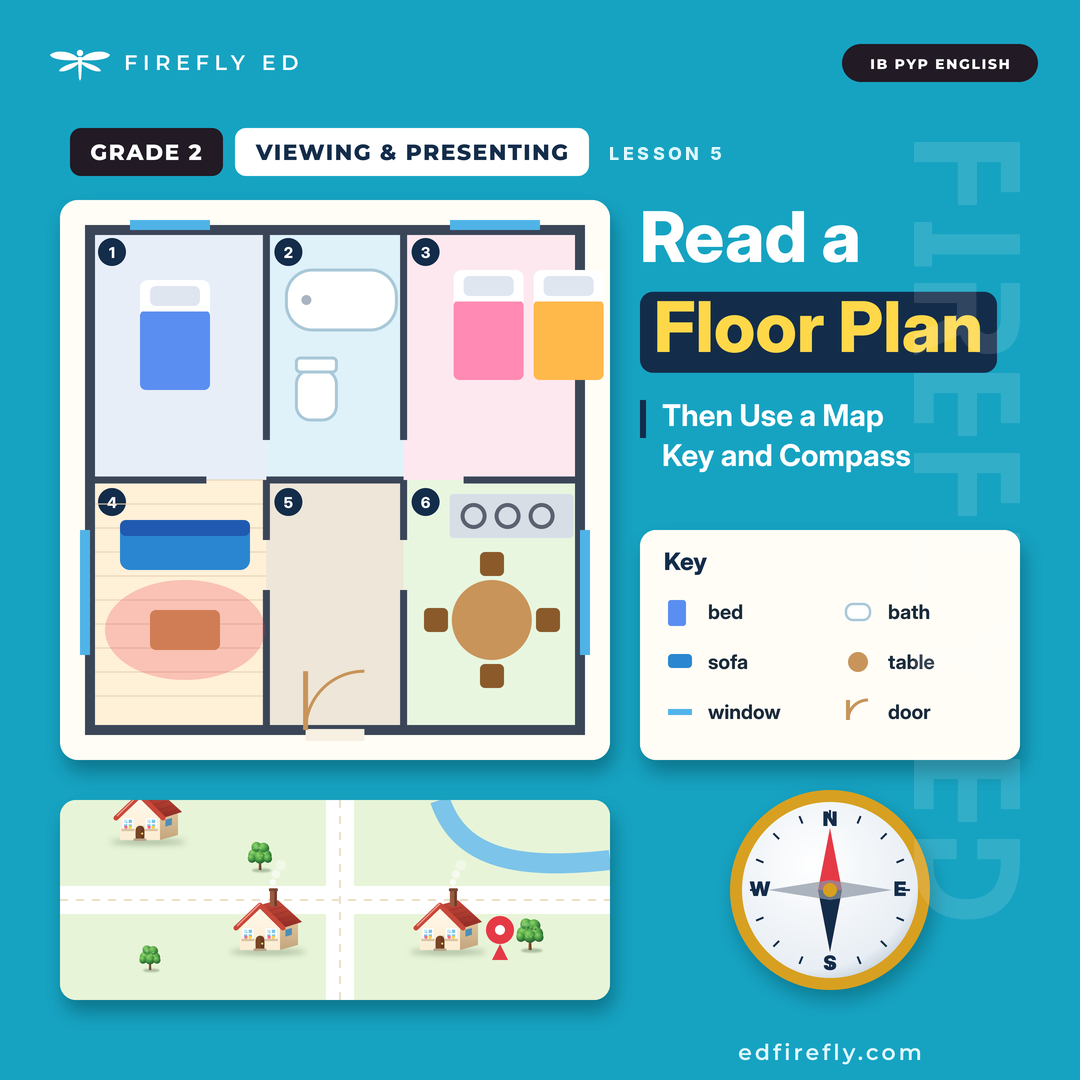
A floor plan is a map of a building. It shows the rooms as if you were a bird looking down from above, with the roof taken off. This is called a bird’s-eye view.
- Thick lines are walls. Gaps in the walls are doorways.
- Small drawings called symbols show furniture, doors and windows.
- The key tells you what each symbol means.
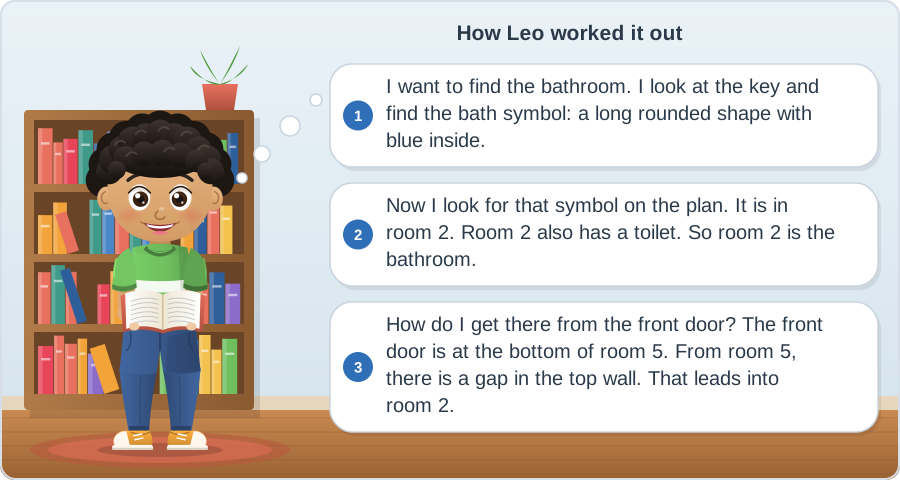
To work out which room is which, look at the furniture. A room with a bath is a bathroom. A room with a cooker is a kitchen.
See How It’s Done
Use the floor plan in Time To Practise.
Now Try It
Use the floor plan in Time To Practise.
1. Which room has the sofa? What kind of room do you think it is?
Hint: Find the sofa symbol in the key first.
2. How many windows does the flat have?
Hint: Look for the blue lines on the outside walls.
Time To Practise
Name: ______________________
1. Read the floor plan.
a) Which room is the kitchen? Room ______ How do you know? ______________________________
b) How many bedrooms are there? ______ How many beds are there altogether? ______
c) Which room do you walk into first through the front door? Room ______
d) From the front door in room 5, which room must you walk through to get to room 3? Room ______
e) Which room has no windows? Room ______
2. Think about the plan.
a) Room 3 has two beds. Who do you think might sleep there?
__________________________________________________________________
b) Why is a key useful on a floor plan?
__________________________________________________________________
3. Draw a floor plan of your home.
Draw your home, or one floor of it, from a bird’s-eye view. Use symbols for at least four things, and make a key. Number the rooms.
Key: ______________________________________________
Check your work. Tick each one you did.
☐ bird’s-eye view ☐ walls and doorways ☐ four or more symbols ☐ a key ☐ numbered rooms
Use your plan to give someone directions from the front door to your bedroom.
Reflect
Think about these questions. Talk about them with someone at home or at school.
1. Go back to the Wonder question: “What would your home look like to a bird flying over with the roof off?” What do you think now?
2. I was a thinker today when I ______________________________.
A thinker thinks carefully to work things out. For example: I was a thinker today when I used the key to work out which room was the kitchen.
Take action: Use your floor plan to play a treasure hunt: hide a small toy and give the room number and a clue.
Next Steps
If this was easy, try: Design a floor plan for your dream home, such as a treehouse or a houseboat, with a key of at least six symbols.
If this was hard, go back to: Task 1. Answer a) and c) first with an adult, pointing to each symbol in the key. Then try the others.
Notes for Parents and Teachers
Show notes for parents and teachers
These notes cover this lesson only. How every lesson runs is explained in How to Use This Material.
Let’s Learn
Look down at a table from above together, then look at it from the side.
See How It’s Done
Trace the route on the plan with your finger as you go through Leo’s thoughts.
Time To Practise
- Task 3: Check the learner’s work together, and tick each one you see.
Answer Key
Reveal Answers
Now Try It
1. Room 4. It is probably the living room.
2. Five
1. Read the plan
a) Room 6. It has a cooker and a table with chairs.
b) Two bedrooms (rooms 1 and 3). Three beds altogether.
c) Room 5
d) Room 6
e) Room 5
Look for: in d), the learner traces the path: room 5, through the doorway into room 6, then up into room 3.
2. Think
a) Sample answer: Two children, such as a brother and a sister, because there are two single beds.
b) Sample answer: It tells you what each symbol means, so you can tell what is in each room.
3. Your floor plan
Look for: four or more ticks, and directions that match the plan.
Reflect
2. Any real moment from the lesson that shows the learner was a thinker. Examples: “I was a thinker today when I used the key to work out which room was the kitchen.” “I was a thinker today when I traced the route through the flat to room 3.”
Lesson 5.8: Read a Map With a Key and a Compass
Visual | About 20 minutes
Term 2 | Level 2
Goal
“I can use a key and a compass to find places on a map, follow directions and give my own directions using north, south, east and west.”
Words to know
map, key, symbol, compass, north, east
Wonder
Think about this question before you start. Say your ideas. You will come back to it at the end of the lesson.
How do maps help us find our way?
Let’s Learn
A map shows a place from above. Two tools help you read it.
- The key shows what each symbol on the map means.
- The compass shows the four directions: north, east, south and west. On most maps, north is at the top.
A way to remember the order going clockwise from the top: Never Eat Soggy Waffles.
We use directions to say where places are: The pond is north of the bus stop. The shop is west of the houses.
See How It’s Done
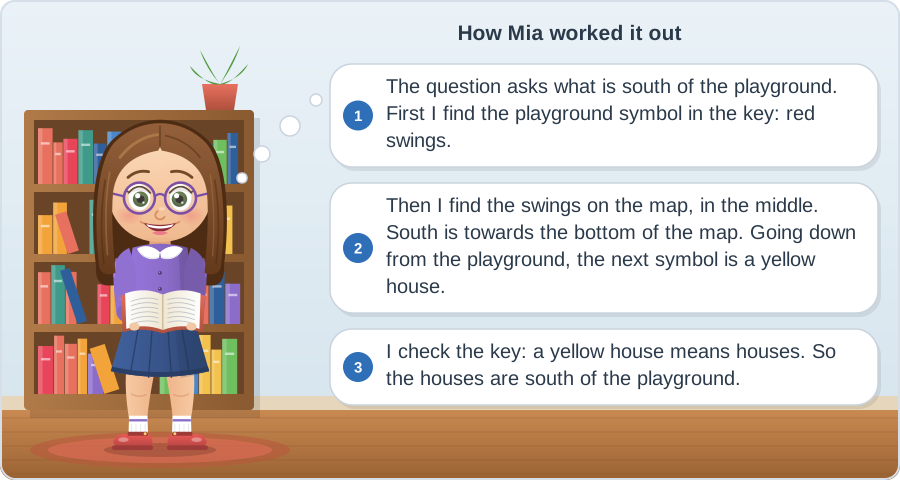
Use the village map in Time To Practise.
Now Try It
Use the village map in Time To Practise.
1. What is north of the library?
Hint: Find the library in the key, then look towards the top of the map.
2. Is the farm east or west of the river?
Hint: Look at the compass. Which side is E?
Time To Practise
Name: ______________________
1. Read the map.
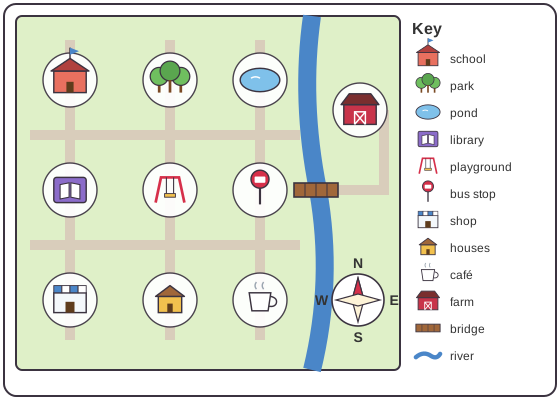
a) What is east of the school? ______________________________
b) What is west of the café? ______________________________
c) Which place is south of the bus stop? ______________________________
d) What must you cross to go from the bus stop to the farm? ______________________________
2. Follow the directions.
Hint: Move one place at a time, along the roads.
a) Start at the shop. Go north two places. Where are you? ______________
b) Start at the houses. Go east one place, then north one place. Where are you? ______________
c) Start at the pond. Go west two places, then south one place. Where are you? ______________
3. Give directions.
Write directions from the library to the pond. Use north, south, east or west.
__________________________________________________________________
Now make up your own direction puzzle on the map for someone at home. Can they find the place?
Reflect
Think about these questions. Talk about them with someone at home or at school.
1. Go back to the Wonder question: “How do maps help us find our way?” What do you think now?
2. I was a thinker today when I ______________________________.
A thinker thinks carefully to work things out. For example: I was a thinker today when I used the compass to say what was north of the library.
Take action: On your next walk, work out which way is north. Then say what is north, south, east and west of your home.
Next Steps
If this was easy, try: Draw a map of your street or a park you know, with a compass and a key of at least six symbols.
If this was hard, go back to: Task 1. Find each place in the key first and put a finger on it on the map. Then answer the questions.
Notes for Parents and Teachers
Show notes for parents and teachers
These notes cover this lesson only. How every lesson runs is explained in How to Use This Material.
Let’s Learn
If you have a real map at home, find its key and compass together.
See How It’s Done
Point to the key, then the map, as you go through Mia’s thoughts.
Answer Key
Reveal Answers
Now Try It
1. The school
2. East
1. Read the map
a) The park
b) The houses
c) The café
d) The river (over the bridge)
2. Directions
a) The school
b) The bus stop
c) The library
Look for: in c), the learner goes west past the park to the school, then south to the library.
3. Your directions
Sample answer: From the library, go east two places to the bus stop. Then go north one place to the pond. (Also correct: go north to the school, then east two places to the pond.)
Reflect
2. Any real moment from the lesson that shows the learner was a thinker. Examples: “I was a thinker today when I used the compass to say what was north of the library.” “I was a thinker today when I followed the directions one place at a time.”
For Teachers: IB Details
Show IB and curriculum details
IB theme: Where we are in place and time. This theme is about our place in space and time: our homes and journeys, and how people in different places live, and lived, in different ways.
Central idea: People build homes that suit the place where they live and the way they live.
| Lesson | Title | Strand | Key concept |
|---|---|---|---|
| 5.7 | Read a Floor Plan | Viewing | Form |
| 5.8 | Read a Map With a Key and a Compass | Viewing | Connection |
Each lesson also matches the national curriculum for England (Year 2) and the US Common Core (Grade 2). The Grade 2 Curriculum Map lists the full standards for every lesson.
← Back to Lesson 5 – Homes Around the World | Lessons – Index
© 2026 Firefly Ed. All rights reserved. This page may be printed for personal, home and classroom use. It may not be sold, shared online or reproduced for commercial use without written permission. edfirefly.com


Share your thoughts or ask something..