

Term 2 | Level 2 | Phonics focus: ai/ay, ee/ea, oa/ow, -ing, -ed
Lesson 5 – Food and Celebrations | Lessons – Index
Lessons
This page has the three phonics lessons in Lesson 5, Food and Celebrations: Lessons 5.9, 5.10 and 5.11. The Lesson 5 page has the Lesson 5 overview, the Lesson 5 review and the PDF download.
Select a lesson to go straight to it. Each lesson ends with a link back to the top of the page.
Lesson 5.9: ai and ay
Phonics | About 20 minutes
Term 2 | Level 2
Goal
“I can read and spell words with ai and ay, and choose the right one.”
Words to know
vowel team, ai, ay, middle, end
Wonder
Think about this question before you start. Say your ideas. You will come back to it at the end of the lesson.
Can two different letter teams make the same sound?
Let’s Learn
Two letters can work as a team to make one vowel sound. We call them a vowel team.
ai and ay both say /ay/, like the letter name A.
Use ai in the middle of a word: rain, paint. Use ay at the end of a word: play, day.
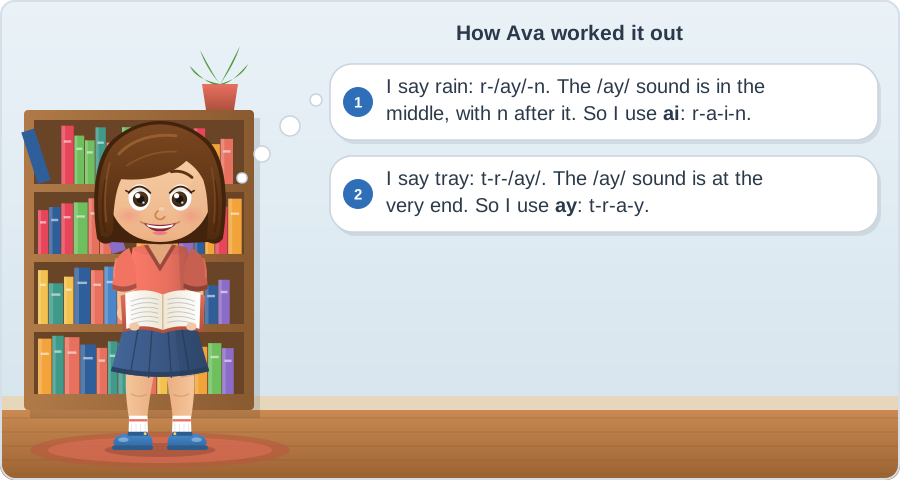
See How It’s Done
Now Try It
1. Say “snail”. Is the /ay/ sound in the middle or at the end? Which team do you use?
Hint: Is there a sound after /ay/?
2. Say “hay”. Which team do you use?
Hint: The /ay/ is the last sound.
Time To Practise
Name: ______________________
1. ai or ay?
Listen as an adult names each picture.
Circle the team you hear in each word.
a) ai ay b) ai ay c) ai ay d) ai ay e) ai ay
2. Sort by where the sound is.
Words: rain | day | paint | play | wait | stay | tail | tray
ai (middle): ____________ ____________ ____________ ____________
ay (end): ____________ ____________ ____________ ____________
3. Write and read.
Listen as an adult names each picture.
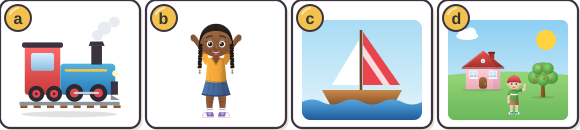
a) Write ai or ay.
tr ___ ___ n pl ___ ___ s ___ ___ l d ___ ___
b) Read: On Holi, we play with colours all day. Underline the ai and ay words.
c) Write your own sentence about a celebration. Use one ai or ay word.
______________________________________________
Reflect
Think about these questions. Talk about them with someone at home or at school.
1. Go back to the Wonder question: “Can two different letter teams make the same sound?” What do you think now?
2. I was a thinker today when I ______________________________.
A thinker thinks carefully to work things out. For example: I was a thinker today when I worked out if a word uses ai or ay.
Take action: Make a celebration word list with ai and ay words, such as play, day, tray and paint.
Next Steps
If this was easy, try: Find ai and ay words in a book about a festival. Sort them into two lists.
If this was hard, go back to: See How It’s Done. Use only four words: rain, tail, day, play. Ask each time: Is the /ay/ in the middle or at the end?
Notes for Parents and Teachers
Show notes for parents and teachers
These notes cover this lesson only. How every lesson runs is explained in How to Use This Material.
Let’s Learn
Point to where each vowel team sits in its word.
See How It’s Done
Say each word slowly and point to where the /ay/ sound is as you go through Ava’s thoughts.
Answer Key
Reveal Answers
Now Try It
1. In the middle, so ai: snail
2. ay: hay
1. ai or ay?
a) ai (rain)
b) ai (snail)
c) ay (tray)
d) ai (paint)
e) ay (hay)
2. Sort by where the sound is
ai: rain, paint, wait, tail
ay: day, play, stay, tray
3. Write and read
a) train, play, sail, day
b) play, day
c) Sample answer: We ate cake on my birthday.
Look for: ai in the middle and ay at the end. “birthday” ends in ay, which follows the rule.
Reflect
2. Any real moment from the lesson that shows the learner was a thinker. Examples: “I was a thinker today when I worked out if a word uses ai or ay.” “I was a thinker today when I sorted words by where the sound is.”
Lesson 5.10: ee and ea
Phonics | About 20 minutes
Term 2 | Level 2
Goal
“I can read and spell words with ee and ea.”
Words to know
vowel team, ee, ea, long e
Wonder
Think about this question before you start. Say your ideas. You will come back to it at the end of the lesson.
What sweet treats have the ee or ea sound?
Let’s Learn
ee and ea are both vowel teams. They both say /ee/, like the letter name E.
There is no easy rule for which one to use. We learn each word by looking at it closely.
Tip: if you are not sure, write the word both ways. Then pick the one that looks right, and check it in a book.
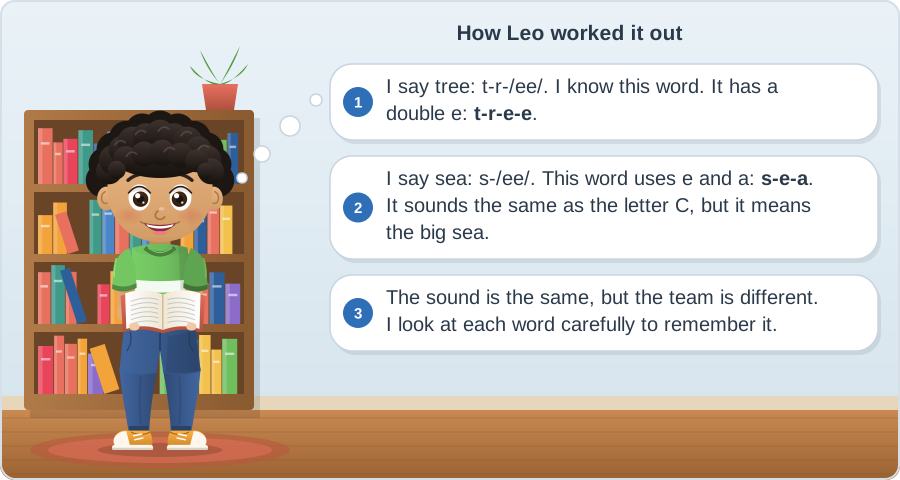
See How It’s Done
Now Try It
1. Read this word: feet. Which team makes the /ee/ sound?
Hint: Look at the middle letters.
2. Read this word: tea. Which team makes the /ee/ sound?
Hint: Look at the end of the word.
Time To Practise
Name: ______________________
1. ee or ea?
Read each word. Circle the team it uses.
a) tree: ee ea b) feet: ee ea c) sea: ee ea d) tea: ee ea e) cheese: ee ea
2. Sort the party food.
Words: sweets | peas | cheese | tea | beans | seeds
ee: ____________ ____________ ____________
ea: ____________ ____________ ____________
3. Read and write.
a) Read: At the feast, we eat sweets and green peas. Underline every ee and ea word.
b) Write a party food list with three ee or ea words.
1. ____________ 2. ____________ 3. ____________
c) Write a sentence about your favourite treat. Use an ee or ea word.
______________________________________________
Reflect
Think about these questions. Talk about them with someone at home or at school.
1. Go back to the Wonder question: “What sweet treats have the ee or ea sound?” What do you think now?
2. I was a risk-taker today when I ______________________________.
A risk-taker tries something new, even when it feels hard. For example: I was a risk-taker today when I tried to read new ee and ea words.
Take action: Write a party food list with ee and ea words, such as sweets, tea and peas.
Next Steps
If this was easy, try: Write a menu for a party with five ee and ea foods, such as peas, beans, cheese and sweets.
If this was hard, go back to: See How It’s Done. Learn two ee words and two ea words at a time. Write each one three times and read it back.
Notes for Parents and Teachers
Show notes for parents and teachers
These notes cover this lesson only. How every lesson runs is explained in How to Use This Material.
Let’s Learn
Point to each vowel team.
See How It’s Done
Write each word and point to the vowel team as you go through Leo’s thoughts.
Answer Key
Reveal Answers
Now Try It
1. ee
2. ea
1. ee or ea?
a) ee
b) ee
c) ea
d) ea
e) ee
2. Sort the party food
ee: sweets, cheese, seeds
ea: peas, tea, beans
3. Read and write
a) feast, eat, sweets, green, peas
b) Sample answer: sweets, peas, tea
c) Sample answer: My favourite treat is a sweet peach.
Look for: words spelled with the correct team. If a learner writes “swets” or “pease”, show the word and ask them to find the team.
Reflect
2. Any real moment from the lesson that shows the learner was a risk-taker. Examples: “I was a risk-taker today when I tried to read new ee and ea words.” “I was a risk-taker today when I had a go at spelling a word I was not sure of.”
Lesson 5.11: oa and ow, -ing and -ed
Phonics | About 20 minutes
Term 2 | Level 2
Goal
“I can read and spell words with oa and ow, and add -ing and -ed to action words.”
Words to know
vowel team, oa, ow, -ing, -ed
Wonder
Think about this question before you start. Say your ideas. You will come back to it at the end of the lesson.
How does a word change when something is happening now or has already happened?
Let’s Learn
oa and ow are both vowel teams. They both say /oa/, like the letter name O.
oa is often in the middle of a word, as in boat and coat. ow is often at the end of a word, as in snow and grow.
We can add -ing or -ed to an action word. -ing tells us it is happening now: I am cooking. -ed tells us it already happened: I cooked.
The -ed ending can sound like /t/, /d/ or /id/, but we always spell it e-d.
See How It’s Done

Now Try It
1. Say this word: goat. Do you spell the /oa/ sound with oa or ow?
Hint: Is the sound in the middle or at the end?
2. Finish this sentence: “Yesterday I ______ the eggs.” Use the word mix.
Hint: It already happened. Which ending do we add?
Time To Practise
Name: ______________________
1. oa or ow?
Listen as an adult names each picture.
Write oa or ow to finish each word.
a) c ___ t b) sn ___ c) b ___ t d) t ___ st e) b ___ l
2. Now or already?
Add -ing and -ed to each cooking word.
| Word | Now (-ing) | Already (-ed) |
|---|---|---|
| cook | cooking | cooked |
| fill | ____________ | ____________ |
| toast | ____________ | ____________ |
| melt | ____________ | ____________ |
3. Cooking day
a) Circle the right word.
1. Now Mum is (mixed / mixing) the eggs in a bowl.
2. Last night we (cooked / cooking) soup.
3. Look! The cheese is (melting / melted) on the toast right now.
4. Yesterday Dad (toasting / toasted) the bread.
b) Write two sentences about cooking with your family. Use -ing in one and -ed in the other.
______________________________________________
______________________________________________
Reflect
Think about these questions. Talk about them with someone at home or at school.
1. Go back to the Wonder question: “How does a word change when something is happening now or has already happened?” What do you think now?
2. I was knowledgeable today when I ______________________________.
Being knowledgeable means knowing things and using what you know. For example: I was knowledgeable today when I added -ing and -ed to cooking words.
Take action: Help cook with an adult. Say what you are doing with -ing, then what you did with -ed.
Next Steps
If this was easy, try: Write three sentences about a snow day. Use one oa word, one ow word and one -ed word.
If this was hard, go back to: See How It’s Done. Practise oa and ow first with boat, coat, snow and grow. Then add -ing and -ed to one word at a time, such as cook.
Notes for Parents and Teachers
Show notes for parents and teachers
These notes cover this lesson only. How every lesson runs is explained in How to Use This Material.
Let’s Learn
Point to each vowel team and each ending.
See How It’s Done
Write each word and point to the vowel team or the ending as you go through Zara’s thoughts.
Answer Key
Reveal Answers
Now Try It
1. oa: g-o-a-t (the sound is in the middle)
2. mixed
1. oa or ow?
a) coat
b) snow
c) boat
d) toast
e) bowl
2. Now or already?
fill: filling, filled
toast: toasting, toasted
melt: melting, melted
3. Cooking day
a) 1. mixing 2. cooked 3. melting 4. toasted
b) Sample answer: I am mixing the eggs. Last week we toasted bread.
Look for: -ing used for now and -ed used for the past, and -ed spelled e-d even when it sounds like /t/. Note: bowl uses ow in the middle. It is one to learn by sight. Also note that ow can say /ow/ as in cow. That comes in Lesson 7.
Reflect
2. Any real moment from the lesson that shows the learner was knowledgeable. Examples: “I was knowledgeable today when I added -ing and -ed to cooking words.” “I was knowledgeable today when I used oa and ow to spell words.”
For Teachers: IB Details
Show IB and curriculum details
IB theme: How we express ourselves. This theme is about how we find and share ideas, feelings, culture and beliefs: through creativity, through the different ways we communicate, and through how others respond.
Central idea: People share food and celebrations to express who they are and what they value.
| Lesson | Title | Strand | Key concept |
|---|---|---|---|
| 5.9 | ai and ay | Reading and spelling | Connection |
| 5.10 | ee and ea | Reading and spelling | Connection |
| 5.11 | oa and ow, -ing and -ed | Reading and spelling | Connection |
Each lesson also matches the national curriculum for England (Year 1) and the US Common Core (Grade 1). The Grade 1 Curriculum Map lists the full standards for every lesson.
← Back to Lesson 5 – Food and Celebrations | Lessons – Index
© 2026 Firefly Ed. All rights reserved. This page may be printed for personal, home and classroom use. It may not be sold, shared online or reproduced for commercial use without written permission. edfirefly.com


Share your thoughts or ask something..