
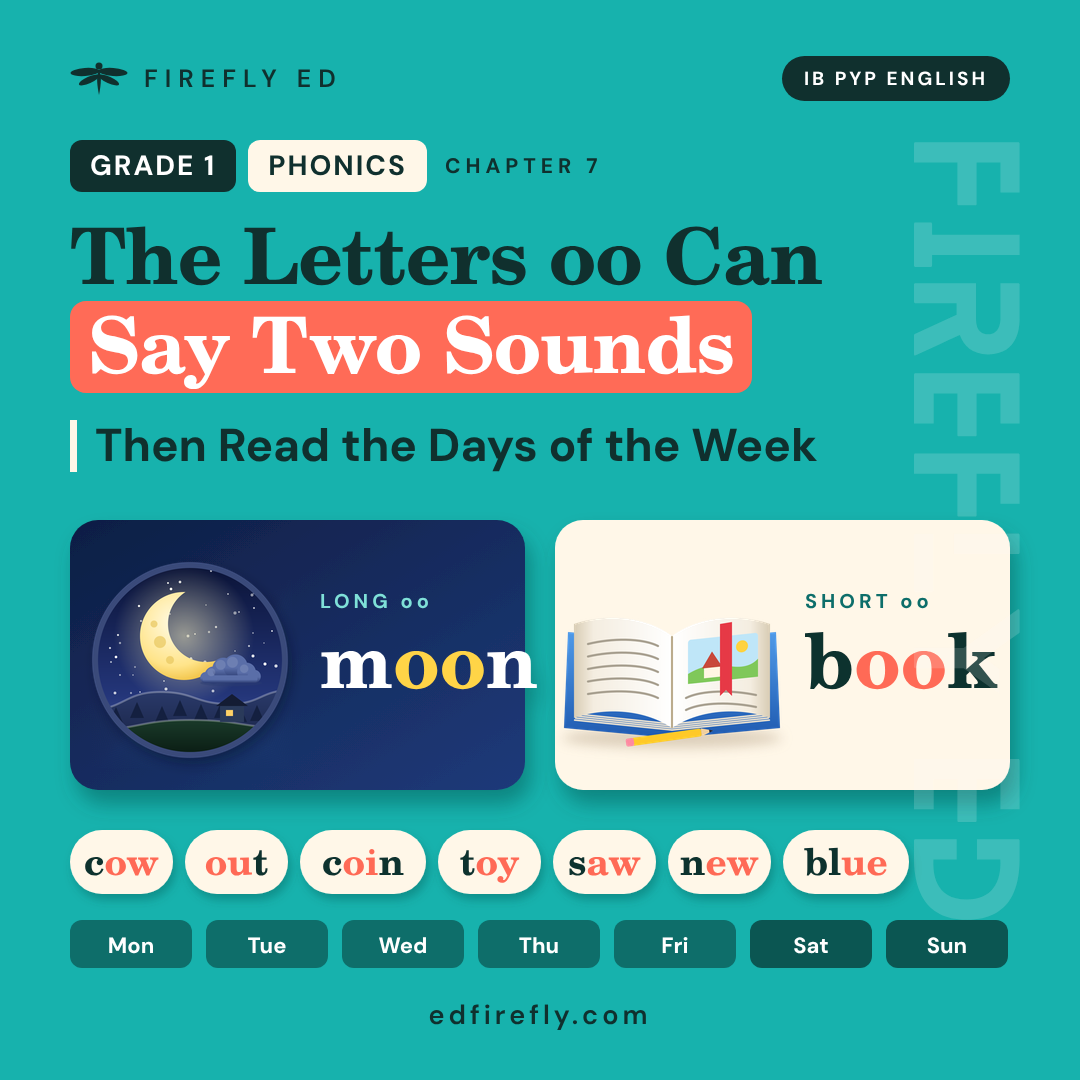
Term 3 | Level 3 | Phonics focus: oo, ou/ow, oi/oy, aw/au, ew/ue, days of the week
Lesson 7 – Weather and Seasons | Lessons – Index
Lessons
This page has the three phonics lessons in Lesson 7, Weather and Seasons: Lessons 7.9, 7.10 and 7.11. The Lesson 7 page has the Lesson 7 overview, the Lesson 7 review and the PDF download.
Select a lesson to go straight to it. Each lesson ends with a link back to the top of the page.
- Lesson 7.9: oo, ou and ow
- Lesson 7.10: oi, oy, aw and au
- Lesson 7.11: ew, ue and the Days of the Week
Lesson 7.9: oo, ou and ow
Phonics | About 20 minutes
Term 3 | Level 3
Goal
“I can read and sort words with oo, ou and ow.”
Words to know
long oo, short oo, ou, ow
Wonder
Think about this question before you start. Say your ideas. You will come back to it at the end of the lesson.
What weather words have oo, ou or ow in them?
Let’s Learn
oo can make two sounds. It can be long, as in moon and spoon, or short, as in book and foot. If one sound does not make a real word, try the other.
ou and ow both say /ow/, the sound you make when you get hurt: ow! We hear it in out, cloud, cow and town.
ou is often in the middle of a word. ow is often at the end, or before n or l. Remember that ow can also say /oa/, as in snow.
See How It’s Done

Now Try It
1. Read this word: spoon. Is the oo long, like moon, or short, like book?
Hint: Try both sounds. Which one makes a real word?
2. Say this word: cow. Do you spell the /ow/ sound with ou or ow?
Hint: Is the sound in the middle or at the end?
Time To Practise
Name: ______________________
1. Long oo or short oo?
Words: moon | book | food | foot | spoon | look
Long oo (moon): ____________ ____________ ____________
Short oo (book): ____________ ____________ ____________
2. ou or ow?
Listen as an adult names each picture.
Write ou or ow to finish each word.
a) cl ___ d b) c ___ c) cr ___ n d) m ___ se
3. A storm in town.
Read:
Dark clouds rolled over the town at noon. We took our books and went inside. Soon we heard a loud boom! The rain poured down for an hour. Now the sun is out, and the air is cool and fresh.
a) Find the oo words and the ou or ow words in the story. Write them in the chart.
| oo words | ou and ow words (say /ow/) |
|---|---|
| ______________________________ | ______________________________ |
b) Write two sentences about a storm. Use one oo word and one ou or ow word.
______________________________________________
______________________________________________
Reflect
Think about these questions. Talk about them with someone at home or at school.
1. Go back to the Wonder question: “What weather words have oo, ou or ow in them?” What do you think now?
2. I was a thinker today when I ______________________________.
A thinker thinks carefully to work things out. For example: I was a thinker today when I worked out if oo makes a long or short sound.
Take action: Make a weather word wall with oo, ou and ow words, such as cloud, cool and shower.
Next Steps
If this was easy, try: Make a weather word wall with ten oo, ou and ow words, such as cloud, shower, cool, gloomy and snow.
If this was hard, go back to: See How It’s Done. Practise moon and book, then cloud and cow. Sort six word cards, one team at a time.
Notes for Parents and Teachers
Show notes for parents and teachers
These notes cover this lesson only. How every lesson runs is explained in How to Use This Material.
Let’s Learn
Point to each team as you say the sound.
See How It’s Done
Write each word on paper as you go through Aisha’s thoughts, and point to the letter team.
Time To Practise
- Task 2: Point to each picture and name it first: cl…, c…, cr…, m… (the full words are in the Answer Key).
Answer Key
Reveal Answers
Now Try It
1. long, like moon
2. ow (the sound is at the end)
1. Long oo or short oo?
Long oo: moon, food, spoon
Short oo: book, foot, look
2. ou or ow?
a) cloud
b) cow
c) crown
d) mouse
3. A storm in town
a) oo words: noon, took, books, soon, boom, cool
ou and ow words: clouds, town, our, loud, down, hour, now, out
Note: poured has ou but does not say /ow/, so it does not go in the chart. Praise a learner who notices this. Hour has a silent h.
b) Sample answer: Soon the storm came. The loud thunder made the cow run.
Look for: the correct team in each word. Crown ends in n, and uses ow before the n.
Reflect
2. Any real moment from the lesson that shows the learner was a thinker. Examples: “I was a thinker today when I worked out if oo makes a long or short sound.” “I was a thinker today when I chose ou or ow to spell a word.”
Lesson 7.10: oi, oy, aw and au
Phonics | About 20 minutes
Term 3 | Level 3
Goal
“I can read and spell words with oi, oy, aw and au.”
Words to know
oi, oy, aw, au
Wonder
Think about this question before you start. Say your ideas. You will come back to it at the end of the lesson.
What changes do we see in autumn?
Let’s Learn
oi and oy both say /oi/, as in coin and boy. oi is usually in the middle of a word: coin, soil, noise. oy is usually at the end: boy, toy, joy.
aw and au both say /aw/, as in saw and autumn. aw is often at the end of a word, or before n or l: saw, paw, yawn, crawl. au is usually at the start or in the middle: autumn, August, sauce.
Tip: autumn has a silent n at the end. We write it, but we do not say it.
See How It’s Done


Now Try It
1. Say this word: saw. Is the /aw/ sound spelled aw or au?
Hint: Is the sound at the end or in the middle?
2. Read this word: autumn. Which team is at the start? Which letter is silent?
Hint: Say the word slowly and look at the last letter.
Time To Practise
Name: ______________________
1. oi or oy?
Listen as an adult names each picture.
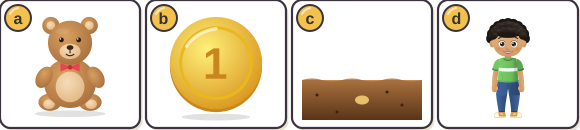
Write oi or oy to finish each word.
a) t ___ b) c ___ n c) s ___ l d) b ___
2. aw or au?
Listen as an adult names each picture.
Write aw or au to finish each word.
a) p ___ b) ___ tumn c) str ___ d) s ___
3. An autumn walk.
Read:
In autumn, Roy and his dad went for a walk in the woods. The leaves were brown and gold. Roy saw a little animal with a nut in its paws. It made a lot of noise in the dry leaves. Then Roy found a shiny coin in the soil. He jumped for joy!
a) Find eight words with oi, oy, aw or au. Write them in the chart.
| oi and oy words | aw and au words |
|---|---|
| ______________________________ | ______________________________ |
b) What do you think the little animal was? Write two sentences. Use one oi or oy word and one aw or au word.
______________________________________________
______________________________________________
Reflect
Think about these questions. Talk about them with someone at home or at school.
1. Go back to the Wonder question: “What changes do we see in autumn?” What do you think now?
2. I was an inquirer today when I ______________________________.
An inquirer asks questions and finds things out. For example: I was an inquirer today when I asked which spelling to use, oi or oy.
Take action: Go on an autumn walk. Collect or draw three things and label them with oi, oy, aw or au words if you can.
Next Steps
If this was easy, try: Go on an autumn walk. Write a list of things you see with oi, oy, aw or au words, such as soil, leaves on the lawn, or a boy with a toy.
If this was hard, go back to: See How It’s Done. Practise coin and boy first. Then saw and autumn. Do Task 1 before moving on to Task 2.
Notes for Parents and Teachers
Show notes for parents and teachers
These notes cover this lesson only. How every lesson runs is explained in How to Use This Material.
Let’s Learn
Point to each team as you say the sound.
See How It’s Done
Write each word on paper as you go through Ben’s thoughts, and point to the letter team.
Time To Practise
- Task 1: Point to each picture and name it first: t…, c…, s…, b… (the full words are in the Answer Key).
- Task 2: Point to each picture and name it first: p…, …mn, st…, s… (the full words are in the Answer Key).
Answer Key
Reveal Answers
Now Try It
1. aw (the sound is at the end)
2. au is at the start. The n at the end is silent.
1. oi or oy?
a) toy
b) coin
c) soil
d) boy
2. aw or au?
a) paw
b) autumn
c) straw
d) saw
3. An autumn walk
a) oi and oy: Roy, noise, coin, soil, joy
aw and au: autumn, saw, paws
b) Sample answer: I think it was a squirrel, because squirrels eat nuts. It held the nut in its paws.
Look for: in part b, a guess with a reason from the text (the nut, the woods); the correct team in each word. Noise has oi in the middle even though it ends in e.
Reflect
2. Any real moment from the lesson that shows the learner was an inquirer. Examples: “I was an inquirer today when I asked which spelling to use, oi or oy.” “I was an inquirer today when I found out when to use aw and when to use au.”
Lesson 7.11: ew, ue and the Days of the Week
Phonics | About 20 minutes
Term 3 | Level 3
Goal
“I can read words with ew and ue, and spell the days of the week.”
Words to know
ew, ue, days of the week, capital letter
Wonder
Think about this question before you start. Say your ideas. You will come back to it at the end of the lesson.
How do the days of the week make a pattern?
Let’s Learn
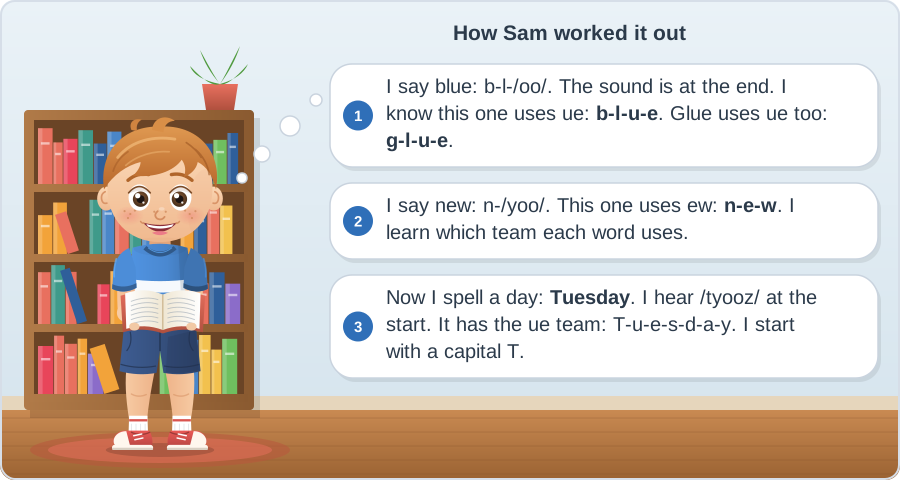
ew and ue both say /oo/ or /yoo/, as in new and blue. Both teams usually come at the end of a word: few, grew, blew, glue, true.
The days of the week always start with a capital letter. They all end with day.
Some days have tricky parts. Tuesday has ue. Thursday has ur. Wednesday has a d we do not say: say it slowly as Wed-nes-day to help you spell it.
See How It’s Done
Now Try It
1. Read this word: stew. Which team makes the /oo/ sound?
Hint: Look at the last two letters.
2. Spell the day that comes after Wednesday.
Hint: Look at the days of the week above. It has ur in it.
Time To Practise
Name: ______________________
1. ew or ue?
Listen as an adult names each picture.
Write ew or ue to finish each word.
a) st ___ b) gl ___ c) bl ___
d) The wind bl ___ the leaves off the tree.
e) Is it tr ___ that it snowed?
2. Days of the week.
a) These days are mixed up. Write them in order, starting with Monday.
Friday Monday Sunday Wednesday Tuesday Saturday Thursday
1. ______________ 2. ______________ 3. ______________ 4. ______________
5. ______________ 6. ______________ 7. ______________
b) Write the missing letters.
W e ___ n e s d a y T ___ ___ s d a y T h ___ ___ s d a y
3. My weather week.
a) Which day comes after Tuesday? ______________
b) Which day comes before Sunday? ______________
c) Write four sentences about the weather this week. Start each one with a day. Use a capital letter for each day.
Example: On Monday, the wind blew hard.
______________________________________________
______________________________________________
______________________________________________
______________________________________________
Reflect
Think about these questions. Talk about them with someone at home or at school.
1. Go back to the Wonder question: “How do the days of the week make a pattern?” What do you think now?
2. I was knowledgeable today when I ______________________________.
Being knowledgeable means knowing things and using what you know. For example: I was knowledgeable today when I put the days of the week in order.
Take action: Make a week planner with the days spelled correctly. Draw the weather for each day.
Next Steps
If this was easy, try: Make a week planner. Write each day with a capital letter, and draw the weather and one thing you did.
If this was hard, go back to: See How It’s Done. Say the days of the week as a chant each morning. Then learn to spell two new days each day.
Notes for Parents and Teachers
Show notes for parents and teachers
These notes cover this lesson only. How every lesson runs is explained in How to Use This Material.
Let’s Learn
Point to each team, then read the days of the week together.
See How It’s Done
Write each word on paper as you go through Sam’s thoughts, and point to the letter team.
Time To Practise
- Task 1: Point to each picture and name it first: st…, gl…, bl… (the full words are in the Answer Key).
Answer Key
Reveal Answers
Now Try It
1. ew
2. Thursday
1. ew or ue?
a) stew
b) glue
c) blue
d) blew
e) true
Note: blew (the wind blew) and blue (the colour) sound the same but have different meanings and spellings.
2. Days of the week
a) Monday, Tuesday, Wednesday, Thursday, Friday, Saturday, Sunday
b) Wednesday (d), Tuesday (u, e), Thursday (u, r)
3. My weather week
a) Wednesday
b) Saturday
c) Sample answer: On Monday, it was sunny and warm. On Tuesday, the wind blew. On Wednesday, it rained all day. On Thursday, I saw a rainbow.
Look for: a capital letter on every day; the days spelled correctly; four sentences that each start with a day.
Reflect
2. Any real moment from the lesson that shows the learner was knowledgeable. Examples: “I was knowledgeable today when I put the days of the week in order.” “I was knowledgeable today when I used ew and ue to spell words.”
For Teachers: IB Details
Show IB and curriculum details
IB theme: How the world works. This theme is about how the natural world works: the patterns we can see in nature, such as weather and seasons, and how these patterns affect people, plants and animals.
Central idea: Weather and seasons change in patterns, and these changes affect how people and other living things live.
| Lesson | Title | Strand | Key concept |
|---|---|---|---|
| 7.9 | oo, ou and ow | Reading and spelling | Connection |
| 7.10 | oi, oy, aw and au | Reading and spelling | Change |
| 7.11 | ew, ue and the Days of the Week | Reading and spelling | Change |
Each lesson also matches the national curriculum for England (Year 1) and the US Common Core (Grade 1). The Grade 1 Curriculum Map lists the full standards for every lesson.
← Back to Lesson 7 – Weather and Seasons | Lessons – Index
© 2026 Firefly Ed. All rights reserved. This page may be printed for personal, home and classroom use. It may not be sold, shared online or reproduced for commercial use without written permission. edfirefly.com


Share your thoughts or ask something..