

Term 2 | Level 2 | Phonics focus: ai/ay, ee/ea, oa/ow, -ing, -ed
Lesson 5 – Food and Celebrations | Lessons – Index
Lessons
This page has the two reading lessons in Lesson 5, Food and Celebrations: Lessons 5.1 and 5.2. The Lesson 5 page has the Lesson 5 overview, the Lesson 5 review and the PDF download.
Select a lesson to go straight to it. Each lesson ends with a link back to the top of the page.
Lesson 5.1: What Kind of Text Is This?
Reading | About 20 minutes
Term 2 | Level 2
Goal
“I can tell whether a text tells a story, gives directions, invites or explains.”
Words to know
purpose, story, directions, invitation, explanation
Wonder
Think about this question before you start. Say your ideas. You will come back to it at the end of the lesson.
Why do people write in so many different ways?
Let’s Learn
Every text has a job. We call this its purpose.
A story tells what happened to characters. Directions tell us how to do something, step by step. An invitation asks someone to come to an event. An explanation tells us why or how something happens.
Clue words help. “Once upon a time” starts a story. “First” and “Next” show directions. “You are invited” starts an invitation. “Because” often shows an explanation.
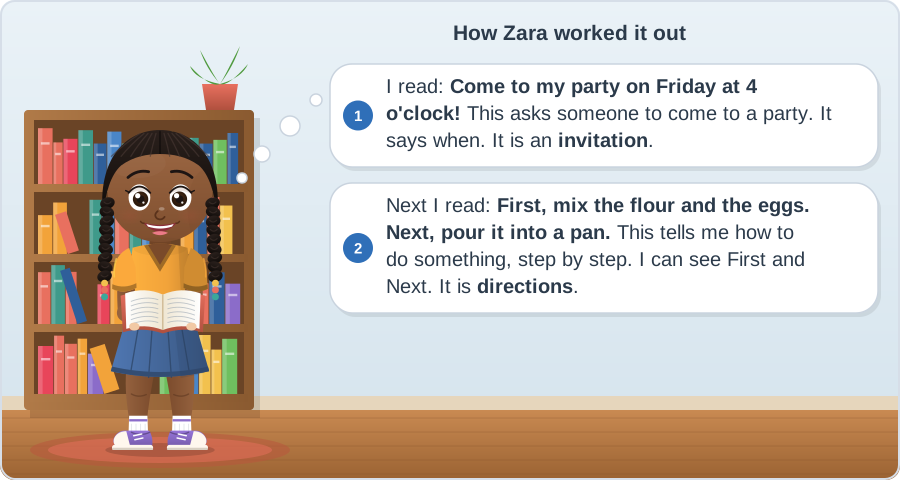
See How It’s Done
Now Try It
Listen as an adult reads each sentence. Then answer.
1. “Once upon a time, a mouse found a big piece of cheese.” What kind of text is this?
Hint: Look at the first four words.
2. “Leaves fall off trees in autumn because the days get shorter and colder.” What kind of text is this?
Hint: Find the word “because”. Does it tell why?
Time To Practise
Name: ______________________
Read with an adult.
Text A
You are invited to Mia’s birthday party! It is on Saturday at 3 o’clock at 12 Park Road. Please come!
Text B
Rice is hard when it is dry. When we cook it in hot water, it soaks up the water. That is why cooked rice is soft.
Text C
Once upon a time, a little bear wanted to bake a cake for his mum. He put in too much flour, and the whole kitchen turned white!
Text D
How to make a jam sandwich. First, get two slices of bread. Next, spread jam on one slice. Last, put the other slice on top.
1. Match each text to its purpose.
Write the number next to each letter.
A ____ B ____ C ____ D ____
1. It gives directions. 2. It tells a story. 3. It invites. 4. It explains.
2. Find the clue words.
Write the clue words that helped you.
a) Text C is a story. The clue words are: ______________________________
b) Text D is directions. The clue words are: ______________________________
3. Which text would you use?
You are hungry and want to make your own lunch. Which text would help you? Why? Write two sentences.
______________________________________________
______________________________________________
Reflect
Think about these questions. Talk about them with someone at home or at school.
1. Go back to the Wonder question: “Why do people write in so many different ways?” What do you think now?
2. I was a thinker today when I ______________________________.
A thinker thinks carefully to work things out. For example: I was a thinker today when I worked out what kind of text each one was.
Take action: Find three different kinds of writing at home, such as a recipe, a card and a storybook. Tell someone what each one is for.
Next Steps
If this was easy, try: Collect four real texts at home, such as a card, a recipe, a storybook and a leaflet. Sort them by purpose.
If this was hard, go back to: See How It’s Done. Sort only two kinds of text at a time, such as stories and directions, until you can sort them easily.
Notes for Parents and Teachers
Show notes for parents and teachers
These notes cover this lesson only. How every lesson runs is explained in How to Use This Material.
Let’s Learn
Point to each card as you explain it.
See How It’s Done
Read each text aloud as you go through Zara’s thoughts.
Answer Key
Reveal Answers
Now Try It
1. a story
2. an explanation
1. Match each text to its purpose
A 3, B 4, C 2, D 1
2. Find the clue words
a) Once upon a time
b) First, Next, Last (also accept “How to make”)
3. Which text would you use?
Sample answer: I would use Text D. It tells me how to make a jam sandwich, step by step.
Look for: the right text and a reason linked to its purpose. This is a simple inference: the learner connects the job of the text to their own need.
Reflect
2. Any real moment from the lesson that shows the learner was a thinker. Examples: “I was a thinker today when I worked out what kind of text each one was.” “I was a thinker today when I used clues to tell an invitation from a story.”
Lesson 5.2: Follow a Recipe
Reading | About 20 minutes
Term 2 | Level 2
Goal
“I can read a recipe and put the steps in order.”
Words to know
recipe, you will need, steps, order
Wonder
Think about this question before you start. Say your ideas. You will come back to it at the end of the lesson.
Why do the steps in a recipe need to be in order?
Let’s Learn
A recipe tells us how to make food.
It has a title, a list of what you will need, and steps that tell us what to do.
The steps must be done in order. Order words such as First, Next, Then and Last help us find the right order.
See How It’s Done
Use the fruit salad recipe in Time To Practise.

Now Try It
Use the fruit salad recipe in Time To Practise.
1. Name two things you need to make fruit salad.
Hint: Look under “You will need”.
2. Which step has the word Last in it?
Hint: Read each step and look for the order word.
Time To Practise
Name: ______________________
Read with an adult.
Fruit Salad
You will need: 1 banana, 1 apple, a bunch of grapes, 1 spoon of honey, a big bowl, a spoon
Steps (mixed up):
____ After that, add a spoon of honey.
____ First, wash the fruit.
____ Last, mix it with a spoon and enjoy!
____ Then, put all the fruit in the big bowl.
____ Next, ask an adult to help you cut the apple and the banana.
1. What do you need?
Circle the four things you need for the fruit salad.
2. Number the steps.
Write 1, 2, 3, 4 or 5 on the line next to each step in the recipe above.
3. Think about the steps.
a) Why do we wash the fruit first? Write one sentence.
______________________________________________
b) Why should an adult help you cut the fruit? Write one sentence.
______________________________________________
Reflect
Think about these questions. Talk about them with someone at home or at school.
1. Go back to the Wonder question: “Why do the steps in a recipe need to be in order?” What do you think now?
2. I was knowledgeable today when I ______________________________.
Being knowledgeable means knowing things and using what you know. For example: I was knowledgeable today when I put the recipe steps in the right order.
Take action: Make the fruit salad with an adult. Follow each step in order and share it with your family.
Next Steps
If this was easy, try: Make the fruit salad with an adult. Then write your own recipe for a simple snack with four steps.
If this was hard, go back to: See How It’s Done. Cut the five steps into strips. Find the order word on each strip before putting them in order.
Notes for Parents and Teachers
Show notes for parents and teachers
These notes cover this lesson only. How every lesson runs is explained in How to Use This Material.
Let’s Learn
Point to the title, the list and the steps on the recipe card.
See How It’s Done
Write each step number as you go through Mia’s thoughts.
Answer Key
Reveal Answers
Now Try It
1. Any two of: a banana, an apple, grapes, honey, a big bowl, a spoon
2. Last, mix it with a spoon and enjoy!
1. What do you need?
a (banana), c (apple), e (grapes), f (honey)
2. Number the steps
4 After that, add a spoon of honey.
1 First, wash the fruit.
5 Last, mix it with a spoon and enjoy!
3 Then, put all the fruit in the big bowl.
2 Next, ask an adult to help you cut the apple and the banana.
Look for: the learner reads the steps aloud in order to check.
3. Think about the steps
a) Sample answer: We wash the fruit to make it clean before we eat it.
b) Sample answer: A knife is sharp, so an adult should help to keep us safe.
Look for: a reason that is not written in the recipe. This is a simple inference.
Reflect
2. Any real moment from the lesson that shows the learner was knowledgeable. Examples: “I was knowledgeable today when I put the recipe steps in the right order.” “I was knowledgeable today when I used what I know about recipes to follow the steps.”
For Teachers: IB Details
Show IB and curriculum details
IB theme: How we express ourselves. This theme is about how we find and share ideas, feelings, culture and beliefs: through creativity, through the different ways we communicate, and through how others respond.
Central idea: People share food and celebrations to express who they are and what they value.
| Lesson | Title | Strand | Key concept |
|---|---|---|---|
| 5.1 | What Kind of Text Is This? | Reading | Function |
| 5.2 | Follow a Recipe | Reading | Function |
Each lesson also matches the national curriculum for England (Year 1) and the US Common Core (Grade 1). The Grade 1 Curriculum Map lists the full standards for every lesson.
← Back to Lesson 5 – Food and Celebrations | Lessons – Index
© 2026 Firefly Ed. All rights reserved. This page may be printed for personal, home and classroom use. It may not be sold, shared online or reproduced for commercial use without written permission. edfirefly.com


Share your thoughts or ask something..