
Term 2 | Level 2 | Phonics focus: igh/ie, ar, or, er/ir/ur, compound words
Lesson 6 – Signs, Maps and Journeys | Lessons – Index
Lessons
This page has the two listening and speaking lessons in Lesson 6, Signs, Maps and Journeys: Lessons 6.5 and 6.6. The Lesson 6 page has the Lesson 6 overview, the Lesson 6 review and the PDF download.
Select a lesson to go straight to it. Each lesson ends with a link back to the top of the page.
Lesson 6.5: Following Spoken Directions
Oral | About 20 minutes
Term 2 | Level 2
Goal
“I can listen to four spoken directions and follow them in order, then give directions to someone else.”
Words to know
directions, first, next, then, last
Wonder
Think about this question before you start. Say your ideas. You will come back to it at the end of the lesson.
Why does the order of directions matter?
Let’s Learn
Spoken directions tell us what to do, one step at a time. We must do the steps in the same order we hear them.
Listen for the order words: first, next, then and last. Each one starts a new step.
Count the steps on your fingers as you listen. Make a picture of each step in your head. Then do them in order.
See How It’s Done
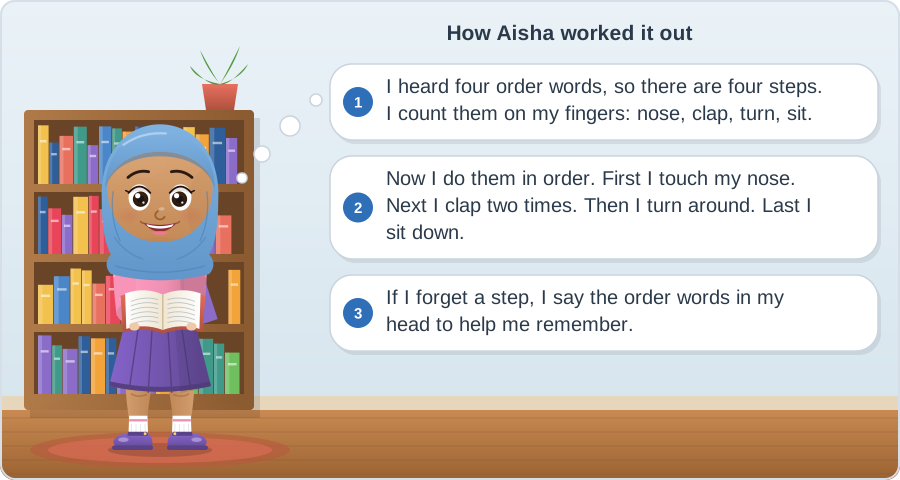
“First, touch your nose. Next, clap two times. Then, turn around. Last, sit down.”
Now Try It
Listen as an adult says each set of directions once. Then do all the steps in order.
1. “First, stand up. Next, hop on one foot. Then, touch your toes.”
Hint: Hold up one finger for each step as you listen.
2. “First, pick up a pencil. Next, put it on your head. Then, walk to the door. Last, say your name.”
Hint: Say the four steps back quietly before you start.
Time To Practise
Name: ______________________
Do not open the directions. Listen as an adult reads each set to you.
Directions for an adult to read aloud
Task 1: “First, draw a sun in the sky above the tree. Next, colour the door of the house red. Then, draw a bird on top of the gate. Last, draw a path from the door to the gate.”
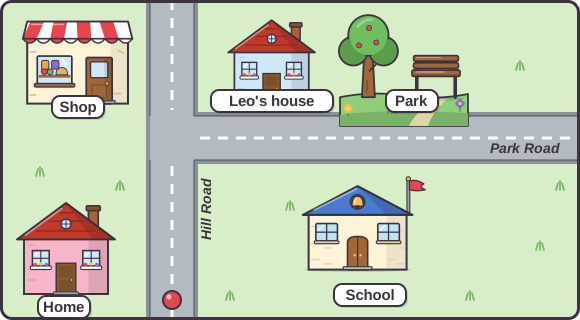
Task 2: “Put your finger on Home. First, go straight up Hill Road. Next, turn right at the shop. Then, walk past Leo’s house. Last, stop at the park.”
1. Listen and draw.
Listen to four directions. Draw on the picture in the same order.
2. Listen and walk the map.
Listen to four directions. Draw a line on the map to show the way. Mark where you stop with an X.
Where did you stop? ______________________________
3. Your turn to give directions.
Give an adult four directions to follow. Use first, next, then and last. Write them here first if it helps.
First, ______________________________________________
Next, ______________________________________________
Then, ______________________________________________
Last, ______________________________________________
☐ I used all four order words.
☐ The adult did my four steps in the right order.
Reflect
Think about these questions. Talk about them with someone at home or at school.
1. Go back to the Wonder question: “Why does the order of directions matter?” What do you think now?
2. I was a risk-taker today when I ______________________________.
A risk-taker tries something new, even when it feels hard. For example: I was a risk-taker today when I listened carefully and followed the directions.
Take action: Play a direction game at home. Give an adult four actions in order and watch them follow.
Next Steps
If this was easy, try: Play a direction game with five steps. Take turns giving and following them.
If this was hard, go back to: Now Try It. Practise with two steps, then three, before trying four. Hold up a finger for each step.
Notes for Parents and Teachers
Show notes for parents and teachers
These notes cover this lesson only. How every lesson runs is explained in How to Use This Material.
Let’s Learn
Point to each order word.
See How It’s Done
Read the four directions aloud, then act them out as you go through Aisha’s thoughts.
Time To Practise
Open the directions and read each set once, clearly. The learner listens and does not see the words. You may read a set a second time if needed, but not a third.
Answer Key
Reveal Answers
Now Try It
1. The learner stands up, hops on one foot, then touches their toes.
2. The learner picks up a pencil, puts it on their head, walks to the door and says their name.
1. Listen and draw
The picture should show: a sun above the tree; a red door; a bird on top of the gate; a path from the door to the gate.
Look for: all four details in the right places. Ask the learner to tell you the order they did them in.
2. Listen and walk the map
The line goes from Home straight up Hill Road, turns right at the shop onto Park Road, passes Leo’s house and stops at the park. Where did you stop? At the park.
3. Your turn to give directions
Sample answer: First, go to the kitchen. Next, get a cup. Then, fill it with water. Last, give it to me.
Look for: four clear steps, each with an order word and an action word, spoken so the adult can follow them. If a step is unclear, ask the learner to say it a different way.
Reflect
2. Any real moment from the lesson that shows the learner was a risk-taker. Examples: “I was a risk-taker today when I listened carefully and followed the directions.” “I was a risk-taker today when I had a go even when the directions were hard.”
Lesson 6.6: Tell About a Trip
Oral | About 20 minutes
Term 2 | Level 2
Goal
“I can tell someone about a trip in order, using first, then and at the end.”
Words to know
trip, first, then, at the end
Wonder
Think about this question before you start. Say your ideas. You will come back to it at the end of the lesson.
How can we help others picture a place they have not seen?
Let’s Learn
When we tell someone about a trip, we help them picture the place and what happened.
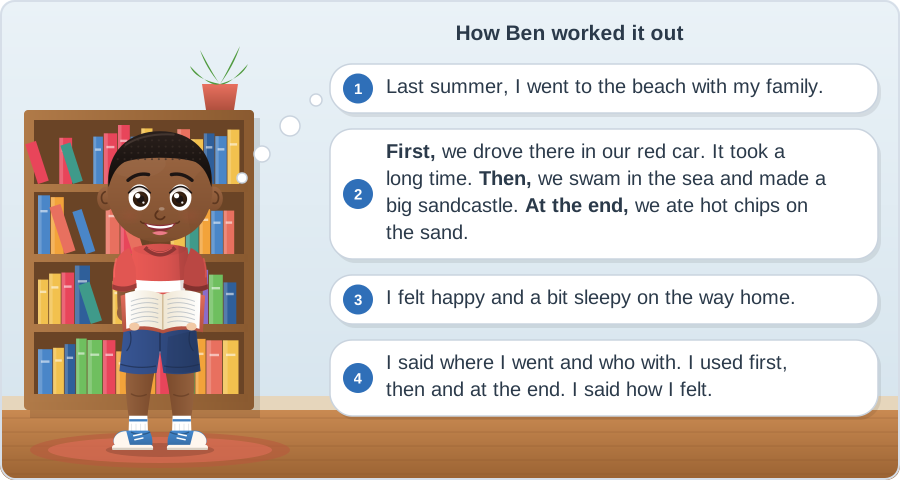
Start by saying where you went and who went with you. Then tell what happened in order, using first, then and at the end.
Finish by saying how you felt. Look at your listener and speak in a clear voice.
See How It’s Done
Now Try It
1. These pictures show a class trip to a farm. Say the first two parts: “First, … Then, …”
Hint: Look at pictures 1 and 2. How did the class get there? What animal did they see?
2. Now say the end and how the class felt: “At the end, … They felt …”
Hint: Look at picture 3. What could they do with apples on a farm?
Time To Practise
Name: ______________________
1. Put the trip in order.
These pictures show a trip to the snowy hills. Write 1, 2 or 3 under each letter to show the order. Then tell the trip to an adult using first, then and at the end.
a) ____ b) ____ c) ____
☐ I told the snow trip in order.
2. Plan your trip talk.
Think of a real trip, such as a visit to a park, a shop, a friend or a family member. Write a few words for each part.
Where did I go? ______________________________________
Who went with me? ______________________________________
First, ______________________________________
Then, ______________________________________
At the end, ______________________________________
How did I feel? ______________________________________
3. Tell about your trip.
Use your plan to tell an adult about your trip. Then the adult asks you one question about it, and you answer.
☐ I said where I went and who went with me.
☐ I used first, then and at the end.
☐ I said how I felt.
☐ I looked at my listener and spoke clearly.
☐ I answered a question about my trip.
Reflect
Think about these questions. Talk about them with someone at home or at school.
1. Go back to the Wonder question: “How can we help others picture a place they have not seen?” What do you think now?
2. I was a communicator today when I ______________________________.
A communicator shares ideas clearly by talking, writing or drawing. For example: I was a communicator today when I told about a trip in the right order.
Take action: Ask a family member about a trip they took. Then tell them about one of yours.
Next Steps
If this was easy, try: Tell about the same trip from another person’s point of view, such as the person who went with you.
If this was hard, go back to: Now Try It. Tell the farm trip with the pictures in front of you, then use the order words to tell your own trip in three sentences.
Notes for Parents and Teachers
Show notes for parents and teachers
These notes cover this lesson only. How every lesson runs is explained in How to Use This Material.
Let’s Learn
Point to each order word.
See How It’s Done
Point to each picture as you go through Ben’s thoughts.
Answer Key
Reveal Answers
Now Try It
1. Sample answer: First, the class went to the farm on a yellow bus. Then, they saw a cow.
2. Sample answer: At the end, they picked apples. They felt happy.
1. Put the trip in order
a) 3
b) 1
c) 2
Sample talk: First, we went to the hills on a train. Then, we played in the snow. At the end, we had hot soup to get warm.
Note: some learners may say they had soup first. Accept a different order if they explain it clearly.
2. Plan your trip talk
Sample answer: Where? the park. Who? my big sister. First, we fed the ducks. Then, we went on the swings. At the end, we had a picnic. How? happy.
3. Tell about your trip
Look for: the talk follows the plan; the order words are used; the learner says how they felt; the learner answers the question with a full sentence. A good talk is about four to six sentences long.
Reflect
2. Any real moment from the lesson that shows the learner was a communicator. Examples: “I was a communicator today when I told about a trip in the right order.” “I was a communicator today when I used first, then and at the end when I talked.”
For Teachers: IB Details
Show IB and curriculum details
IB theme: Where we are in place and time. It covers our homes and journeys, how we find our way, and how people explore and share the places they visit.
Central idea: People use signs, maps and stories to find their way and to share the places they visit.
| Lesson | Title | Strand | Key concept |
|---|---|---|---|
| 6.5 | Following Spoken Directions | Listening and speaking | Function |
| 6.6 | Tell About a Trip | Speaking | Connection |
Each lesson also matches the national curriculum for England (Year 1) and the US Common Core (Grade 1). The Grade 1 Curriculum Map lists the full standards for every lesson.
← Back to Lesson 6 – Signs, Maps and Journeys | Lessons – Index
© 2026 Firefly Ed. All rights reserved. This page may be printed for personal, home and classroom use. It may not be sold, shared online or reproduced for commercial use without written permission. edfirefly.com


Share your thoughts or ask something..