
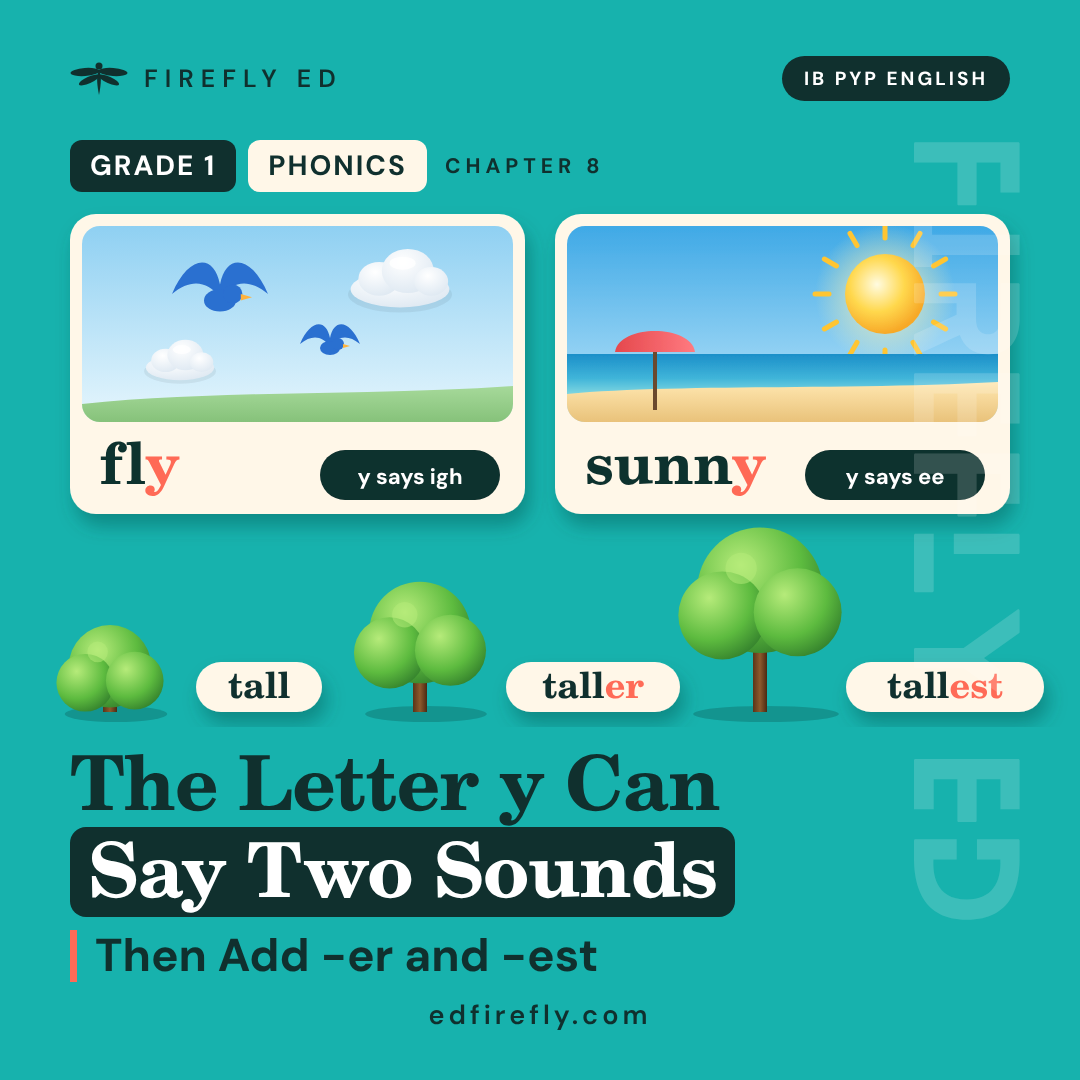
Term 3 | Level 3 | Phonics focus: y, ea, soft c and g, wh, ph, -er, -est, un-
Lesson 8 – Friends and Feelings | Lessons – Index
Lessons
This page has the three phonics lessons in Lesson 8, Friends and Feelings: Lessons 8.9, 8.10 and 8.11. The Lesson 8 page has the Lesson 8 overview, the Lesson 8 review and the PDF download.
Select a lesson to go straight to it. Each lesson ends with a link back to the top of the page.
- Lesson 8.9: y and ea: Two Sounds Each
- Lesson 8.10: Soft c and g, wh and ph
- Lesson 8.11: -er, -est and un-
Lesson 8.9: y and ea: Two Sounds Each
Phonics | About 20 minutes
Term 3 | Level 3
Goal
“I can read words where y and ea make two different sounds, and choose the right sound.”
Words to know
y, ea, two sounds, beats
Wonder
Think about this question before you start. Say your ideas. You will come back to it at the end of the lesson.
Can the same letters say different sounds?
Let’s Learn
Some letters can make two different sounds.
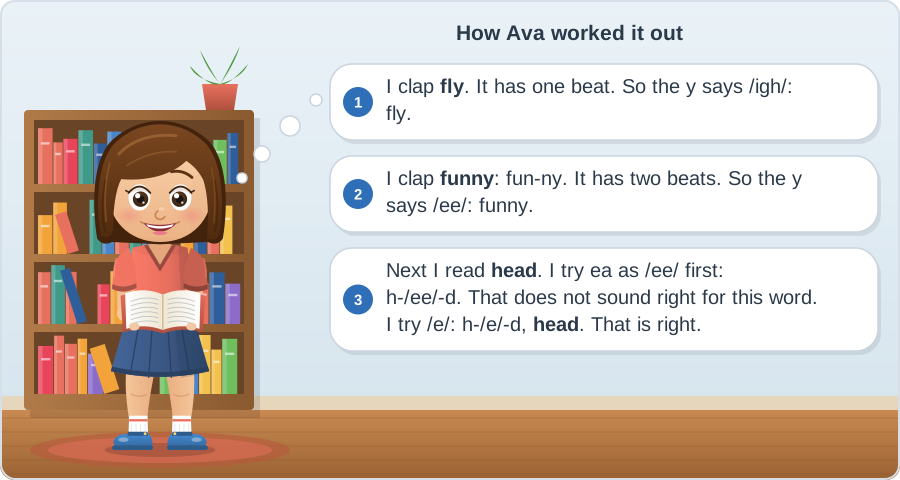
y at the end of a word: in a short word with one beat, y says /igh/, as in fly, my and sky. In a longer word, y says /ee/, as in funny, happy and sunny.
ea usually says /ee/, as in sea and eat. Sometimes it says /e/, as in head and bread. If one sound does not make a word that makes sense, try the other.
See How It’s Done
Now Try It
1. Read this word: sunny. Does the y say /igh/ or /ee/?
Hint: Clap the word. How many beats?
2. Read this word: bread. Does the ea say /ee/ or /e/?
Hint: Try /ee/ first. Does it match the picture? If not, try /e/.
Time To Practise
Name: ______________________
1. Two sounds of y.
Read each word. Clap the beats. Sort the words.
Words: my | happy | fly | sunny | cry | windy
y says /igh/: ____________ ____________ ____________
y says /ee/: ____________ ____________ ____________
2. Two sounds of ea.
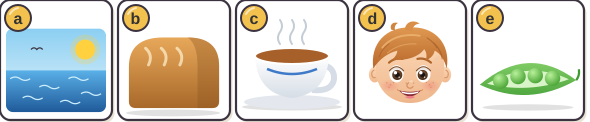
Say each word. Circle the sound the ea makes.
a) sea: /ee/ /e/ b) bread: /ee/ /e/ c) tea: /ee/ /e/ d) head: /ee/ /e/ e) peas: /ee/ /e/
3. Read and sort.
Read:
Jenny was ready for the party. She had a funny hat on her head. “Why are you so happy?” I asked. “I can fly my new kite in the sky,” she said, “and eat sweet treats!”
Find the words and write them in the chart.
| y says /ee/ | y says /igh/ | ea says /ee/ | ea says /e/ |
|---|---|---|---|
| ______________ | ______________ | ______________ | ______________ |
| ______________ | ______________ | ______________ | ______________ |
Reflect
Think about these questions. Talk about them with someone at home or at school.
1. Go back to the Wonder question: “Can the same letters say different sounds?” What do you think now?
2. I was a thinker today when I ______________________________.
A thinker thinks carefully to work things out. For example: I was a thinker today when I worked out which sound y makes in a word.
Take action: Find three y words and three ea words in a storybook. Read them aloud and sort them by sound.
Next Steps
If this was easy, try: Find five y words and five ea words in a storybook. Sort them by sound and read them to a friend.
If this was hard, go back to: See How It’s Done. Clap fly and funny together until the difference is clear. Then sort only the y words in Task 1.
Notes for Parents and Teachers
Show notes for parents and teachers
These notes cover this lesson only. How every lesson runs is explained in How to Use This Material.
Let’s Learn
Clap the beats in each word.
See How It’s Done
Clap the beats in each word as you go through Ava’s thoughts.
Answer Key
Reveal Answers
Now Try It
1. /ee/ (sun-ny has two beats)
2. /e/
1. Two sounds of y
y says /igh/: my, fly, cry
y says /ee/: happy, sunny, windy
2. Two sounds of ea
a) /ee/
b) /e/
c) /ee/
d) /e/
e) /ee/
3. Read and sort
y says /ee/: Jenny, ready, party, funny, happy
y says /igh/: why, fly, my, sky
ea says /ee/: eat, treats
ea says /e/: ready, head
Note: ready has both patterns: ea says /e/ and y says /ee/. Accept it in either column, or both. Look for: the learner claps the beats to decide the y sound, and tries both sounds for ea.
Reflect
2. Any real moment from the lesson that shows the learner was a thinker. Examples: “I was a thinker today when I worked out which sound y makes in a word.” “I was a thinker today when I worked out which sound ea makes in a word.”
Lesson 8.10: Soft c and g, wh and ph
Phonics | About 20 minutes
Term 3 | Level 3
Goal
“I can read words with soft c, soft g, wh and ph.”
Words to know
soft c, soft g, wh, ph
Wonder
Think about this question before you start. Say your ideas. You will come back to it at the end of the lesson.
Why do some letters change their sound?
Let’s Learn
Soft c: when c comes before e, i or y, it usually says /s/, as in city, face and ice. Before other letters, it says /k/, as in cat and cup.
Soft g: when g comes before e, i or y, it often says /j/, as in giant, gem and cage. Some words break the rule, such as get and girl.
wh says /w/, as in when, what and whale. ph says /f/, as in phone, photo and elephant.
See How It’s Done

Now Try It
1. Read this word: ice. Does the c say /s/ or /k/? Why?
Hint: Look at the letter after the c.
2. Read this word: whale. What sound do w and h make together?
Hint: It is the same sound as at the start of when.
Time To Practise
Name: ______________________
1. Hard or soft?
Read each word. Look at the letter after c or g. Sort the words.
Words: cat | city | face | cup | gem | goat | cage | gum
Soft c or g (/s/ or /j/): ____________ ____________ ____________ ____________
Hard c or g (/k/ or /g/): ____________ ____________ ____________ ____________
2. wh or ph?
Listen as an adult names each picture.
Write wh or ph to finish each word.
a) ___ one b) ___ ale c) ___ eel d) ele ___ ant
3. A friend far away.
Read:
When my best friend Grace moved to the city, I felt sad. Then her mum sent me a photo. Grace was standing next to a giant elephant at the zoo! Now we talk on the phone every week, and I do not feel so lonely.
a) Find one word for each pattern in the story.
soft c: ______________ soft g: ______________ wh: ______________ ph: ______________
b) Write a question you would ask Grace on the phone. Start with a wh word: what, where, when, why or which.
______________________________________________
Reflect
Think about these questions. Talk about them with someone at home or at school.
1. Go back to the Wonder question: “Why do some letters change their sound?” What do you think now?
2. I was an inquirer today when I ______________________________.
An inquirer asks questions and finds things out. For example: I was an inquirer today when I asked why c and g sometimes make a soft sound.
Take action: Go on a word hunt for c, g, wh and ph words in a book. Read them to a friend.
Next Steps
If this was easy, try: Go on a word hunt in a book for words with soft c, soft g, wh and ph. Make a list with four words for each.
If this was hard, go back to: See How It’s Done. Practise only soft c and hard c first with city and cat. Do wh and ph on another day.
Notes for Parents and Teachers
Show notes for parents and teachers
These notes cover this lesson only. How every lesson runs is explained in How to Use This Material.
Let’s Learn
Point to the letter after each c and g.
See How It’s Done
Write each word on paper as you go through Ben’s thoughts, and point to the letter that tells you the sound.
Time To Practise
- Task 2: Point to each picture and name it first: …ne, …le, …el, el… (the full words are in the Answer Key).
Answer Key
Reveal Answers
Now Try It
1. /s/, because the c comes before e.
2. /w/
1. Hard or soft?
Soft: city, face, gem, cage
Hard: cat, cup, goat, gum
2. wh or ph?
a) phone
b) whale
c) wheel
d) elephant
3. A friend far away
a) soft c: Grace or city soft g: giant wh: When ph: photo, elephant or phone
b) Sample answer: What is your new school like?
Look for: in part b, a question that starts with a wh word and ends with a question mark. Note: who also starts with wh, but the w is silent and it says /h/.
Reflect
2. Any real moment from the lesson that shows the learner was an inquirer. Examples: “I was an inquirer today when I asked why c and g sometimes make a soft sound.” “I was an inquirer today when I found the rule for soft c and soft g.”
Lesson 8.11: -er, -est and un-
Phonics | About 20 minutes
Term 3 | Level 3
Goal
“I can add -er, -est and un- to words and explain how they change the meaning.”
Words to know
-er, -est, un-, compare
Wonder
Think about this question before you start. Say your ideas. You will come back to it at the end of the lesson.
How can a small part of a word change its meaning?
Let’s Learn
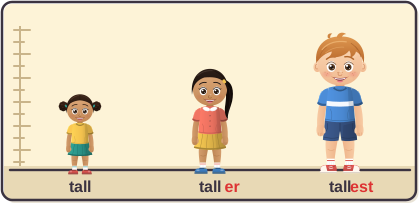
We add -er to a describing word to compare two things: Ben is taller than Kim.
We add -est to compare three or more things: Sam is the tallest of all.
We add un- to the start of a word to mean not: unhappy means not happy, unkind means not kind. un- can also mean to undo something: unlock, untie.
See How It’s Done
Look at the three children in Let’s Learn.

Now Try It
1. Add -er and -est to small. Say both words in a sentence.
Hint: Use -er for two things and -est for three or more.
2. Add un- to kind. What does the new word mean?
Hint: un- means not.
Time To Practise
Name: ______________________
1. Add -er and -est.
| Word | -er | -est |
|---|---|---|
| tall | taller | tallest |
| small | ____________ | ____________ |
| fast | ____________ | ____________ |
| cold | ____________ | ____________ |
| long | ____________ | ____________ |
2. Choose the right word.
Circle the right word.
a) Mia is (taller / tallest) than her brother.
b) Ben is the (fastest / faster) runner in the whole class.
c) Today is the (coldest / colder) day of the year.
d) My snake is (longer / longest) than your snake.
3. un- words and feelings.
a) Add un- to each word. Write what the new word means.
happy: ______________ means ______________________
kind: ______________ means ______________________
fair: ______________ means ______________________
lock: ______________ means ______________________
b) Write about a time you felt unhappy and a friend helped you. Write four sentences. Use one un- word and one -er or -est word.
______________________________________________
______________________________________________
______________________________________________
______________________________________________
Reflect
Think about these questions. Talk about them with someone at home or at school.
1. Go back to the Wonder question: “How can a small part of a word change its meaning?” What do you think now?
2. I was caring today when I ______________________________.
Being caring means being kind and helping others. For example: I was caring today when I used un- to talk about how someone feels.
Take action: Tell a friend about your day with un- and -est words, such as unhappy or the kindest.
Next Steps
If this was easy, try: Line up three toys by size. Write sentences using long, longer and longest, then small, smaller and smallest.
If this was hard, go back to: Let’s Learn. Line up two toys and say which is taller. Then add a third toy and say which is the tallest.
Notes for Parents and Teachers
Show notes for parents and teachers
These notes cover this lesson only. How every lesson runs is explained in How to Use This Material.
Let’s Learn
Point to each child as you say tall, taller and tallest.
See How It’s Done
Point to the children in Let’s Learn as you go through Leo’s thoughts.
Answer Key
Reveal Answers
Now Try It
1. smaller, smallest. Sample: My cat is smaller than my dog. The mouse is the smallest of all.
2. unkind. It means not kind.
1. Add -er and -est
small: smaller, smallest
fast: faster, fastest
cold: colder, coldest
long: longer, longest
2. Choose the right word
a) taller (comparing two)
b) fastest (the whole class)
c) coldest (the whole year)
d) longer (comparing two)
3. un- words and feelings
a) unhappy: not happy. unkind: not kind. unfair: not fair. unlock: open a lock.
b) Sample answer: I felt unhappy when I lost my new ball. My friend Ali helped me look for it. We found it under the tallest tree in the park. Ali is the kindest friend.
Look for: -er when two things are compared and -est for three or more; un- added with no change to the base word. Note: words that end in y change y to i before -er and -est (happy, happier, happiest). This comes in later grades.
Reflect
2. Any real moment from the lesson that shows the learner was caring. Examples: “I was caring today when I used un- to talk about how someone feels.” “I was caring today when I thought about how to help someone who is unhappy.”
For Teachers: IB Details
Show IB and curriculum details
IB theme: Who we are. It covers our feelings, our friendships and relationships, and how we understand and care for other people.
Central idea: Friendships grow when we understand our own feelings and the feelings of others.
| Lesson | Title | Strand | Key concept |
|---|---|---|---|
| 8.9 | y and ea: Two Sounds Each | Reading and spelling | Perspective |
| 8.10 | Soft c and g, wh and ph | Reading and spelling | Causation |
| 8.11 | -er, -est and un- | Reading and spelling | Perspective |
Each lesson also matches the national curriculum for England (Year 1) and the US Common Core (Grade 1). The Grade 1 Curriculum Map lists the full standards for every lesson.
← Back to Lesson 8 – Friends and Feelings | Lessons – Index
© 2026 Firefly Ed. All rights reserved. This page may be printed for personal, home and classroom use. It may not be sold, shared online or reproduced for commercial use without written permission. edfirefly.com


Share your thoughts or ask something..