This page has the two listening and speaking lessons in Lesson 1, All About Me: Lessons 1.5 and 1.6. The Lesson 1 page has the Lesson 1 overview, the Lesson 1 review and the PDF download.
Select a lesson to go straight to it. Each lesson ends with a link back to the top of the page.
“I can listen to a sentence and say if it tells or asks.”
Words to know
tell, ask, question, question mark
Wonder
Think about this question before you start. Say your ideas. You will come back to it at the end of the lesson.
How do we find out things about other people?
Let’s Learn
Some sentences tell us something. “I have a cat.” tells us about a cat. A telling sentence ends with a full stop.
Some sentences ask something. “Can I have water?” asks for water. An asking sentence is a question. The person wants an answer.
A question ends with a question mark.
Many questions start with words like Can, Is, Who or What. Our voice often goes up at the end of a question.
See How It’s Done
Now Try It
Listen as an adult says each sentence. Point to the tell bubble or the ask bubble.
1. “Is it hot?” Does it tell or ask?
Hint: Does the person want an answer? Listen to the first word.
2. “The dog is big.” Does it tell or ask?
Hint: Say it again. Does your voice go up at the end?
Time To Practise
Name: ______________________
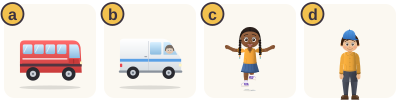
1. Listen. Tick tell or ask.
Listen as an adult reads each sentence.
a) ☐ tell ☐ ask
b) ☐ tell ☐ ask
c) ☐ tell ☐ ask
d) ☐ tell ☐ ask
2. Circle the end mark.
Say each sentence. Circle the full stop or the question mark that belongs at the end.
a) Is the bus red .?
b) Dad is in the van .?
c) Pam can hop .?
d) Has Dad got a cap .?
3. Say it as a question.
a) Change the telling sentence into a question. Say it out loud.
The dog is in the box.
Is the dog ______________________?
b) You want the bun. Ask for it. Say it, then write it.
Can I have ______________________?
Reflect
Think about these questions. Talk about them with someone at home or at school.
1. Go back to the Wonder question: “How do we find out things about other people?” What do you think now?
2. I was an inquirer today when I ______________________________.
An inquirer asks questions and finds things out. For example: I was an inquirer today when I asked a question and put a question mark at the end.
Take action: Ask a family member three questions about when they were six. Tell someone what you found out.
Next Steps
If this was easy, try: Play a game at home. One person says a sentence. The other says “tell” or “ask”. Then swap and make up your own questions.
If this was hard, go back to: See How It’s Done. Say “I have a cat.” and “Can I have water?” many times. Nod for telling. Put a hand up for asking.
Notes for Parents and Teachers
Show notes for parents and teachers
These notes cover this lesson only. How every lesson runs is explained in How to Use This Material.
Let’s Learn
Say each example sentence in a natural voice.
See How It’s Done
Say each sentence aloud in a natural voice, then go through Ken’s thoughts.
Now Try It
Say each sentence aloud. The learner points to the tell bubble or the ask bubble.
Time To Practise
Task 1: The sentences are in the Answer Key. Read each one aloud once. The learner can look at the picture.
Answer Key
Reveal Answers
Now Try It
1. ask
2. tell
Look for: the learner gives a reason, such as “It starts with Is” or “Nobody needs to answer”.
1. Listen. Tick tell or ask.
a) I got a red hat. (tell)
b) Can I have water? (ask)
c) Is the cat in the bag? (ask)
d) The sun is hot. (tell)
Look for: the learner answers after one listen. If the learner guesses, say the sentence again and ask: Does this person want an answer?
2. Circle the end mark
a) ? (question mark)
b) . (full stop)
c) . (full stop)
d) ? (question mark)
Look for: the learner links the first word to the mark. “Is” and “Has” at the start point to a question mark. In b) and c), the sentence tells, so it takes a full stop.
3. Say it as a question
a) Is the dog in the box?
Look for: the voice goes up at the end.
b) Sample answer: Can I have the bun?
Look for: a question mark at the end. Accept “Can I have a bun?” and “Can I have it?”. A learner who adds “please” is doing well.
Reflect
2. Any real moment from the lesson that shows the learner was an inquirer. Examples: “I was an inquirer today when I asked a question and put a question mark at the end.” “I was an inquirer today when I asked someone a question to find out about them.”
“I can plan and say three sentences about my favourite thing.”
Words to know
favourite, show and tell, plan, listener
Wonder
Think about this question before you start. Say your ideas. You will come back to it at the end of the lesson.
What can a favourite thing tell other people about us?
Let’s Learn
In show and tell, we show a thing and talk about it.
Our favourite thing is the one we like best.
We plan three sentences. First, say what it is. Next, say what it looks like. Last, say why you like it.
Look at your listener. Speak so they can hear every word.
See How It’s Done
Now Try It
1. Say what it is. Start with “This is my…”
Hint: Look at the picture. What toy is it?
2. Say what it looks like. Start with “It is…”
Hint: Say the colour. You can also say if it is big or small.
Time To Practise
Name: ______________________
1. Tick the sentence.
Which sentence tells what the ball looks like?
☐ I like to kick it.
☐ This is my ball.
☐ It is big and red.
2. Put the plan in order.
Write 1, 2 or 3 in each box. Then say the sentences in order.
☐ I like it because it is fun.
☐ This is my bus.
☐ It is red and big.
3. Plan your show and tell.
a) Draw your favourite thing.
b) Finish the plan.
Word bank: soft | red | fun | big | pink | bed
1. This is my ______________________.
2. It is ______________________.
3. I like it because ______________________.
c) Say your three sentences to an adult. Tick each box when you have done it.
☐ I looked at my listener.
☐ I spoke so they could hear me.
☐ I said three sentences.
Reflect
Think about these questions. Talk about them with someone at home or at school.
1. Go back to the Wonder question: “What can a favourite thing tell other people about us?” What do you think now?
2. I was a risk-taker today when I ______________________________.
A risk-taker tries something new, even when it feels hard. For example: I was a risk-taker today when I talked about my favourite thing in front of someone.
Take action: Share your favourite thing with a friend. Then listen while they share theirs, and ask one question.
Next Steps
If this was easy, try: Add a fourth sentence that tells where you got it or where you keep it. Then answer one question from your listener.
If this was hard, go back to: Say only sentence 1 while holding the thing. When that is easy, add sentence 2. Use the three picture steps in Let’s Learn as a guide.
Notes for Parents and Teachers
Show notes for parents and teachers
These notes cover this lesson only. How every lesson runs is explained in How to Use This Material.
Let’s Learn
Hold up one of your own things as you explain.
See How It’s Done
Hold up the picture or a real soft toy as you go through Pam’s thoughts. Then say the three sentences.
Answer Key
Reveal Answers
Now Try It
1. This is my car.
2. Sample answer: It is green and small.
Look for: a whole sentence, not one word. If the learner says “car”, ask them to say it with “This is my”.
1. Tick the sentence
It is big and red.
Look for: the learner can say what the other two sentences do. “This is my ball.” says what it is. “I like to kick it.” says why they like it.
2. Put the plan in order
3 I like it because it is fun.
1 This is my bus.
2 It is red and big.
Look for: the learner says the three sentences in order: This is my bus. It is red and big. I like it because it is fun.
3. Plan your show and tell
Sample answer: This is my teddy. It is soft and pink. I like it because I hug it in bed.
Look for: sentence 1 names the thing, sentence 2 describes it and sentence 3 gives a reason. The learner speaks clearly and looks at the listener. Accept sound-based spelling. The writing is a plan only; the spoken sentences are what count.
Reflect
2. Any real moment from the lesson that shows the learner was a risk-taker. Examples: “I was a risk-taker today when I talked about my favourite thing in front of someone.” “I was a risk-taker today when I spoke up even though I felt shy.”
Each lesson also matches the national curriculum for England (Year 1) and the US Common Core (Grade 1). The Grade 1 Curriculum Map lists the full standards for every lesson.





Share your thoughts or ask something..