
Term 1 | Level 1 | Phonics focus: short vowels, CVC words
Lesson 1 – All About Me | Lessons – Index
Lessons
This page has the two viewing and presenting lessons in Lesson 1, All About Me: Lessons 1.7 and 1.8. The Lesson 1 page has the Lesson 1 overview, the Lesson 1 review and the PDF download.
Select a lesson to go straight to it. Each lesson ends with a link back to the top of the page.
Lesson 1.7: How Do They Feel?
Visual | About 20 minutes
Term 1 | Level 1
Goal
“I can look at a face and name the feeling it shows.”
Words to know
feeling, face, happy, sad, angry, surprised
Wonder
Think about this question before you start. Say your ideas. You will come back to it at the end of the lesson.
How can we tell how someone feels without them telling us?
Let’s Learn

Our faces show how we feel.
Look at the mouth, the eyes and the eyebrows.
Happy: the mouth goes up in a smile. Sad: the mouth goes down. There may be a tear.
Angry: the eyebrows point down in the middle. Surprised: the eyes and the mouth open wide.
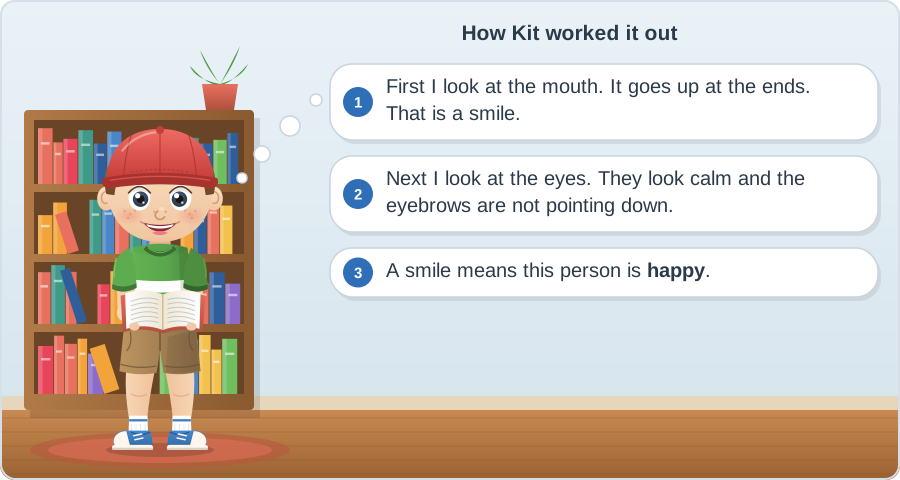
See How It’s Done
Now Try It
1. How does this person feel?
Hint: Look at the mouth. Does it go up or down? What is on the cheek?
2. How does this person feel?
Hint: Look at the eyes and the mouth. Are they open wide?
Time To Practise
Name: ______________________
1. Circle the feeling.
a)
sad happy angry
b)
angry happy surprised
2. Write the feeling.
Look at each face. Write the feeling it shows.
Word bank: sad | angry | happy | surprised
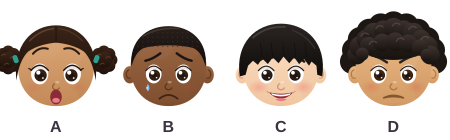
A. ______________ B. ______________
C. ______________ D. ______________
3. Look and write.
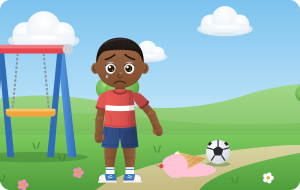
a) How does Ben feel? Look at his face.
Ben is ______________________.
b) How do you feel today? Draw your face.
I am ______________________.
Reflect
Think about these questions. Talk about them with someone at home or at school.
1. Go back to the Wonder question: “How can we tell how someone feels without them telling us?” What do you think now?
2. I was caring today when I ______________________________.
Being caring means being kind and helping others. For example: I was caring today when I looked at Ben’s face and worked out how he felt.
Take action: This week, notice when someone looks sad. Ask them if they are okay.
Next Steps
If this was easy, try: Look at the pictures in a storybook. Name how one character feels on each page and say which part of the face tells you.
If this was hard, go back to: Let’s Learn. Stand in front of a mirror. Make a happy face and a sad face. Then try angry and surprised.
Notes for Parents and Teachers
Show notes for parents and teachers
These notes cover this lesson only. How every lesson runs is explained in How to Use This Material.
Let’s Learn
Make each face yourself as you say the word.
See How It’s Done
Point to each part of the face as you go through Kit’s thoughts.
Answer Key
Reveal Answers
Now Try It
1. sad
2. surprised
Look for: the learner names a part of the face to explain, such as “The mouth goes down” or “There is a tear”.
1. Circle the feeling
a) happy
b) angry
Look for: the learner points to the mouth for a) and the eyebrows for b).
2. Write the feeling
A. surprised
B. sad
C. happy
D. angry
Look for: words copied from the word bank. Do not mark the spelling of “surprised” or “angry”; learners copy these as whole words.
3. Look and write
a) Ben is sad.
Look for: the learner links the feeling to the picture. Accept “Ben is upset.” Ask: Why is Ben sad? A good answer mentions the ice cream on the ground.
b) Sample answer: I am happy.
Look for: the drawn face matches the word. Accept any feeling the learner names.
Reflect
2. Any real moment from the lesson that shows the learner was caring. Examples: “I was caring today when I looked at Ben’s face and worked out how he felt.” “I was caring today when I said how I would help someone who looks sad.”
Lesson 1.8: My Self-Portrait and Caption
Visual | About 20 minutes
Term 1 | Level 1
Goal
“I can draw a picture of myself and write a caption for it.”
Words to know
self-portrait, caption, detail, mirror
Wonder
Think about this question before you start. Say your ideas. You will come back to it at the end of the lesson.
What makes your face your own?
Let’s Learn
A self-portrait is a picture you draw of yourself.
Look in a mirror. Draw the shape of your face first. Then add your eyes, nose, mouth and hair.
A detail is a small part that makes the picture look like you, such as your hair colour or a hat you like.
A caption is a short sentence under a picture. It tells what the picture shows.
See How It’s Done
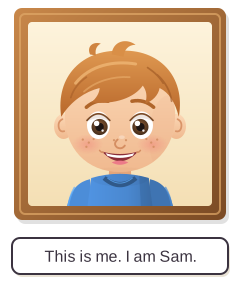
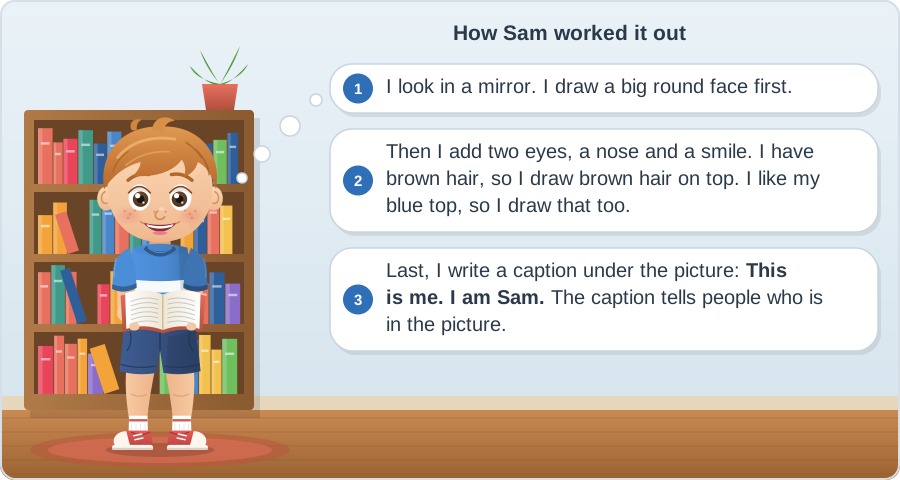
Now Try It
1. Point to the caption. Read it together.
Hint: The caption is the words under the picture, not the picture.

2. Say a caption for this picture.
Hint: Start with “This is…” Say who and what you can see.
Time To Practise
Name: ______________________
1. Match the picture to the caption.
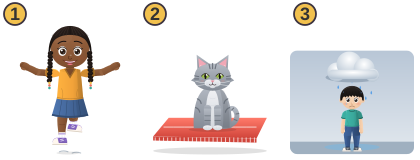
Write the letter next to each number.
1. ____ 2. ____ 3. ____
A. The cat is on the mat.
B. I am wet.
C. Pam can hop.
2. Tick the best caption.
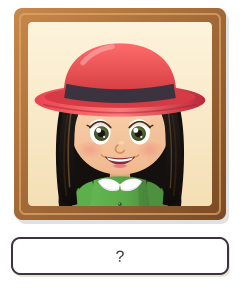
This is Meg’s self-portrait. Which caption tells us the most about it?
☐ Meg is sad.
☐ This is a cat.
☐ This is Meg in a red hat.
3. Draw yourself. Write a caption.
a) Look in a mirror. Draw yourself in the box.
Tick what you drew:
☐ face ☐ eyes ☐ nose ☐ mouth ☐ hair
b) Write your caption.
Word bank: six | me | happy | red | hat
This is ______________________.
I am ______________________.
Reflect
Think about these questions. Talk about them with someone at home or at school.
1. Go back to the Wonder question: “What makes your face your own?” What do you think now?
2. I was reflective today when I ______________________________.
Being reflective means looking back at your work and thinking how to make it better. For example: I was reflective today when I looked in the mirror and checked my drawing.
Take action: Make a family gallery. Draw each person at home and add a caption with their name.
Next Steps
If this was easy, try: Draw a portrait of someone at home. Add two details that match them. Write a caption with their name.
If this was hard, go back to: Let’s Learn. Draw only the face shape, eyes and mouth. Say the caption “This is me.” out loud before writing it.
Notes for Parents and Teachers
Show notes for parents and teachers
These notes cover this lesson only. How every lesson runs is explained in How to Use This Material.
Let’s Learn
Have a mirror ready if you can.
See How It’s Done
Point to each part of the portrait as you go through Sam’s thoughts.
Answer Key
Reveal Answers
Now Try It
1. Rex is my dog.
2. Sample answer: This is a boy and a cat.
Look for: the learner points to the words, not the picture. For 2, accept any caption that names what is in the picture.
1. Match the picture to the caption
1. C
2. A
3. B
Look for: the learner reads each caption and checks it against the picture before writing the letter.
2. Tick the best caption
This is Meg in a red hat.
Look for: the learner says why the others are wrong. Meg is smiling, so she is not sad. There is no cat in the picture.
3. Draw yourself. Write a caption.
Sample answer: This is me. I am six.
Look for: a face with eyes, nose, mouth and hair, and at least one detail that matches the learner. The caption starts with a capital letter and ends with a full stop. Accept any true caption.
Reflect
2. Any real moment from the lesson that shows the learner was reflective. Examples: “I was reflective today when I looked in the mirror and checked my drawing.” “I was reflective today when I checked that my caption tells people about me.”
For Teachers: IB Details
Show IB and curriculum details
IB theme: Who we are. It covers our bodies and feelings, our families and friends, where we belong, and how we learn and grow.
Central idea: Each of us is unique, and we can share who we are with others.
| Lesson | Title | Strand | Key concept |
|---|---|---|---|
| 1.7 | How Do They Feel? | Viewing | Perspective |
| 1.8 | My Self-Portrait and Caption | Presenting | Form |
Each lesson also matches the national curriculum for England (Year 1) and the US Common Core (Grade 1). The Grade 1 Curriculum Map lists the full standards for every lesson.
← Back to Lesson 1 – All About Me | Lessons – Index
© 2026 Firefly Ed. All rights reserved. This page may be printed for personal, home and classroom use. It may not be sold, shared online or reproduced for commercial use without written permission. edfirefly.com


Share your thoughts or ask something..